20 Ton Overhead Crane for Confined Ship Engine Rooms
Custom overhead crane enables precise, safe lifting of heavy marine engines in low-headroom, tight ship engine room environments.
Working in ship engine rooms is no easy task. These spaces are notoriously tight, with low ceilings, narrow aisles, and limited room to maneuver. Installing or moving marine engines in such conditions requires careful planning and the right equipment. Lifting a heavy engine isn’t just about raw power—it’s about precision, safety, and efficiency.
For shipyards and marine workshops, choosing the correct overhead crane for confined spaces can make the difference between smooth operations and costly delays. A crane that fits the space, moves precisely, and handles the load safely is essential.
- Marine engines are heavy and bulky, often weighing several tons, requiring specialized lifting equipment.
- Low-headroom conditions demand compact crane designs and optimized hoist systems.
- Operators need precise control to prevent damage to engines and surrounding structures.
- Target audience: maritime engineers, shipyard managers, and crane procurement teams looking for tailored engine room solutions.
Customer / Project Background
This case involves a mid-sized shipyard specializing in engine installation for commercial vessels. The workshop regularly handles engines ranging from 10 to 20 tons, which must be lifted and positioned in confined engine rooms.
The customer had several specific requirements:
- Engine Weight and Size: Each engine weighed up to 20 tons with a bulky frame that required careful handling.
- Handling Frequency: Engines were installed multiple times per week, so the lifting system needed to be reliable and durable.
Space Constraints:
- Low ceiling height limited overhead crane options.
- Narrow aisles made standard cranes difficult to operate.
- Limited access points required a flexible crane system capable of precise positioning in tight corners.
These constraints made a standard overhead crane unsuitable. The customer needed a solution designed specifically for confined engine rooms—one that combined strength, precision, and safety.
Challenges Faced
Installing marine engines in confined engine rooms is not as simple as picking a crane off the shelf. Several challenges made this project particularly demanding.
First, space was extremely limited. The engine rooms had low ceilings and narrow aisles, leaving very little room for standard crane configurations. Every centimeter mattered, both for the crane itself and for safe operator movement.
Second, precision handling was critical. Marine engines are delicate in the sense that even small misalignments during lifting can damage engine mounts, piping, or surrounding structures. Operators needed a crane that could lift heavy loads smoothly and position them with millimeter-level accuracy.
Safety was another major concern. Working in tight spaces increases the risk of collisions, pinching hazards, and operator injury. The crane needed to incorporate robust safety systems to minimize risks in these confined conditions.
Finally, reliability and low maintenance were essential. With engines being installed multiple times per week, downtime was not an option. The crane had to withstand frequent use without frequent repairs, ensuring long-term performance for the shipyard.
Solution Provided
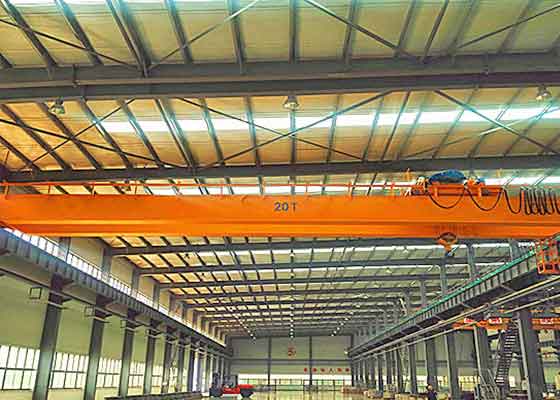
To meet these challenges, a 20-ton overhead crane was selected—customized specifically for confined ship engine rooms. Depending on the workshop layout, either a single-girder or double-girder configuration was used to optimize space and load capacity.
Design Adaptations for Low-Headroom Installation:
- Compact hoist design: The hoist was specially designed to maximize lifting height while fitting within low ceilings.
- Customized end trucks and wheelbase: These modifications allowed the crane to run smoothly on shorter or constrained runway beams, maintaining stability and maneuverability in tight spaces.
Control System:
- Precise movement controls enabled operators to align engines accurately with mounts and support structures.
- Smooth acceleration and deceleration reduced load swing, improving safety and handling.
Safety Features:
- Overload protection to prevent damage or accidents during heavy lifts.
- Emergency stop functions for immediate response in case of unexpected situations.
- Smooth start/stop mechanisms to protect both the engine and crane components during frequent operations.
By combining these adaptations, the crane was able to safely and efficiently handle heavy marine engines in a challenging, confined environment—delivering reliable performance day after day.
Results
The installation of the 20-ton overhead crane in the shipyard’s confined engine rooms brought measurable improvements across efficiency, safety, and reliability.
Improved Efficiency and Reduced Installation Time:
- Engine lifting and positioning, which previously took several hours, could now be completed more quickly due to precise crane movements.
- Operators spent less time maneuvering engines in tight spaces, reducing workflow bottlenecks and speeding up project schedules.
Enhanced Safety for Operators:
- Confined areas inherently carry risks of collisions and injury. The crane’s smooth start/stop mechanism and precise controls minimized unexpected load swings, lowering the chance of accidents.
- Emergency stop functions and overload protection gave operators confidence while handling heavy engines.
Demonstrated Reliability Under Confined-Space Conditions:
- Despite frequent use, the crane maintained consistent performance with minimal maintenance required.
- Its compact design and customized end trucks ensured stable operation even in low-headroom conditions.
Positive Feedback from Engineers and Shipyard Managers:
- Users praised the crane’s ability to handle heavy engines with accuracy, reducing stress on both machinery and personnel.
- The project reinforced the value of a tailored crane solution, highlighting that well-planned customization pays off in operational efficiency.
The installation of the 20-ton overhead crane delivered clear, practical benefits for the shipyard. Engine installation times were significantly reduced, as operators could lift and position heavy engines quickly and accurately, even in tight, low-headroom spaces. Safety was greatly enhanced thanks to precise movement controls, smooth start/stop mechanisms, overload protection, and emergency stop functions, all of which minimized risks in confined areas. The crane proved highly reliable, handling frequent lifts without significant maintenance, while its compact design and customized features ensured stable operation in limited spaces. Overall, the solution improved workflow efficiency, safeguarded personnel, and earned strong approval from engineers and shipyard managers, demonstrating the value of a tailored crane designed specifically for challenging engine room conditions.
Benifits
Practical Solution for Tight Spaces
This case study shows how a 20-ton overhead crane can operate effectively in low-headroom, confined engine rooms. It provides a tangible example that many shipyard managers and maritime engineers can relate to, turning complex lifting challenges into clear, achievable solutions.
Addresses Key Buyer Concerns
- Precision Handling: Ensures heavy engines are lifted and positioned accurately.
- Safety in Confined Areas: Reduces risks of collisions and accidents in tight spaces.
- Space Constraints: Demonstrates solutions for limited vertical and horizontal clearance.
Send Us An Inquiry
If your shipyard or marine workshop faces challenges with lifting heavy engines in confined spaces, we can help. Our team specializes in customized overhead cranes designed for low-headroom engine rooms, precise handling, and safe operation.
- Request a Free Consultation: Share your facility’s dimensions, load requirements, and lifting needs, and we’ll provide expert guidance.
- Project Assessment: We can evaluate your current setup and recommend tailored crane solutions to improve efficiency and safety.