Wall Jib Cranes vs Floor-Mounted Cranes in Automotive Lines
Check why automotive assembly lines prefer wall jib cranes over floor-mounted cranes for better space efficiency, safety, and workflow optimization.
Most Important Takeaway
Automotive assembly lines prefer wall-mounted jib cranes because they eliminate floor obstruction, enabling uninterrupted material flow, safer movement of AGVs and forklifts, and higher workstation density compared to floor-mounted crane systems that consume valuable production space.
- Wall-mounted jib cranes keep the entire floor area free for production movement
- Floor-mounted jib cranes reduce usable workspace due to foundation requirements
- Wall systems improve assembly line efficiency by supporting continuous material flow
- Reduced congestion significantly improves safety in narrow automotive workstations
- Ideal for high-density automotive manufacturing environments with multiple stations
FAQ: Wall-Mounted Jib Cranes in Automotive Assembly Lines
Automotive assembly lines prefer wall-mounted jib cranes mainly because they keep the floor area open. In real workshop layouts, space is already crowded with operators, carts, and AGVs.
Wall-mounted systems help by:
- Leaving the entire floor free for movement and assembly work
- Supporting lifting directly at workstation level
- Reducing interference in narrow production lines
- Helping maintain a steady and simple workflow
In practice, many plants choose them because “the floor needs to stay clear for everything else.”
Floor-mounted jib cranes take up permanent space on the workshop floor, and this affects layout planning.
Main limitations include:
- Fixed pedestal occupies usable production space
- Creates obstacles for forklifts and AGVs
- Reduces flexibility in workstation arrangement
- Can create bottlenecks in busy movement areas
In tight automotive lines, even a small obstruction can slow down the flow.
Wall-mounted jib cranes improve material flow by supporting direct, station-based lifting without blocking movement paths.
They help by:
- Enabling quick transfer between nearby stations
- Reducing waiting time during lifting operations
- Avoiding traffic conflicts with mobile equipment
- Keeping workflow continuous and stable
In real operation, this means less stopping, less waiting, and smoother production rhythm.
For compact automotive layouts, wall-mounted jib cranes are generally the better choice.
They are preferred because:
- They do not occupy floor space
- They fit better into high-density workstation layouts
- They support modular and tight production lines
- They allow easier line expansion or changes
Floor-mounted cranes are usually used only when a fixed lifting point is required and space is not limited.
Yes, they can improve both safety and AGV movement efficiency in automotive workshops.
They help by:
- Keeping AGV and forklift paths clear
- Reducing physical obstacles in walking zones
- Lowering collision risks in narrow work areas
- Supporting smoother and more predictable traffic flow
In practical terms, a clear floor layout makes daily movement safer and more controlled.
Introduction: Material Handling in Automotive Assembly Environments
Automotive assembly lines today operate with tightly planned workflows. Multiple stations run at the same time, and parts move in a fixed sequence from sub-assembly to final assembly. In this setup, material handling is not just about lifting weight, but about keeping production flow stable.
Most workshops are also moving toward lean manufacturing and compact workstation layouts. Floor space is reduced, and every area is used for production, movement, or storage. This leaves little room for equipment that blocks access or interrupts movement paths.
Because of this, many plants rely more on overhead lifting systems and wall-mounted jib cranes. These systems keep the floor clear and support repeated lifting tasks at fixed stations, such as engine assembly, gearbox handling, and component feeding.
In practical workshop operation, the key requirement is simple: materials must move smoothly between stations without stopping the line. Crane selection, therefore, directly affects workflow efficiency, space utilization, and overall production continuity.
Jib Crane Options in Automotive Workshops
In automotive assembly workshops, jib cranes are mainly used in two configurations: floor-mounted and wall-mounted. Both are used for local lifting tasks, but their layout impact on production lines is very different. The choice usually depends on how dense the workshop is and how the material flow is arranged.
Floor-mounted jib cranes are installed on a fixed pedestal that is anchored to a concrete foundation. The structure is rigid and stable, but it permanently occupies a section of floor space.
In practical workshop use, this footprint cannot be ignored. It stays in place and becomes part of the working layout.
- Fixed pedestal structure requiring reinforced concrete foundation
- Permanent installation occupying dedicated floor area
- Simple rotation for local lifting within a limited radius
- Common in open workshops with fewer space constraints
In automotive environments with wide layouts, this type can work well. However, in dense assembly lines, the fixed base can interfere with movement paths. Forklifts, AGVs, and assembly carts must route around it, which reduces flexibility in line design.
Wall-mounted jib cranes are fixed directly onto structural walls or support columns. They do not require floor foundations, which keeps the ground area open for production activity.
The jib arm swings within a defined workstation zone, allowing operators to handle parts exactly where they are needed.
- Mounted on building columns or reinforced workshop walls
- No floor occupation, keeping ground space fully open
- Swing arm design for targeted lifting at specific stations
- Well suited for linear automotive assembly workflows
In the automotive production lines, this setup supports repeated lifting tasks such as engine positioning, gearbox handling, and part feeding. It allows the crane to serve one or several adjacent stations without blocking movement paths, which helps maintain a steady production flow.
Limitations of Floor-Mounted Jib Cranes in Automotive Production
Floor-mounted jib cranes are widely used in general workshops, but in automotive assembly lines with tight layouts, their limitations become more visible. These issues are mostly related to space occupation and how material moves through the line.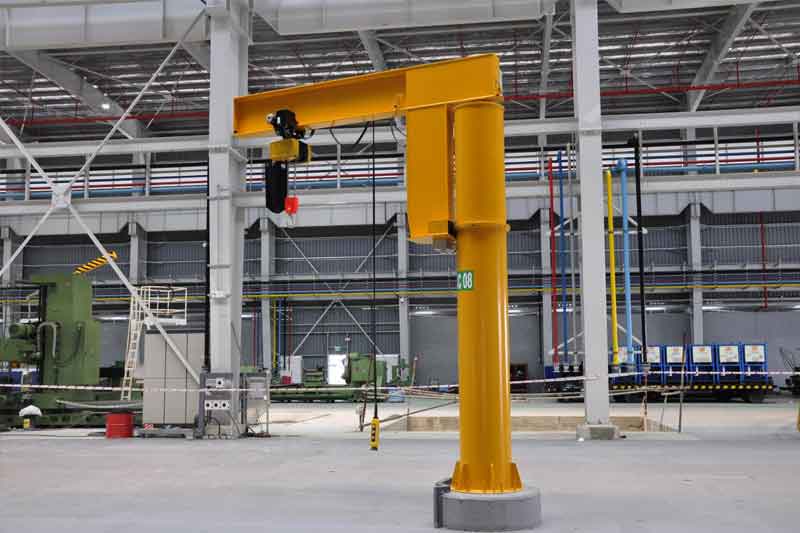
floor mounted jib crane for sale
A floor-mounted jib crane is fixed on a base that takes up permanent floor area. This space cannot be used for other production activities.
In automotive assembly, where every workstation is closely arranged, this becomes a practical constraint rather than just a design detail.
- Permanent floor obstruction reduces usable production area
- Fixed base interferes with workstation planning and line balancing
- Conflicts with assembly carts, tooling stations, and part storage zones
- Limits how closely stations can be arranged in compact layouts
In daily operation, workers often need to route around the crane base. Over time, this reduces the efficiency of movement within the workshop.
Modern automotive plants rely heavily on smooth material flow. Parts are moved by forklifts, AGVs, or manual carts in a continuous sequence. Any obstacle in this path affects the entire rhythm.
Floor-mounted jib cranes introduce fixed points that must be avoided.
- Interference with forklift and AGV routing paths
- Narrowing of movement corridors between stations
- Creation of congestion points in high-frequency travel zones
- Slower transfer of parts between production stages
In practice, even small routing delays can build up and affect downstream stations. This is why floor-based obstacles are often avoided in high-volume assembly lines.
Automotive production lines are often adjusted as models change or production volume increases. Layout flexibility is important for long-term planning.
Floor-mounted jib cranes limit this flexibility because they are fixed structural installations.
- Difficult to relocate or modify after installation
- Requires civil work for repositioning or removal
- Restricts changes in workstation layout or line expansion
- Limits adaptability in modular or mixed-model production systems
In the industrial projects, this means less freedom to redesign the line when production requirements change.
Why Wall-Mounted Jib Cranes Are Preferred in Automotive Assembly Lines
In automotive assembly environments, wall-mounted jib cranes are widely used because they fit better into compact and high-efficiency layouts. The main reason is not only lifting performance, but how well they support space planning and continuous production flow.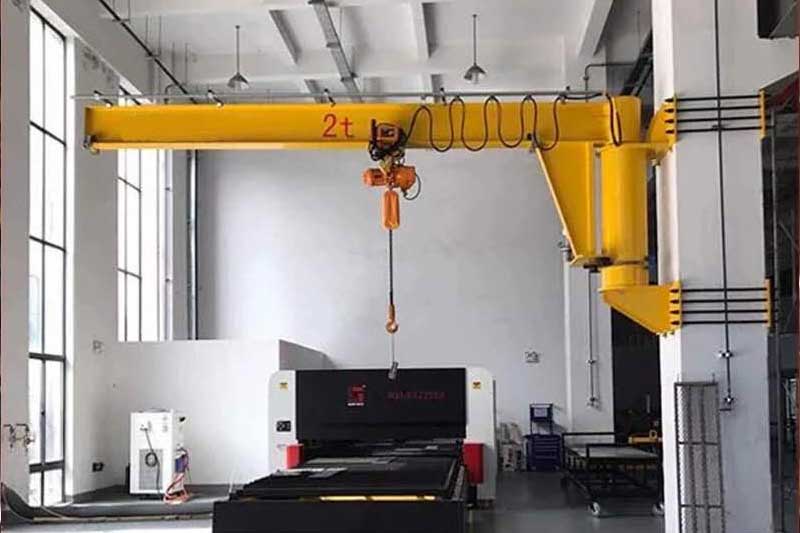 wall mounted jib crane for your reference
Wall-mounted jib cranes are installed on structural walls or columns, so they do not occupy floor space. This keeps the ground area open for production and logistics activities.
In automotive plants, this makes a noticeable difference in layout planning.
- Entire floor area remains free for assembly operations and material movement
- No fixed pedestal or base occupying workstation space
- Easier placement of assembly stations in compact layouts
- Supports high-density workstation arrangements in line production
In practical use, operators can move parts without working around crane structures on the floor. This improves overall space efficiency in tight workshop conditions.
Material flow in automotive assembly needs to be steady and predictable. Wall-mounted jib cranes help by allowing lifting tasks directly at the workstation without interrupting movement paths.
This supports smoother handling between processes.
- Direct lifting between adjacent assembly stations
- Faster positioning of engines, gearboxes, and components
- Reduced waiting time between lifting and installation steps
- Fewer interruptions in repetitive assembly tasks
In real workshop operation, this helps maintain a stable production rhythm, especially in line-based assembly systems.
Automotive assembly lines often have narrow working zones with operators, carts, and AGVs moving at the same time. Floor obstructions increase the chance of interference.
Wall-mounted jib cranes reduce these risks by keeping the ground clear.
- No fixed obstacles in operator walking paths
- Easier movement for forklifts and AGVs
- Lower risk of collision in tight workstation areas
- Safer material handling during repetitive lifting tasks
In daily operation, a clear floor layout helps reduce small accidents and improves overall working conditions.
Modern automotive production relies heavily on coordinated logistics systems such as AGVs and just-in-time (JIT) delivery. Wall-mounted jib cranes fit naturally into this type of setup.
They support controlled and timed material delivery without blocking system routes.
- Compatible with AGV-based material transport systems
- Supports lean manufacturing and JIT production flow
- Works well in modular and reconfigurable assembly lines
- Helps maintain consistent part supply to each workstation
In practical industrial use, this combination of wall-mounted lifting and automated transport systems helps keep production lines running with fewer interruptions.
Application Scenarios in Automotive Manufacturing
Wall-mounted jib cranes are mainly used in automotive plants where lifting tasks repeat at fixed stations and floor space must stay open. They are not for long-distance transport, more like “right here lifting” at the workstation. In real workshop terms, they just sit where you need them and do the job.
In engine assembly areas, parts are handled frequently and with care. Engines, housings, and subcomponents need to be lifted, aligned, and installed at specific points.
Wall-mounted jib cranes are often placed along the line so each station has its own lifting range.
- Handling of complete engine blocks and cylinder housings
- Positioning of subassemblies during engine build process
- Support for tight workstation layouts with limited floor space
- Smooth transfer between engine assembly steps
In practice, operators often say “just lift it here and drop it in place.” The crane makes that kind of direct movement possible without extra repositioning.
Transmission and gearbox assembly requires more precision than raw lifting force. Components must be positioned carefully to align with fixtures and tooling points.
Wall-mounted jib cranes are suitable because they provide controlled movement within a limited radius.
- Precision lifting of gearboxes and transmission units
- Alignment support during installation and testing steps
- Handling of medium-weight mechanical assemblies
- Reduced repositioning time between operations
In real workshop use, it’s not about speed only, but about getting the alignment right the first time. The crane helps operators “fine-tune” the position without struggle.
In welding and body assembly areas, parts such as steel frames, brackets, and panels are handled repeatedly. These zones often run in linear layouts where flow matters more than anything else.
Wall-mounted jib cranes support these repetitive tasks without blocking movement paths.
- Repetitive lifting of steel frames and body components
- Support for welding fixture positioning
- Operation within narrow linear production lanes
- Reduced interference with operators and welding equipment
To put it simply, operators can keep working without stopping to clear space. The crane stays out of the way but is always ready when needed.
Subassembly stations rely on a constant supply of parts. These parts are usually smaller but handled in high frequency. So the movement has to be quick and clean.
Wall-mounted jib cranes help position components quickly at each workstation.
- Efficient feeding of parts to multiple assembly stages
- Quick positioning of components for operator use
- Support for multi-step subassembly processes
- Reduced waiting time between part delivery and installation
In day-to-day operation, this is where you feel the benefit most. Parts come in, get lifted, placed, and used—no delay, no extra handling. It keeps the rhythm of the line steady.
Comparison: Wall-Mounted vs Floor-Mounted Jib Cranes
In automotive assembly workshops, both wall-mounted and floor-mounted jib cranes are used for local lifting. But when you compare them in real production conditions, the difference is mostly about space usage, workflow smoothness, and layout flexibility.
| Comparison Point | Wall-Mounted Jib Crane | Floor-Mounted Jib Crane |
|---|---|---|
| Space Efficiency | Keeps floor fully open. No base on ground. Better for tight automotive layouts. | Takes fixed floor space due to pedestal base. |
| • Optimizes usable workspace | • Occupies permanent ground area | |
| • No floor obstruction | • Limits layout density | |
| Workflow Continuity | Supports smooth station-to-station flow. No blockage in movement paths. | Can interrupt flow around crane base area. |
| • Faster material transfer | • Possible movement bottlenecks | |
| • Less AGV/forklift interference | • Needs routing adjustments | |
| Installation Requirements | Mounted on wall or column. Depends on structure strength. | Requires concrete foundation and anchoring. |
| • Easier fit into existing layout | • More civil construction needed | |
| • No floor foundation work | • Fixed installation position | |
| Operational Flexibility | Better for modular and changing layouts. Can serve multiple stations. | Fixed position, harder to relocate or modify. |
| • Supports line expansion | • Limited flexibility after install | |
| • Multi-station coverage | • Single-zone operation |
Wall-mounted systems are designed to keep the floor area open. They are fixed on walls or structural columns, so the ground space stays fully available for production.
Floor-mounted jib cranes, on the other hand, always take up a fixed area on the workshop floor.
- Wall-mounted systems optimize usable production footprint
- No floor obstruction from pedestal or base structure
- Better use of tight automotive workstation layouts
- Floor-mounted cranes occupy permanent ground space
In practical terms, many workshop managers prefer wall-mounted units because “the floor is already busy enough.” Keeping it clear makes a big difference in daily movement.
Material flow in automotive assembly needs to stay smooth. Parts should move from one station to another without stops or rerouting.
Wall-mounted jib cranes support this kind of flow better because they work directly at the station level.
- Wall systems reduce interruptions in material handling
- Faster transfer between adjacent assembly stations
- Less interference with forklifts and AGV routes
- Floor-mounted cranes may create movement bottlenecks around their base
In real operation, even small obstructions can slow the line. Wall-mounted cranes help avoid that by staying out of the main movement path.
There is also a clear difference in installation method and structural demand.
Floor-mounted cranes need a reinforced concrete foundation. Once installed, they are fixed in place and difficult to relocate.
Wall-mounted cranes depend on the strength of the building structure, usually columns or load-bearing walls.
- Floor cranes require concrete foundation and anchoring work
- Wall cranes depend on structural wall or column strength
- Floor systems involve more civil work during installation
- Wall systems are easier to integrate into existing workshop layouts
In practice, installation planning is important. If the structure is not ready, it limits which system can be used.
Automotive production lines change over time. New models, new stations, or layout adjustments are common. So flexibility matters.
Wall-mounted jib cranes fit better into modular production layouts because they can serve multiple stations along a line without occupying floor space.
- Wall-mounted systems adapt better to modular production layouts
- Easier to support line expansion or workstation reconfiguration
- More suitable for multi-station coverage along assembly lines
- Floor-mounted cranes are fixed and harder to reposition
In day-to-day factory planning, this flexibility is often what decides the final choice. Wall-mounted systems simply leave more options open for future changes.
Selection Considerations for Automotive Workshops
Choosing between wall-mounted and floor-mounted jib cranes in automotive workshops is not only about lifting capacity. In real production planning, it is more about how the crane fits into the layout, supports movement, and keeps the line running without interruption. Below are the main points that usually guide the decision.
In automotive assembly lines, workstation spacing is often tight. Multiple stations are arranged in a continuous flow, and every meter of floor space is planned.
- High-density production layouts usually favor wall-mounted jib cranes
- Narrow workstation spacing requires clear floor access for operators and carts
- Floor-mounted cranes can limit how closely stations are arranged
- Wall-mounted systems help keep the layout compact and organized
In practice, if the line is already “packed,” floor space becomes too valuable to lose. That is where wall-mounted cranes are usually preferred.
Different automotive parts have different handling requirements. Some are light and frequent, others are heavier and need stable positioning.
- Engine blocks, gearboxes, and housings require controlled lifting
- Subassemblies need frequent but lighter handling operations
- Jib crane capacity must match real component weight, not just peak load
- Smooth positioning is often more important than raw lifting speed
In real workshops, operators often say: “It’s not just lifting it, it’s placing it right.” That is why load control and precision matter as much as capacity.
Wall-mounted jib cranes depend heavily on the building structure. If the wall or column is not strong enough, the system cannot operate safely.
- Load-bearing capacity of walls or steel columns must be verified
- Structural reinforcement may be required in older workshops
- Installation planning should consider dynamic load during rotation
- Floor-mounted cranes avoid this dependency but require foundation work instead
In practical engineering work, this step is critical. Skipping it can lead to operational limits later, so it is usually checked early in the design stage.
Modern automotive plants use mixed logistics systems. Forklifts, AGVs, and conveyors all share the same space. Crane selection must support this flow.
- Wall-mounted jib cranes keep ground space open for AGV and forklift routes
- Floor-mounted cranes can create fixed obstacles in movement paths
- Conveyor-fed lines benefit from clear floor access around workstations
- Smooth integration reduces traffic conflicts inside the workshop
In real operations, this is often a key reason for switching to wall-mounted systems. Less blockage means fewer delays in daily movement.
Not all stations have the same lifting frequency. Some operate continuously, while others only require occasional lifting.
- High-frequency lifting stations benefit from dedicated wall-mounted coverage
- Repetitive handling tasks are better supported by fixed-position cranes
- Occasional lifting may not justify permanent floor occupation
- Cycle time stability improves when lifting is consistent and nearby
In simple terms, if lifting happens many times per shift, a fixed wall-mounted jib crane makes daily work smoother. If lifting is rare, a simpler setup may be enough.
Engineering Factors in Wall-Mounted Jib Crane Deployment
In automotive workshops, installing a wall-mounted jib crane is not just “fix it on the wall and start using it.” In real projects, it needs proper engineering checks. Structure, reach, hoist selection, and safety setup all work together. If one point is wrong, the whole operation feels it.
First thing first — the structure. Wall-mounted jib cranes transfer all lifting load into the building, so the wall or column must be strong enough. This is usually checked early, not later.
- Load-bearing capacity of walls or steel columns must be evaluated
- Structural reinforcement may be required, especially in older workshops
- Dynamic load during lifting and rotation must be considered, not just static weight
- No foundation is used, so the building structure is doing all the work
In practical terms, people in the field often say: “If the wall is not solid, don’t even start installation.” That’s the reality.
Next is the jib arm design. This decides how far the crane can reach and how many stations it can serve. In automotive layouts, this is directly tied to workflow efficiency.
- Arm length should match workstation spacing in the assembly line
- Rotation range determines coverage between adjacent stations
- Over-length arms may cause instability under load
- Short arms may limit working coverage and slow down handling
In practice, it’s always a balance. Not too long, not too short — just enough to cover the working zone smoothly without overreach.
The hoist is where the actual lifting happens. In automotive assembly, it’s not only about lifting weight, but also about control and positioning.
- Electric chain hoists are commonly used for medium-load automotive parts
- Wire rope hoists are selected when higher capacity or longer lifting height is needed
- Smooth start and stop helps with accurate positioning
- Fine control is important for engine, gearbox, and component alignment
Operators often care about this more than people think. They usually say, “If it moves smooth, the job is easy.” And that is exactly the point here.
Safety systems are not optional in real industrial use. In automotive workshops, cranes run all day, so protection systems must work reliably every time.
- Overload protection prevents lifting beyond rated capacity
- Travel and rotation limit switches control working boundaries
- Emergency stop function allows quick shutdown when needed
- Anti-swing control helps keep load stable during movement
In industrial operation, these features are what keep things under control. No one really thinks about them when everything works fine — but they matter a lot when conditions get busy or tight.
Industry Trend: Shift Toward Space-Efficient Automotive Manufacturing
The automotive industry is clearly moving in one direction — use less space, but produce more output. In real factory planning, people often say, “floor space is getting expensive,” and that is exactly what is driving this change.
Lean manufacturing is now widely applied in automotive assembly plants. The focus is on reducing waste and keeping production flow steady, without unnecessary stops or movement.
- Less waiting time between assembly operations
- Reduced material handling distance between stations
- Better coordination between lifting, assembly, and inspection steps
- Smooth continuous flow instead of batch-style interruptions
In practical terms, it’s simple: keep things moving, don’t let work pile up, and avoid anything that blocks flow.
Automotive plants are no longer fixed for decades. Layouts change more often now, depending on models, demand, or production targets. So flexibility has become a normal requirement.
- Modular workstation layouts are increasingly used in new plants
- Production lines can be adjusted or expanded with less downtime
- Equipment needs to support changing station positions
- Factory layouts are designed with future changes in mind
In real projects, engineers often say, “We may need to move this line later,” so flexibility is built in from the start.
As floor space becomes tighter, equipment size matters more than before. Large systems that block movement are no longer preferred in dense assembly areas.
- Compact lifting systems help save valuable floor space
- Short-distance, workstation-level lifting is widely used
- Equipment must support frequent, repetitive handling tasks
- Less interference with AGVs, forklifts, and operator movement
In simple terms, plants want lifting tools that “do the job and stay out of the way.”
Because of these changes, more factories are shifting toward lifting systems that stay above or beside the working area. This keeps the floor open and easier to manage.
- Overhead and wall-mounted systems free up working space
- Better compatibility with AGV-based logistics systems
- Improved material flow in narrow production lines
- More suitable for lean, high-density automotive layouts
In actual workshop use, this has become a practical standard. Keep the floor clear, keep the flow smooth — that’s the direction most automotive plants are heading now.
Wall-mounted jib cranes have become the preferred solution in automotive assembly lines due to their ability to eliminate floor obstruction, support uninterrupted material flow, and enhance safety in compact workstation environments. Compared to floor-mounted jib cranes, they provide superior space efficiency and operational flexibility, making them essential for modern automotive manufacturing layouts focused on productivity and lean workflow optimization.