
Yuantai Crane for Better Solutions:
Energy-Saving | Space-Saving | Cost-Efficient | CE/ISO/EX
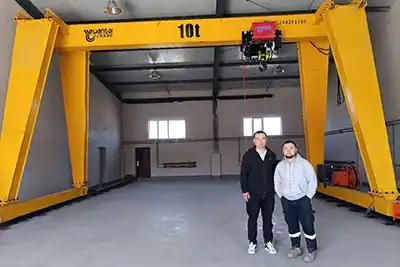
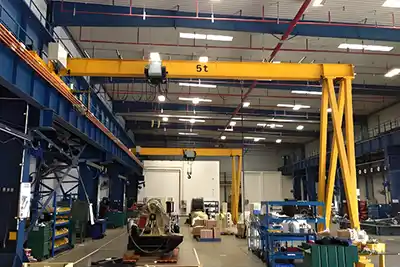
Semi gantry crane with ground wheel travel design. Flexible workshop lifting solution without rail installation for steel and precast handling.
Semi Gantry Crane Wheel Travelling, No Ground Embeded Rail
| Product Type: | BMH Semi Gantry Crane |
|---|---|
| Lifting Capacity: | 1 Ton to 20 Ton |
| Span: | As request |
| Lifting Height: | As your request |
| Working Class: | A3-A5 |
| Ambient Temperature: | -20-+40 ℃ |
| Crane Price Rangs | More Inquiry Form |
| USD 2,000- 22,000+ for reference only. Contact us to get tailored solution and specific crane price. | |
| [email protected] 008615038346929 | |
Ground Rail-Free Semi Gantry Crane
" Semi Gantry crane with rubber tyred wheel, a new solution for indoor material handling. No harm to your ground, no groud rail. Save Your Ground Space."A ground rail-free semi gantry crane is a type of semi gantry crane designed to travel without steel rails installed on the workshop floor. One side of the gantry crane runs on an elevated runway beam, while the other side moves directly on the concrete floor using polyurethane wheels or rubber wheels.
This design is commonly used in workshops where customers want to avoid floor rail installation, reduce civil construction work, or keep the production layout flexible. You will often see the half gantry cranes in fabrication shops, machine assembly areas, mold handling workshops, warehouse loading zones, and maintenance bays.
Compared with a traditional rail-mounted semi gantry crane, a rail-free semi gantry crane is easier to install and usually requires less modification to the building floor. Forklifts, pallet trucks, and AGVs can move across the working area more freely because there are no embedded steel rails on the ground.
Typical lifting capacities are usually from 1 ton to 10 tons, although some custom semi gantry crane designs can be built for higher capacities depending on floor conditions and duty requirements.
Difference from Traditional Rail-Mounted Semi Gantry Cranes
Although both crane types perform similar lifting functions, there are major differences in installation, operation, and workshop flexibility.
A rail-free semi gantry crane is generally selected for flexible indoor handling, while a rail-mounted semi gantry crane is more suitable for heavier industrial duty and long travel applications.
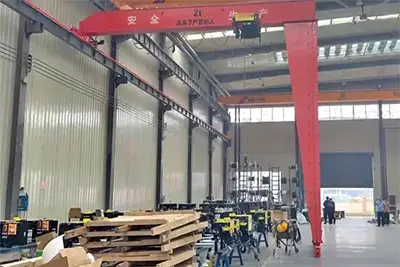 Semi gantry crane with no ground rail but with wheel travelling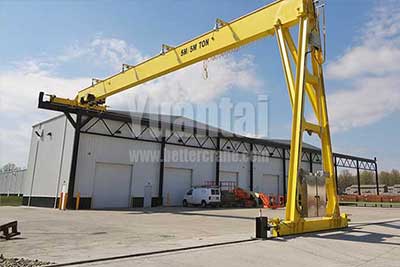
| Feature | Rail-Free Semi Gantry Crane | Rail-Mounted Semi Gantry Crane |
|---|---|---|
| Ground Rail | Not required | Required |
| Installation Cost | Lower | Higher |
| Layout Flexibility | High | Limited |
| Heavy Duty Capability | Medium | High |
| Floor Requirement | High-quality concrete floor | Rail foundation required |
A traditional semi gantry crane requires steel rails embedded or fixed onto the floor.
This usually involves:
- rail foundation work
- floor cutting
- grouting
- rail alignment
- concrete reinforcement
A rail-free semi gantry crane avoids these steps entirely.
That is one reason many workshop owners choose this design for retrofit projects or rented factory buildings.
Rail-mounted systems generally require more civil construction work.
Additional costs may include:
- runway rail installation
- floor rail foundation
- alignment adjustment
- structural reinforcement
A rail-free gantry crane usually has:
- faster installation
- lower civil work cost
- reduced workshop downtime
especially for indoor applications.
Without floor rails, the workshop remains more open.
This allows:
- forklift crossing
- pallet truck movement
- AGV operation
- flexible workstation arrangement
- easier production line modification
For workshops that change layouts frequently, this flexibility matters quite a lot.
Rail-mounted semi gantry cranes are still better for:
- high-duty cycle operation
- long travel distances
- very heavy loads
- continuous industrial handling
Steel rail systems provide more stable travel under heavy wheel pressure.
Rail-free semi gantry cranes are more commonly used for:
- light-duty handling
- medium-duty handling
- intermittent lifting work
- indoor production support
A rail-free semi gantry crane depends heavily on floor quality.
The concrete floor should have:
- sufficient compressive strength
- good flatness
- low surface damage
- proper reinforcement
Poor floor conditions can lead to:
- wheel wear
- unstable travel
- alignment problems
- uneven load distribution
For this reason, floor evaluation is usually one of the first technical checks before selecting a rail-free gantry crane system.
Main Benefits of Rail-Free Semi Gantry Cranes
A rail-free semi gantry crane is mainly selected for workshops that need flexible indoor material handling without installing steel rails on the floor. Compared with traditional rail-mounted gantry crane systems, this design reduces construction work and makes future layout changes easier.
No Ground Rail Installation
One of the biggest advantages of a rail-free semi gantry crane is that it does not require steel rails embedded into the workshop floor.
Traditional rail-mounted gantry cranes normally require:
- rail foundation construction
- floor cutting
- concrete reinforcement
- rail alignment
- grouting work
- long installation periods
For many factories, especially operating workshops, this construction work can become expensive and disruptive.
A rail-free semi gantry crane avoids most of these issues because the ground travelling side moves directly on the concrete floor using polyurethane wheels or rubber wheels.
This helps reduce:
- civil construction cost
- installation complexity
- production downtime
- workshop shutdown time
In many retrofit projects, customers prefer rail-free crane systems because they can install the crane without heavily modifying the existing floor structure.
Typical installation advantages include:
- no embedded rail system
- reduced concrete work
- fewer installation steps
- shorter commissioning period
- lower foundation engineering cost
For smaller workshops, honestly speaking, avoiding rail installation alone can save a considerable amount of project cost.
Civil work is often one of the hidden costs in crane installation projects.
For rail-mounted systems, customers may need:
- reinforced rail foundations
- precision rail alignment
- additional floor thickness
- concrete repair work
A rail-free semi gantry crane eliminates most of these requirements.
This is especially useful for:
- medium-sized factories
- rented industrial buildings
- low-budget workshop upgrades
- temporary production areas
In some projects, the crane installation cost becomes much lower simply because there is no need to rebuild the floor.
Without floor rail installation, the overall project schedule becomes shorter.
The installation process is usually simpler because the crane only requires:
- elevated runway installation
- power supply connection
- wheel alignment adjustment
- travel testing
This reduces:
- installation labor
- on-site construction time
- production interruption
Many indoor workshop crane projects prefer this approach because factories often cannot stop production for long periods.
Retrofitting an existing workshop can be difficult when floor rails must be added later.
Customers may face issues such as:
- underground piping
- existing floor damage
- machine foundations
- uneven concrete floors
- limited construction access
A rail-free semi gantry crane reduces these retrofit problems.
It can often be installed in:
- old industrial buildings
- machine repair shops
- fabrication workshops
- maintenance bays
- warehouse handling areas
without major structural reconstruction.
Flexible Workshop Layout
Another major benefit of a rail-free semi gantry crane is workshop flexibility.
Because there are no steel rails fixed to the ground, the working area remains more open. This allows material handling equipment and production traffic to move more freely through the workshop.
For modern factories using flexible manufacturing systems, this matters quite a lot.
Floor rails can become obstacles for forklifts and pallet trucks.
In rail-mounted crane systems, forklifts may experience:
- wheel impact
- unstable movement
- load vibration
- restricted travel paths
A rail-free semi gantry crane eliminates these crossing issues.
Forklifts can move across the workshop floor more smoothly because there are no rail gaps or protruding steel tracks.
This improves:
- internal logistics flow
- warehouse traffic efficiency
- workshop safety
- material transfer speed
It is especially useful in mixed-use workshops where cranes and forklifts operate in the same area.
Many modern factories now use AGVs (Automated Guided Vehicles) for internal material transport.
Floor rails may interfere with:
- AGV navigation
- wheel movement
- sensor tracking
- travel routing
A rail-free crane system provides a cleaner floor layout for AGV operation.
This makes the crane suitable for:
- automated production lines
- smart factories
- lean manufacturing systems
- flexible assembly workshops
As more factories move toward automation, compatibility with AGVs and automated logistics systems becomes more important.
Without rail tracks, workshop layouts become easier to modify later.
Production areas can be adjusted more freely for:
- machine relocation
- assembly line changes
- storage expansion
- temporary workstations
- seasonal production demands
This open floor arrangement is often preferred in workshops where production requirements change frequently.
In some cases, customers choose rail-free semi gantry cranes specifically because they expect future workshop expansion.
Lower Noise Operation
Noise control is another reason many factories choose polyurethane wheel semi gantry cranes for indoor material handling.
Traditional steel wheel crane systems can generate noticeable rolling noise, especially on long travel distances or uneven rails.
Polyurethane wheels help reduce:
- rolling impact
- vibration transmission
- floor contact noise
- travel shock
This creates a quieter working environment.
Polyurethane wheels are widely used in indoor crane systems because they provide smoother floor contact compared with steel wheels.
Main advantages include:
- quieter operation
- lower vibration
- reduced floor wear
- smoother travel
- cleaner indoor movement
The wheel surface also helps absorb some travel shock during crane movement.
For precision workshops or indoor assembly areas, this smoother operation is often preferred.
A rail-free semi gantry crane with polyurethane wheels usually travels more smoothly on properly finished concrete floors.
This helps reduce:
- load swing
- sudden travel impact
- wheel slipping
- mechanical shock
Smooth travel is important when handling:
- molds
- precision machinery
- electronic equipment
- finished products
- assembled components
Especially in assembly workshops, operators often prefer cranes with stable and predictable travel movement.
Lower noise operation makes these cranes suitable for indoor industrial environments such as:
- assembly plants
- machine workshops
- electronics manufacturing
- maintenance centers
- warehouse handling areas
- precision fabrication shops
In enclosed buildings, reducing travel noise can improve the overall working environment for operators and nearby production lines.
Reduced Floor Modification
A rail-free semi gantry crane is often selected when customers want to minimize changes to the existing workshop floor.
This is common in buildings where floor reconstruction is difficult, expensive, or simply not allowed.
Because the crane travels directly on the concrete floor, there is usually no need for:
- embedded rails
- floor trenching
- deep foundation cutting
- extensive concrete replacement
That makes installation much easier in certain industrial situations.
Many manufacturers operate in rented industrial buildings where major floor modification may not be permitted.
Installing steel rails could create problems such as:
- landlord approval issues
- restoration cost at lease end
- permanent floor damage
A rail-free semi gantry crane reduces these concerns because the installation is less invasive.
For temporary factory operations, this can be a very practical solution.
Older workshops often have:
- aging concrete floors
- embedded utilities
- limited construction access
- existing machine foundations
Installing rail systems in these environments may become difficult.
A rail-free crane system allows customers to add lifting equipment with less disruption to the existing workshop structure.
Some factories operate temporary production projects or short-term assembly areas.
In these cases, customers may not want permanent crane rail systems installed.
A rail-free semi gantry crane can support:
- temporary manufacturing zones
- project-based assembly work
- temporary warehouse operations
- seasonal production expansion
without major civil construction.
Easier Relocation and Expansion
Production requirements often change over time.
Factories may:
- expand production
- move machinery
- reorganize workflow
- add new assembly lines
A rail-free semi gantry crane provides more flexibility for these future changes.
Many modern workshops use modular production layouts where workstations can be adjusted based on production demand.
A rail-free crane system fits well into this approach because it does not permanently divide the workshop floor with fixed rail tracks.
This supports:
- modular assembly stations
- flexible manufacturing cells
- reconfigurable production lines
- changing workflow arrangements
When workshop layouts change, rail-mounted systems may require:
- rail relocation
- foundation reconstruction
- floor repair work
A rail-free semi gantry crane is generally easier to reposition or adapt to the new layout.
That helps reduce:
- future modification cost
- production downtime
- relocation labor
For growing factories, this flexibility can become important later.
Factories planning future expansion often prefer crane systems that can adapt more easily.
A rail-free semi gantry crane may later be:
- relocated
- extended
- upgraded
- integrated into new workshop areas
depending on production growth.
For companies with changing manufacturing requirements, this type of flexible crane system provides more long-term adaptability compared with permanently fixed rail-mounted systems.
Typical Industrial Applications of Rail-Free Semi Gantry Cranes
Rail-free semi gantry cranes are widely used in indoor industrial environments where material handling needs to be flexible, frequent, and not dependent on fixed rail infrastructure. They are especially suitable for workshops where load size changes often and production layout needs to stay adjustable.
In practical industrial projects, these cranes are not limited to one sector. You will find them in fabrication shops, maintenance facilities, warehouses, and assembly plants. The key reason is simple: they can move heavy loads safely without requiring permanent floor rails.
Steel fabrication workshops are one of the most common application environments for rail-free semi gantry cranes. These workshops usually deal with heavy, irregular, and sometimes long steel components that need flexible lifting and positioning.
In many cases, the workshop layout changes depending on the production order, so fixed rail systems can become a limitation.
Typical materials handled include:
- steel frames and welded structures
- steel plates and sheets
- fabricated machine bases
- structural beams and assemblies
The crane is used for both lifting and positioning work during fabrication, welding preparation, and final assembly stages.
In real workshop conditions, operators often prefer rail-free semi gantry cranes because they allow:
- easier movement between workstations
- flexible positioning of steel parts
- reduced obstruction on the floor
- smoother coordination with forklifts
For medium-duty fabrication work, a 3 ton, 5 ton, or 10 ton rail-free semi gantry crane is commonly selected depending on load size and frequency of use.
Mold and die workshops require careful handling of high-value and precision components. These parts are often heavy but also sensitive to impact and misalignment.
Rail-free semi gantry cranes are widely used here because they provide controlled lifting and smooth movement without rail gaps or sudden vibration changes.
Typical handling objects include:
- injection molds
- stamping dies
- tooling systems
- precision fixtures
- machine maintenance components
In many mold workshops, space is limited and layouts are dense. A rail-free crane system helps operators move molds between machines without blocking permanent floor space.
Key operational advantages include:
- accurate positioning during mold installation
- reduced vibration during transport
- smooth travel on polished concrete floors
- flexible movement between machines
In practical terms, mold handling often requires slow and controlled crane operation, so polyurethane wheel systems with variable frequency drives are commonly used.
In warehouse and logistics environments, rail-free semi gantry cranes are used for handling general industrial loads that are too heavy or too large for forklifts alone.
These cranes are often installed in distribution centers, maintenance warehouses, and industrial storage facilities.
Typical handling tasks include:
- palletized goods and bulk loads
- industrial equipment and spare parts
- machine components and packaging units
- maintenance tools and assemblies
Unlike fixed rail cranes, rail-free systems allow forklifts and pallet trucks to continue operating in the same area without obstruction.
This improves internal logistics flow, especially in warehouses where space must be shared between storage and handling operations.
In many warehouse projects, the crane is used for:
- loading and unloading heavy pallets
- transferring equipment between zones
- maintenance lifting operations
- temporary handling stations
The ability to operate without floor rails makes layout changes easier when storage patterns are updated.
Automotive component plants often require flexible and continuous material handling between multiple production stages. Rail-free semi gantry cranes are widely used here because they support changing production layouts and reduce floor restrictions.
Typical applications include:
- assembly line support lifting
- movement of engine components
- handling of chassis parts and frames
- transport of sub-assemblies between stations
In automotive manufacturing, production lines are frequently adjusted based on model changes or production volume. A fixed rail system can restrict this flexibility, while a rail-free crane system allows easier adjustment.
Another important factor is noise control. Many automotive plants operate in semi-enclosed indoor environments where worker comfort matters.
Rail-free cranes with polyurethane wheels provide:
- lower operating noise
- smoother travel along assembly lines
- reduced vibration impact on parts
- safer interaction with production workers
For lean manufacturing layouts, this type of crane supports flexible production cells rather than fixed lifting points.
Equipment maintenance bays are another common application area where rail-free semi gantry cranes are widely used. These areas are typically designed for repairing and servicing industrial machinery.
The crane is used to lift and position heavy equipment parts during maintenance operations.
Typical applications include:
- motor repair and installation
- pump maintenance and replacement
- gearbox and reducer handling
- industrial machine servicing
- equipment disassembly and reassembly
In maintenance environments, the advantage of a rail-free system is flexibility. Equipment layouts can change depending on the type of repair work being carried out.
Instead of fixed lifting paths, operators can move the crane to different working zones within the bay.
This supports:
- multi-purpose maintenance areas
- flexible repair stations
- temporary heavy lifting zones
- reduced dependency on fixed infrastructure
In many industrial maintenance workshops, the crane is not used continuously but rather intermittently. A rail-free semi gantry crane fits this operating pattern well, especially when combined with polyurethane wheel systems for smooth indoor travel.
Overall, rail-free semi gantry cranes are selected not only based on lifting capacity but also based on how flexible the workshop needs to be. In modern industrial environments, production layouts change frequently, and this type of crane supports that requirement without heavy civil construction work or fixed rail limitations.
Technical Specifications
The following specifications represent typical design parameters for rail-free semi gantry cranes. Final configurations may vary depending on workshop layout, floor conditions, duty requirements, and application type.
These values are commonly used as a baseline reference for engineering selection and quotation preparation.
Standard Technical Specification Table
| Item | Typical Range | Engineering Notes |
|---|---|---|
| Capacity | 1–10 tons (standard) | Light to medium-duty workshop handling. Custom designs may exceed 10 tons depending on floor strength and wheel system. |
| Span | 3–15 m | Determined by workshop width and runway beam layout. Larger spans require reinforced structural design and synchronized wheel travel systems. |
| Lift Height | 3–12 m | Influenced by building height, girder configuration, and hoist type (chain vs wire rope vs European hoist). |
| Travel Speed | Customized (0–20 m/min typical range) | Varies based on duty class, load sensitivity, and VFD control system integration. |
| Wheel Type | Polyurethane / Rubber (optional hybrid design) | PU wheels for smooth indoor operation; rubber wheels for light-duty and impact absorption. |
| Duty Class | A3–A5 (ISO/FEM equivalent) | A3: light intermittent use; A4: moderate workshop duty; A5: frequent industrial operation. |
The rated capacity defines the maximum safe lifting load, but in rail-free systems, it must also account for:
- Crane self-weight distribution across floor wheels
- Dynamic load amplification during travel and braking
- Uneven load conditions caused by offset lifting
- Floor bearing limitations (critical factor in PU wheel systems)
In practical engineering design, a 10–20% safety margin is typically applied depending on duty classification and application severity.
Span refers to the horizontal distance between the runway support side and the ground traveling side.
Engineering considerations include:
- Floor flatness and alignment over long distances
- Structural deflection of the bridge girder
- Wheel synchronization accuracy
- Lateral stability during loaded travel
As span increases:
- Wheel load distribution becomes more sensitive
- Anti-skew systems become more important
- Structural reinforcement requirements increase
Lift height is determined by:
- Workshop ceiling height
- Girder structural configuration (single vs double girder)
- Hoist type and drum design
- Hook approach clearance requirements
Practical impact:
- Single girder systems reduce hook height due to under-running hoist geometry
- Double girder systems provide higher effective lifting height
- European hoists optimize vertical space utilization with compact design
Travel speed is not fixed and is configured according to operational workflow requirements.
Typical speed ranges include:
- Low speed (precision positioning): 0–10 m/min
- Standard workshop operation: 10–20 m/min
- Higher efficiency systems (VFD controlled): up to ~30 m/min (application dependent)
Key influencing factors:
- Load sensitivity (fragile or precision components require slower speed)
- Floor condition (irregular surfaces require controlled acceleration)
- Duty cycle (frequent starts require smoother ramp-up profiles)
Floor Requirements and Installation
The performance and service life of a rail-free semi gantry crane are strongly influenced by floor conditions, power supply configuration, and installation methodology. Unlike rail-mounted systems, this crane type interacts directly with the building floor, making proper site preparation a critical engineering requirement.
Concrete Floor Requirements
Since the crane travels directly on the workshop floor, the concrete slab becomes an active structural component of the crane system, not just a passive foundation.
Proper floor design ensures stable wheel contact, controlled load distribution, and long-term operational reliability.
Flatness is one of the most critical parameters for rail-free crane operation.
Engineering Requirements:
- Uniform surface elevation across travel path
- Minimal undulation over long distances
- Controlled leveling tolerance within industrial standards
Practical Impact:
- Poor flatness can lead to:
- uneven wheel loading across support legs
- crane skewing during travel
- increased wheel wear on one side
- vibration during loaded movement
- reduced positioning accuracy
For longer span cranes, even small deviations in floor level can significantly amplify alignment instability and structural stress.
The concrete floor must be designed to support both static and dynamic wheel loads.
Load Considerations:
- Crane self-weight distribution
- Maximum rated lifting load
- Dynamic impact during start/stop cycles
- Concentrated wheel contact pressure
Engineering Requirement:
- Reinforced industrial-grade concrete slab
- Proper rebar reinforcement layout
- Adequate subgrade compaction and stability
Practical Risk if Undersized:
- Surface cracking under repeated wheel travel
- Localized sinking or deformation
- Long-term misalignment of crane travel path
- Increased maintenance and repair costs
Surface condition affects both wheel life and travel stability.
Common Surface Types:
- Hardened concrete finish (preferred)
- Epoxy-coated industrial flooring
- Polished or sealed surfaces
Engineering Considerations:
- Smooth surfaces reduce wheel abrasion
- Coated floors reduce dust but may affect traction
- Rough surfaces increase rolling resistance and wear rate
A balanced surface design ensures:
- stable wheel grip
- controlled friction coefficient
- reduced long-term maintenance of both floor and wheel system
Rail-free systems require controlled floor geometry for safe operation.
Recommended Conditions:
- Minimal longitudinal slope along travel path
- No abrupt elevation transitions
- Controlled drainage slope away from crane running path
Operational Impact:
- Excessive slope or uneven gradient may cause:
- unintended crane drift
- uneven wheel load distribution
- increased motor load on uphill movement
- braking instability during loaded travel
For long-span cranes, slope consistency is more important than absolute flatness.
Power Supply Requirements
Power supply systems must ensure continuous, stable energy delivery to both hoisting and traveling mechanisms.
Depending on workshop layout and crane travel range, different power supply systems may be used.
A festoon system uses cable trolleys running along a support track to supply power to the moving crane.
Key Features:
- Flexible cable movement along travel path
- Suitable for medium travel distances
- Simple structure and easy maintenance
- Reliable for indoor workshop environments
Advantages:
- Stable power transmission
- Low system complexity
- Easy installation and replacement
- Cost-effective solution for most workshops
Typical Application:
- Short to medium span semi gantry cranes
- Indoor fabrication workshops
- Maintenance and assembly lines
A cable reel system uses a spring or motor-driven reel to manage cable extension and retraction during crane movement.
Key Features:
- Automatic cable winding mechanism
- Suitable for longer travel distances
- Compact installation footprint
Advantages:
- Supports extended crane travel paths
- Reduces floor clutter from cable routing
- Suitable for flexible production layouts
Considerations:
- Requires proper tension control
- Cable wear must be monitored over time
- Higher initial system cost compared to festoon systems
A conductor bar system uses rigid electrified rails mounted along the travel path to supply continuous power.
Key Features:
- Continuous electrical contact system
- High reliability for frequent operation
- Suitable for long travel distances and higher duty cycles
Advantages:
- Stable and uninterrupted power supply
- Low cable wear compared to flexible systems
- Ideal for industrial continuous operation environments
Considerations:
- Requires precise installation alignment
- Higher installation complexity
- More suitable for fixed industrial layouts
Installation Process
The installation process of a rail-free semi gantry crane is generally simpler than rail-mounted systems because it eliminates rail alignment, track leveling, and precision rail fixing work.
One of the major advantages of rail-free systems is the elimination of rail installation.
Engineering Impact:
- No rail gauge adjustment required
- No track welding or anchoring operations
- No rail straightness calibration process
This significantly reduces:
- installation time
- labor complexity
- construction error risk
Commissioning focuses mainly on:
- wheel alignment verification
- motor synchronization testing
- travel smoothness evaluation
- load trial operation
Compared with rail-mounted systems, commissioning is:
- faster
- less dependent on civil precision
- easier to adjust on-site
Because the system does not require embedded rail infrastructure, installation can be completed with minimal interruption to workshop operations.
Practical Benefits:
- Reduced production downtime
- Faster project deployment
- Lower civil engineering coordination requirements
- Easier retrofit into existing workshops
Rail-free semi gantry crane installation is characterized by:
- dependence on floor quality instead of rail infrastructure
- simplified mechanical alignment process
- flexible integration into existing industrial buildings
- reduced overall installation complexity and time
However, successful installation still requires:
- properly prepared concrete flooring
- correctly designed power supply system
- precise wheel alignment and commissioning
Limitations and Engineering Considerations
While rail-free semi gantry cranes provide significant advantages in installation flexibility and cost reduction, their performance is strongly dependent on floor conditions, wheel–surface interaction, and operational duty profile. These constraints must be evaluated during engineering selection to ensure long-term reliability.
Rail-free semi gantry cranes are generally optimized for light to medium-duty intermittent operation rather than continuous heavy industrial cycles.
Wheel Wear Limitations
- Continuous friction between wheel and floor surface
- Heat buildup during long travel cycles
- Localized deformation under high wheel loads
- Abrasive wear from dust, debris, or uneven flooring
Engineering impact includes:
- gradual reduction in wheel diameter affecting alignment
- uneven wear leading to skewing and side loading
- increased rolling resistance over time
- higher maintenance frequency compared to rail-based systems
Wear effects become more significant under frequent load cycles, long travel distances, or poor floor conditions.
Floor Load Concentration
- High point loading through wheel contact areas
- Repeated loading along fixed travel paths
- Potential micro-cracking in concrete slabs
- Long-term fatigue in reinforcement layers
Even when overall load capacity is sufficient, localized stress concentration can become a limiting factor in older or lightly reinforced workshops.
Alignment Sensitivity
- Minor wheel diameter differences affect tracking
- Uneven floor resistance induces directional drift
- Structural deflection accumulates over long cycles
Operational consequences include increased motor load imbalance, side-skew forces, uneven gearbox wear, and reduced positioning accuracy. Rail-guided systems remain more stable for continuous heavy-duty applications due to mechanical constraint.
As travel distance increases, rail-free systems require higher precision in control and synchronization to maintain stable movement.
Synchronization Challenges
- Motor speed variation between drive units
- Variable floor friction along travel path
- Wheel wear inconsistency
- Load eccentricity during motion
Without proper control, this may result in diagonal drift, torsional stress, and uneven wheel loading.
Anti-Skew Control Requirements
- Encoder-based motor synchronization
- Anti-skew sensors
- Automatic travel correction algorithms
- Differential speed compensation systems
- Mechanical balancing wheel arrangements
These systems help maintain linear travel accuracy over extended distances.
Drive Coordination Complexity
- Dual drive motor synchronization
- Gear reducer coordination
- Braking system balance
- VFD control integration
Without proper coordination, risks include jerky motion, torsional stress on the girder, structural fatigue, and uneven braking loads. Closed-loop VFD systems with feedback control are typically required for long-span applications.
Rail-free semi gantry cranes are primarily designed for indoor or controlled environments. Outdoor operation introduces multiple structural and environmental challenges that reduce performance reliability.
Uneven Ground Conditions
- Soil settlement and deformation
- Asphalt surface instability under load
- Gravel or compacted ground irregularities
- Water accumulation and erosion effects
These conditions lead to unstable wheel contact, load shocks, and misalignment risks.
Weather Exposure Effects
- Moisture reduces friction stability and increases corrosion risk
- Temperature variation affects polyurethane hardness and alignment stability
- UV exposure accelerates aging of polymer materials and cable insulation
Debris and Contamination
- Dust and sand infiltration increases wear rate
- Metal fragments and industrial waste damage wheel surfaces
- Oil and chemical residues affect traction consistency
- Water mixed with abrasives accelerates bearing and wheel failure
These factors result in higher rolling resistance, accelerated wear, and inconsistent travel behavior.
Rail-free semi gantry cranes are best understood as precision indoor material handling systems with defined operational boundaries.
They are optimized for:
- clean or semi-clean indoor environments
- medium-duty intermittent workflows
- flexible workshop layouts
- cost-efficient installation scenarios
They are not suitable for:
- continuous heavy-duty industrial cycles
- long-term outdoor operation
- highly uneven or uncontrolled ground conditions
How to Select a Rail-Free Semi Gantry Crane
Selecting the right rail-free semi gantry crane starts with understanding your actual working conditions. These basic parameters determine the crane structure, wheel system, and overall performance. Without them, it is difficult to choose a safe and cost-effective solution.
Buyer Checklist
- Load weight: Maximum lifting capacity
- Load size: Dimensions of material
- Travel distance: How far the crane moves
- Floor condition: Concrete strength and flatness
- Duty cycle: How often it is used (light/medium/frequent)
- Indoor or outdoor: Indoor is preferred
- Power supply: Festoon, cable reel, or conductor bar
Once these factors are clear, the crane configuration becomes much easier to define. They directly point to the right structure, hoist type, and travel system.
Simple Selection Guide
- Light load → Single girder + PU wheel
- General use → Single girder + wire rope hoist
- Heavier/stable load → Double girder + wire rope hoist
- Long travel → conductor bar or synchronized drive
This simple logic helps quickly match most workshop requirements with a suitable rail-free semi gantry crane configuration.
FAQ Section
Yes, rail-free semi gantry cranes operate directly on concrete floors without embedded rails.
- Also called trackless semi gantry or floor traveling gantry, ideal for flexible workshop layouts.
- Uses elevated runway beam on one side and floor-running wheels for stable movement.
Requires reinforced, level concrete with controlled flatness and adequate load-bearing strength.
- Poor floor quality causes vibration, uneven wheel wear, and alignment issues.
- Common in PU wheel gantry crane systems or indoor floor traveling setups.
Typically 1–10 tons; higher capacities possible with custom designs depending on wheel selection, floor limits, and duty cycle.
- Targeted for light-duty workshop semi gantry and small-capacity handling.
Suitable for light to medium-duty indoor use; not ideal for continuous heavy cycles.
- Excellent in controlled workshops with moderate lifting frequency.
- Continuous heavy loads or rough floors accelerate wear; steel wheel rail systems may be better.
Yes, open floor design allows forklifts, pallet trucks, and AGVs to pass freely.
- Popular for warehouse material handling and flexible production layouts.
Used in fabrication, assembly, mold handling, maintenance, and warehouse loading.
- Ideal for environments where layouts change frequently, like machine assembly workshops and steel fabrication plants.
Eliminates rail installation, alignment work, and major civil modifications, reducing downtime and construction effort.
- Effective for retrofits and fast deployment projects.
Yes, for higher lifting height, stability, and heavy load handling.
- Common in heavy-duty indoor gantry applications requiring rigidity and precision.
Regular inspection of wheel wear, alignment, and bearings is essential.
- Proper floor and controlled duty cycles extend wheel life and ensure stable operation.
Yes, relocation is easier than rail-mounted systems, requiring disassembly, floor evaluation, and re-leveling.
- Popular for portable semi gantry cranes in workshops and modular layouts.
Product Detail
Support
1 Ton Gantry Crane – Buy Portable & Adjustable Lifting Cranes
Explore 1-ton gantry cranes for workshops and job sites. Portable, adjustable, manual or electric hoists. Request a quote or download specs today. Read More
3 Ton Gantry Crane for Sale – Compact & Customizable
Buy a 3 ton gantry crane from Yuantai Crane. Compact, flexible, and customizable for workshops, maintenance yards, and small fabrication plants. Read More
2 Ton Gantry Cranes: Buyer’s Guide for Workshops & Factories
Learn to choose the right 2-ton gantry crane for your workshop—compare aluminum vs steel, hoists, mobility, safety, and cost. Get your 2 ton gantry crane! Read More
50 Ton Gantry Crane for Sale
50 ton gantry crane for sale. 50 ton double girder gantry crane for wide industrial sector. Reliable crane supplier from China, Custom gantry crane design. Read More
40 Ton Gantry Crane for Sale, Chinese 40 Ton Gantry Crane Maker & Supplier
40 ton gantry crane for sale. Double girder gantry crane 40 ton for indoor /outdoor use with A frame / U frame gantry, rubber tire / rail travelling for sale. Read More
25 Ton Gantry Crane for Sale, Custom Gantry Crane for Sale
25 ton gantry crane for sale. Custom gantry crane with tailored gantry crane specifications for your particular needs. Check 25 ton gantry crane designs now. Read More
20 Ton Gantry Crane for Sale, Good Price Gantry Cranes
20 ton gantry crane for sale, types of gantry cranes in single girder or double girder, full gantry or semi gantry crane designs to meet your needs. Check now. Read More
15 Ton Gantry Crane For Sale, Good Price Custom Gantry Crane 15 Ton
15 ton gantry crane for sale. Types of gantry crane designs & configurations for your selection, cusotmized 15 ton gantry crane specifications for your applications. Read More
12 Ton Gantry Crane for Sale, Indoor & Outdoor Gantry Crane
Indoor gantry & outdoor gantry crane 12 ton for sale. Types of gantry crane designs & configurations are available to custom your indoor & outdoor cranes. Read More
Cantilever Gantry Crane10 Ton for Sale, Outdoor Use Gantry Crane
10 ton gantry crane for sale, cantilever gantry cranes for outdoor use 10 ton for sale. Types of cantilever gantry cranes 10 ton for selection. Check now. Read More
6 Ton Gantry Crane for Sale, Various Types & Designs, Economical Gantry Crane
6 ton gantry crane for sale good price, single girder gantry crane, economical electric hoist gantry, customized for your application. Check now. Read More
5 Ton Gantry Crane- Single Girder Gantry Crane Design 5 Ton
Gantry Crane for sale 5 Ton, single beam girder, suspension hoist, remote control & pendant control gantry crane 5 ton for sale. Read More
Portable A Frame Crane 0.5 Ton, 1 Ton, 2 Ton, 3 Ton, 5 Ton
A frame crane for sale. 2 ton small gantry crane with roller travelling & rail travelling, customized gantry crane are available. Design your a frame gantry crane now! Read More
25 Ton Single Girder Gantry Crane Case Study – Morocco
Check the successful delivery of 2 MH series 25-ton gantry cranes to Morocco, highlighting fabrication, assembly, and client satisfaction. Read More
20 Ton Single Girder Gantry Crane for Sale America, Good Price
20-ton single girder gantry crane with single-speed hoist, ideal for outdoor heavy lifting, 10m span, 460V power. Get your customized 20 ton gantry crane! Read More
Case Study: 20 Ton Gantry Crane for Industrial Use in USA
20-ton gantry crane enhances efficiency, reliability, and material handling for various industries in America. Get your design! Read More
20 Ton Single Girder Gantry Crane Design Case for Netherlands
20 ton gantry crane for sale. Check our 20 ton single girder gantry crane design, optimizing efficiency & productivity in Netherlands' industrial use. Read More
10 Ton Single Girder Gantry Crane for Lumber Mills in Papua New Guinea
Single Girder Gantry crane for sale.Custom 10 ton single girder gantry crane for lumber mill in Papua New Guinea. Electric gantry crane 400V50H for sale. Read More
Indoor Gantry Crane Senegal, 5 Ton & 10 Ton Single Girder Cranes
Indoor gantry crane for sale Senegal.Single girder gantry crane with wire rope hoist for sale Senegal good price. 5 ton & 10 ton gantry crane project. Read More