Die Gripper Cranes for Automotive Mold Handling, Up to 66 Ton
Yuantai Solution
Engineered for fast, safe mold change, die gripper crane deliver precision, automation & efficiency in automotive stamping workshop. Get overhead crane!.
Overview
Stamping in Automotive Manufacturing: High Volume, High Precision
Automotive stamping workshops operate at a relentless pace. Each day, these production lines shape and form over a million body panels, brackets, and structural components. Every part must meet tight tolerances and precise dimensions. To support such output, stamping workshops rely heavily on large stamping presses and, more critically, the molds—or dies—that shape the sheet metal.
But here’s the catch: each vehicle model requires different dies. That means frequent die changes throughout the day. In some plants, die turnover can happen every 15 to 30 minutes, especially when multiple car models are produced on a single line.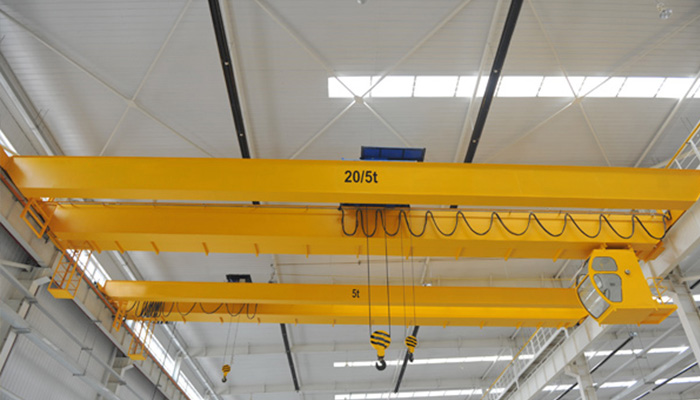
Double girder overhead crane for sale
The Real Challenge: Frequent and Safe Die Changes
Die changes aren’t just about speed—they must also be safe, controlled, and gentle. Each die can weigh several tons and often comes in awkward dimensions, with off-centered load distribution. If handling isn’t precise, it risks damage to the mold, the press, or even the operator.
Manually changing dies, or using outdated crane systems, leads to:
- Increased downtime during each mold switch
- Higher risk of tool damage or operator error
- Difficulty accessing compact storage systems
- Slower production cycles and reduced output
That’s why improving the die-handling process is so critical. It’s not just about productivity—it’s about protecting high-value tools and keeping operations running smoothly.
A Smarter Way: Overhead Cranes with Die Gripper Systems
Many automotive plants are now turning to specialized overhead cranes with die gripper attachments. These aren’t your typical hook-and-sling cranes. Instead, they’re engineered specifically for fast, accurate, and repeatable mold handling.
With built-in automation and precise load positioning, die gripper cranes make mold changeovers much easier, even in tight spaces or multi-layered storage racks.
Key improvements these cranes offer:
- Handle dies with weights up to 60+ tons safely
- Position loads with millimeter-level accuracy
- Eliminate swinging and pendulum movement during transport
- Reduce changeover time between stamping cycles
- Integrate with plant automation systems (like press line software)
These systems are designed to meet the real-world needs of automotive stamping shops—where space is tight, time is short, and downtime is costly.
Importance of Overhead Cranes in Auto Manufacturing
Where Overhead Cranes Fit in the Factory Floor
In an automotive manufacturing plant, overhead cranes aren’t just tools—they’re essential links in the production chain. From raw materials to finished assemblies, these cranes quietly do the heavy lifting that keeps the entire process moving.
You’ll find them at several key points inside the facility:
- Stamping workshops – For lifting and changing heavy molds, moving formed panels, and feeding the press line with steel sheets.
- Assembly lines – Used to position large car body components like chassis, doors, and engines.
- Parts warehouses – For loading and unloading crates, tooling, and pre-assembled components from trucks and storage racks.
- Welding and body shops – For transferring body-in-white (BIW) assemblies between stations.
- Tooling and maintenance areas – Supporting mold repair, inspection, and storage operations.
These areas often operate in tight spaces with high foot traffic, so the cranes must work smoothly and safely above all other activities.
The Need for Speed and Precision
Automotive plants operate with tight schedules and minimal margin for delay. A few minutes of downtime can ripple through the entire line. That’s why speed, accuracy, and consistency in material movement are absolutely vital.
Overhead cranes must meet all of these expectations—day after day, shift after shift:
- Quick die changes between stamping batches
- Smooth, vibration-free movement to prevent part damage
- Accurate placement of molds and components without manual corrections
- Minimal maintenance interruptions for maximum uptime
If a crane system lags or fails, it can bottleneck an entire production area. That’s why the right crane system isn’t just a convenience—it’s a requirement for staying competitive.
How Modern Crane Technology Keeps Up
Older crane systems, with basic hooks and manual controls, can’t handle today’s volume or pace. That’s where modern, process-optimized overhead cranes come in.
Equipped with automation, intelligent positioning, and safety systems, these cranes are engineered for the fast-moving demands of auto manufacturing.
What today’s advanced cranes bring to the table:
- Variable frequency drives (VFDs) for smooth acceleration and deceleration
- Anti-sway and swing control systems for safe load handling
- Precision sensors and feedback systems to maintain positioning accuracy
- Remote or automated operation to integrate with smart factories
- High lifting capacities without sacrificing control or flexibility
These features help plants move more parts, faster, with fewer people and less risk—exactly what modern vehicle production demands.
As automotive manufacturing continues to evolve, so do the cranes that support it. Investing in the right overhead crane system is no longer optional—it’s a foundation for consistent quality and continuous output.
Die Gripper Overhead Cranes
Built for the Job: Cranes Made for Mold and Die Handling
Die gripper overhead cranes are not your average lifting equipment. While standard overhead cranes might be fine for general lifting tasks, handling stamping dies requires something much more refined—and much more stable.
These cranes are purpose-built for lifting, rotating, positioning, and storing large, heavy stamping dies used in automotive production. A single die can weigh up to 60 tons and often needs to be moved multiple times a day during production shifts. That means safety, control, and speed aren’t nice-to-haves—they’re non-negotiable.
Instead of using chains, slings, or hooks, die gripper cranes use specialized gripping devices that hold the dies securely from their base or edges, depending on the mold design. The goal is simple: move the mold without swinging, tilting, or risking damage to the tool or surroundings.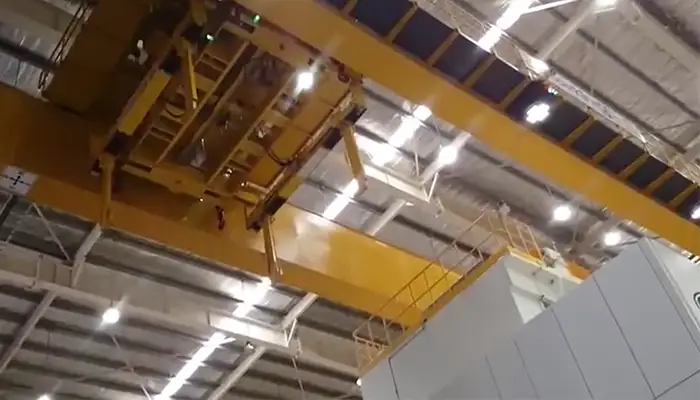
What Makes Them Different from Standard Overhead Cranes?
The main difference lies in how the load is handled and positioned. Die gripper cranes are engineered with added intelligence and structure to address the real-world challenges of mold handling.
Key differences include:
- Mold grippers instead of hooks or slings
Traditional cranes lift loads from above; die gripper cranes secure molds with clamp-style gripping systems that provide firm, controlled support. - Integrated swing control and precise positioning
They’re equipped with sensors and control logic that detect movement and correct it instantly, ensuring stable mold transport. - Balanced load suspension
These cranes are built to handle offset loads caused by uneven die shapes or eccentric centers of gravity—without tipping or stress on components. - Redundant safety systems
Backup sensors and fail-safe logic protect the operator, equipment, and mold from mishandling or collisions. - Automatic rotation and alignment
Some systems include a rotation mechanism in the gripper to position dies precisely before placement into presses or racks.
Benefits on the Workshop Floor
Die gripper overhead cranes make mold handling faster, safer, and more efficient—not just in theory, but in daily practice. In high-output automotive stamping workshops, where time is money and space is limited, their advantages are clear.
Practical benefits include:
- Quick die swaps
Reduce mold changeover times from 30–60 minutes to under 10 minutes in some setups. - Space-efficient storage
Enables compact, multi-layer mold storage systems thanks to precise load positioning. - Minimized risk of damage
Molds are protected during lifting, travel, and placement—reducing tooling repair costs. - Improved safety
Operators stay out of the danger zone, and built-in systems reduce the need for manual intervention. - Lower operational fatigue
With remote control or semi-automation, crane operators don’t need to physically assist or align the mold, improving ergonomics and reducing mistakes.
These cranes are built for one thing: moving molds the right way. In a world where downtime costs thousands per minute, that kind of specialized performance pays for itself.
Core Advantages and Performance Features
Time is everything on a stamping line. A slow die change can delay an entire batch. That's where die gripper overhead cranes excel—they're built for quick and accurate mold handling.
These cranes offer pendulum-free positioning, which means molds are moved with a steady, balanced motion—even over long distances or when the crane needs to rotate. No swinging, no second attempts at alignment.
What this means in practice:
- Die changes are faster — typical changeovers can be cut from 30–60 minutes to just 10–15 minutes
- Less manual alignment needed, thanks to precision gripping and rotation control
- Better use of floor space, enabling multi-level mold storage racks or tight access zones
- Higher productivity — more stamping batches per shift with fewer delays
If your line handles frequent mold changes, this feature alone can improve overall equipment effectiveness (OEE).
These cranes aren't just strong—they're intelligent. Equipped with redundant sensors and programmable logic controllers (PLCs), they monitor every movement, weight change, and position update in real time.
Safety is built into the system. If something goes out of tolerance—like a nearby obstacle or a grip misalignment—the crane automatically slows or stops to prevent accidents.
Smart safety features include:
- Dual-sensor load detection for stable, consistent lifting
- Fail-safe PLCs that manage emergency stops and load diagnostics
- Collision avoidance systems, including laser or barcode scanners
- Safe zone monitoring to ensure molds aren't placed or moved unsafely
- Automatic slowdown in congested or restricted areas
This allows operators to work with confidence, knowing the crane is constantly checking for safe movement—reducing the chance of human error.
Unlike standard cranes, die gripper systems are specifically designed for uneven, heavy, and awkward mold loads. That includes dies with eccentric load centers or non-uniform shapes.
Their modular structure means they can be adapted to your facility layout, mold specs, and even the way your press line is arranged. Whether you're working with 5-ton or 60-ton molds, the system can be scaled to suit your needs.
Custom design features include:
- Offset load center compensation — handles molds with asymmetrical weights
- Wide mold size range — typically from 1,650 mm to 4,850 mm wide, and up to 2,850 mm tall
- Rotary grippers — for precise angular positioning of dies before insertion
- Custom spans and hook paths — to match building layout or storage design
- Compatible with compact racks — maximizing space usage in mold storage rooms
This level of customization makes them ideal for both high-volume OEM production lines and smaller, multi-model stamping setups.
High reliability means fewer breakdowns, fewer service calls, and fewer interruptions to production. These cranes are engineered for high-frequency operation—with duty cycles of up to 2 million lifts. That makes them suitable for facilities that run 24/7 or rotate across multiple shifts.
Maintenance is also designed to be as painless as possible. The wire rope system, often a weak point in older cranes, is optimized to distribute load evenly, reducing wear. Many models also support remote monitoring, so service teams can track usage and schedule inspections before problems occur.
Maintenance-friendly design highlights:
- Rope layout reduces strand wear, extending rope life
- High structural stability, especially under repetitive loading
- Easy access to motors, gearboxes, and sensors for faster servicing
- Remote diagnostics — enables predictive maintenance planning without stopping the line
- Modular spare parts that are easy to replace without custom fabrication
All this adds up to fewer interruptions and lower long-term ownership costs—two things every plant manager wants to hear.
Technical Summary at a Glance
| Type | Attribute |
|---|---|
| Crane classificationEN 13001 U-class(load cycles) | U7 |
| Crane dassification EN 13001 U-class(load collective) | Q5 |
| Hoist classification (FEM/EN) | M7(FEM)A7(EN) |
| Trolley type | 2 coupled open winches |
| Duty cycles gripper | 2million |
| Load capacity on tool gripper | Up to 66t |
| Die dimensions in width | 1.650-4.850mm |
| Die dimensions inheight | 1.200-2.850mm |
| Positioning accuracy | 1.600mm |
| Positioning accuracy of the load rotation angle | +/-10mm at the gripper |
| Span | +/-0.2degrees at the gripper |
| Lifting height,max. | Up to 40m |
| Lifting speed with load | 15m |
| Lifting speed with empty gripper | 12m/min |
| Birdge travel speed | 18m/min |
| Trolley travel speed | Up to 100m/min |
| Trolley power speed | Up to 40 m/min |
| Manual control | Radio/Pendant |
When choosing the right die gripper overhead crane, it’s important to understand what it’s built to handle. Below are the practical working parameters that define how these cranes perform on the factory floor.
Load Capacity and Mold Size Range
These cranes are built to lift and move heavy stamping dies used in automotive production with full stability and control.
- Maximum lifting capacity: Up to 66 tons
- Mold width range: 1,650 mm to 4,850 mm
- Mold height range: 1,200 mm to 2,850 mm
This broad capacity range makes the crane suitable for most automotive mold sizes, whether for small parts or full-body panel dies.
Lifting and Travel Performance
To keep pace with fast die changeovers and high-volume production, the crane’s lifting and travel speeds are tuned for performance without compromising control.
- Maximum lifting height: 40 meters – suitable for tall storage racks or multi-level plants
- Lifting speed (with load): 15 meters per minute – fast enough for quick swaps, slow enough for safety
- Trolley travel speed: Up to 100 meters per minute – reduces time wasted moving between stations
The smooth operation of both the hoist and the trolley ensures stable, sway-free movement even when handling heavy and unbalanced dies.
Control Options
Operators can choose the control method that best suits the task at hand and the working environment.
- Manual control via pendant – ideal for close-range, precision tasks
- Wireless remote control – allows the operator to stand at a safe distance or move along with the crane
These flexible control modes help improve ergonomics, reduce fatigue, and enhance situational awareness—especially in busy or restricted spaces.
This technical profile gives you a clear understanding of the crane’s working range and its ability to handle tough, high-volume die handling jobs in a modern automotive stamping facility.
Why It’s the Right Fit for Your Automotive Plant
A Smart Investment That Pays Off Every Day
If your plant is constantly changing stamping dies, managing tight production schedules, or dealing with mold handling challenges, then a die gripper overhead crane isn’t just a convenience—it’s the solution you’ve been looking for. This system directly addresses the real issues seen in high-output automotive stamping environments.
Here’s how it brings value to your operation:
- Increases production speed
Faster die changeovers mean shorter downtime between batches, helping you maintain high throughput even with multiple model variations on the same line. - Improves workplace safety
With anti-sway technology, remote control, and automated alignment, operators stay out of danger zones while the crane handles the heavy lifting with precision and control. - Reduces damage to tools and equipment
Mold damage from improper handling is costly. These cranes lift and place dies smoothly, reducing wear and tear on high-value tools. - Fits into smart factory systems
Equipped with intelligent controls and sensor feedback, die gripper cranes can be integrated into existing automation platforms, MES systems, or Industry 4.0 initiatives. - Makes better use of space
Their accurate positioning allows for high-density mold storage and more efficient workshop layouts—critical in space-limited stamping halls.
In short, these cranes do more than lift. They improve overall plant performance.
Final Thoughts
Reliable Mold Handling = Reliable Production
Stamping operations are the heartbeat of automotive manufacturing, and if mold handling becomes a bottleneck, everything slows down. Die gripper overhead cranes provide a consistent, safe, and highly efficient way to manage heavy stamping dies—day in and day out.
Let’s recap the core benefits:
- Faster and safer die changes
- Precise load positioning without manual correction
- Custom-fit designs for your plant’s specific requirements
- Built-in diagnostics for smarter maintenance and lower downtime
Whether you’re modernizing an older plant or setting up a new production line, this type of crane system is a long-term asset that improves productivity and reduces risk.
Ready to upgrade your die handling process?
Let our crane experts help you choose or customize the right die gripper overhead crane for your stamping workshop. Contact us today to start the conversation.