Material Handling Overhead Cranes for Military Ammunition Depots
Yuantai Solution
Reliable, explosion-proof cranes designed for safe, efficient ammunition handling—ideal for procurement, engineering, and depot management.
Introduction
Purpose & Scope
Handling ammunition is not like moving regular goods. It’s dangerous, sensitive, and demands accuracy every time.
That’s why specialized overhead cranes or gantry cranes are essential in military ammunition depots. They help move heavy and hazardous loads safely. They also reduce the risk of accidents and ensure smooth operations inside tight and controlled spaces.
These customized matterial handling cranes aren’t off-the-shelf machines. They need to meet military standards. They often include explosion-proof features, precise control systems, and rugged construction to perform in harsh or sensitive environments.
In short, a regular lifting crane won’t cut it here. You need the right one for the job—or you could face serious delays, safety risks, or compliance issues.
Why Specialized Overhead Cranes Are Critical in Ammunition Depots
Ammunition depots are secure, high-risk zones. The material handling cranes used there must match that level of care.
Here’s what makes these cranes so important:
- Safety first – Moving explosive materials is risky. The crane must be stable, reliable, and designed to prevent sparks or drops.
- Precise control – You often need to move small loads, slowly and carefully. A swing or bump can cause damage—or worse.
- Space efficiency – Depots often have low ceilings and narrow aisles. The crane design must fit the layout.
- Long-term reliability – Downtime isn’t an option. Cranes must be built to last and easy to maintain.
Think of it this way: in a depot, the crane is not just a machine—it’s part of the safety system.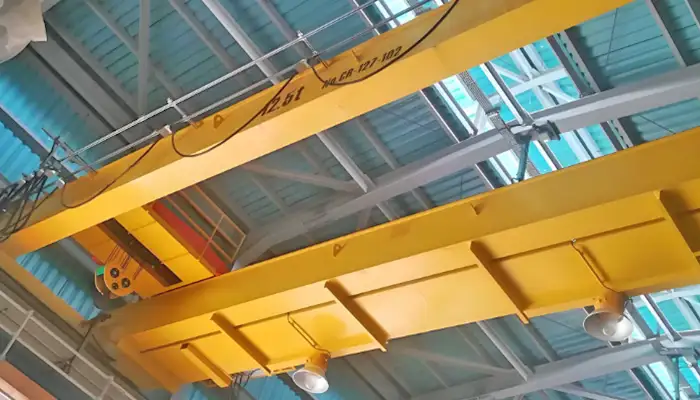
Explosion proof overhead crane with European style design for low headroom workshop to save your space
Overview of Depot Material-Handling Challenges
Moving ammunition isn’t just about lifting and lowering. It comes with real challenges.
- Variety of loads – You’re not just handling one size of shell or missile. Loads vary in weight, shape, and packaging.
- Strict regulations – Military and defense rules must be followed at every step. One mistake could halt operations.
- Limited space – Depots aren’t built like open warehouses. There are barriers, walls, and often reinforced zones.
- Explosion risk – Some areas may be flammable or hazardous. Cranes must be rated accordingly.
- No room for error – These are high-security zones. Every movement matters, and mistakes can be costly.
So, choosing the wrong crane—or ignoring these challenges—can lead to real problems.
This guide is made for decision-makers and technical staff who work with or buy equipment for ammunition depots.
If you’re in one of these roles, this content is for you:
- Procurement Officers / Deputy Managers – Indirect Sourcing
You’re responsible for getting the right equipment, at the right price, with full compliance. - Project Engineers & Maintenance Supervisors
You’ll want cranes that fit into the depot layout, require low upkeep, and work long-term. - Safety & Compliance Managers
You’ll focus on the standards, certifications, and explosion-proof features. The crane must help meet safety goals.
Operational Requirements in Ammunition Depots
Load Characteristics
When handling ammunition, the loads are rarely the same. You might be lifting anything from small arms boxes to heavy artillery shells or missile components.
- Weight range – Loads can be as light as 20 kg or as heavy as several tons. Some pallets hold dozens of rounds.
- Size variation – Items can be long and narrow, round, boxed, or strapped in custom containers.
- Packaging types – Ammunition often comes in steel boxes, wooden crates, or reinforced containers. Some may be shrink-wrapped or strapped for added security.
So, the crane must adapt to different shapes, weights, and securing methods. And it needs attachments—like slings, clamps, or lifting beams—that suit each load type.
Batch vs. Unit Load Handling
Not everything is lifted one by one. Sometimes you move full batches at once, sometimes just a single crate.
- Batch handling – Often used during resupply or transfer between storage areas. The crane should handle full pallets efficiently and safely.
- Unit load handling – Needed for inspection, testing, or when filling transport cases. Precision matters more here.
Good cranes in ammo depots should switch easily between batch and unit lifting, without complex changes or delays.
Environmental & Facility Constraints
Military depots are not all built the same. Some are modern. Some are old and tight. Some are out in remote areas with rough weather.
Indoor Magazine Spaces vs. Covered Storage Yards
- Indoor magazines – Usually have low ceilings, thick concrete walls, and limited crane runway length. The crane needs a compact design and low headroom.
- Covered storage yards – These might have more space, but face weather issues. Outdoor-rated cranes with protection against dust and rain are a must.
Know your site layout well before choosing a crane.
Temperature, Humidity, and Corrosion Considerations
These factors affect crane lifespan and performance more than most realize.
- High humidity or salt air – Can lead to rust and electrical problems if not handled with sealed or coated components.
- Temperature extremes – Both cold and heat affect motors, brakes, and control systems. Cranes should be rated for your region.
- Dust and debris – Some depots are in dry, dusty locations. You’ll want sealed motors and covered electrical systems.
Choosing the right protection level will save time and money later on.
Regulatory & Safety Standards
Military ammunition depots don’t operate like civilian warehouses. The rules are stricter—and for good reason.
MIL-STD Requirements (e.g., MIL-STD-1472, MIL-STD-1273)
These military standards cover everything from ergonomic controls to how ammunition should be lifted and moved.
- MIL-STD-1472 – Focuses on human engineering. Controls should be safe, intuitive, and usable even under stress.
- MIL-STD-1273 – Covers how munitions should be packaged and handled. The crane system must match these packaging methods.
Compliance isn’t optional—it’s a must for approval and operation.
Explosion-Proof and Spark-Free Design Mandates
Ammunition storage areas may contain explosive vapors, powders, or fumes. That’s why standard cranes are not safe here.
- Explosion-proof motors, brakes, and controls – Required in hazardous zones (often classified as Zone 1 or Zone 2).
- Non-sparking materials – Like bronze hooks or copper-plated components, used in high-risk areas.
These features prevent ignition from electrical sparks or static buildup. Safety should come first—always.
Matterial Handling Crane Types & Configurations
Choosing the right crane type depends on what you're lifting, how often, and where. Let’s go through the most suitable options for ammunition depots.
Top-Running Double-Girder Overhead Cranes
This is the heavy-duty workhorse for high-capacity needs. If your depot moves large, dense pallets or bulk loads, this crane is often the go-to.
- Lifting capacity – Commonly handles 10 to 50 tons. Can go higher if needed.
- Strong and stable – Dual girders give better load distribution, minimal sway, and reduced deflection.
- Long spans possible – Ideal for wide bays or storage halls.
- Add-ons supported – Can carry explosion-proof hoists, precise control systems, or even automated handling.
These cranes are perfect for main storage halls with enough ceiling clearance. If you need power and precision, this is it.
Single-Girder Overhead Cranes
These are simpler, lighter, and often cheaper—great for many depot needs.
- For 1 to 15-ton loads – Ideal for crates, boxes, or light pallets.
- Compact and low headroom – Works well in older magazines or small storage buildings.
- Lower maintenance – Fewer moving parts, simple controls, and easier to inspect.
If your depot handles mid-sized loads or has limited ceiling space, a single-girder crane is a smart option.
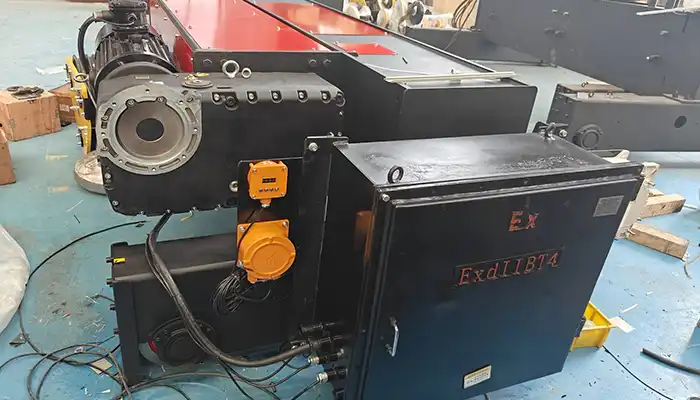
Explosion proof electric wire rope hoist for limited space indoor use
Explosion-Proof Hoists & Trolleys
This is a must-have if you’re operating in areas with explosive materials or flammable vapors.
Zone Classification
Check your depot’s hazard level:
- Zone 1 – High risk. Ignitable vapors likely present during operation. You need full explosion-proof systems here.
- Zone 2 – Lower risk, but still serious. Ignitable vapors may appear under fault conditions. Requires certified spark-proof gear.
Your hoist and trolley setup must match your zone rating. It’s not just about safety—it’s also about legal compliance.
Attachment Comparison
Depending on your load, you might choose different lifting tools:
Electromagnetic lifters
- Fast and efficient for steel-cased ammunition.
- Easy to control, but needs power backup in case of failure.
Mechanical clamp attachments
- Reliable for odd-shaped or non-magnetic loads.
- No risk of power loss. Simple and rugged.
Each has its place. Some depots even use both, depending on the load type.
Key Design Considerations
Choosing a crane is not just about picking a model. You need to think through the working environment, safety needs, and how the crane fits into your depot operations. Let’s break down the core design factors.
Load Capacity & Span
Before anything else, you need to know what you’re lifting—and how far.
- Rated capacity – Always choose a crane that can lift more than your heaviest expected load. Add a safety factor of 10–25%, depending on local or military standards.
- Span – This is the distance between the crane rails. It must match your building or yard layout.
- Lift height – Consider the height needed to clear stacks, equipment, or support beams.
- Runway profile – Check if your structure supports a top-running or under-running system. Also factor in if you'll need runway beams built or if you're using existing support.
If you’re not sure, it’s better to overspec than underspec—especially in a depot where the margin for error is small.
Explosion-Proof Classification
This is one of the most critical parts for ammunition depots. A standard crane won’t pass the safety test here.
Certified Components
- ATEX (Europe) and IECEx (International) standards should guide your selection. Only use hoists, motors, brakes, and enclosures that are certified for explosive zones.
- Components must match the zone classification—Zone 1 or Zone 2, depending on depot hazard levels.
Environmental Protection
- Enclosure types – Look for flameproof housings or pressurized enclosures.
- Temperature classes – Lower surface temperatures reduce the risk of igniting flammable materials.
- IP ratings – Go for IP65 or higher to protect against dust and moisture.
Explosion-proof doesn’t just mean “sealed.” It must meet formal tests and be labeled accordingly.
Control & Automation Features
How the crane is operated affects both safety and efficiency.
Operation Modes
- Pendant control – Simple and direct. Good for small or low-speed lifts.
- Radio remote – Keeps operators at a safe distance, especially in hazard zones.
- PLC-based operation – Offers advanced control, including programmable logic and interlocks.
Smart Features
- Anti-sway control – Helps prevent swinging loads during movement.
- Load monitoring – Tracks weight in real-time. Warns operators if limits are exceeded.
- Programmable limits – Set lift height, travel range, or speed limits based on task or zone.
If your team handles high-value or dangerous loads, these features can make a big difference in daily operation and long-term safety.
Integration with Depot Systems
In modern depots, cranes often don’t work alone. They’re part of a full material flow system.
- Conveyors – Cranes may load/unload from conveyor belts for faster handling.
- AGVs (Automated Guided Vehicles) – Some systems transfer loads from AGVs to cranes with minimal human input.
- RFID tracking – Helps track every pallet or crate by tag. Can be linked to crane position or lift records.
- MES (Manufacturing Execution System) – Integration allows better planning, traceability, and security reporting.
If your depot is upgrading or digitizing, choose a crane system that supports these links.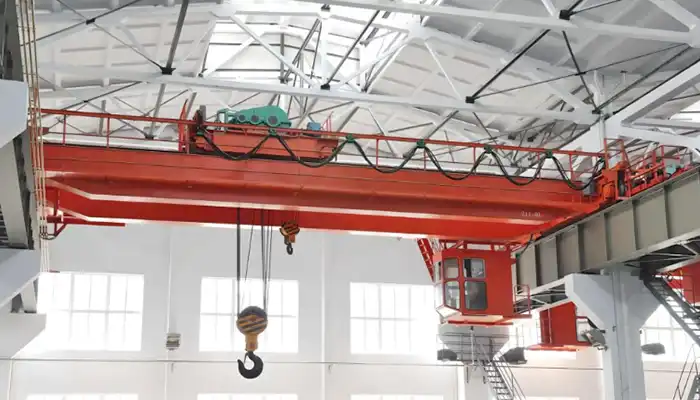
QB series of double girder explosion proof overhead crane with affordable price
Safety, Compliance & Risk Mitigation
In an ammunition depot, safety is not negotiable. Cranes must be built and operated with strict safety standards. Let’s break down what really matters here.
Redundant Safety Devices
Redundancy means backups—and in high-risk zones, that’s essential.
- Overload protection – Prevents the crane from lifting loads that exceed safe capacity. Modern systems cut power automatically when limits are reached.
- Emergency stop (E-stop) – Should be easily reachable from all operator positions. It must stop all motion instantly in case of a fault.
- Limit switches – These prevent over-travel in lifting, lowering, and trolley motion. This protects both the load and crane structure.
Every safety device should be tested regularly. Don't rely on just one layer—stack your protection.
Inspection & Testing Protocols
Routine checks catch problems early. Skip them, and small issues can turn into major failures.
Daily Pre-Use Checks
Done by crane operators or shift supervisors:
- Visual check of hoist, hook, and wire rope
- Control buttons and emergency stop test
- Check for oil leaks, odd sounds, or movement jerks
Takes 5–10 minutes. Saves lives.
Periodic Testing
More detailed and often handled by maintenance staff or certified inspectors:
- NDT (Non-Destructive Testing) – For welds, hooks, and structural elements.
- Load testing – Usually done annually, with a certified test load.
Third-Party Certification
- Helps meet legal and military compliance.
- Required for insurance or audit readiness.
- Must be documented—no exceptions.
Keep detailed inspection records. They protect you legally and help with future maintenance planning.
Operator Training & Procedures
The crane is only as safe as the person running it.
SOPs and Drills
- Depot-specific SOPs – Every depot is different. Make sure crane use follows your exact site’s protocols.
- Emergency drills – What to do if the crane fails mid-lift? If a fire breaks out? Practice these regularly.
- Lockout/tagout (LOTO) – Clear rules on who can power up or down equipment during servicing.
Recertification
- Operators should be trained and recertified on a set schedule—every 1 to 3 years.
- Any change in equipment should trigger a retraining.
Well-trained operators spot problems early and prevent accidents.
Infrastructure & Installation
Even the best crane won’t perform well without proper support. Your depot’s structure, power setup, and install plan all matter just as much as the crane itself.
Runway Beam & Support Structures
Before you install anything, check if your building can handle it.
- Structural analysis – Cranes create both static (resting) and dynamic (moving) loads. Your building must safely support both.
- Steel columns, rafters, and beams may need reinforcement. Don’t guess—get calculations from a qualified engineer.
- Seismic zones – If your depot is in an earthquake-prone area, the crane and runway system must be built to absorb lateral forces. This is critical for avoiding damage or derailment.
Always align crane design with the real conditions of your depot.
Foundation Design
For new buildings or outdoor yards, don’t overlook this step.
- A deep and balanced foundation prevents runway beam settlement, especially for heavy-duty cranes.
- Consider soil type, drainage, and crane wheel pressure. Even a small misalignment here can cause tracking issues.
- Anchor bolts and grouting should follow military or national standards.
Crane misalignment usually starts at the foundation—get it right the first time.
Electrical & Power Supply
Cranes are power-hungry. Make sure your electrical system can handle the load.
- Voltage and phase – Most overhead cranes in depots run on 380–480V, 3-phase power. Check what’s available on-site.
- Cable festoon systems or conductor bars – These supply moving power to the hoist and trolley. Choose the setup that fits your crane type and runway length.
- UPS (Uninterruptible Power Supply) – Optional, but highly recommended. It allows for controlled shutdown during power loss—critical when lifting sensitive or dangerous loads.
Sudden power cuts during lifting operations can be dangerous. A small investment in backup power goes a long way.
Installation Phasing
Depot operations can’t stop just because a crane is being installed. Plan the work in phases.
- Divide work zones – Keep active ammunition areas separate from installation zones.
- Weekend or night shifts – Many depots choose off-peak hours to limit disruption.
- Modular crane kits – Pre-assembled modules help speed up on-site work.
Talk to your crane supplier about minimizing install time without cutting corners.
Coordination with Other Trades
Cranes don’t exist in isolation. Your installation team must work closely with others.
- Fire protection systems – Sprinklers or suppression systems must clear crane movement paths.
- HVAC ducts, lighting, cable trays – These must be positioned to avoid interfering with the crane.
- Safety signage and pathways – Update once the crane is installed.
A coordinated install avoids rework, saves time, and keeps everything compliant.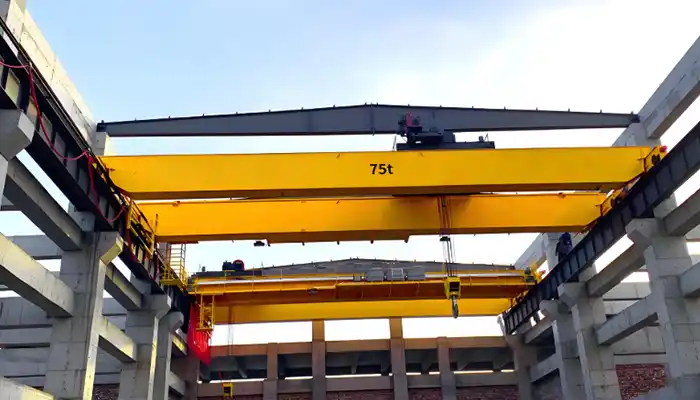
European style open winch explosion proof crane for sale
Maintenance & Lifecycle Management
Cranes in ammunition depots can’t afford breakdowns. Maintenance planning must start from day one—not after problems show up. This section covers how to manage your crane over the long term.
Preventive & Predictive Maintenance
Don’t wait for something to fail. Plan ahead.
Preventive Maintenance (Scheduled)
- Lubrication – Stick to a strict schedule for hoist gears, trolley wheels, and wire ropes. Use depot-approved lubricants.
- Visual checks – Look for cracks, frayed wires, oil leaks, and loose bolts.
- Brake and limit switch testing – Regularly test for wear or drift. These are safety-critical parts.
Simple tasks done regularly will prevent big repairs later.
Predictive Maintenance (Smart Monitoring)
- Vibration monitoring – Helps detect early-stage bearing or motor faults.
- Thermal sensors – Spot overheating in motors, brakes, or control panels.
- IoT-based alerts – Some cranes can now send real-time health updates. A smart hoist can tell you when it needs service—before it breaks.
These features aren’t just for new cranes. Ask your supplier about retrofitting options.
Spare Parts Strategy
Having the right parts on hand is critical—especially for defense-related operations.
What to Stock
- Motors – Keep at least one spare hoisting motor if downtime is critical.
- Brakes – Friction pads wear out fast in depot environments. Stock replacements.
- Control units – PLCs, pendant stations, and relays should be part of your critical spares kit.
Stocking Strategy
- On-site stocking – Ideal for remote depots or high-uptime needs.
- Consignment programs – Some suppliers offer parts stocking on your site but bill only when used.
- Lead-time reduction – Work with suppliers who can provide short delivery windows for emergency parts.
Delays in sourcing parts can leave your crane idle—and your operations stuck.
Upgrades & Future Expansion
Your crane should grow with your depot’s needs. Plan for flexibility.
Modular Upgrades
- Swap-out hoists – You can replace a 10-ton hoist with a 15-ton one if your girder is rated high enough.
- Bridge extensions – Some systems allow you to increase span or hook coverage later.
Make sure your crane frame and runway were designed with future needs in mind.
Automation Add-ons
Add features like:
- Anti-sway systems
- Auto-positioning
- Remote operation
- MES/RFID integration
Planning for upgrades at the beginning makes them cheaper and smoother to implement later.
A good crane is a long-term asset—but only if it’s maintained and upgraded with care. Build your service plan, stock your spares, and think ahead. That’s how you make sure your depot stays ready—year after year.
Next Steps & Buyer’s Checklist
Ready to buy your material handling overhead crane? Follow this checklist to stay on track and avoid surprises.
Define Operational Needs
- What loads will you lift? (Weight, size, packaging)
- How often will the crane run? (Duty cycle)
- What are your environmental conditions? (Indoor/outdoor, temperature, humidity)
- Are there special safety or explosion-proof requirements?
Clear answers here shape the right crane specs.
Engage Certified Suppliers
- Look for manufacturers with CE, ISO, and MIL-STD certifications.
- Verify their experience with ammunition depot cranes.
- Ask for references or case studies in similar environments.
Working with certified, proven suppliers reduces risk.
Request Detailed RFQ (Request for Quotation)
Make sure your RFQ includes:
- Load data sheets — Detailed weights and handling requirements.
- Zone and classification requirements — Explosion-proof zones, safety classifications.
- Layout drawings — Building plans, runway beam info, and installation constraints.
The more details you provide, the more accurate your quotes and solutions.
Plan Site Survey & Factory Acceptance Testing (FAT)
- Schedule a site survey with the supplier’s engineers before manufacturing.
- Arrange Factory Acceptance Testing to inspect and test the crane before shipment.
These steps prevent costly changes after delivery.
Schedule Training & Handover Protocols
- Arrange operator and maintenance training well before commissioning.
- Confirm handover documents include manuals, test reports, and spare parts lists.
- Set a clear maintenance schedule and emergency contact for support.
Proper training and clear handover mean your team can run the crane safely and efficiently from day one.