
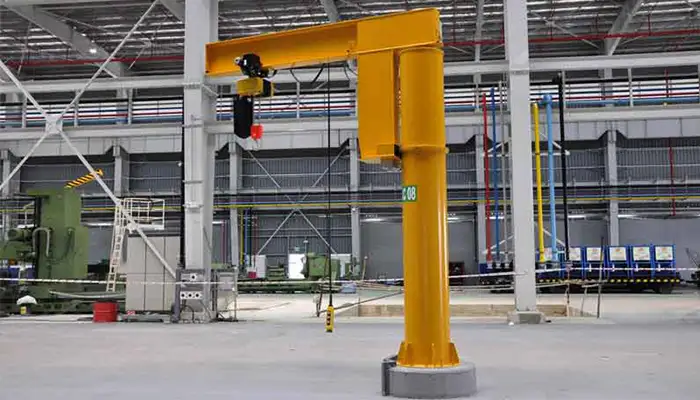
Yuantai Crane for Better Solutions:
Energy-Saving | Space-Saving | Cost-Efficient | CE/ISO/EX
1 ton jib crane for sale. All on 1 ton jib cranes—types, specifications, pricing, installation & maintenance—to choose the best rotating lifting solution.
1 Ton Jib Crane
| Product Type: | Jib Crane |
|---|---|
| Lifting Capacity: | 1 Ton |
| Span: | As your request |
| Lifting Height: | As your request |
| Working Class: | A3-A5 |
| Ambient Temperature: | -20-+40 ℃ |
| Crane Price Rangs | More Inquiry Form |
| $1,000 – $3,500 | |
| [email protected] 008615038346929 | |
1 ton jib crane for sale. All on 1 ton jib cranes—types, specifications, pricing, installation & maintenance—to choose the best rotating lifting solution.
Introduction: Why Choose a 1 Ton Jib Crane?
What Is a Jib Crane? A jib crane is a simple but highly useful lifting device designed for handling loads within a fixed area. Unlike overhead cranes that cover an entire workshop, a jib crane has a horizontal arm (called the jib or boom) that supports a hoist for lifting and moving materials. It’s usually mounted on a wall, column, or a floor stand, making it compact and easy to install in limited spaces.
Why 1 Ton Capacity Is So Popular
When buyers search for jib cranes, the 1 ton model is often at the top of the list. Why? Because it fits a sweet spot between light-duty and heavy-duty lifting needs. It’s strong enough to handle most common workshop loads, yet small enough to be installed without major structural changes.
- Balanced Capacity: A 1 ton rating covers a wide range of lifting jobs without overbuilding.
- Compact Size: Easier to fit in small and medium facilities than large cranes.
- Lower Cost: More affordable compared to higher-capacity cranes, both in purchase and installation.
Typical Applications of a 1 Ton Jib Crane
You’ll often find 1 ton jib cranes in workplaces where localized lifting is needed but installing a large crane system isn’t practical. They are the go-to solution for many small to mid-scale operations.
- Workshops & Maintenance Bays – Lifting engines, tools, or spare parts.
- Warehouses & Logistics – Loading and unloading pallets, drums, or small machinery.
- Assembly Lines – Moving components from one workstation to another.
- Garages & Service Shops – Handling car parts, gearboxes, or tire sets.
- Small Factories – Assisting in production or packaging areas where items weigh less than 1 ton.
Key Benefits of a 1 Ton Jib Crane
The advantages of installing a 1 ton jib crane are very straightforward. They provide lifting power exactly where you need it, without the high cost or space requirements of larger crane systems.
- Localized Lifting: Perfect for work zones where overhead cranes can’t reach.
- Cost-Effective: Affordable purchase price, low installation requirements, and reduced operating costs.
- Flexible Installation: Can be floor-mounted, wall-mounted, or even mobile depending on your workspace.
- Easy Operation: Simple controls, minimal training, and fast setup for workers.
Types of 1 Ton Jib Cranes for Sale
Not all workspaces are the same, and that’s why 1 ton jib cranes come in several different designs. Each type is built to suit a certain layout, lifting requirement, or style of operation. Below are the most common types, along with their practical uses, benefits, and possible limitations.
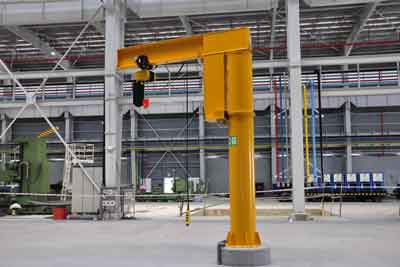
A free standing jib crane is mounted directly on the floor and supported by its own foundation. This design gives it full independence from the building structure, making it suitable for almost any type of workshop.
- Ideal Use Case: Open areas in factories, assembly lines, or loading zones where you need full rotation and no wall support is available.
- Advantages:Offers 360° rotation for maximum coverage.Strong and stable, designed for long-term heavy use.
- Limitations:Requires a solid concrete foundation.Takes up valuable floor space.
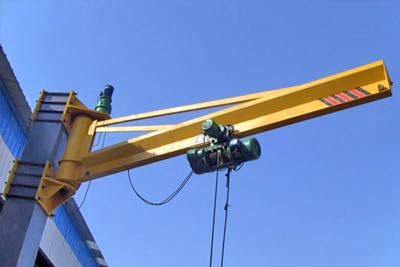
This crane is attached to an existing wall or building column. Since it doesn't need a floor foundation, it's a smart option where space is limited.
- Ideal Use Case: Workshops and warehouses with strong walls or columns where floor space needs to stay clear.
- Advantages:Saves valuable floor area.Lower installation cost compared to free standing models.
- Limitations:Rotation angle is limited (usually 180°).Requires a strong building structure for safe mounting.
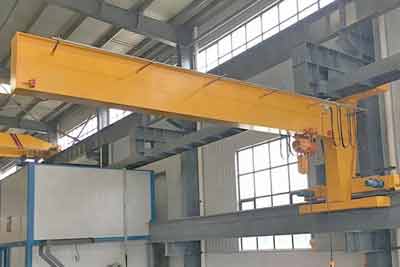
Wall Travelling Jib Crane 1 Ton
A wall travelling jib crane runs along a rail system fixed to a wall or structure. Instead of being limited to a single point, it can move along the length of the wall.
- Ideal Use Case: Long production lines or workshops where loads need to be moved between multiple stations.
- Advantages:Provides coverage along an extended working area.Efficient for repetitive tasks along a line.
- Limitations:Installation requires additional rail systems.More complex and expensive setup compared to fixed jib cranes.
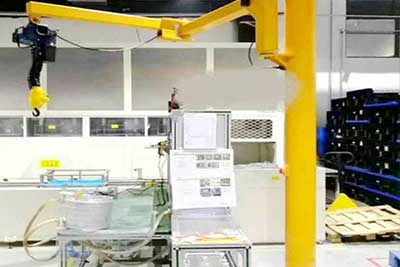
This type features a two-part arm (inner and outer boom) that allows loads to move around corners and reach into tight spots.
- Ideal Use Case: Workstations with obstructions or where loads need precise positioning.
- Advantages:Excellent maneuverability in confined areas.Can reach around columns, machinery, or other obstacles.
- Limitations:More complex design compared to standard jib cranes.Typically has a smaller working radius than straight-arm models.
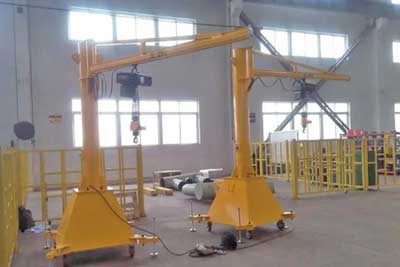
Portable / Mobile Jib Crane 1 Ton
Portable jib cranes are mounted on a wheeled base or lightweight frame, making them easy to move around the workshop.
- Ideal Use Case: Temporary lifting jobs, maintenance work, or situations where loads need to be handled in multiple locations.
- Advantages:Flexible and can be moved anywhere.No permanent installation required.
- Limitations:Lower lifting height compared to fixed cranes.Stability depends on floor conditions and wheel locks.
Comparison at a Glance
| Type | Rotation | Installation Needs | Best For | Space Requirement | Mobility |
|---|---|---|---|---|---|
| Free Standing | 360° | Foundation required | Open spaces, heavy use | High | Fixed |
| Wall Mounted | 180° | Strong wall/column | Saving floor space | Low | Fixed |
| Wall Travelling | 180° | Rail + wall support | Production lines | Medium | Fixed |
| Articulating | Varies | Standard or wall/floor | Tight spaces, precise work | Medium | Fixed |
| Balance | Manual | Minimal | Frequent small adjustments | Low | Fixed |
| Portable / Mobile | 360° | None, wheel locks required | Temporary tasks, multiple spots | Low | Mobile |
Technical Specifications of a 1 Ton Jib Crane
When comparing 1 ton jib cranes, looking at the technical details is essential. These numbers tell you how far the crane can reach, how high it can lift, and how easily it can be operated in your workspace. Below is a quick reference table, followed by simple explanations of each key term.
Specification Table
| Parameter | Range / Option | Notes |
|---|---|---|
| Capacity | 1 Ton | Rated lifting weight (maximum load) |
| Boom Length | 2m – 6m (customizable) | Determines how far the crane can reach |
| Rotation Angle | 180° – 360° | Depends on mounting type (wall vs free-standing) |
| Lifting Height | 2m – 6m (standard) | Customizable to fit building height |
| Control Mode | Manual / Electric | Pendant control or wireless remote options |
| Power Supply | 220V / 380V / 415V | Standard AC supply, varies by country |
How to Choose the Right 1 Ton Jib Crane
Choosing the right jib crane is not just about capacity. The design, installation method, and operating environment all affect how well the crane will perform in daily use. Below are the main factors to think about before making your decision.
- Boom Length: This is the horizontal arm of the jib crane. A longer boom lets you reach further into your work area, but it also requires stronger support. For small workshops, a 2–3 meter boom is usually enough. Larger warehouses may choose 5–6 meters to cover more ground.
- Rotation Angle: This refers to how far the jib arm can swing. Wall-mounted cranes are usually limited to 180 degrees, since the wall blocks a full rotation. Free-standing cranes, on the other hand, can rotate up to 360 degrees, giving full coverage around the base.
- Lifting Height: This is how high the hoist can raise a load. Standard ranges are 2–6 meters, but it can be customized depending on the building’s ceiling height. If you’re installing in a low workshop or garage, you’ll likely need a shorter lifting height, while factories with tall structures often go higher.
- Control Mode: Control can be as simple as manual pushing for light, short movements, or as convenient as electric operation with a pendant button or wireless remote. Manual controls are cheaper and low-maintenance, while electric controls improve efficiency, especially if the crane is used many times a day.
The first thing to check is where the crane will be installed. Some cranes need a strong floor foundation, while others make use of walls or existing columns.
- Floor-Mounted (Free Standing): Best if you have open space and want full 360° rotation. Keep in mind that a concrete foundation may be required.
- Wall-Mounted: Good for saving floor space. This type depends on a strong building structure for safe mounting, and rotation is usually limited to 180°.
- Ceiling Height and Floor Strength: Taller ceilings allow greater lifting height. If the floor is weak or thin, wall-mounted cranes are often a safer option.
Think about how the crane will be used day to day. A jib crane designed for indoor production may not work well outdoors without special protection.
- Indoor Use: Standard steel designs with electric hoists are common for workshops, assembly lines, and warehouses.
- Outdoor Use: Consider weather protection, corrosion-resistant materials, or stainless steel for long-term durability.
- Fixed vs Mobile: Fixed cranes (floor- or wall-mounted) are stable and reliable for repetitive tasks in one spot. Portable cranes give flexibility, but usually with lower lifting height and limited stability.
It's easy to focus on the purchase price, but the total cost includes installation, power supply setup, and long-term maintenance.
- Initial Investment: Wall-mounted cranes tend to be the most cost-friendly. Free standing cranes are more expensive due to the foundation work.
- Installation Costs: Rail systems or articulating arms add to upfront costs. Simple designs are quicker and cheaper to install.
- Maintenance and Longevity: Electric cranes require regular checks and servicing. Manual or balance jib cranes are cheaper to maintain but less efficient for frequent lifting.
1 Ton Jib Crane Price – What to Expect
Price is one of the first questions buyers ask when looking for a 1 ton jib crane. The answer is not always simple because the cost depends on several design choices and site conditions. Below we break it down so you know what to expect before requesting a detailed quote.
Pricing Factors
The base price of a jib crane can change significantly depending on specifications and installation needs.
- Capacity: While all the cranes here are rated at 1 ton, additional safety factors or heavy-duty components may increase cost.
- Boom Length: Longer booms (5–6 meters) require stronger materials and more counter-support compared to short arms.
- Power System: Manual cranes are cheaper, while electric hoists and remote controls add to the price.
- Mounting Type: Wall-mounted cranes are generally more affordable; free standing cranes require a reinforced foundation, which raises the cost.
- Installation Complexity: Simple bolt-on wall cranes are cheaper to install. Foundation work, rail systems, or articulating arms add labor and material costs.
- Customization: Options like stainless steel (for food plants), explosion-proof (for chemical sites), or special coatings for outdoor use all increase the price.
Typical Price Range
As a general guideline, a 1 ton jib crane usually falls in the range of $1,500 – $6,000, depending on type and features.
- Wall-Mounted: around $1,500 – $3,000.
- Free Standing: around $3,000 – $6,000, mainly due to foundation work.
- Portable or Balance Jib: often on the lower end, but with limited height and features.
- Articulating or Customized Models: usually higher due to added complexity.
Why Request a Quote
Prices listed above are only estimates. The final cost depends on your exact requirements and site conditions.
- Shipping: Freight can vary widely depending on destination, especially for overseas buyers.
- Installation: Local construction and labor rates may add significantly to total cost.
- Special Features: Explosion-proof motors, stainless steel builds, or unusual spans require custom pricing.
That’s why suppliers will almost always ask for details such as span, lifting height, power supply, and installation site before giving a final number. A proper quote ensures you get accurate pricing and avoid hidden costs later.
Installation & Foundation Requirements
Installing a 1 ton jib crane properly is just as important as choosing the right type. A poorly installed crane can be unsafe, cause structural damage, or reduce the crane's lifespan. The installation method depends on the type of crane and the workspace conditions.
These cranes stand on their own foundation and require a strong, level concrete base. Proper preparation ensures stability and safety during lifting operations.
- Anchor Bolts: Heavy-duty anchor bolts secure the crane to the concrete. Placement must match the crane's base design.
- Concrete Thickness: Usually 200–300mm of reinforced concrete is required, depending on the floor load and crane design.
- Reinforcement: Steel rebar is often needed inside the concrete to prevent cracking under repeated loads.
- Tip: Always check the floor load rating and consult an engineer if in doubt.
Wall-mounted cranes rely on a building column or wall for support. The strength of the structure is crucial to prevent bending or failure.
- Structural Strength: Ensure walls or columns can support both the crane's weight and the lifted load.
- Attachment Hardware: Bolts, brackets, or plates must match the crane's mounting design.
- Considerations: Rotation angle is often limited to 180° because of wall interference.
Wall travelling cranes move along rails attached to a wall or structure. Proper installation ensures smooth movement and long-term reliability.
- Rail / Track Installation: Rails must be straight, level, and securely fastened to the wall or columns.
- Space Requirements: Allow enough clearance for the crane to move without obstruction and for workers to operate safely.
- Support Checks: Verify that walls or columns along the rail can handle the cumulative load of the crane and moving materials.
Maintenance & Safety
Keeping a 1 ton jib crane in good working condition is essential for safety, efficiency, and long-term performance. Regular maintenance prevents unexpected downtime and ensures the crane can handle loads safely.
Daily Checks
A few minutes of inspection at the start of each shift can save serious trouble later.
- Hook Condition: Look for cracks, deformation, or excessive wear. Replace immediately if damaged.
- Hoist Rope or Chain: Check for fraying, kinks, broken links, or signs of rust.
- Electrical Controls: Test pendant buttons, switches, and emergency stops to make sure everything works properly.
- Observation: Listen for unusual noises during operation, which can indicate mechanical issues.
Monthly / Annual Inspection
More detailed inspections should be performed by a trained technician. These ensure the crane remains reliable under regular use.
- Lubrication: Apply grease to rotating parts, bearings, and wire ropes where required.
- Structural Inspection: Check welds, bolts, and the crane frame for cracks, corrosion, or loose connections.
- Motor and Gearbox: Inspect for overheating, unusual sounds, or oil leaks. Replace worn components before failure.
- Documentation: Keep a maintenance log to track repairs and inspections, which is helpful for safety compliance and warranty purposes.
Safety Standards
Using a crane that meets recognized safety standards helps protect workers and ensures legal compliance.
- OSHA: Safety rules for operation in workplaces in the United States.
- ISO: International standards for design, performance, and quality.
- CE Compliance: Required for cranes used in European markets; indicates conformity with EU safety regulations.
- Tip: Always follow the manufacturer’s instructions and train workers on proper lifting procedures.
FAQs: Common Buyer Questions
Buying a 1 ton jib crane can raise several practical questions. Here are the answers to some of the most common ones to help you make an informed decision.
- Free-Standing Jib Crane: Mounted on a floor foundation, it can rotate 360° and cover a larger area. Requires space and a reinforced concrete base.
- Wall-Mounted Jib Crane: Fixed to a wall or column, typically rotates 180°, saving floor space. Ideal for small workshops or areas where floor space is limited.
- Daily Checks: Hook, rope/chain, and controls should be checked every day before operation.
- Monthly / Annual Inspections: More thorough inspections by trained technicians should happen monthly or annually, depending on usage and safety regulations. Keeping a maintenance log is strongly recommended.
- Manual Operation: Some cranes are purely manual, which is simple and low-maintenance.
- Electric Operation: Most modern 1 ton jib cranes use AC motors powered by 220V, 380V, or 415V, depending on the region. Controls can be pendant or wireless.
- Tip: Choose the power type based on how frequently the crane will be used and how heavy the loads are.
- Wall-Mounted Cranes: Usually 1–2 days, depending on wall strength and preparation.
- Floor-Mounted Cranes: May take 3–5 days if a concrete foundation is needed.
- Rail-Mounted Cranes: Installation can take longer because of rail setup and alignment.
- Tip: Always allow extra time for safety checks and adjustments.
Yes. Custom options include:
- Stainless Steel: Ideal for food, pharmaceutical, or chemical environments.
- Explosion-Proof / ATEX: For hazardous locations with flammable gases or dust.
- Customized Boom Length, Lifting Height, or Rotation: Tailored to fit your workspace and workflow.
Tip: Discuss your exact requirements with the supplier to ensure safe and compliant design.
Choosing the right supplier ensures your crane is safe, reliable, and long-lasting. Here's why we stand out:
- Global Experience – Exported to 120+ countries, we understand diverse operational and installation needs.
- International Standards – ISO, CE, and SGS certified for quality and safety.
- Customization – Adjustable span, lifting height, power supply, and options like stainless steel or explosion-proof designs.
- After-Sales Support – Guidance on installation, maintenance tips, and fast access to spare parts and repairs.
Send us An Inquiry
Ready to find the perfect 1 ton jib crane for your workspace? Take the next step today:
- Request a Free Quote Today – Get pricing and specifications tailored to your needs.
- Contact Us for Custom Solutions – We’ll help design a crane to match your space, workflow, and safety requirements.
Product Detail
Support

5 Ton Jib Crane
Explore 5 Ton Jib Cranes for sale, including price, specifications, types, and customization options for workshops and industrial use. Read More
3 Ton Jib Crane
3 ton jib crane for sale. 3 ton jib cranes with wall mounted jib crane & freestanding column mounted jib cranes for sale, with standard & custom options. Read More
2 Ton Jib Crane
2 ton jib crane for sale. Check 2 ton wall & floor jib cranes for lifting, space efficiency, rotation range, installation, & workshop workflow suitability. Read More
1 Ton Jib Crane
1 ton jib crane for sale. All on 1 ton jib cranes—types, specifications, pricing, installation & maintenance—to choose the best rotating lifting solution. Read More
1 Ton Wall-Mounted Jib Crane for Sale in Cyprus
Buy a 1-ton wall-mounted jib crane in Cyprus with BX electric chain hoist, 8.8m lifting height, and optional accessories for workshops and light industrial use. Read More
5 Ton Jib Crane with Chain Hoist – Maldives Project
Discover our 5-ton jib crane with BZ chain hoist project in the Maldives. Reliable, corrosion-resistant, and versatile for floor, rotary, and cantilever jib cranes. Read More
Case- 6 Sets of Floor Jib Crane 4 Ton for Sale, Good Price
Compact 4-ton floor-mounted jib cranes, ideal for limited indoor spaces. Durable, efficient, and ready for immediate use. Read More
5 Ton Pillar Mounted Jib Cranes for Dam Maintenance
Customized 5-ton pillar jib cranes support efficient, safe dam maintenance with high lifting capacity and 360° rotation for accessibility. Read More
2-Ton Pillar Mounted Jib Cranes for Maritime Applications in Belgium
Custom 2-ton pillar-mounted jib cranes in Belgium designed for maritime applications, offering durability, corrosion resistance, and efficient load handling. Read More
Floor Jib Crane 10 Ton for Sale, Good Price Jib Crane Factory
10 ton floor jib crane for sale good price. 30 + years jib crane factory in China, customized floor jib crane design for Sudan factory. Check jib crane now. Read More