Explosion-Proof 50-Ton Overhead Cranes for Petrochemical Plants
Safe Lifting for Hazardous Operations, in Jazan, Saudi Arabia
Safe overhead crane designed for hazardous zones in Jazan's petrochemical industry, handling heavy equipment with certified explosion-proof features.
Introduction
Jazan, located on Saudi Arabia’s southwestern Red Sea coast, is becoming a major center for the country’s downstream oil and gas operations. With the launch of the Jazan Refinery Complex and associated petrochemical infrastructure, the region is expected to handle large-scale hydrocarbon processing, storage, and export. This growth brings an increased need for reliable and safe material handling systems across refineries, gas processing units, and utility plants.
One of the biggest concerns in petrochemical environments is safety—especially when it comes to lifting operations around flammable gases and vapor zones. This is where explosion-proof overhead cranes come in. These cranes are not just optional; in many areas of a refinery, they’re required by law and industry standards.
Among the various capacities available, 50-ton explosion-proof overhead cranes are widely used across workshops and process buildings in Jazan’s petrochemical sector. Why? Because they hit a practical balance: strong enough to handle heavy pumps, compressors, and skid units—but still adaptable enough to fit within the size and layout of most refinery buildings.
Here’s why this size and type of crane makes sense in Jazan’s petrochemical environment:
- Fits typical load profiles: Many modular refinery units, such as large pumps, motor-driven valves, or heat exchangers, fall within the 30 to 40-ton range. A 50-ton crane gives enough margin.
- Good for maintenance and shutdown work: Maintenance workshops often need to lift full assemblies for repair or replacement. A 50-ton crane covers most of these needs without overkill.
- Suitable for high-duty operation: Rated for heavy usage (often M6 or M7 duty class), they can work multiple shifts daily in hot, dusty, and potentially explosive conditions.
If you're operating or building a facility in Jazan, selecting the right explosion-proof crane early in the design phase is essential—not only to meet safety regulations but also to keep your operation running without costly delays.
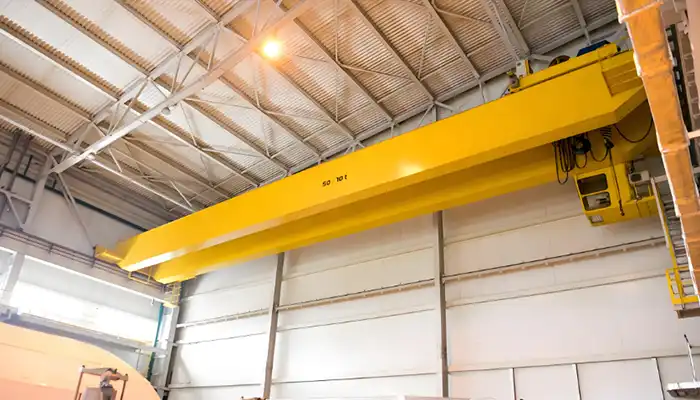
double girder overhead crane 50 ton for explosion proof design
Where and Why 50-Ton Explosion-Proof Cranes Are Used in Petrochemical Plants
In Jazan’s petrochemical facilities—especially modular refineries and gas processing units—overhead cranes play a key role in both daily operations and scheduled maintenance. Among these, 50-ton explosion-proof cranes are some of the most widely installed.
They are not oversized for the building, yet strong enough to handle the majority of process equipment used in hydrocarbon production. Whether lifting large components during plant installation or removing a skid unit for repair during a shutdown, this capacity range covers a wide spectrum of heavy-lift scenarios safely and efficiently.
Typical Loads Lifted
In a typical refinery or gas unit, the following equipment often requires overhead lifting, especially during maintenance or installation phases:
- Pumps and compressors: These are essential parts of any process line. Cranes help with initial placement and later maintenance.
- Skid-mounted process units: These compact, prefabricated modules may include filtration, separation, or blending systems—often weighing 20 to 45 tons each.
- Heat exchangers and pressure vessels: These are bulky and sensitive to misalignment; lifting must be controlled and smooth.
- Valve manifolds and motor-driven equipment: These components are dense, often packed into confined spaces, and need careful handling during lifts to avoid damage or leaks.
Why 50 Tons Is the Preferred Capacity
This crane size hits a “sweet spot” for most petrochemical facilities in Jazan. It’s not too big to overburden the building structure, but strong enough to handle almost any core equipment.
- Versatile enough for heavy equipment: Covers the lifting range for over 80% of refinery mechanical components, from major pumps to process skids.
- Matches common module sizes: Many prefabricated modules—especially utility or auxiliary systems—are designed to weigh under 50 tons to ease transportation and lifting during site installation.
- Balances load needs with structural limits: A 50-ton double girder EOT crane can be installed in workshops or process buildings without needing major foundation or column reinforcement, keeping construction costs under control.
So, for plant managers or project engineers planning crane installations in Jazan’s petrochemical sector, the 50-ton capacity is often not just suitable—it’s practical. It meets current needs, allows for safe operation in hazardous environments, and leaves room for growth without overcomplicating the building design.
Explosion-Proof Design Requirements for Hazardous Zones
In petrochemical plants like those in Jazan, lifting operations often take place in environments where flammable gases, vapors, or dust are present. These areas are classified as hazardous zones, and cranes used in such locations must be built to strict explosion-proof standards.
Zone Classifications: What They Mean
The classification of hazardous areas helps determine what level of explosion protection is needed. In most petrochemical facilities:
- Zone 1: An area where explosive gas atmospheres are likely to occur during normal operation.
- Zone 2: An area where explosive gases are not likely to occur in normal operation, but may appear for short periods.
Cranes installed in either zone must prevent any electrical or mechanical spark from igniting a flammable atmosphere.
Applicable Standards
To ensure safety and compliance, explosion-proof cranes must meet international and local regulations:
- ATEX (EU standard): Required for equipment operating in explosive atmospheres within the European Union.
- IECEx (International Electrotechnical Commission System for Certification): A global standard for explosive environments.
- Saudi Aramco Engineering Standards (SAES): Specifically outline explosion-proof requirements for facilities under Aramco’s control or influence, including refineries in Jazan.
Meeting these standards ensures the crane’s electrical and mechanical components are properly sealed, certified, and built to avoid ignition sources.
Critical Explosion-Proof Components
A crane isn’t truly explosion-proof unless each component in contact with the hazardous environment is designed to contain or prevent sparks. Some of the most important parts include:
Flameproof hoisting motors
- Specially enclosed motors prevent internal sparks from escaping into the environment.
- Rated for continuous operation in gas-prone zones.
Sealed control panels with spark prevention
- All wiring and controls are placed inside explosion-proof enclosures.
- Buttons, switches, and remote controls are designed to prevent static or arcing.
Stainless steel or bronze-coated hooks
- These materials reduce the risk of friction sparks during contact with hard surfaces.
- They’re also corrosion-resistant, which is essential in coastal areas like Jazan.
Antistatic trolleys and cable systems
- Prevent electrostatic buildup as the crane moves across rails or beams.
- Ensure safe operation even with long duty cycles.
In short, every explosion-proof crane installed in Jazan’s petrochemical facilities must be engineered from the ground up to handle the risks of the environment. From the hoist motor to the pendant control, safety features must be certified, tested, and appropriate for the zone classification. It's not just about lifting heavy loads—it's about doing it without ever risking a spark.
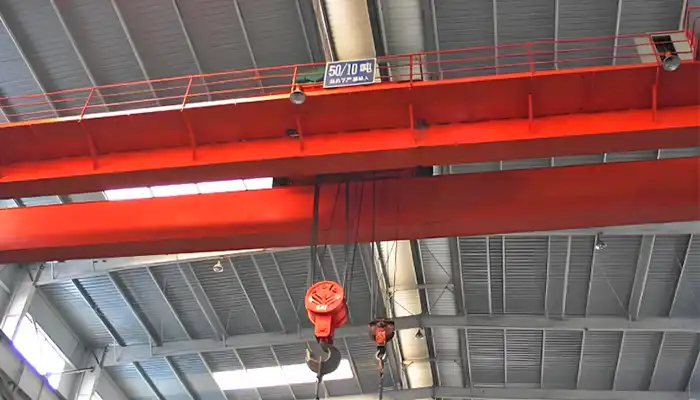
50/10 Ton Explosion-Proof Overhead Cranes
Main Features of 50-Ton Explosion-Proof Overhead Cranes
In a high-risk environment like a petrochemical plant, the crane you use must be more than strong—it must be reliable, safe, and fully compatible with hazardous zone operations. The 50-ton explosion-proof overhead crane is designed to meet these demands with a combination of sturdy construction, precision control, and certified safety features.
Configuration: Built for Heavy-Duty, High-Clearance Work
- Double girder, top-running design: This setup is ideal for handling large, heavy loads while maintaining stability across long spans. It also provides better headroom and lifting height, which is crucial in buildings where space is tight around piping, cable trays, or HVAC ducts.
Lifting Mechanism: Safe and Smooth Hoisting
- Explosion-proof wire rope hoist with dual-speed inverter: The wire rope hoist is enclosed in a flameproof casing, making it safe for use in Zone 1 or Zone 2 environments.
Dual-speed control allows operators to move heavy equipment with both speed and precision—fast for approach, slow for placement.
Control Options: Adaptable to Site Needs
Depending on how the crane is used, there are several safe and ergonomic control choices:
- Pendant control — hardwired and built with sealed pushbuttons in a flameproof housing.
- Wireless remote control — allows operation from a safe distance. Ideal for areas with limited access.
- Cabin control — enclosed and sealed operator cabins can be included for long-span or outdoor setups.
Safety Systems: Protect Equipment and Operators
Every 50-ton crane must include core safety components to prevent accidents and damage:
Overload limiter
- Prevents the crane from lifting loads beyond its rated capacity.
- Alerts the operator and shuts down hoisting when limits are exceeded.
Redundant brake systems
- Ensures a secondary braking system is available in case the primary brake fails.
- Especially important for heavy lifts in critical areas like reactor units.
Emergency stop circuits
- Allows for immediate shutdown of crane motion during unexpected events.
- All emergency stops are explosion-proof and compliant with hazardous zone standards.
Optional Features: Boosting Safety and Efficiency
Depending on your plant’s layout and lifting tasks, additional features can further improve crane performance:
Anti-sway control
- Uses sensors and logic to reduce load swing during trolley or bridge travel.
- Improves placement accuracy and reduces time spent realigning loads.
Flameproof lighting for the working area
- Integrated lighting helps operators see hook positions and load points clearly in dimly lit workshops or night shifts.
Load display with memory function
- Digital readouts show real-time load weight.
- Can log recent lifts for maintenance tracking or safety reporting.
Altogether, these features make the 50-ton explosion-proof overhead crane a dependable workhorse for Jazan’s petrochemical sector—especially in workshops where large equipment must be moved with both power and care, and where the slightest spark can’t be risked.
Material and Environmental Considerations for Jazan
Jazan’s industrial zones lie along the Red Sea coast—a location that brings unique environmental challenges for equipment like overhead cranes. High humidity, salty air, fine dust, and extreme heat can all affect the crane’s durability, electrical safety, and mechanical performance over time. That’s why proper material selection and protective features are not optional—they’re essential.
Coastal Location: Humidity, Salt, and Corrosion Risks
The Red Sea coastline exposes cranes to salt-laden air and high moisture levels year-round. If not properly protected, metal parts can rust, control systems can short-circuit, and mechanical wear will accelerate—especially in outdoor or partially enclosed areas of a refinery.
Recommended Protection Measures
To extend the life of your crane and reduce maintenance costs, the following protective features should be part of any explosion-proof crane installed in Jazan:
C5M anti-corrosion coatings
- This is a marine-grade coating system designed to protect steel structures in highly corrosive coastal and chemical environments.
- It prevents surface rust, paint blistering, and metal degradation over time.
Galvanized or stainless steel components
- Hooks, fasteners, cable guides, and rails should be made from or coated with corrosion-resistant materials.
- Stainless steel is especially useful in crane components exposed to constant salt air or chemical vapors.
Dust- and moisture-sealed control cabinets
- Electrical panels and control boxes should have IP65 or higher protection.
- Internal parts must be sealed against fine dust particles and humid air to prevent short-circuits or corrosion of contact points.
Ambient Temperature Range and Motor Performance
In Jazan, daytime temperatures often reach 45°C or higher, especially during peak summer months. These high temperatures can affect the performance and lifespan of crane motors, gearboxes, and electrical systems.
- Motors should be rated for high ambient temperatures—ideally up to 55°C or more.
- Ventilation and cooling systems should be built into the motor housing or electrical cabinet to prevent overheating.
- Use of temperature monitoring sensors is highly recommended, especially for hoisting motors used in long duty cycles.
In short, environmental resistance is just as important as load capacity when selecting a crane for Jazan’s petrochemical plants. Cranes that aren’t built for the region’s coastal and high-heat conditions may suffer from early corrosion, frequent breakdowns, and costly downtimes. A well-protected crane keeps operations smooth—and safe—year after year.
Installation and Maintenance Best Practices
Explosion-proof cranes are safety-critical equipment, especially in Jazan’s petrochemical plants where hazardous zones are common. To ensure long-term reliability and full compliance with safety regulations, both installation and maintenance must follow strict guidelines.
Certified Installation in Hazardous Areas
Crane installation in areas classified as Zone 1 or Zone 2 must be done by trained technicians with certification for hazardous environments.
- Installers must understand flameproof enclosure standards and cable entry sealing.
- The crane system should be grounded properly and aligned to prevent mechanical stress or uneven wear.
- Equipment must be installed in accordance with ATEX/IECEx and local Saudi standards (such as SAES).
Pre-Installation Testing and Third-Party Inspection
Before commissioning the crane, a full inspection and functional test must be carried out.
- This includes hoisting tests, trolley/bridge travel, limit switches, emergency stop functions, and load tests.
- Third-party inspection agencies or in-house QA teams (such as Aramco-approved inspectors) often verify these results.
- All explosion-proof components must be checked for correct labeling, sealing, and conformity to the zone classification.
Maintenance Intervals and Key Items to Inspect
Routine maintenance is critical—not just to keep the crane working, but to ensure it remains explosion-safe throughout its life. Maintenance intervals can vary depending on usage, but critical components should be checked at least quarterly.
Key inspection items include:
- Hoist rope wear: Look for wire strand breakage, flattening, or corrosion. Replace if damage exceeds limits.
- Brake pad integrity: Check for wear thickness, contamination, or uneven surface. Faulty brakes can compromise load holding.
- Sealing of flameproof enclosures: Ensure all joints, gaskets, and cable entries are tight and intact. Even small gaps can break explosion protection.Other checks include gear lubrication, corrosion on load-bearing parts, and proper function of limit switches and safety relays.
Record-Keeping and Regulatory Compliance
All inspections, repairs, and parts replacements must be logged.
- Keep detailed records for each crane, including serial numbers, test results, repair history, and parts replaced.
- Documentation must be available for regulatory audits or insurance claims.
- In many Saudi petrochemical sites, this is not optional—it’s required to maintain site compliance with national and international safety laws.
Following these best practices ensures not only smoother operation but also peace of mind. In hazardous zones, a crane that’s poorly maintained or improperly installed isn’t just inefficient—it’s a serious safety risk.
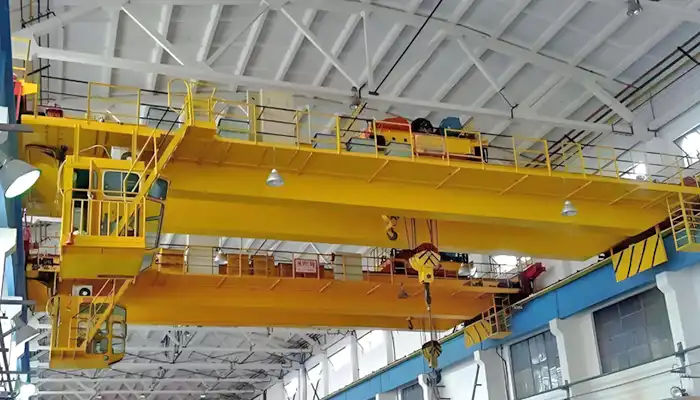
Case: 50-Ton Overhead Crane Installed in a Jazan Refinery
To see how a properly specified explosion-proof crane can make a difference, let’s look at a real-world example from a refinery project in Jazan.
Project Summary
- Span: 22 meters — enough to cover the entire workshop floor and provide full access to heavy equipment areas.
- Lift height: 10 meters — suitable for lifting tall pumps, vessels, and skid-mounted units.
- Zone 1 classification: The crane was designed and certified for the highest level of hazardous gas exposure in this refinery’s process building.
Result
- Reduced manual lifting: Before the crane, heavy equipment had to be moved using less reliable and more labor-intensive methods. The crane’s installation significantly cut down on manual handling, improving worker safety.
- Improved equipment maintenance efficiency: Routine repairs and replacements could be done faster and with less downtime, as the crane enabled quick, precise lifts and transfers.
- Full compliance with safety standards: The explosion-proof design met all ATEX, IECEx, and Saudi Aramco safety requirements, allowing the refinery to operate confidently within regulatory guidelines.
This project highlights how investing in the right crane—one that matches load, environment, and safety needs—helps petrochemical plants in Jazan run safer and more efficiently every day.
How to Specify the Right 50-Ton Explosion-Proof Crane
Picking the right crane means giving clear details upfront so it fits your plant perfectly and works safely.
Key Details to Prepare
- Hazardous Zone: Know if the crane will be in Zone 1 or Zone 2 to meet the right explosion-proof standards.
- Building Size: Measure the span between runway beams and the ceiling height to ensure proper crane size and lift height.
- Power Supply: Provide voltage and frequency (e.g., 380V/60Hz) so motors and controls match your site.
- Duty Cycle: Refineries usually need heavy-duty cranes (M6 or higher) for frequent, long shifts.
Custom Design Matters
- Make sure hook approach and clearance fit your layout to avoid collisions and allow smooth lifting.
- Consider obstacles like pipes, cables, and other equipment under or around the crane.
- Specify any special lifting tools or attachments you’ll need.
Work With Experienced Manufacturers
- Choose suppliers familiar with Saudi standards like ATEX, IECEx, and Aramco specs.
- They understand local conditions like coastal corrosion and high heat.
- Local support and spare parts availability are important for ongoing crane reliability.
Clear info and the right partner will get you a crane that’s safe, reliable, and just right for your Jazan petrochemical plant.
Conclusion and Send Us an Inquiry
A 50-ton explosion-proof crane is a key piece of equipment for any petrochemical plant in Jazan. It ensures safe handling of heavy, hazardous loads while meeting strict safety standards. Choosing the right crane helps keep your operations efficient and protects your workers and assets.
If you’re planning a new facility or upgrading your material handling systems, it’s important to work with a certified supplier who understands your industry’s needs and local requirements.
Send Us An Inquiry:
- Consult with an experienced crane manufacturer for a solution tailored to your plant.
- Send us your project details and lifting requirements to get a customized quotation.
We’re here to help you find the right crane for your operation—safe, reliable, and built for Jazan’s challenging environment.