Container Cranes in Jazan Port, Saudi Arabia: RMG vs RTG vs STS
Jazan Port Container Cranes in Saudi Arabia: RMG, RTG, or STS? Compare RMG, RTG, and STS cranes at Jazan Port to choose the best option for space, capacity, and future expansion.
Introduction
Saudi Arabia is working hard to improve its ports. The country wants to handle more cargo and make trade faster and smoother. Ports are very important for this, so upgrading their equipment is a big focus.
Jazan Port is one of the important ports on the Red Sea coast. It connects trade routes between Asia, Africa, and Europe. As more goods come through, Jazan needs strong and reliable cranes to move containers quickly and safely.
Picking the right crane is a big decision. Cranes lift and move heavy containers, and they affect how fast ships can unload and how many containers can be stored. If the wrong crane is chosen, it could slow down work or cost more money in repairs.
In this section, we’ll compare three common types of container cranes:
- Rail Mounted Gantry Cranes (RMG)
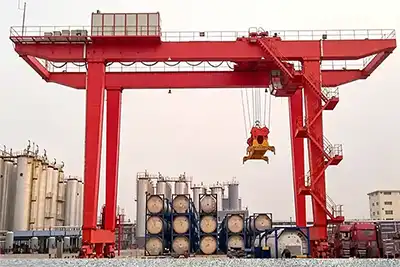
- Rubber Tyred Gantry Cranes (RTG)
- Ship-to-Shore Cranes (STS)
These cranes can lift between 35 and 100 tons. This comparison will help port managers at Jazan Port decide which crane fits best based on their space, how many containers they expect to handle, and budget.
What You Will Learn Here:
- Why Saudi Arabia is upgrading its ports
- Why Jazan Port is important for trade
- Why choosing the right crane matters
- Basic info about RMG, RTG, and STS cranes
Overview of Container Handling Cranes in Saudi Arabian Ports
In Saudi Arabia, major ports like Jeddah, Dammam, and Jazan rely on a few key types of container cranes to handle growing trade volumes efficiently. These cranes are the backbone of container movement, whether stacking in yards or loading and unloading ships. Understanding which crane works best in the Saudi environment helps ports run smoothly and keep up with increasing cargo demands.
Let’s break down the three main crane types widely used across Saudi ports: Rail Mounted Gantry Cranes (RMG), Rubber Tyred Gantry Cranes (RTG), and Ship-to-Shore Cranes (STS).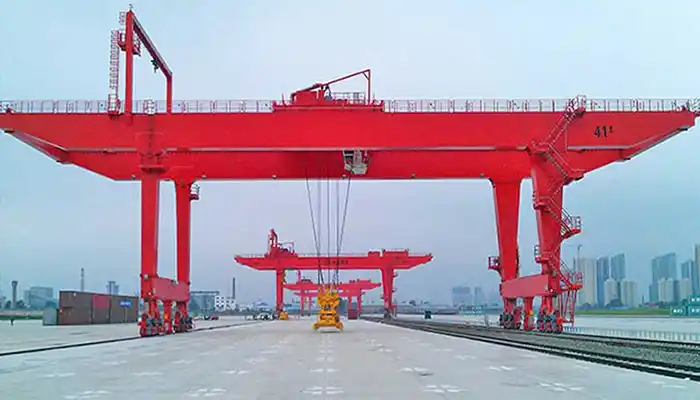
Rail Mounted Gantry Cranes (RMG)
RMGs are popular in Saudi ports with strong infrastructure like the King Abdul Aziz Port in Dammam and Jeddah Islamic Port. These cranes run on rails laid out in container yards and excel at stacking containers tightly.
Advantages in Saudi Arabia:
- Well suited for large, permanent terminals with flat, stable ground like Dammam and Jazan
- Electrical power fits Saudi Arabia’s growing push for cleaner energy in industrial sectors
- Ideal for high-density stacking to maximize limited yard space
Challenges to consider:
- Require heavy upfront investment to build rail infrastructure, which can be a factor in newer or expanding ports
- Fixed paths mean less flexibility if the terminal layout changes in the future
- Installation and rail maintenance require technical expertise not always available in remote areas
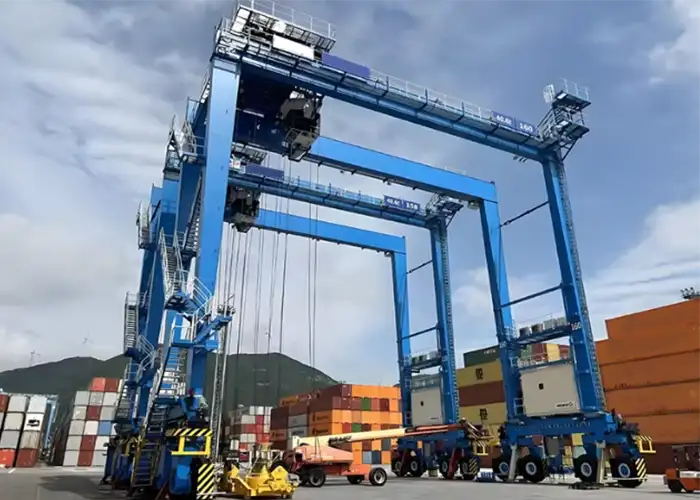
Rubber Tyred Gantry Cranes (RTG)
RTGs are widely used across Saudi Arabia for their flexibility. Ports like Jazan and smaller terminals often choose RTGs because they don’t require rails and can easily adapt as the yard layout changes or expands.
Advantages in Saudi Arabia:
- Mobile cranes that can move around, making them perfect for expanding or evolving ports
- Easier and faster to deploy, especially useful for Saudi ports developing rapidly under Vision 2030 projects
- Can be electric or diesel powered, offering options depending on energy availability and environmental goals
Challenges to consider:
- Diesel RTGs may raise environmental concerns in Saudi cities focusing more on air quality
- Maintenance of tires and engines can add to operating costs, especially in dusty desert environments
- Electrical infrastructure needs to be reliable for electric RTGs to avoid downtime
Ship-to-Shore Cranes (STS)
STS cranes are the primary cranes used to unload ships at Saudi Arabia’s major deep-water ports like Jeddah Islamic Port and King Abdul Aziz Port. They are essential for handling large container vessels calling on the Red Sea and Arabian Gulf.
Advantages in Saudi Arabia:
- Handle very heavy loads from large ships, some up to 100 tons capacity, matching Saudi Arabia’s expanding maritime trade
- Modern STS cranes support automation trends that Saudi ports are adopting to improve efficiency
- Built to withstand harsh marine conditions typical of the Red Sea and Arabian Gulf
Challenges to consider:
- High costs for purchase and installation mean long-term planning and investment are critical
- Require solid dock infrastructure, which may limit use at smaller or newer Saudi ports
- Maintenance can be demanding due to the coastal environment’s salt and heat
Typical Lifting Capacities in Saudi Ports
Given the variety of cargo passing through Saudi Arabia’s ports, cranes need to cover a broad range of lifting capacities:
- 35 to 50 tons: Used commonly for standard container handling across most Saudi terminals
- 50 to 80 tons: Supports heavier containers and stacked loads typical of busy Saudi ports like Jeddah
- 80 to 100 tons: Mostly STS cranes used at large Saudi ports for the biggest vessels and cargo loads
Saudi ports balance these crane types depending on their size, layout, and growth plans. For Jazan Port, which is expanding quickly, the choice will depend on its terminal design and how much throughput it aims to handle.
Technical Profile of Container Handling Crane Types for Saudi Ports
Rail Mounted Gantry Cranes (RMG)
In Saudi Arabia, Rail Mounted Gantry Cranes (RMGs) are typically used in container yards that already have rail infrastructure, such as established ports like King Abdul Aziz Port in Dammam and Jeddah Islamic Port. These cranes move along fixed rails to stack containers efficiently, making them a solid choice where space is tight and high-density stacking is needed.
- Capacity and Suitability: RMGs can handle containers weighing between 35 and 80 tons, which fits well with the demands at Jazan Port and other busy Saudi terminals. Their precision and stability allow ports to stack containers tightly, maximizing yard capacity.
- Energy and Maintenance: Most RMGs in Saudi Arabia run on electricity, which aligns with the country’s push toward cleaner energy solutions in industrial operations. Compared to diesel-powered cranes, they offer lower emissions and energy costs. However, maintenance must be planned carefully because the desert climate—hot and dusty—can cause wear on moving parts and electrical components.
- Other Considerations: The rail system itself requires upkeep, and any rail damage can cause operational delays. Saudi ports with the right infrastructure find RMGs a reliable choice, but installation and upkeep need technical skill.
Rubber Tyred Gantry Cranes (RTG)
Rubber Tyred Gantry Cranes (RTGs) are very common in Saudi ports that either don’t have rail infrastructure or need more flexibility. Jazan Port, still growing and adjusting its terminal layout, benefits from RTGs because they can easily move around without rails.
- Flexibility and Mobility: RTGs can quickly change positions within the container yard, which makes them ideal for terminals that expect to expand or rearrange their layout frequently. This mobility helps keep operations smooth as Jazan Port develops.
- Fuel and Environmental Impact: RTGs in Saudi Arabia come in diesel and electric models. Diesel RTGs are widely used but can cause pollution and require more maintenance, especially in dusty conditions. Electric RTGs, though less common, are growing in popularity because they align better with Saudi Arabia’s environmental goals, helping reduce emissions in line with Vision 2030.
- Maintenance: Tires and engines of RTGs need regular checks, especially given Saudi Arabia’s desert environment. Dust and heat can accelerate wear, so proactive maintenance is important to avoid downtime.
Ship-to-Shore Cranes (STS)
Ship-to-Shore Cranes are the heavy lifters at Saudi Arabia’s deep-water ports. These cranes unload containers directly from vessels, playing a key role in ports like Jazan, Jeddah, and Dammam, which handle large container ships regularly.
- Capacity and Reach: STS cranes in Saudi ports typically lift loads between 40 and 100 tons, enough to handle the largest container ships docking along the Red Sea and Arabian Gulf. Their long booms and wide reach enable efficient loading and unloading without delays.
- Integration with Automation: Saudi ports are increasingly adopting automation to improve safety and speed. Many modern STS cranes come with automation features like remote operation and advanced control systems. This fits well with Saudi Arabia’s push to modernize port operations and increase competitiveness.
- Durability: Built to handle the harsh coastal environment—heat, salt air, and occasional sandstorms—STS cranes in Saudi Arabia are designed with corrosion-resistant materials and regular maintenance plans.
Key Factors for Crane Selection at Jazan Port, Saudi Arabia
Terminal Layout Specific to Jazan Port
Jazan Port is growing rapidly, but space is always a key issue. The terminal has to make the best use of the available area while planning for future expansions. This means cranes need to fit into a layout that might change over time.
- Space Constraints: The current yard size limits how many cranes can operate side by side. Efficient stacking is crucial because every square meter counts.
- Planned Expansion: Jazan is not static. The port authority has several phases planned to increase capacity, so any crane choice should allow flexibility to adapt as the terminal grows.
- Infrastructure: Currently, Jazan does not have extensive rail infrastructure like some older Saudi ports. This affects whether Rail Mounted Gantry Cranes are practical. The ground conditions—mostly compacted soil and some paved areas—must also support crane foundations and movements.
Throughput and Trade Growth in Saudi Arabia
Saudi Arabia’s Vision 2030 expects ports like Jazan to play a bigger role in global trade, so container volumes will rise steadily.
- Expected Throughput Growth: Jazan Port’s container traffic is forecasted to grow by double digits in the next few years. This means cranes must handle higher loads efficiently without causing bottlenecks.
- Operational Speed: To keep up with increasing cargo volumes, cranes need to work fast and reliably. Slow crane cycles could hold ships at berth longer, hurting port reputation and increasing costs.
- Peak Season Handling: During high-demand periods, Jazan must handle surges smoothly. Crane capacity and number must be sufficient to avoid slowdowns, especially when multiple large vessels arrive at once.
Financial and ROI Considerations within Saudi Market
Money matters, and investing in cranes is a big decision. Saudi Arabia’s market has some unique factors that affect costs and returns.
- Capital Investment: While the government supports port growth with funding, budget limits still exist. Cranes must offer the best value, balancing upfront cost with long-term benefits.
- Operational Costs: Energy costs in Saudi Arabia can be relatively low due to local fuel availability, but labor costs and maintenance must be optimized. Choosing cranes that are energy-efficient and easy to maintain can reduce ongoing expenses.
- Lifecycle and Environment: Cranes at Jazan will face high temperatures, dust, and occasional sandstorms. This wears equipment down faster. Selecting robust cranes built to handle these conditions means fewer breakdowns and longer service life, improving ROI over time.
Comparative Analysis for Saudi Arabia: RMG vs RTG vs STS
Choosing the right crane means looking closely at several factors. Here’s a straightforward comparison of Rail Mounted Gantry Cranes (RMG), Rubber Tyred Gantry Cranes (RTG), and Ship-to-Shore Cranes (STS), especially for Jazan Port’s needs and the Saudi market.
Cost Efficiency in Saudi Market
- RMG: High upfront costs because of rail installation and infrastructure work. However, electric RMGs can save money over time through lower energy use and maintenance. Ideal for long-term, high-density operations.
- RTG: Lower initial investment since no rail infrastructure is needed. But diesel RTGs can have higher fuel and maintenance costs, especially with wear from desert conditions. Electric RTGs are more efficient but require reliable power.
- STS: The most expensive cranes to buy and install. But necessary for ship unloading/loading. Their cost is justified by improving ship turnaround times and handling large vessels efficiently.
Capacity Matching Saudi Import/Export Volumes
- RMG: Typically lifts between 35 and 80 tons, suitable for stacking containers in yards with moderate to high volume. Works well for Jazan’s expected growth.
- RTG: Similar capacity range to RMG, flexible for various container weights and stacking heights. Best when terminal layouts are changing.
- STS: Handles the heaviest loads (up to 100 tons or more), essential for large container ships frequenting Saudi deep-water ports like Jazan.
Flexibility to Accommodate Jazan’s Terminal Design
- RMG: Limited flexibility due to fixed rails. Good for well-planned, stable terminal layouts but less adaptable if Jazan’s design changes often.
- RTG: Highly flexible, can be moved around as the yard expands or changes. Perfect for Jazan’s ongoing expansion plans.
- STS: Fixed cranes at the quay but can cover wide berth areas. Flexibility is more about operational capacity than physical movement.
Maintenance in Saudi Climate
- RMG: Requires regular checks on rails and electrical systems. Dust and heat increase wear but electric power reduces engine maintenance.
- RTG: Tires, engines, and hydraulics need constant upkeep, especially with desert dust and heat. Electric models reduce some maintenance but rely on stable power.
- STS: Subject to marine environment challenges—salt corrosion, heat, sandstorms. Requires corrosion-resistant materials and frequent preventive maintenance.
Environmental Compliance and Energy Use
- RMG: Usually electrically powered, producing fewer emissions—good for Saudi Arabia’s environmental goals.
- RTG: Diesel RTGs emit more pollution; electric RTGs are better but need reliable energy sources.
- STS: Increasingly designed with energy-saving and emission controls, supporting Saudi ports’ moves toward greener operations.
This comparison highlights that no one crane type fits all needs. Jazan Port must balance cost, capacity, flexibility, and climate challenges when choosing cranes.
Application Scenarios Tailored to Jazan Port and Saudi Operations
Choosing the right crane often depends on real-life situations at the port. Here are three typical scenarios that match what Jazan Port and similar Saudi ports might face.
Maximizing Space Utilization Under Limited Land Availability at Jazan
Jazan Port’s current footprint is tight, with limited room to expand quickly. The priority here is to make the most of every square meter.
Best crane choice: Rail Mounted Gantry Cranes (RMG)
Why:
- RMGs move on rails, allowing very tight container stacking with precision.
- They maximize vertical and horizontal storage capacity, essential where land is limited.
- Electrically powered RMGs reduce emissions, supporting clean energy goals.
Considerations:
- Requires investment in rail infrastructure, but the space savings and efficiency pay off over time.
- Terminal layout should be stable with little frequent change.
Balancing Mobility and Cost for Medium Throughput at Expanding Saudi Ports
Some Saudi ports, including the growing sections of Jazan, need flexibility. They may not have extensive rail infrastructure yet, and terminal layouts are still evolving.
Best crane choice: Rubber Tyred Gantry Cranes (RTG)
Why:
- RTGs can move anywhere in the yard without rails, making them ideal for changing layouts.
- Lower initial cost compared to RMGs, speeding up deployment.
- Suitable for medium throughput levels where flexibility and cost control matter.
Considerations:
- Diesel RTGs need more maintenance and produce emissions; electric RTGs are better but require stable power supply.
- Maintenance plans should account for harsh desert conditions.
Handling Ultra-Large Container Vessels with High-Capacity STS Cranes
Jazan and other Saudi ports are preparing to handle bigger ships bringing more containers at once. Fast, heavy lifting is needed at the quay.
Best crane choice: Ship-to-Shore Cranes (STS)
Why:
- STS cranes have the capacity (up to 100 tons) to unload large container vessels efficiently.
- Their long reach and speed reduce ship turnaround time, improving port productivity.
- Modern STS cranes include automation features that improve safety and operational precision.
Considerations:
- High capital and maintenance costs require long-term investment planning.
- Strong quay infrastructure is essential to support the cranes.
Recommendations for Jazan Port Management
Suggested Crane Types Aligned with Saudi Arabia’s Trade Forecasts and Jazan’s Terminal Plan
For Jazan Port, the best crane choice depends largely on balancing current needs with future growth. Given Saudi Arabia’s rising trade volumes and the port’s expansion plans:
- Rail Mounted Gantry Cranes (RMG) are ideal for high-density stacking areas where space is tight and stable infrastructure exists. These cranes support efficient container storage and help maximize yard capacity.
- Rubber Tyred Gantry Cranes (RTG) offer the flexibility needed during expansion phases. They allow Jazan to adapt its yard layout without heavy upfront rail investments.
- Ship-to-Shore Cranes (STS) are essential for handling the larger container vessels expected to call at Jazan. Investing in modern STS cranes with automation will speed up ship turnaround and boost overall throughput.
Choosing a mix of these cranes, tailored to different terminal zones, will help Jazan Port operate smoothly today and be ready for future demands.
Phased Investment Approach Consistent with Saudi Infrastructure Development Programs
Saudi Arabia’s Vision 2030 supports phased development, and Jazan Port can benefit from this approach by:
- Starting with more flexible cranes like RTGs to support early growth and yard rearrangements.
- Gradually adding RMGs as the terminal layout stabilizes and stacking density needs increase.
- Planning STS crane purchases in line with berth deepening and increasing ship sizes to avoid over-investment early on.
This staged approach reduces risk, spreads capital costs, and aligns with government funding cycles and infrastructure projects.
Coordination with Saudi Port Authorities and Equipment Suppliers for Long-Term Service Support
Long-term success depends not just on buying cranes but maintaining them well. Jazan Port management should:
- Work closely with Saudi port authorities to align crane purchases with national regulations and standards.
- Build strong relationships with crane manufacturers and suppliers who understand Saudi climate and operational challenges.
- Arrange for local training and spare parts support to minimize downtime and keep cranes running smoothly in harsh desert conditions.
This proactive coordination will ensure that crane investments deliver reliable performance over many years.
Conclusion
Selecting the right container cranes for Jazan Port means looking beyond just price or capacity. It requires understanding Saudi Arabia’s growing trade demands and how Jazan’s terminal layout and environment influence crane performance. Whether it’s RMGs, RTGs, or STS cranes, each has strengths that can serve different parts of the port’s operations.
The key is to choose cranes that fit Jazan’s specific needs—space limitations, harsh desert climate, and expected cargo growth—while keeping a close eye on long-term return on investment. Smart crane choices help ensure efficient cargo handling, reduce downtime, and support Saudi Arabia’s broader logistics goals under Vision 2030.
To move forward confidently, Jazan Port management should:
- Consult with crane manufacturers and suppliers who know the Saudi market well. These experts can provide practical advice tailored to local conditions and regulations.
- Request feasibility studies and detailed ROI assessments that look at Jazan’s specific terminal layout, throughput forecasts, and operational goals. This helps avoid costly mistakes and ensures investments pay off over time.
Taking these steps will put Jazan Port in a strong position to meet the demands of the future and play a key role in Saudi Arabia’s expanding trade network.