10 Ton Overhead Crane for Mechanical Assembly in Doha, Qatar
10 Ton Overhead Crane for sale Qatar: Best for Mechanical Assembly in Doha’s Growing Industrial Sector
Introduction
Doha’s industrial sector has been growing steadily in recent years. With new factories and workshops opening up, especially in areas focused on mechanical assembly, the demand for efficient material handling solutions has increased. These workshops often deal with medium-sized mechanical parts that require reliable lifting equipment to keep production moving smoothly.
Overhead cranes play a crucial role in these assembly lines. They make it easier to move heavy components from one station to another without relying on manual labor or forklifts, which can be slower and less precise. A good overhead crane reduces the risk of damage to parts and helps maintain a steady workflow.
Among the various crane options, the 10-ton double girder overhead crane stands out as a popular choice in Doha’s mechanical assembly workshops. It offers just the right balance of lifting capacity and stability for handling moderate loads. Plus, the double girder design allows for higher hook lifting heights, which is important in multi-bay workshops where maximizing vertical space is key.
Why a 10-ton double girder crane is often chosen:
- Provides enough lifting power for most mechanical assembly tasks without being overkill
- Double girder setup ensures stable lifting and better load distribution
- Allows for higher hook travel, making it suitable for taller workshop ceilings
- Durable and reliable, designed for frequent daily use in busy environments
This crane type fits well with the specific needs of Doha’s growing industrial workshops, making it a practical investment for businesses aiming to improve their assembly processes.
Overview of 10 Ton Double Girder Overhead Cranes
Double girder overhead cranes are built with two main beams (girders) that span across the runway rails. The hoist and trolley run on top of these girders, allowing the crane to carry heavier loads and operate smoothly over wider spans. This design is more robust compared to single girder cranes and provides better stability during lifting.
Key features of 10-ton double girder cranes include:
- Two parallel girders: These support the trolley and hoist, distributing the load evenly across the crane structure.
- Higher lifting capacity: Designed to safely handle up to 10 tons, making them ideal for medium-duty applications.
- Longer hook lift height: Since the hoist travels on top of the girders, it frees up vertical space below, allowing higher lifts inside the workshop.
- Stronger construction: The steel girders and end trucks are built to withstand frequent use and heavier stress.
- Smooth trolley and crane travel: The dual girder setup offers better stability, reducing sway and vibrations during operation.
Compared to single girder cranes, which have just one main beam with the hoist hanging below, double girder cranes offer several advantages especially useful in assembly settings:
- Greater lifting capacity: Single girder cranes typically max out around 10 tons, but double girder cranes handle 10 tons comfortably with extra durability.
- Higher hook approach and lifting height: Double girder cranes maximize vertical clearance, critical in workshops where every centimeter counts.
- Improved load stability: The twin girder design reduces twisting or bending under load, making it safer when lifting awkward or heavy mechanical parts.
- Better suited for longer spans: Double girders allow wider coverage without compromising crane rigidity.
For mechanical assembly lines in Doha, these advantages translate to smoother, safer, and more efficient material handling, which helps keep production lines running without interruptions.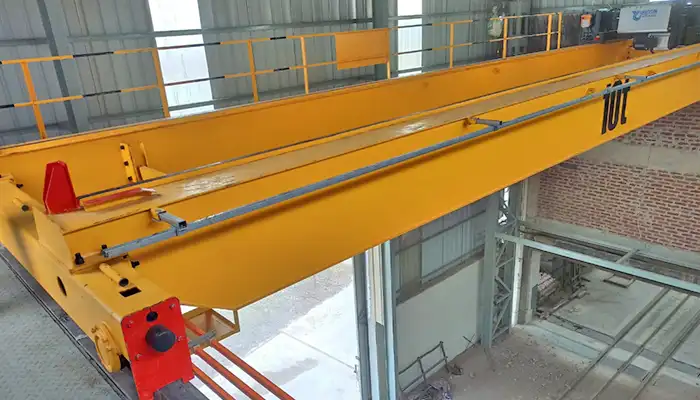
10 ton double girder overhead crane, more types of double girder overhead crane for sale from Yuantai Crane
Mechanical Assembly Industry in Doha
Doha’s mechanical assembly sector is a key part of the city’s expanding industrial base. From equipment servicing workshops to machinery manufacturing plants, these facilities handle a wide range of components that are heavy, bulky, or awkward to move manually. That’s where overhead cranes come in.
Typical Mechanical Components Handled
Most assembly lines in Doha deal with mid-sized mechanical parts that can’t be safely lifted by hand or moved easily with forklifts. These include:
- Gearboxes, motors, and pumps
- Machine frames, panels, and brackets
- Hydraulic cylinders and assemblies
- Engine parts and compressors
- Pre-machined sub-assemblies
Many of these items weigh between 1 to 8 tons each, making a 10-ton crane the right-sized tool—not too small to be overloaded, and not too large to be cost-inefficient.
Multi-Bay Workshop Layouts in Doha
It’s common to see long-span workshops with multiple bays, especially in Doha’s industrial zones like the New Industrial Area, Mesaimeer, or near the Salwa Road corridor.
- Each bay often serves a specific function: part assembly, testing, or maintenance.
- Overhead cranes allow easy movement between bays without blocking the floor.
- The use of shared runways enables a single crane to serve multiple work zones.
This layout works well with double girder cranes, especially those with dual hoists or tandem lifting capability, offering flexibility in handling components of various sizes.
Lifting and Handling Challenges
Mechanical assembly is not just about lifting weight—it’s about precision, safety, and speed.
- Many components have irregular shapes or sensitive surfaces that require careful movement.
- Assemblies must be aligned accurately, which means the crane must offer fine control and stable lifting.
- Some operations require the crane to hold a load in place for a while—strong brakes and smooth control are essential.
- Limited headroom and busy shop floors call for cranes that maximize lifting height while staying out of the way.
A 10-ton double girder crane solves many of these problems. It’s strong enough for everyday loads, stable for precise alignment, and adaptable to Doha’s modern industrial workshop layouts.
Practical Benefits of Using 10 Ton Double Girder Cranes
In a mechanical assembly workshop, every lift counts. Whether you're moving a motor, aligning a gearbox, or placing a machine frame into position, the equipment you use must be stable, precise, and reliable. That’s exactly what a 10-ton double girder overhead crane offers—especially in busy Doha workshops where efficiency and safety go hand in hand.
Stability and Load Distribution Advantages
Double girder cranes are built for balanced lifting. The load is distributed evenly across two girders, reducing structural stress and minimizing sway during travel.
- Less vibration during lifting means safer handling of sensitive components.
- Reduced crane deflection increases precision, especially when aligning parts during assembly.
- Stronger bridge structure ensures the crane stays stable even when the trolley is at full span.
This stability is particularly important in multi-bay assembly lines where precise lifting over long spans is required daily.
Longer Hook Height for Improved Vertical Reach
Because the hoist sits on top of the girders (instead of below them, as in single girder cranes), you gain extra lifting height—crucial in workshops with tall machinery or overhead obstacles.
- Maximizes usable vertical space in high-bay workshops.
- Allows clearance for larger parts like tall engine blocks or sub-assemblies.
- Reduces risk of load collisions with beams, lights, or ductwork above.
In practical terms, you get more room to work without needing to modify the building structure.
Enhanced Safety and Precision in Material Handling
Safety isn’t just about preventing accidents—it’s about maintaining control and consistency. A double girder crane supports both with features designed for smooth operation.
- Fine movement control with inverter drives or dual-speed motors.
- Anti-sway systems (optional) reduce pendulum motion, especially useful when moving parts into tight spaces.
- Heavy-duty brakes and overload protection ensure peace of mind for operators.
- Radio remote control or cabin operation adds distance between personnel and moving loads.
This level of control reduces wear on components, prevents costly damage, and protects workers during lifting tasks.
Ability to Handle Moderate-Sized Mechanical Parts Efficiently
Most mechanical parts in Doha’s workshops fall in the 1–8 ton range, which makes a 10-ton capacity crane ideal. It gives you some headroom for heavier items without over-investing in a higher tonnage system.
- No need to switch between cranes or hoists for various parts—one crane does it all.
- Suitable for lifting, rotating, and aligning parts during assembly.
- Efficient cycle times keep production moving with minimal downtime.
Simply put, the 10-ton double girder overhead crane hits the sweet spot—strong enough for most tasks, compact enough to install in standard workshop bays, and efficient enough to keep up with a fast-paced production line.
Customization and Adaptability for Doha Workshops
Not all workshops are built the same, and that’s especially true in Doha. Ceiling heights vary, workspaces are often shared between departments, and environmental conditions can be tough. That’s why a one-size-fits-all crane doesn’t cut it. A 10-ton double girder overhead crane offers a flexible platform that can be adapted to match your exact needs—both structurally and operationally.
Options for Span Length, Runway Configurations, and Lifting Speeds
Crane systems must match your facility layout to be truly effective. Whether you're working in a wide-span bay or a more compact multi-zone workshop, customization makes the difference.
- Variable span lengths to fit across bays of different widths—custom girder fabrication allows precise fit.
- Runway options including free-standing steel structures or building-mounted systems depending on your site constraints.
- Adjustable lifting speeds, with two-speed or inverter drive options, let you fine-tune the crane for your process—slow speed for alignment tasks, higher speed for general transport.
Practical Tip: A site inspection by your crane supplier can help determine optimal girder length and runway support design.
Integration with Remote Controls and Automation for Better Workflow
Efficiency isn’t just about how fast a crane lifts—it’s also about how seamlessly it fits into your daily operations.
- Radio remote controls give operators mobility, allowing better load visibility and safer positioning.
- Push-button pendant options can be installed with flexible cable systems or suspended from a track for easy movement.
- Automated features, such as pre-set trolley travel limits or position memory, help speed up repetitive lifting routines.
- Integration with production lines—in some cases, cranes can be synced with conveyor systems or robotic arms.
These options reduce operator fatigue, improve speed, and contribute to a safer, more efficient work environment.
Adaptation to Doha’s Environmental Conditions (Heat, Dust)
Let’s face it—Qatar’s climate is tough. High temperatures, dry air, and airborne dust are constant concerns, especially in partially open or uncooled facilities.
- Tropical-rated motors and control panels are designed to withstand 50°C+ operating temperatures.
- Sealed bearings and enclosed hoist mechanisms prevent dust from entering sensitive parts.
- Protective paint coatings resist corrosion from exposure to heat, moisture, or salty coastal air.
- Sunshields and weather-resistant enclosures for outdoor installations or cranes in roofed-but-open bays.
Practical Tip: If your workshop operates in an open-air layout or near the coast, ask for anti-corrosion upgrades and thermal protection as part of your crane spec.
Conclusion
In Doha’s mechanical assembly sector, where daily operations involve lifting moderate-sized but critical components, the 10-ton double girder overhead crane hits the mark. It offers the right mix of strength, stability, and flexibility—perfectly suited for multi-bay workshops, high-bay facilities, and production lines that need dependable material handling without overcomplicating the system.
From better hook height and improved safety features to custom spans and heat-resistant designs, this crane type adapts well to Doha’s industrial needs and environmental conditions. It supports smoother workflows, protects both workers and materials, and helps businesses maintain consistent output.
If you’re planning to upgrade or install a new lifting system in your workshop, don’t leave it to guesswork. Talk to crane experts who understand both the technical side and local requirements. With proper consultation, your crane system can be tailored to your exact space, lifting tasks, and operating conditions—making it a long-term asset, not just another machine in the shop.