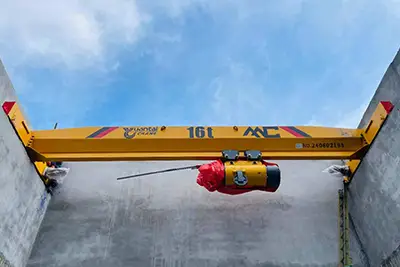
5 Ton Overhead Crane for Australia | 16m Span, 415V Powe
5 Ton Overhead Cranes for an Australian Workshop
Project Summary
For an Australian workshop material-handling application, Yuantai Crane supplied two 5 ton LD single girder overhead cranes with CD electric wire rope hoists.
The cranes were designed around the customer's actual workshop dimensions and electrical requirements, including a 16 m span, 5 m lifting height, 415V / 50Hz / 3-phase power supply, P15 runway rail and conductor system.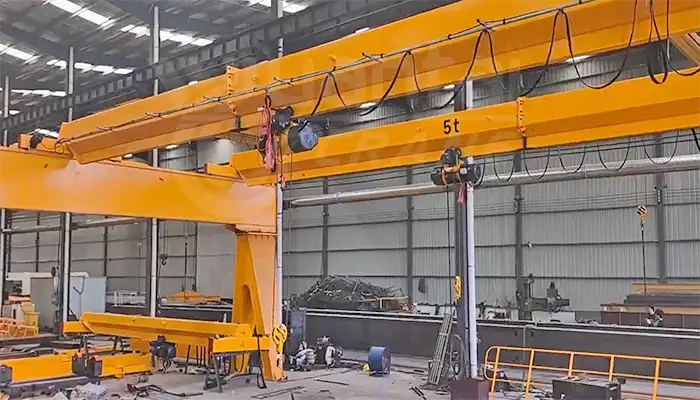
No load testing
| Parameter | Specification |
|---|---|
| Crane Type | LD Single Girder Overhead Crane |
| Quantity | 2 sets |
| Capacity | 5 ton |
| Span | 16 m |
| Lifting Height | 5 m |
| Hoist | CD Electric Wire Rope Hoist |
| Power Supply | 415V / 50Hz / 3Ph |
| Runway Rail | P15 |
| Power Supply System | Conductor / Sliding Line |
Crane Solution
For this Australian workshop, the selected lifting system was a 5 ton LD single girder overhead crane with a CD electric wire rope hoist. The design was based on the required span, lifting height, electrical supply and runway arrangement rather than capacity alone.
| Design Item | Project Specification | Why It Matters |
|---|---|---|
| Crane Type | LD Single Girder Overhead Crane | Practical configuration for general workshop material handling |
| Rated Capacity | 5 ton | Determines the maximum allowable lifting load |
| Quantity | 2 sets | Provides lifting coverage for two workshop areas or operating positions |
| Span | 16 m | Defines the crane's horizontal working coverage |
| Lifting Height | 5 m | Determines the available vertical lifting range |
| Hoist Type | CD Electric Wire Rope Hoist | Provides electric lifting and trolley travel |
| Power Supply | 415V / 50Hz / 3Ph | Matches the customer's specified site electrical supply |
| Runway Rail | P15 | Forms the running track for the crane |
| Power Collection | Conductor / Sliding Line | Supplies electrical power to the traveling crane |
The key point for buyers is that a 5 ton crane is not selected by capacity alone. Span, lifting height, duty class, headroom, wheel loads, runway conditions and site power supply all affect the final crane configuration.
Electrical Configuration: 415V / 50Hz / 3Ph
For this Australian project, the crane electrical system was configured for the customer's specified 415V / 50Hz / 3-phase power supply. This information needs to be confirmed before manufacturing because the crane motors and electrical components must be compatible with the actual site power.
| Electrical Requirement | Specification | Buyer Consideration |
|---|---|---|
| Voltage | 415V | Must match the available site supply |
| Frequency | 50Hz | Affects motor and electrical equipment selection |
| Phase | 3 Phase | Standard industrial configuration for this application |
| Motor Configuration | According to 415V / 50Hz supply | Prevents voltage mismatch |
| Control System | Configured for the specified power supply | Should be confirmed before production |
For an export crane quotation, buyers should avoid simply writing "three-phase power." The manufacturer should receive the complete voltage + frequency + phase specification. Confirming this information early helps reduce the risk of electrical modifications, component mismatch and commissioning delays.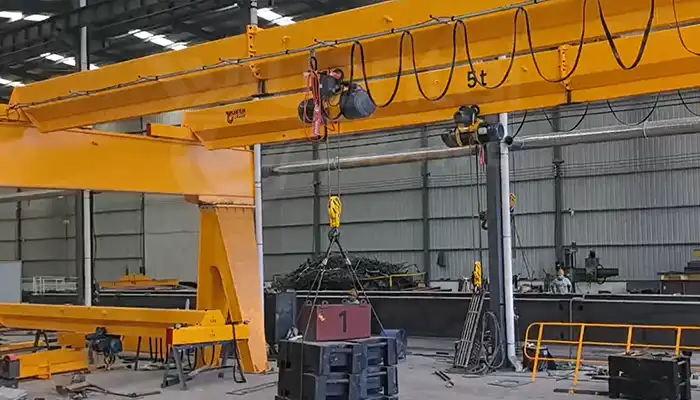
P15 Runway Rail and Conductor System
The project also included the P15 runway rail and conductor/sliding-line power supply system. These components are part of the crane installation and should be considered together with the bridge crane rather than treated as completely separate items.
| Runway / Power System | Project Specification | What the Buyer Should Confirm |
|---|---|---|
| Runway Rail | P15 | Rail type and compatibility with crane wheels |
| Rail Gauge | According to crane design | Must match the crane span/runway arrangement |
| Runway Length | Project-specific | Determines crane travel distance |
| Supporting Structure | Existing/project structure | Check load-bearing capacity and installation dimensions |
| Conductor System | Conductor / Sliding Line | Confirm current capacity, arrangement and installation |
| Existing Runway | To be verified if applicable | Provide drawings and dimensions before final design |
If the customer already has a runway structure, the manufacturer should receive the rail dimensions, gauge, runway length, support information and relevant drawings before finalizing the crane design. This reduces the risk of dimensional conflicts during installation.
Key Technical Benefits
The value of this solution comes from matching the crane to the actual workshop requirements. The following points are directly relevant to buyers comparing different crane configurations.
| Technical Feature | Project Specification | Practical Benefit |
|---|---|---|
| Crane Capacity | 5 ton | Suitable for loads within the specified 5 ton SWL |
| 16 m Span | 16 m | Provides the required horizontal coverage |
| 5 m Lift | 5 m | Provides the required hook travel height |
| Single Girder Design | LD type | Compact and practical for this capacity and application |
| Electric Hoist | CD wire rope hoist | Provides powered lifting and trolley movement |
| 415V / 50Hz / 3Ph | Australian site requirement | Ensures electrical compatibility |
| P15 Runway Rail | P15 | Provides the specified crane running track |
| Conductor System | Sliding-line/conductor supply | Provides continuous electrical power during crane travel |
For a buyer, the main advantage is not one individual component. It is the compatibility of the crane, hoist, electrical system, runway and power supply as one complete lifting system.
What Buyers Should Confirm Before Ordering
Before requesting a quotation for a similar overhead crane, the following technical information should be confirmed with the manufacturer.
| Required Information | Example from This Project | Why It Is Needed |
|---|---|---|
| Lifting Capacity | 5 ton | Determines crane and hoist rating |
| Span | 16 m | Determines bridge structure and wheel loads |
| Lifting Height | 5 m | Determines hoist and hook travel requirements |
| Hoist Type | CD electric wire rope hoist | Defines lifting mechanism |
| Power Supply | 415V / 50Hz / 3Ph | Ensures electrical compatibility |
| Runway Rail | P15 | Ensures crane/runway compatibility |
| Runway Length | Project-specific | Determines crane travel range |
| Duty Class | To be confirmed | Determines structural and mechanical design |
| Application | Workshop material handling | Helps determine operating requirements |
| Building / Runway Drawings | Recommended | Allows dimensional and structural verification |
Providing these parameters at the quotation stage gives the manufacturer enough information to propose a crane based on the actual operating conditions, rather than providing a generic 5 ton crane price.
Problems Solved — FAQ
What information is needed to select a 5 ton overhead crane?
At minimum, provide the lifting capacity, span, lifting height, duty class, runway length, power supply and application.
Building or runway drawings are also highly useful when available.
Is a 5 ton single girder crane suitable for a 16 m span?
It can be suitable, but span alone does not determine the crane type. The manufacturer should also check the duty class, lifting height, headroom, wheel loads and runway structure before finalizing the design.
Why is 415V / 50Hz important when buying a crane?
The crane motors and electrical components must match the actual site power supply. Confirming 415V / 50Hz / 3Ph before production helps avoid electrical modifications and commissioning problems.
Does an overhead crane include the runway?
Not necessarily.
The buyer should clearly state whether the quotation covers the crane and hoist only, or also includes the runway rail and conductor system.
For this project, the specified scope included the P15 runway rail and conductor/sliding-line system.
What should I provide when requesting a crane quotation?
Start with these seven items:
- Capacity
- Span
- Lifting height
- Runway length
- Duty class
- Power supply
- Application and load type
If the crane will be installed in an existing building, provide the runway or building drawings as well.
What Crane Buyers Can Learn from This Project
This project shows that selecting an overhead crane is not simply a matter of choosing a lifting capacity.
For a similar 5 ton crane, the manufacturer needs to understand the load, working area, lifting height, duty cycle, electrical supply and runway conditions.
For export projects in particular, confirming these details before production can prevent costly changes later.
In short: specify the complete working conditions, not just "5 ton overhead crane."