20 Ton Steel Plant Maintenance Crane | Yuantai Craness
At a Glance: What Was Supplied?
Yuantai Craness designed a 20 ton steel plant maintenance overhead crane system for heavy equipment repair and maintenance.
The project required two double girder EOT cranes with open winches.
The cranes operate in a demanding steelmaking environment with:
- Ambient temperature up to 65°C
- Fine iron dust
- Relative humidity up to 95%
- Frequent crane starts
- 36 m hook stroke
- 55 m travelling course
To match these conditions, the reference design uses A5 crane structure classification, M5 hoist and trolley mechanisms, IP65 Class H motors, IC411 cooling, PTC temperature protection, 40% ED and up to 100 starts/hour.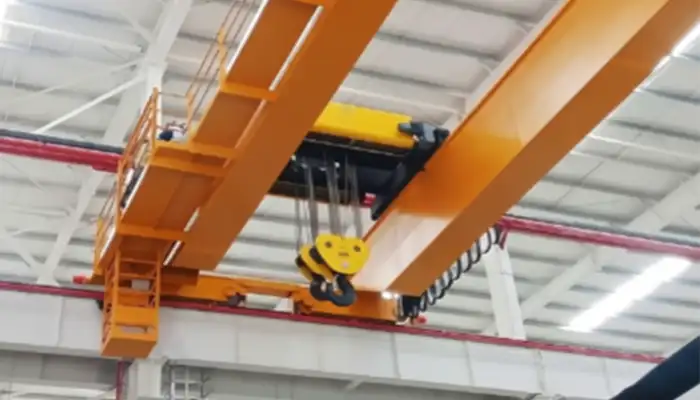
Project Data
| Item | Reference Specification |
|---|---|
| Application | Steel plant equipment maintenance |
| Crane capacity | 20 ton |
| Quantity | 2 sets |
| Crane type | Double girder EOT crane |
| Hoisting system | Open winch |
| Hook stroke | 36 m |
| Travelling course | 55 m |
| Crane structure | A5 |
| Hoist & trolley mechanism | M5 |
| Control | Radio remote control |
| Ambient temperature | Up to 65°C |
| Humidity | Up to 95% |
| Working environment | Fine iron dust |
| Motor protection | IP65 |
| Motor insulation | Class H |
| Motor cooling | IC411 |
| Motor protection | PTC |
| Duty cycle | 40% ED |
| Starting frequency | Up to 100 starts/hour |
Customer Requirement: A Crane for Steel Plant Maintenance
This crane is used for maintenance work inside a steelmaking plant.
The lifting requirement is different from a normal fabrication workshop.
The maintenance team may need to remove a motor from its foundation, lift a gearbox, replace a pump or move a heavy mechanical assembly during a shutdown.
Typical maintenance loads include:
- Electric motors
- Gearboxes
- Pumps
- Valves
- Mechanical assemblies
- Replacement components
- Maintenance tools
- Lifting fixtures
The project required:
2 × 20 ton double girder EOT cranes
The rated capacity is 20 ton. For a similar project, the buyer should also confirm the actual weight of the heaviest component, including lifting beams, spreaders or other attachments where applicable.
The Site Conditions Changed the Crane Design
The most important part of this project was not the 20 ton capacity.
It was the working environment.
The reference conditions included:
- 65°C maximum specified ambient temperature
- Fine iron dust
- 95% relative humidity
- Frequent starts and stops
- Long lifting stroke
- Regular maintenance requirements
These conditions directly affect the selection of motors, electrical equipment, cooling, insulation, protection devices and maintenance access.
A crane designed for a normal indoor workshop should not automatically be transferred into a steelmaking area without reviewing these conditions.
Four Engineering Issues Yuantai Had to Solve
High Temperature — Up to 65°C
At 65°C, motor thermal performance becomes an important design input.
Yuantai's engineering review needs to consider:
- Motor insulation
- Motor temperature rise
- Cooling capacity
- Brake performance
- Electrical components
- Cable insulation
- Lubrication requirements
- Control cabinet operating conditions
The reference design uses Class H motor insulation and IC411 cooling.
The motor selection still needs to be checked against the actual load and duty cycle.
Fine Iron Dust
Fine metallic dust can increase contamination and maintenance requirements.
The reference crane uses IP65 motors.
For the complete crane, engineers should also review:
- Electrical enclosures
- Cable entries
- Limit switches
- Sensors
- Control components
- Motor cooling surfaces
- Inspection points
IP65 on the motor does not mean every electrical component on the crane automatically has the same protection level. Each component should be specified according to its location and function.
Frequent Starts and Stops
Maintenance work is usually intermittent.
The crane may repeatedly:
lift → travel → stop → position → lower → release → lift again.
The reference project specifies:
- 40% ED
- Up to 100 starts/hour
- M5 hoist mechanism
- M5 trolley mechanism
- A5 crane structure classification
This gives the engineering team a basis for checking motor heating, brake operation, gearbox loading and mechanism selection.
36 m Hook Stroke
A 36 m hook stroke is another major design input.
It affects:
- Wire rope length
- Rope drum capacity
- Rope reeving
- Sheave arrangement
- Hook block
- Brake selection
- Upper/lower limit protection
- Additional hoisting-path protection
The project also specifies rotary and counterweight limit devices for additional hoisting protection.
Yuantai Cranes Solution
Based on the lifting requirement and site conditions, Yuantai selected:
20 Ton Double Girder EOT Crane + Open Winch
The configuration provides a suitable bridge arrangement for the required lifting capacity, long hook stroke, duty and maintenance access.
Engineering Configuration
| Requirement | Yuantai Design Response |
|---|---|
| 20 ton maintenance load | Double girder EOT crane |
| Long 36 m hook stroke | Open winch + engineered rope system |
| Frequent operation | A5 / M5 mechanism classification |
| 65°C environment | Class H motor + thermal review |
| Fine iron dust | IP65 motors |
| Frequent starts | 40% ED + up to 100 starts/hour |
| Motor temperature monitoring | PTC |
| Long travelling course | 55 m travel + travel protection |
| Operator mobility | Radio remote control |
| Crane servicing | Walkways, platforms and access provisions |
This is the key part of the Yuantai approach:
Site conditions are converted into engineering requirements before the final crane configuration is fixed.
Why Double Girder for This 20 Ton Maintenance Crane?
The selected crane uses a double girder bridge.
The decision is related to the complete application rather than capacity alone.
The project combines:
- 20 ton rated load
- 36 m hook stroke
- Open winch
- M5 hoist and trolley
- Frequent operation
- Steel plant environment
- Crane maintenance access
A double girder bridge provides a practical structure for installing the open winch trolley and associated equipment.
It also provides more room for service walkways and access arrangements than many compact crane configurations.
For similar projects, the final choice should be checked against:
- Capacity
- Span
- Lift height
- Duty
- Headroom
- Trolley arrangement
- Site temperature
- Maintenance requirements
Why Yuantai Used an Open Winch
The hoisting system uses an open winch.
The main hoisting components are arranged separately:
- Hoisting motor
- Gearbox
- Brake
- Coupling
- Rope drum
- Wire rope system
This configuration is useful where the crane requires a demanding hoisting duty and a long lifting stroke.
It also gives maintenance personnel direct access to individual mechanical components.
For the 36 m hook stroke, Yuantai's engineering review needs to check:
rope drum capacity → reeving → sheave arrangement → braking → hook limits → maintenance access.
This is more useful to a buyer than simply specifying “20 ton open winch crane.”
Motor Protection: Why These Specifications Matter
IP65 Motor Protection
The reference design uses IP65 motors.
This provides protection against dust ingress and water jets.
It is relevant to steel plant areas where fine dust is present.
The complete electrical system still needs to be reviewed according to the actual installation location.
Class H Motor Insulation
The motors use Class H insulation.
This provides a higher thermal insulation class for the motor winding system.
For a specified ambient temperature of up to 65°C, motor thermal conditions need to be reviewed carefully.
The insulation class should be considered together with:
- Motor temperature rise
- Duty cycle
- Load
- Starting frequency
- Cooling method
- Ambient temperature
IC411 Cooling
The reference motor uses IC411 cooling.
This is a totally enclosed, fan-cooled motor arrangement.
For high-temperature applications, the cooling system must be checked against the motor's actual operating load and ambient temperature.
PTC Temperature Protection
PTC thermistors monitor motor winding temperature.
This gives the control system an additional way to detect excessive motor temperature.
It is particularly useful when the crane has:
- High ambient temperature
- Frequent starts
- Repeated lifting cycles
Duty Class: A5 and M5 Are Not Just Numbers
The project specifies:
- A5 crane structure classification
- M5 hoist mechanism
- M5 trolley mechanism
- 40% ED
- Up to 100 starts/hour
These parameters describe how the crane is expected to work.
For buyers, the important question is not simply:
“Is M5 a heavy-duty crane?”
The better question is:
“Does M5 match my actual operating cycle?”
When requesting a quotation, provide:
- Working hours per day
- Working days per year
- Average load
- Maximum load
- Lifting frequency
- Travel frequency
- Starts per hour
- Expected service life
If the duty classification is unknown, the actual work cycle can be provided to the crane manufacturer for engineering review.
Maintenance Access Was Designed Into the Maintanance Overhead Crane
A steel plant maintenance crane has a special requirement:
The crane itself must be easy to inspect and service.
The reference design includes provisions for:
- Full-length walkway
- Anti-slip flooring
- Handrails
- Maintenance platforms
- Access ladders
- Stairs
- Inspection covers
- Motor access
- Gearbox access
- Brake inspection
- Rope inspection
- Wheel inspection and replacement
- Maintenance lifting points
The buyer should check access to every component that may require service.
This includes the:
motor, gearbox, brake, rope drum, wire rope, sheaves, wheels, bearings, limit devices and electrical equipment.
A good crane layout should answer a simple question:
When a component needs to be inspected or replaced, can the maintenance technician reach it safely?
10. Safety and Protection Features
The reference design includes several layers of protection.
Overload Protection
A dedicated microprocessor-based overload protection system is specified.
The overload setting is limited to a maximum of 10% above rated load.
When overload is detected, the system is designed to:
- Stop upward hoisting
- Allow lowering where required
- Prevent continued lifting under overload
The final protection logic should follow the approved electrical control design.
Hoisting Limit Protection
The crane uses additional hoisting-path protection with:
- Rotary limit device
- Counterweight limit device
These devices help control the hook within the permitted lifting range.
Travel Protection
For the 55 m travelling course, travel limit and control arrangements should be incorporated into the final crane design according to the site layout.
What the Buyer Gets From This Engineering Approach
For the customer, the value is straightforward.
The crane is matched to the actual site.
Not just to the 20 ton rated load.
The electrical system is selected around the environment.
65°C, dust and humidity become engineering inputs.
The hoisting system is selected around the lifting height.
The 36 m hook stroke affects the rope and drum arrangement.
The duty is based on the work cycle.
40% ED and 100 starts/hour are evaluated against actual crane operation.
Maintenance is considered before fabrication.
Walkways, platforms and component access are incorporated into the crane layout.
This reduces the risk of discovering access problems after installation.
Buyer Checklist: What to Include in Your RFQ
If you are sourcing a steel plant maintenance overhead crane, send these details to the crane manufacturer.
Lifting Data
- Rated capacity
- Maximum load
- Heaviest maintenance component
- Lifting fixtures or spreader weight
- Hook stroke / lifting height
Crane Geometry
- Crane span
- Runway length
- Travelling distance
- Available headroom
- Existing runway rail information
Duty
- Working hours/day
- Working days/year
- Average load
- Load spectrum
- Lifting frequency
- Starts/hour
- Required service life
Environment
- Maximum temperature
- Minimum temperature
- Dust type
- Humidity
- Indoor/outdoor installation
- Corrosive atmosphere, if applicable
Electrical and Control
- Voltage
- Frequency
- Phase
- Control method
- Radio remote requirement
- Existing power supply arrangement
Engineering
- Required standards
- Building drawings
- Crane runway drawings
- Maintenance access requirements
- Inspection requirements
- Required documentation
The more complete this information is, the more useful the quotation becomes.
A request saying “20 ton EOT crane for steel plant” gives the manufacturer the capacity.
It does not give enough information to engineer the crane correctly.
FAQ for Steel Plant Maintenance Crane Buyers
What type of overhead crane is suitable for steel plant maintenance?
For heavy maintenance applications, a double girder EOT crane with an open winch can be suitable when the required capacity, lifting height, duty and site conditions support this configuration.
The final selection should be based on the complete operating requirements.
Can a 20 ton crane operate at 65°C?
A 20 ton crane can be engineered for a specified high-temperature environment, but the complete system must be reviewed.
Motor insulation, cooling, brakes, electrical components, cables and lubrication all need to be checked against the actual ambient temperature.
Why use an open winch?
An open winch provides separate motor, gearbox, brake, coupling and rope drum components.
It is useful for cranes requiring long lifting strokes, demanding duty and practical access for maintenance.
Why are IP65 motors specified?
IP65 provides protection against dust ingress and water jets.
It is relevant where fine iron dust is present.
The protection level of other electrical components should be selected according to their actual installation conditions.
What does 40% ED mean?
40% ED refers to the specified motor duty cycle.
It should be evaluated together with load spectrum, operating hours and starts per hour.
Is 100 starts/hour important?
Yes.
Frequent starting increases motor heating and affects the selection of motors, brakes, contactors or drives and the overall duty assessment.
What maintenance access should be included?
The crane should provide safe access to components requiring inspection and service.
Typical provisions include walkways, handrails, platforms, ladders and access to motors, gearboxes, brakes, rope drums, wheels and electrical equipment.