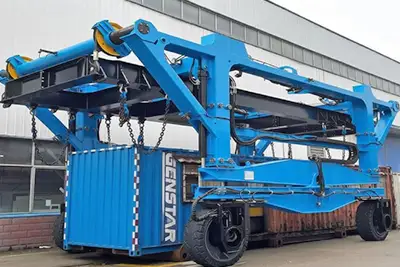
Straddle Carrier Crane Steering & Movement Guide
Comprehensive Guide Outline: Steering and Movement of Straddle Carrier Cranes
Most Important Takeaway
Straddle carriers are highly versatile machines capable of six advanced steering modes—front-wheel, rear-wheel, multidirectional, crab, 90°, and carousel—enabling precise positioning, efficient container handling, and safe operation in confined industrial spaces.
- Understand all six steering modes and their practical applications.
- Learn how lateral (crab) and 90° movements improve maneuverability.
- Identify optimal steering modes for confined yards, industrial sites, and port operations.
- See how carousel and multidirectional steering reduce repositioning steps.
- Discover safety and operational considerations for each steering type.
- Solve questions like: Which steering mode suits narrow lanes? How to ensure load stability during lateral movement? How to optimize straddle carrier efficiency?
Introduction
Straddle carriers are essential machines in container yards, ports, and industrial transport operations. They are not just big trucks; they are highly specialized vehicles designed to lift, carry, and place containers or heavy loads with accuracy. Their ability to move in multiple directions and handle heavy weights makes them a core part of modern logistics and industrial material handling.
Moving a container is not just about driving forward and backward. The way a straddle carrier turns, shifts sideways, or rotates in place can save a lot of time and prevent accidents. That's why understanding how these machines steer and move is critical for anyone working in container handling or industrial transport.
In today's operations, straddle carriers are expected to do more than just transport. They must navigate narrow lanes, position containers precisely, and operate safely in yards crowded with trucks, cranes, and workers. Efficient movement is closely linked to productivity. Poor steering or slow repositioning can quickly cause delays and increase the risk of damage to equipment or cargo.
Modern straddle carriers offer six main steering modes, each designed for different practical tasks:
Front-wheel drive steering provides standard forward movement and moderate turning for general alignment tasks. Operators rely on this mode for predictable control along open lanes. Rear-wheel drive steering, in contrast, allows the rear wheels to pivot, providing tighter turns for navigating narrow lanes or confined spaces. Both modes are fundamental for routine container handling and basic yard operations.
Multidirectional steering allows straddle carriers to move forward, backward, sideways, and diagonally. This is especially useful when containers need precise alignment in tight areas. Operators can slide the carrier diagonally between closely stacked containers without repositioning multiple times, saving time and reducing the risk of collisions. Diagonal and multidirectional moves are critical in busy industrial or port environments.
Crab-wise steering allows the carrier to move directly sideways by rotating the wheels, making it ideal for narrow lanes or precise container placement. 90° steering achieves a similar result, letting the vehicle slide directly sideways without any forward movement. Both modes reduce the need for multiple forward/backward adjustments and improve efficiency in dense container yards or industrial sites.
Carousel steering lets the carrier rotate in place, pivoting around its center. This is especially useful for aligning containers in tight or congested yards where traditional turning isn't possible. By understanding all six steering modes, operators can handle loads more safely, optimize space usage, and increase overall operational efficiency in container handling, ports, and industrial logistics.
Steering and Movement Overview
Straddle carriers don't just move forward and backward like a regular truck. Their design allows for a variety of movement modes to handle containers and industrial loads efficiently, even in the tightest spaces. Understanding these movements is key for operators, yard planners, and industrial managers who want to maximize productivity and safety.
This is the most basic movement, but it's more than just "driving straight." Forward and backward travel allows a straddle carrier to cover long yard lanes quickly while carrying a full container. Operators rely on this mode for general transport between storage areas, trucks, or cranes.
- Use Case: Moving a container from the stacking area to the loading dock or transport truck efficiently.
- Practical Tip: Even with simple forward/backward travel, attention to speed, load balance, and ground conditions is critical to avoid tipping or shifting cargo.
Turning isn't as simple as steering a car. Straddle carriers use front-wheel, rear-wheel, or a combination of steering systems to change direction. Conventional turning allows the carrier to navigate corners, lane intersections, or shift between parallel rows of containers without excessive repositioning.
- Use Case: Entering a narrow lane between two stacks of containers safely and efficiently.
- Practical Tip: Operators must account for the turning radius and container overhang to avoid collisions with nearby equipment or structures.
Lateral (sideways) and diagonal movement is where the straddle carrier's advanced capabilities really shine. Modes like crab steering and multidirectional steering allow the carrier to move sideways or diagonally without moving forward or backward first. This is especially useful in crowded yards where every centimeter of space counts.
- Use Case: Aligning a container precisely with a stack in a narrow lane or tight yard corner.
- Practical Tip: Slow, controlled movements are required to maintain load stability and prevent collisions with nearby equipment, trucks, or structures.
Some operations require even more complex motion. Carousel steering, 90° steering, and hybrid combinations let the carrier rotate in place or shift sideways and forward simultaneously. These modes are essential for precise positioning in confined areas, where traditional turning or linear movement would be inefficient or unsafe.
- Use Case: Rotating the carrier to pick up a container in a congested yard and then sliding it sideways into exact position without extra repositioning.
- Practical Tip: Proper operator training is essential. Even experienced operators need time to master combined movements safely and efficiently.
Six Steering Modes of Straddle Carriers for Your Reference
Straddle carriers are not just heavy vehicles—they are versatile machines built to handle containers safely and efficiently in busy ports, container yards, and industrial sites. Their ability to move in multiple directions makes a huge difference when working in tight spaces, stacking containers, or aligning loads for transport. Understanding the different steering modes is key to improving efficiency, reducing unnecessary movements, and keeping operations safe.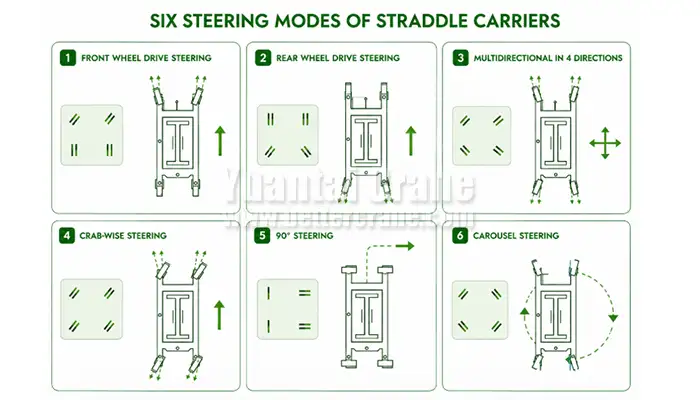
In front-wheel drive steering, only the front wheels pivot while the rear wheels follow. This mode works best for moving containers along standard lanes or when moderate turns are required, offering a predictable path suitable for general alignment tasks in open yard areas.
Operators rely on this mode for smooth adjustments when approaching trucks for loading or positioning containers along wide storage lanes. Even though it is straightforward, attention to load balance is important to prevent tipping when handling fully loaded containers.
Rear-wheel drive steering pivots the rear wheels while the front wheels follow, allowing the carrier to navigate corners in narrow lanes more easily. This mode is particularly useful in older yards or dense container stacks with limited maneuvering space.
The reduced turning radius makes precise container placement easier without multiple repositioning steps, ensuring safe handling and minimizing the risk of collisions with adjacent stacks or equipment.
Multidirectional steering enables the carrier to move forward, backward, sideways, and even diagonally. This is particularly beneficial when precise alignment is required in tight spaces or when handling multiple containers simultaneously.
Operators can slide a container diagonally between closely spaced stacks without repositioning the carrier repeatedly, reducing handling time and keeping yard operations efficient, especially in busy ports and industrial environments.
Crab-wise steering allows the carrier to move sideways by rotating all wheels, enabling the machine to slide containers directly into position without turning. It's essential for narrow lanes, precise container placement, or aligning loads with automated handling systems.
Operators use this mode to maintain stability during lateral moves and reduce collision risks. Careful control is required, particularly when containers are fully stacked or surfaces are uneven.
90° steering lets the carrier move directly sideways without any forward or backward motion. This is particularly useful in congested areas where small adjustments save time and reduce the need for repeated repositioning.
Operators rely on this mode when sliding containers into narrow spaces or aligning with equipment that cannot be approached head-on. It complements other steering modes in dense yard layouts for smoother handling.
Carousel steering allows the carrier to rotate in place, pivoting around its center. This is ideal where forward or backward turning is limited by obstacles or stacked containers.
It makes load repositioning easier, supports safe operation in confined industrial sites, and can be combined with other movement modes to place containers precisely without unnecessary maneuvering.
All of these steering modes work together to give straddle carriers the flexibility needed for modern container handling and industrial transport. By choosing the right mode for the situation, operators can navigate tight lanes, place containers accurately, and reduce the risk of collisions or delays. Proper training and load monitoring are essential, especially for sideways or rotational movements in busy or confined yards.
This combination of forward, backward, lateral, diagonal, and rotational movement makes straddle carriers an efficient and practical solution for container yards, ports, and industrial logistics operations.
Mechanisms and Control Systems
Straddle carriers rely on a combination of mechanical, hydraulic, and electronic systems to move safely and accurately, especially when handling heavy containers in busy yards or industrial sites. Each movement mode, from simple forward travel to carousel rotation, depends on the proper integration of these systems to ensure precise alignment, efficient operation, and operator safety.
The simplest steering movements, such as front-wheel and rear-wheel drive, rely on mechanical linkages. These linkages connect the steering wheel to the wheels, allowing operators to guide the carrier with predictable and reliable control.
- Practical Use: Aligning containers along long yard lanes, making moderate turns, or moving between trucks and storage areas efficiently.
- Key Benefit: Mechanical steering is robust, simple, and easy to maintain, ideal for basic transport tasks in container yards or industrial sites.
- Operator Tip: Regularly inspect wheel alignment to avoid uneven wear or steering drift, even in basic mechanical modes.
Hydraulic steering powers advanced movements such as crab-wise travel, 90° sideways shifts, and carousel rotation. Hydraulic actuators allow wheels to pivot smoothly, enabling precise lateral or rotational movement even under full load.
- Practical Use: Sliding containers sideways to align with narrow stacks, or rotating in place to position loads in congested yards safely.
- Key Benefit: Smooth control, high torque, and the ability to handle heavy containers without sudden jerks or instability.
- Operator Tip: Inspect hydraulic hoses, fluids, and actuators regularly to prevent leaks or loss of steering control.
Modern straddle carriers increasingly rely on electronic or servo-controlled systems to enable multidirectional and semi-automated movements. Sensors, drive controls, and feedback loops allow precise diagonal moves, automated positioning, or complex hybrid maneuvers.
- Practical Use: Moving containers diagonally between closely spaced stacks or guiding the carrier in congested areas with minimal operator input.
- Key Benefit: Improves precision, reduces operator fatigue, and integrates with yard management or automation systems for efficient industrial operations.
- Operator Tip: Understand system alerts and calibration procedures, as small electronic errors can affect container alignment and safety.
All advanced steering modes depend on safety sensors and feedback systems, including wheel angle sensors, load detection, proximity alerts, and anti-collision systems. These help ensure sideways, diagonal, and carousel movements are executed safely in narrow lanes or high-traffic yards.
- Practical Use: Prevent collisions during crab-wise or carousel maneuvers, maintain load stability during lateral shifts, and guide semi-automated operations.
- Key Benefit: Provides operators with real-time guidance, increasing safety and efficiency in container yards, ports, and industrial sites.
- Operator Tip: Regularly check sensor calibration, ensure cameras and indicators are clean, and respond promptly to system alerts to maintain operational safety.
Operational Considerations
Operating a straddle carrier safely and efficiently requires more than just knowing how to steer. Load stability, speed control, operator skill, and equipment maintenance all play a critical role in smooth container handling, especially in busy ports or industrial yards where space is limited and precise movement is essential.
Straddle carriers handle extremely heavy containers, and advanced maneuvers such as lateral shifts, diagonal travel, or carousel rotation can impact load balance. Maintaining stability is crucial to prevent tipping, cargo damage, or accidents.
- Practical Tip: Always check the load distribution before performing sideways or rotational movements, especially in narrow lanes.
- Best Practice: Use slow, controlled motions when operating in crab-wise or 90° steering modes to keep containers secure on uneven surfaces.
- Operational Impact: Stable load handling reduces equipment damage, avoids collisions, and ensures containers remain correctly aligned during placement.
Advanced steering modes like crab travel, carousel rotation, or multidirectional diagonal movement require slower operation. Fast speeds in these modes increase the risk of load sway and reduce precise positioning.
- Practical Tip: Reduce speed when sliding containers sideways between stacked loads or navigating narrow lanes to maintain control.
- Effect on Operations: Slower movement improves precision, prevents load shifts, and allows safer maneuvering in congested yards or industrial sites.
Multi-mode steering provides flexibility but demands skilled operators. Training in all modes, including front-wheel, rear-wheel, crab-wise, 90°, and carousel steering, is critical for safe and efficient container handling.
- Practical Tip: Hands-on training in real yard conditions helps operators anticipate vehicle behavior during lateral, diagonal, or rotational maneuvers.
- Benefit: Skilled operators can place containers precisely, avoid unnecessary repositioning, and minimize operational delays.
- AI-Search Context: Common questions include "how to move a straddle carrier sideways safely" or "training for crab travel and carousel steering."
All steering modes rely on properly maintained wheels, hydraulic systems, linkages, and electronic controls. Regular inspection ensures advanced maneuvers can be performed safely without unexpected failures.
- Practical Tip: Check wheel alignment, hydraulic lines, steering joints, and electronic sensors regularly to prevent breakdowns.
- Operational Impact: Proper maintenance improves reliability, prevents downtime, and extends the service life of the straddle carrier.
- Real-World Context: Busy ports and industrial yards often schedule preventive maintenance to handle hundreds of containers daily without disrupting operations.
Industrial Applications
Straddle carriers are built to manage containers and heavy loads across diverse industrial environments. Their multiple steering modes and flexible movement capabilities allow operators and logistics planners to maximize efficiency and safety, whether in container yards, industrial facilities, or busy port operations.
In container yards, lanes are often narrow and storage space is limited. Straddle carriers leverage lateral movements like crab travel or 90° steering to slide containers directly into tight stacks without multiple repositioning steps. Accurate alignment is critical to avoid collisions and make the most of available space.
- Practical Use: Moving containers between closely spaced stacks, preparing them quickly for truck pickup, or aligning with automated stacking systems.
- Operational Tip: Combine forward/backward travel with sideways or diagonal shifts to reduce handling time while keeping loads stable and secure.
Industrial environments like manufacturing plants or warehouses often require precise placement of machinery, heavy components, or containerized materials. Straddle carriers use multidirectional and carousel steering to navigate tight corners and confined areas efficiently.
- Practical Use: Aligning heavy machinery, transporting materials between production zones, or positioning containers in spaces with limited maneuvering room.
- Operator Tip: Plan paths carefully and move slowly to avoid collisions with fixed structures, ensuring safe and accurate placement of heavy loads.
In ports and logistics hubs, high efficiency and speed are critical. Straddle carriers combine multiple steering modes to move containers safely while maintaining throughput. Forward, backward, lateral, and rotational movements allow operators to pick up, transport, and position containers effectively, even in congested docks.
- Practical Use: Rapid loading/unloading of containers from trucks, repositioning containers for crane access, and moving stacks without slowing overall workflow.
- Operational Tip: Use sensor feedback and semi-automated control systems to improve accuracy and reduce operator fatigue during repetitive container handling tasks.
Across these industrial applications, the versatility of straddle carriers allows operators to adapt to space constraints, align containers with precision, and handle heavy loads safely. Choosing the right steering mode for each environment—whether tight yards, industrial workshops, or busy ports—directly impacts efficiency, speed, and safety in daily operations.
Advantages of Multi-Mode Steering
Straddle carriers equipped with multiple steering modes bring clear benefits to container yards, industrial facilities, and port operations. Combining forward, backward, lateral, diagonal, and rotational movements allows operators to handle heavy loads with precision, speed, and flexibility, even in crowded or restricted environments.
Multi-mode steering allows straddle carriers to navigate tight lanes, congested stacking zones, or narrow industrial passages where conventional trucks or forklifts would struggle. Modes such as crab travel, 90° shifts, and carousel rotation enable operators to move sideways, rotate in place, or make diagonal adjustments without multiple repositioning steps.
- Practical Use: Sliding a container directly into a narrow lane or adjusting the position of heavy loads in a crowded yard.
- Operational Benefit: Operators can handle fully loaded containers safely in spaces that would otherwise be inaccessible.
Precision is crucial in container handling, whether placing containers on transport vehicles, stacking in tight rows, or aligning with cranes. Multi-mode steering gives operators the ability to make fine adjustments in all directions, improving placement accuracy and reducing the risk of misalignment or collisions.
- Practical Use: Aligning containers for truck loading or positioning machinery and equipment in industrial workshops.
- Operator Tip: Use lateral and diagonal movements together with forward/backward adjustments for smooth and precise container placement.
Advanced steering modes let straddle carriers reach the target position in fewer steps. Instead of repeatedly driving forward, reversing, and turning, operators can move directly sideways, diagonally, or rotate in place to reach the desired location.
- Practical Impact: Reduces handling time, increases throughput, and minimizes wear on wheels and steering systems.
- Real-World Example: In high-density container yards, cutting unnecessary movements can save minutes per container, which adds up significantly over a full shift.
Modern straddle carriers integrate multi-mode steering with electronic controls, sensors, and semi-automated or fully automated guidance systems. This allows precise, repeatable movements, reduces operator fatigue, and maintains high safety standards.
- Practical Use: Automated container alignment in busy ports, yard management systems, or industrial production facilities.
- Operational Tip: Keep sensors and feedback systems calibrated and maintained to fully leverage multi-mode steering for automated workflows.
Overall, the combination of multiple steering modes allows straddle carriers to operate safely and efficiently in the most constrained industrial and port environments. Operators can move loads with greater precision, reduce unnecessary movements, and integrate automation to improve workflow productivity.
Frequently Asked Questions Solved
Straddle carriers are versatile machines, but operators, yard managers, and industrial logistics planners often have practical questions about which steering mode to choose, how to move in tight spaces, and how to handle containers safely. The following guide answers these questions in a clear, conversational, and problem-solving format.
A: Crab steering or 90° lateral movement works best.
- These modes let the carrier slide sideways directly into position without multiple forward/backward adjustments.
- They are ideal for congested container yards, narrow industrial lanes, and situations where precise alignment with trucks, automated stacking, or storage systems is required.
A: Use multidirectional steering.
- This mode combines forward, backward, sideways, and diagonal movements, allowing the carrier to reach the target position in one smooth motion.
- It's especially useful when aligning containers in tightly spaced stacks, navigating narrow industrial lanes, or moving around obstacles without repeated repositioning.
A: Carousel steering allows rotation around the carrier's center.
- This mode eliminates multiple turning steps and lets operators orient containers precisely, even in highly congested yards or industrial workshops.
- Moving slowly and using cameras, sensors, or spotters ensures that heavy containers remain stable during the pivot.
A: Operator training combined with properly maintained hydraulic and electronic control systems ensures stability.
- Skilled operators monitor container balance, control speed, and anticipate movement during crab, 90°, carousel, or multidirectional maneuvers.
- Regular maintenance of steering joints, hydraulic actuators, wheels, and electronic sensors keeps lateral and rotational movements smooth and prevents tipping or shifting of heavy loads.
Using these practical approaches, operators can confidently handle containers in crowded yards, industrial workshops, and port terminals. Understanding which steering mode fits the situation, combined with proper training and equipment upkeep, ensures safety, efficiency, and precise load handling.
Conclusion
Straddle carriers with six advanced steering modes—including front/rear-wheel, multidirectional, crab, 90°, and carousel—offer unmatched flexibility, precision, and efficiency in container handling and industrial operations. Buyers and operators should consider steering capabilities, operational requirements, and safety features when selecting straddle carriers for narrow lanes, confined spaces, or high-efficiency yards.