Straddle Carrier for BESS | Safe 30–60T Straddle Carrier ContainerCrane
Safe 30–60T Straddle Carrier Container Crane for BESS & Energy Storage Yards
A high-stability rubber-tyred straddle carrier built for lifting and moving battery energy storage containers inside BESS yards, where space is tight and the load needs controlled handling from pickup to placement.
In most energy storage projects, containers are not just standard cargo. They often include battery systems that require steady movement and careful positioning. This equipment is designed for that kind of work, where operators need predictable control during every travel and lifting cycle.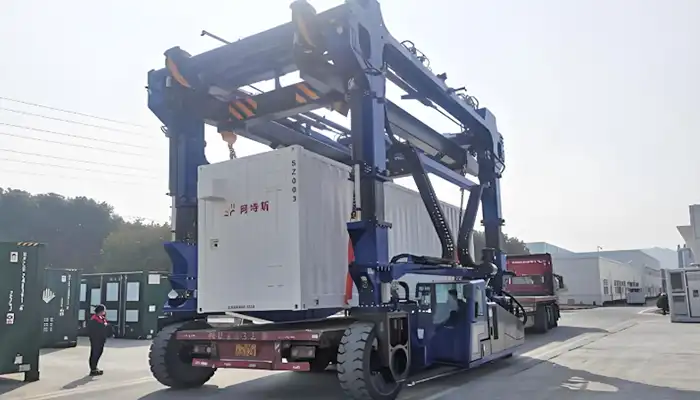 60 ton straddle carrier for BESSY & energy stroage yards
Key Buyer Value Points
The straddle carrier is configured for 30 to 60 ton working loads, depending on project requirements and container weight.
- Suitable for standard BESS container modules
- Supports heavy industrial energy storage units
- Load range can be adjusted based on spreader and structure design
- Keeps lifting within stable working limits under full travel conditions
This capacity range fits most current battery energy storage container sizes used in utility-scale projects.
Stability is one of the main concerns when moving BESS containers across a yard. The frame and hydraulic system are arranged to keep movement steady, even when the ground is not perfectly even.
- Hydraulic lifting system helps balance load during travel
- Wide support structure reduces tilt during turns
- Slow and controlled acceleration for loaded movement
- Designed to reduce vibration during transport
In practice, operators often need to move containers between storage rows, and the equipment is set up to keep that movement consistent and controlled, not rushed.
This straddle carrier is built around the working pattern of energy storage yards, not general container ports.
- Works with repeated short-distance moves inside BESS sites
- Supports frequent loading and unloading cycles
- Fits modular container layout used in battery storage parks
- Can be integrated with site planning from early project stage
In many cases, the yard layout changes over time, so flexibility in handling paths becomes important.
Energy storage sites are often limited in space. Wide turning radius equipment or rail-based systems may not fit well. This machine moves freely within the yard without fixed track requirements.
- Rubber-tyred travel system for unrestricted movement
- 360-degree steering for tight turning areas
- Can operate between narrow container rows
- Works on standard reinforced yard ground
Operators can reposition containers without needing dedicated crane lanes or fixed rails.
Compared to reach stackers and forklifts, this straddle carrier provides a more balanced lifting approach for heavier and wider BESS containers.
- Load is supported evenly from both sides
- Reduced risk of tipping during lifting
- Better control when stacking or placing containers
- More stable under continuous yard operation
Forklifts can reach limits in both capacity and stability, while reach stackers depend more on forward outreach. This system keeps the load centered during movement, which helps during repeated handling cycles.
Send Us An Inquiry
If you are planning a BESS yard or upgrading an existing energy storage site, the next step is usually to match the carrier configuration with your container size and yard layout.
- Request Technical Proposal
- Get Quote for 30–60T Configuration
- Send Yard Layout for Planning Review
A simple layout drawing is often enough to start the technical discussion, and from there capacity, span, and travel path can be adjusted to match the project requirement.
What Is a Straddle Carrier for BESS Container Handling?
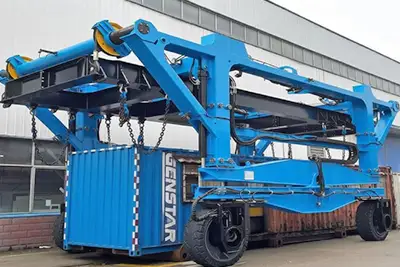
A straddle carrier container crane is a rubber-tyred mobile lifting and transport machine used inside industrial yards to move, lift, and stack heavy containers. It works by driving over the container, lifting it from the ground, and carrying it directly to the required position without the need for fixed rails or external lifting cranes.
In normal container yards, it is mainly used for fast and flexible material movement. In battery energy storage projects, the same structure is adapted to handle more sensitive and higher-value equipment, where control during lifting and travel becomes more important than speed alone.
For BESS (Battery Energy Storage System) applications, the equipment is specially adapted for the working conditions found in energy storage sites, where containers are often arranged in tight layouts and must be moved carefully between charging, storage, and installation areas.
It is commonly used for:
- Battery energy storage container handling inside BESS yards
- High-value equipment movement with controlled lifting and reduced vibration
- Flexible yard logistics where no rail system or fixed crane runway is installed
- Short-distance repetitive transport between container rows and staging zones
- Precise placement of energy storage units during installation or maintenance
In practice, this type of equipment is chosen when the project needs stable container movement across a yard without building heavy infrastructure. It allows operators to adjust handling routes based on site conditions, which is often the case in expanding or modular BESS facilities.
Why Energy Storage Projects Need a 30–60T Straddle Carrier
In battery energy storage projects, the handling environment is not like a traditional warehouse or a simple container yard. Containers are heavier, layouts are tighter, and most sites are built in stages. Because of that, BESS project developers and EPC contractors usually run into a few practical limitations during planning and operation.
BESS project developers and EPC contractors typically face:
- Limited yard space and tight container layouts
Energy storage sites are often designed with high container density. Aisles between units can be narrow, and turning space is not always generous, especially in retrofit or expansion projects. - High-value battery containers requiring safe handling
These containers include sensitive electrical and battery systems. Any impact, vibration, or unstable lifting during movement can create operational risks, so handling needs to stay controlled and steady. - Need for fast loading and unloading cycles
In many projects, containers are frequently moved during installation, commissioning, and maintenance phases. Waiting for slow or fixed-position lifting equipment can reduce site efficiency. - Lack of fixed crane infrastructure
Not every project builds rail-mounted cranes or permanent gantry systems. Some sites are temporary, phased, or located where civil construction cost must be minimized. - Requirement for flexible yard mobility
The handling equipment needs to move across different zones—storage, maintenance, and transport areas—without depending on fixed tracks or predefined lifting points.
Because of these conditions, the 30–60 ton straddle carrier crane becomes a practical choice. It supports direct container handling inside the yard, reduces dependence on fixed infrastructure, and allows operators to adjust movement paths based on actual site layout rather than a fixed installation design.
In many BESS projects, this flexibility is what keeps the logistics flow working smoothly during both early construction and later operational stages.
Where Straddle Carrier for BESS Is Used
The 30–60T straddle carrier for BESS container handling is mainly used in yards where energy storage containers and heavy modular equipment need to be moved regularly, but fixed lifting systems are not practical. These projects usually involve frequent layout changes, staged construction, or mixed equipment types.
In real operation, the equipment is chosen when operators need to move containers directly inside the yard, not just load or unload from a fixed point.
These are the most common application sites. Containers are stored, charged, and relocated within the same yard, often in dense layouts.
- Moving battery storage containers between rows
- Positioning units for installation or commissioning
- Supporting daily operational adjustments inside the yard
- Handling repeated short-distance transfers
In renewable energy projects, storage systems are often built next to generation sites to balance output.
- Transporting energy storage containers between staging and installation zones
- Supporting hybrid solar–wind storage infrastructure
- Handling expansion modules as projects grow
- Coordinating container movement during phased development
Some logistics hubs handle both standard containers and energy storage units, especially in integrated industrial parks.
- Mixed handling of ISO containers and BESS modules
- Yard stacking and repositioning operations
- Supporting short turnaround container flow
- Flexible movement across different storage zones
These yards are used during pre-assembly and testing of battery storage systems before final deployment.
- Moving partially assembled energy storage units
- Positioning modules for system integration and testing
- Handling components during assembly workflow
- Adjusting layout based on production stages
In port environments, energy storage containers may be temporarily stored before delivery to project sites.
- Loading and unloading from transport vessels or trucks
- Temporary stacking in port storage areas
- Coordinating container transfer between logistics systems
- Supporting export and import handling operations
Beyond energy storage, the same equipment is also used in general industrial yards where heavy and oversized loads are handled.
- Moving large steel or machinery components
- Handling prefabricated industrial structures
- Supporting equipment relocation within factory yards
- Flexible use in multi-purpose heavy-duty sites
In all these scenarios, the key requirement is the same: controlled movement of heavy containers inside a flexible yard environment, where layout, safety, and operational flow matter more than fixed lifting infrastructure.
Advantages of Safe 30–60T Straddle Carrier Container Crane
In BESS and industrial container yards, the choice of handling equipment is usually based on stability, safety, and how well it fits the site layout. A 30–60 ton straddle carrier is designed around these practical requirements, especially where containers need to be moved repeatedly within limited space.
Stability is one of the main concerns when handling full-load energy storage containers. The structure and hydraulic system are arranged to keep the load balanced during lifting and travel.
- Balanced hydraulic lifting system that supports even load distribution during lifting and lowering
- Anti-tilt structural frame design that helps maintain stability during turning and positioning
- Smooth operation under full load (30–60T), even when moving across uneven yard surfaces
In daily use, this stability helps operators move containers with less adjustment during travel, especially when working in long repetitive cycles.
Battery energy storage containers require more controlled movement compared to standard freight containers. Internal battery systems are sensitive to vibration and sudden impact.
- Designed for sensitive BESS modules with controlled lifting force and movement speed
- Reduced vibration and shock impact during transport and positioning
- Precise positioning for high-value units during installation or relocation inside the yard
This makes it suitable for projects where equipment protection is as important as handling efficiency.
Many energy storage projects are built without fixed rail systems to reduce construction time and cost. This equipment is designed for free movement inside the yard.
- Rubber-tyred mobility system allows unrestricted travel paths
- 360° steering capability supports tight turning in compact layouts
- Works in narrow container aisles where large fixed cranes cannot operate
In practice, this flexibility allows the same machine to handle multiple zones in the yard without reconfiguration.
Fixed crane systems such as rail-mounted gantry cranes require significant civil work and long installation periods. A straddle carrier reduces that dependency.
- No rail installation required, reducing groundwork and construction time
- Lower infrastructure investment compared to fixed crane systems
- Faster deployment for BESS projects, especially for phased or temporary sites
For many project developers, this means the handling system can be put into operation earlier, without waiting for heavy civil construction to finish.
What Can the 30–60T Straddle Carrier Handle?
The 30–60 ton straddle carrier container crane is designed for mixed heavy-duty yard operations, especially where different types of containers and oversized equipment need to be moved within the same working area. In BESS projects and industrial yards, the load is not always uniform, so the equipment is built to handle both standard containers and special modular units.
In daily operation, it is mainly used for lifting, carrying, and positioning loads that require stable ground contact and controlled movement across short to medium yard distances.
These are one of the primary applications in modern energy storage projects. The containers usually include battery racks, power systems, and cooling units.
- Handling fully assembled BESS containers in storage or installation stages
- Moving units between staging, testing, and final placement areas
- Supporting repeated relocation during commissioning phases
- Maintaining stable transport for sensitive internal systems
The equipment can also be used for standard container handling when energy storage sites share logistics functions.
- Moving 20ft and 40ft ISO containers within the yard
- Supporting storage and dispatch operations
- Handling mixed container flows in industrial logistics parks
- Flexible use in multi-purpose container terminals
Many BESS projects use prefabricated modules that are assembled off-site and transported as complete units.
- Transporting modular energy blocks and skid-mounted systems
- Positioning prefabricated electrical and power units
- Supporting staged assembly workflows in energy parks
- Handling oversized modular components with balanced lifting
In industrial yards, the same carrier is often used for general heavy fabrication work.
- Moving large steel frames and structural components
- Handling machinery parts during installation or relocation
- Transporting irregular-shaped industrial equipment
- Supporting fabrication yard logistics operations
Some projects involve non-standard loads that exceed normal container dimensions.
- Handling oversized industrial modules and assemblies
- Moving equipment that requires wide-span lifting support
- Supporting special transport tasks within confined yard spaces
- Flexible use for non-containerized heavy cargo
The working capacity of the straddle carrier can be configured based on project requirements and load conditions.
- Standard configuration: 30 tons
Suitable for typical container yard operations and lighter BESS modules - Heavy-duty configuration: up to 60 tons
Designed for large energy storage containers and heavier industrial equipment
In practice, the selection between 30T and 60T depends on the maximum container weight, future expansion plans, and how frequently heavy lifting cycles are required in the yard.
Engineering Design of Container Straddle Carrier Crane
The 30–60T straddle carrier container crane for BESS and industrial yards is built around a simple idea: move heavy containers safely inside the yard without depending on fixed infrastructure. The design focuses on structural strength, controlled lifting, and stable travel performance under repeated working cycles.
In energy storage projects, the equipment often runs continuously during installation, commissioning, and daily operations, so each system is arranged to keep movement steady and predictable under load.
The main frame is designed to carry heavy container loads while maintaining structural balance during lifting and travel.
- High-strength welded steel structure for long-term load support
- Reinforced beams in key stress areas to reduce deformation
- Designed for repeated lifting cycles under 30–60 ton working conditions
- Improved rigidity for stable container positioning
This structure helps maintain alignment when handling long or heavy BESS containers across uneven yard surfaces.
The lifting system is central to safe container handling, especially for energy storage units that require controlled movement.
- Multi-point hydraulic lifting for even load distribution
- Integrated balancing control during lifting and lowering
- Smooth vertical motion to reduce sudden impact on containers
- Stable operation during full-load transport
In practical use, this system helps reduce sudden movement during pickup and placement, which is important for sensitive battery equipment.
Unlike rail-mounted systems, this equipment is designed for free movement inside the yard.
- Rubber-tyred chassis suitable for concrete yard surfaces
- 360° steering capability for tight working areas
- Flexible routing between container rows
- Suitable for both straight and curved travel paths
This allows operators to adjust movement paths based on real yard conditions rather than fixed infrastructure.
Different energy storage projects may have different operating environments, so multiple drive options are available.
- Diesel drive for high-intensity outdoor operation
- Hybrid system for balanced fuel efficiency and performance
- Electric drive for low-emission or indoor-adjacent applications
- Adaptable power configuration based on site requirement
The selection usually depends on operation hours, emission restrictions, and site energy strategy.
For projects requiring higher control precision, additional systems can be integrated.
- Load monitoring during lifting and transport
- Positioning assistance for accurate container placement
- Semi-automatic or remote operation options
- Data tracking for operational management
These functions are often used in larger BESS facilities where multiple carriers operate in the same yard.
Operator control and visibility are important for safe handling of high-value containers.
- Elevated cabin position for wide working view
- Large glass panels for improved yard visibility
- Ergonomic control layout for long operating shifts
- Reduced blind spots during lifting and turning operations
This design supports safer operation, especially when working in dense container layouts where movement space is limited.
Straddle Carrier vs Other Container Handling Equipment
When planning a BESS container yard, buyers usually compare different equipment options. The main focus is simple: safety, stability, and how easy it is to move heavy containers in a limited space.
Reach stackers are common in many container yards, but they are more limited when containers are heavy or moved very often.
- Straddle carrier gives better stability for BESS containers
- More suitable for repeated yard movement
- Keeps the load more balanced during travel
- Works better for continuous daily operations
Reach stackers are flexible, but straddle carriers feel more stable when handling heavy energy storage units again and again.
RTG cranes usually need fixed rails or a set path, which makes them less flexible for changing yard layouts.
- No rail or fixed track needed for straddle carrier
- Easier to change yard layout in BESS projects
- Can move freely in different directions
- Faster to install and start using
RTG cranes work well in large terminals, but straddle carriers are better when the site needs flexibility.
Forklifts are useful for small or light containers, but they have limits for heavy BESS units.
- Straddle carrier handles much heavier loads (30–60T)
- Safer for large battery containers
- More stable during lifting and moving
- Better for wide and heavy equipment
Forklifts are good for light work, but straddle carriers are safer and more stable for heavy energy storage containers.
Safe Operation for Battery Energy Storage Handling
Safety is a key concern in BESS container handling, especially when moving heavy battery energy storage units inside a busy yard. The 30–60T straddle carrier is designed with multiple safety systems to keep lifting and transport stable, even during continuous operation.
This system helps reduce swinging or shaking when the container is lifted or moved.
- Keeps the load steady during travel
- Reduces movement during lifting and lowering
- Helps with accurate container placement
- Important for sensitive battery energy storage units
Built to stop the machine quickly and safely if needed.
- Immediate braking during abnormal situations
- Helps prevent accidents during yard operation
- Supports safe stopping even under load
- Adds extra protection for operators and equipment
This function allows operators to see the load condition during lifting.
- Shows actual load weight during operation
- Helps avoid overloading
- Supports safer decision-making during movement
- Useful for high-value BESS containers
The operator cabin is designed for clear visibility and safe control.
- Wide viewing area for yard operation
- Comfortable control layout for long shifts
- Better visibility during lifting and turning
- Helps reduce blind spots in tight container spaces
Multiple sensors are used to monitor equipment condition and working status.
- Detects unsafe operating conditions
- Supports early warning during abnormal movement
- Improves overall operational safety
- Works together with control system for stable handling
In BESS container yards, these safety systems work together to keep operations steady, especially when containers are heavy, valuable, and moved frequently within limited space.
Customized Straddle Carrier for Your BESS Project
Every BESS container yard has a different layout, container size, and operating flow. Some sites focus on fast installation, while others need long-term daily operation with repeated container movement. Because of this, the 30–60T straddle carrier container crane is often customized to match the real working conditions of the project, not a fixed standard design.
Customization is usually based on three things: load requirement, yard space, and operation method.
The lifting capacity can be selected based on the heaviest container in your system.
- 30T: suitable for standard BESS containers and light modular units
- 40T–50T: common choice for medium-size energy storage projects
- 60T: used for large battery storage containers or heavy industrial loads
- Capacity is matched with safety margin for stable lifting
In practice, buyers often choose slightly higher capacity than current needs to allow future expansion.
Different energy storage containers may have different widths or stacking layouts, so the span can be adjusted.
- Matches standard ISO container width or custom BESS module sizes
- Supports different yard row spacing designs
- Helps improve movement efficiency in tight layouts
- Allows better stability during lifting and transport
This is especially useful when the project expands in phases.
The drive system can be selected based on site conditions and environmental requirements.
- Diesel: strong power output, suitable for outdoor heavy-duty use
- Electric: lower noise and suitable for cleaner energy projects
- Hybrid: balanced option for long working hours and fuel efficiency
- Choice depends on operating schedule and site restrictions
Many energy storage projects now prefer electric or hybrid systems due to sustainability goals.
For larger or more advanced BESS yards, control systems can be upgraded.
- Remote operation for improved safety distance
- Semi-automatic movement support
- Load positioning assistance during container placement
- Optional integration with yard management systems
This helps reduce manual workload in repetitive handling environments.
Since BESS containers are not always standard ISO types, the lifting spreader can be adapted.
- Custom gripping points for battery energy storage containers
- Stable lifting to reduce vibration and impact
- Designed for different container frame structures
- Ensures safe connection during lifting and transport
In most projects, customization is not just about technical preference. It is about matching the equipment to the real yard layout so that daily operation feels smooth, predictable, and safe when handling energy storage containers.
What Buyers Need to Prepare
Before installing a 30–60T straddle carrier for BESS container handling, the project site needs to be properly evaluated. This helps ensure the equipment can operate safely, turn smoothly, and handle full-load containers without stress on the ground or system.
Most preparation work is simple, but it must match real operating conditions in the yard.
The yard layout decides how the straddle carrier will move between containers.
- Clear planning of container rows and storage positions
- Enough space between rows for safe movement and turning
- Defined paths for loading, unloading, and transport flow
- Future expansion space if the BESS project grows
A well-planned layout helps reduce unnecessary movement and improves daily efficiency.
Since the equipment carries heavy loads, the ground condition is important for safe operation.
- Concrete or reinforced yard surface is usually required
- Ground must support full 30–60T working load
- Even surface helps reduce vibration during travel
- Poor ground conditions may affect stability and long-term use
In practice, many delays in projects come from weak or uneven yard surfaces, so this is often checked early.
Different projects have different handling speeds depending on workload.
- How fast containers need to be moved per cycle
- Frequency of daily lifting operations
- Peak workload during installation or maintenance periods
- Balance between speed and safety during movement
This helps determine motor power, hydraulic response, and control system settings.
The power setup depends on the chosen drive type of the straddle carrier.
- Diesel system: requires fuel supply planning for continuous operation
- Electric system: needs stable charging infrastructure or power connection
- Hybrid system: combines both for flexible usage
- Backup planning for long working hours in large projects
A stable energy supply ensures the equipment can run without interruption.
Space for movement is one of the most important design factors in BESS yards.
- Enough turning space for 360° movement
- Aisle width must match equipment span and container size
- Avoid sharp or restricted corners in layout design
- Ensure smooth passage between tightly packed container rows
If space is too narrow, it can slow down operations and increase handling time.
When these basic conditions are planned correctly, the straddle carrier container crane can operate smoothly, safely, and with predictable performance in daily BESS yard operations.
Frequently Asked Questions
Below are common questions from buyers planning a BESS container yard using a 30–60T straddle carrier container crane. These answers focus on practical use in real projects, not just specifications.
Yes. It is designed for battery energy storage container handling in yard environments where safety and stability are important.
- Stable lifting for heavy and sensitive BESS units
- Controlled movement during transport and placement
- Suitable for repeated daily yard operations
- Works well in tight energy storage layouts
In most BESS projects, it is used for both installation and long-term container movement inside the same yard.
The working capacity is normally between 30 to 60 tons, depending on project requirements.
- 30T: standard energy storage containers
- 40–50T: medium-duty BESS or modular systems
- 60T: heavy or oversized industrial energy storage units
- Capacity can be matched with safety margin based on real load
This range covers most current utility-scale energy storage container designs.
No. The straddle carrier is a rubber-tyred mobile system, so it does not depend on fixed rails.
- Free movement across the yard
- No rail construction or civil track work needed
- Flexible route planning based on site layout
- Faster setup compared to fixed crane systems
This is especially useful for projects that need quick deployment or phased construction.
Yes. The equipment is often customized based on the real layout of the energy storage site.
- Adjustable span for different container widths
- Custom spreader design for BESS containers
- Control system options for manual or semi-automatic operation
- Drive system selection based on site conditions
In practice, most BESS yards require some level of customization to match container spacing, ground conditions, and operating flow.
Get Your 30–60T Straddle Carrier Solution for BESS Yards
If you are planning a battery energy storage (BESS) container yard, the right handling equipment makes daily operation smoother and more predictable. A 30–60T straddle carrier container crane is built for stable movement, safe lifting, and flexible yard operation without fixed rails or complex infrastructure.
It is commonly used in projects where containers need to be moved repeatedly between storage, installation, and maintenance areas.
This equipment is built for real yard conditions where space, timing, and safety all matter at the same time.
- Stable handling of heavy BESS containers during transport and placement
- Smooth movement across narrow or busy container yards
- Reliable operation under continuous daily workload
- Suitable for both installation phase and long-term operation
In many projects, it becomes the main equipment for internal yard logistics, not just occasional lifting work.
To match the right configuration for your project, we usually start from basic yard and container information.
Main Parameters Required for a Tailored Straddle Carrier Container Crane
- Container type (BESS container, ISO container, modular unit)
- Maximum load weight (30T / 40T / 50T / 60T requirement)
- Yard layout and available working space
- Container row spacing and stacking plan
- Ground condition and bearing capacity
- Required handling cycle time (moves per hour/day)
- Drive system preference (diesel / electric / hybrid)
- Special requirements (anti-vibration, automation, remote control)
- Future expansion or layout change plans
A simple layout drawing or container specification is enough to begin, and then capacity, span, and movement plan can be adjusted based on your BESS yard requirements.