
Yuantai Crane for Better Solutions:
Energy-Saving | Space-Saving | Cost-Efficient | CE/ISO/EX
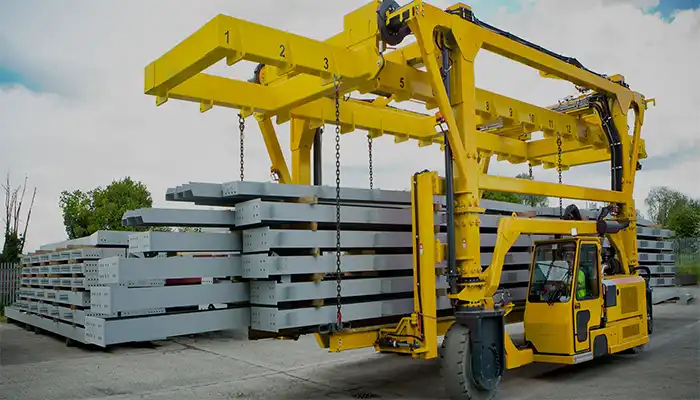
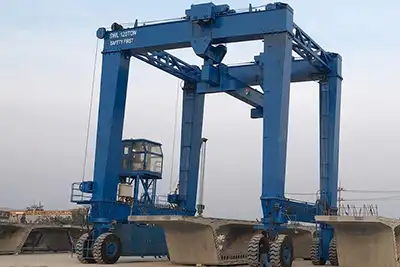
Efficiently handle containers, heavy machinery, modular units, steel structures, and precast concrete with versatile rubber-tyred straddle carriers.
Straddle Carriers for Ports, Steel, and Construction Loads
| Product Type: | Straddle Carrier |
|---|---|
| Lifting Capacity: | 1~80 ton |
| Span: | As request |
| Lifting Height: | As your request |
| Working Class: | A5, A6 |
| Ambient Temperature: | -20-+40 ℃ |
| Crane Price Rangs | More Inquiry Form |
| $60,000 to $600,000+ USD, for reference only. Contact Yuantai Crane to get specific price. | |
| [email protected] 008615038346929 | |
Heavy-Duty Straddle Carriers
Straddle carriers are the ultimate solution for efficiently and safely handling extremely heavy and oversized loads, including containers, modular buildings, steel structures, precast components, and industrial equipment modules.
Heavy-duty straddle carriers are specialized vehicles designed to lift, transport, and position extremely heavy and oversized loads. They are widely used in industrial yards, construction sites, manufacturing facilities, and port terminals. Unlike forklifts or traditional cranes, straddle carriers are built to move large objects efficiently while keeping stability and safety at the forefront.
Straddle carriers are not just about moving stuff from point A to point B. They are engineered to handle containers, prefabricated modules, steel structures, precast components, heavy machinery, and even specialized items like gas tanks or battery cabinets. Their combination of mechanical, hydraulic, and electronic systems makes them reliable for continuous operation and heavy-duty applications.
These machines shine when loads are too heavy, bulky, or awkward for other lifting equipment. They are a common sight in:
- Ports and intermodal yards: Moving and stacking ISO containers safely.
- Construction sites: Transporting modular buildings, precast concrete panels, and steel structures across the site.
- Factories and warehouses: Handling heavy machinery, large electrical cabinets, or industrial gas tanks.
- Energy storage facilities: Relocating large battery cabinets or control units without damaging sensitive components.
The key is that straddle carriers combine lifting, moving, and precise positioning in a single piece of equipment. Operators can handle loads that would normally require multiple forklifts or cranes, reducing complexity and time.
Straddle carriers offer several advantages when compared to forklifts, reach stackers, or traditional cranes:
- High load capacity: Can lift loads far heavier than a forklift without compromising safety.
- Multi-directional movement: Unlike cranes, which are limited to one point, straddle carriers can move forward, backward, sideways, and even pivot on the spot in some models.
- Stability for oversized loads: The rectangular wheel configuration and low center of gravity prevent tipping, even with irregular-shaped or tall items.
- Efficiency: Operators can lift and transport in one motion, avoiding multiple handling steps and saving time.
- Reduced footprint: Works in tight spaces where large cranes cannot be installed, especially inside warehouses or narrow yard lanes.
Straddle carriers are not just about moving heavy items—they improve how work is done on site. Their ability to precisely place, stack, and transport heavy loads simplifies planning, reduces downtime, and minimizes accidents caused by unstable loads.
- Workflow optimization: By combining transport and lifting, less coordination is needed between teams, and the number of handling steps is reduced.
- Faster operations: High-capacity lifting and smooth travel speed allow multiple loads to be moved quickly, which is especially useful in ports or industrial yards.
- Improved safety: Integrated sensors, hydraulic locks, and precise controls reduce the risk of accidents. Even fragile or sensitive loads like electrical cabinets or battery units can be moved without damage.
In short, straddle carriers fill a niche where heavy, bulky, or irregular loads need to be moved safely, quickly, and with minimal manual effort. They are practical, reliable, and designed to handle the demands of industrial and construction environments every day.
How Straddle Carriers Work
Straddle carriers may look straightforward at first glance, but under the hood, they are a combination of mechanical, hydraulic, and electronic systems working in sync to lift and transport extremely heavy loads safely and efficiently. Understanding how these systems operate together helps explain why straddle carriers are preferred in ports, construction sites, and industrial yards.
At the core, straddle carriers rely on mechanical strength, hydraulic power, and intelligent electronic control.
- Mechanical system: Provides the basic lifting frame, structure, and wheels capable of supporting heavy weights. The steel frames are designed for rigidity, stability, and long-term durability.
- Hydraulic system: Powers the lifting and lowering of loads through smooth, controlled motion. Hydraulic cylinders often include locks to prevent accidental drops if a line fails.
- Electronic system: Controls vehicle movement, lifting speed, and positioning. Modern systems integrate sensors, control units, and sometimes GPS for precise handling of loads.
Together, these systems allow operators to handle heavy, oversized, or fragile materials with accuracy and safety, without the jerks or instability often associated with traditional forklifts or cranes.
One of the defining features of straddle carriers is the adjustable lifting frame with a spreader at the base. This makes them extremely versatile:
- Spreader arms can adjust to fit containers, modular units, precast panels, or industrial equipment.
- Lifting height can often be modified, allowing operators to stack items at different levels or clear overhead obstacles.
- Custom spreaders can handle oddly shaped or oversized loads, ensuring that even unconventional items like battery cabinets or gas tanks can be lifted safely.
This flexibility is crucial in mixed-use yards or construction sites where load sizes vary frequently.
Straddle carriers are designed to move in any direction with stability, thanks to their unique wheel arrangement:
- The rectangular wheel layout provides a low center of gravity, keeping tall or heavy loads from tipping.
- Many models offer crab-wise steering, 90-degree turns, or carousel rotation, allowing movement in tight spaces where forklifts or cranes would struggle.
- Multi-speed hydrostatic drives allow operators to adjust speed for safety or efficiency, depending on the load and environment.
This mobility makes straddle carriers highly practical for dense industrial yards or construction sites where precise placement is critical.
Modern straddle carriers incorporate electronic intelligence to improve safety and efficiency:
- Sensors detect obstacles and help prevent collisions with objects or personnel.
- GPS systems provide real-time navigation and tracking, especially in large yards or intermodal terminals.
- Computerized control units synchronize lifting, lowering, and transport, ensuring loads remain balanced and operations are smooth.
- Some systems even include automatic leveling and self-locking features, giving operators confidence when handling fragile or high-value loads.
The combination of mechanical, hydraulic, and electronic systems ensures that heavy or oversized loads can be transported precisely, safely, and efficiently, even in challenging environments.
Types of Straddle Carriers
Straddle carriers come in different designs to match the type of load and operational needs. Choosing the right type is crucial because it affects efficiency, safety, and cost. The two main types are fixed-frame carriers and telescopic-frame carriers.
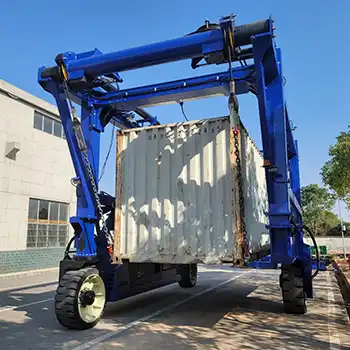 chain type container straddle carrier
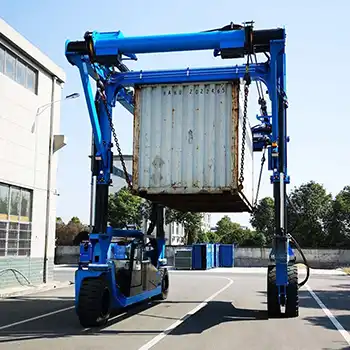 Telescopic Chain Container Straddle Carrier
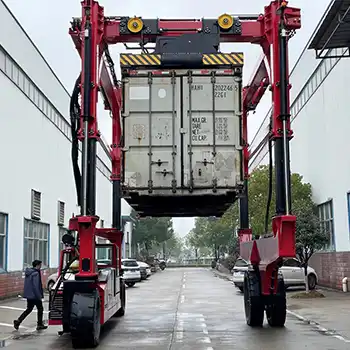 Telescopic Toplift Container Straddle Carrier
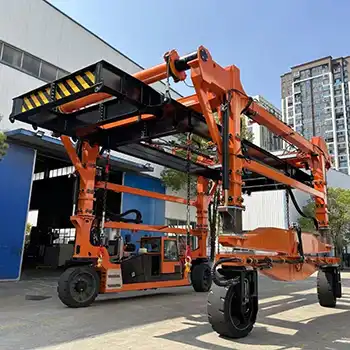 Multifunctional straddle carrier
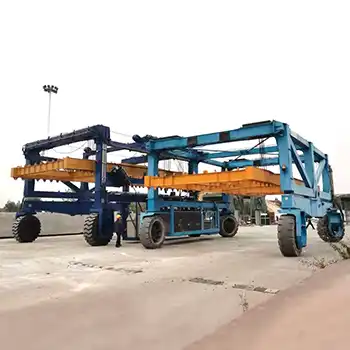 Multifunctional straddle carrier
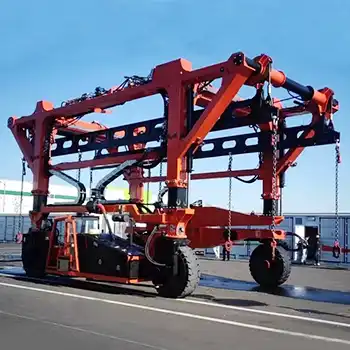 Multifunctional straddle carrier
Fixed-Frame Straddle Carriers
Fixed-frame straddle carriers are designed with a rigid frame and set lifting height. They are ideal for uniform loads that are repetitive in size and weight.
Best for: ISO containers, standard steel bundles, or prefabricated components of consistent dimensions.
Advantages:
- Simple construction, which makes them easier and cheaper to maintain.
- High stability due to the fixed frame design.
- Lower initial investment compared to telescopic models.
Limitations:
- Cannot adjust height or width, so less flexible for oversized or irregular loads.
- Less adaptable if operational needs change frequently.
In practice, fixed-frame carriers are often used in ports, steel yards, and factories where loads are consistent and stacking or transfer operations are repetitive.
Telescopic-Frame Straddle Carriers
Telescopic-frame carriers have an adjustable lifting frame, allowing the width and sometimes the height to be modified. They are designed for variable-sized or oversized loads.
Best for: Mixed container sizes, modular buildings, precast concrete panels, or irregularly shaped industrial equipment.
Advantages:
- High flexibility to handle multiple load dimensions.
- Can adjust stacking height for tight spaces or higher storage requirements.
- Ideal for operations with changing load types, such as construction sites or intermodal yards.
Limitations:
- More complex hydraulic and mechanical systems mean higher maintenance requirements.
- Higher upfront cost than fixed-frame carriers.
Telescopic carriers are especially useful in yards or construction sites where the types of loads vary daily, giving operators the ability to lift, transport, and place items of different sizes without additional equipment.
Comparison Between Fixed and Telescopic Straddle Carriers
| Feature | Fixed-Frame Carrier | Telescopic-Frame Carrier |
|---|---|---|
| Lifting Height | Fixed, limited | Adjustable, can handle higher stacks |
| Load Capacity | Suitable for uniform loads | Can handle mixed or oversized loads |
| Flexibility | Limited | High, adapts to changing operations |
| Operational Cost | Lower maintenance, simpler systems | Higher maintenance, more complex systems |
| Best Use Cases | Ports, steel mills, factories | Intermodal yards, construction sites, modular building handling |
Applications in Heavy Load Handling
Straddle carriers are versatile machines for lifting, transporting, and positioning heavy or oversized loads in ports, industrial yards, construction sites, and manufacturing facilities. They combine hydraulic precision, mechanical strength, and electronic controls to improve safety, reduce handling time, and optimize workflows.
Straddle carriers, including rubber-tyred straddle carriers and straddle cranes, are versatile machines designed for efficient lifting, transporting, and positioning of heavy and oversized loads. Used widely in ports, industrial yards, construction sites, steel fabrication plants, and renewable energy projects, they combine mechanical strength, hydraulic precision, and electronic controls to optimize workflows, reduce labor, and enhance safety.
This guide covers typical objects handled, industrial applications, typical capacities, practical selection tips, and advantages over forklifts, reach stackers, and traditional cranes.
Container Handling
Industrial Background: Ports, terminals, and container yards require fast, safe, and repetitive handling of ISO-standard containers. Straddle carriers are ideal for stacking and transporting containers efficiently, particularly in congested or multi-directional yard layouts.
| Feature | Details |
|---|---|
| Load Types | ISO containers: 20ft, 40ft, 45ft, high cube, wide pallet containers |
| Typical Capacity | 30–60 tons; up to 80 tons for heavy-duty units |
| Selection Tips | Choose adjustable spreaders for different container types; verify stacking height; check yard turning radius |
| Advantages | Safer than forklifts; more flexible than RTG cranes; faster and smoother stacking than reach stackers |
Modular Building Handling
Industrial Background: Construction companies handling prefabricated residential, commercial, or industrial modules rely on straddle carriers for transport and placement. Rubber-tyred straddle carriers enable movement across uneven sites without requiring crane foundations.
| Feature | Details |
|---|---|
| Load Types | Prefabricated modular units, volumetric construction units |
| Typical Capacity | 20–50 tons depending on module size |
| Selection Tips | Use adjustable lifting frames; ensure hydraulic durability for outdoor sites; protective spreaders prevent wall damage |
| Advantages | Precise placement; safer than forklifts; reduces labor and handling time; can operate on unfinished site surfaces |
Steel Structure Transfer
Industrial Background: Steel fabrication workshops and assembly yards often need large beams, trusses, or fabricated frames moved between cutting, welding, and assembly stations. Straddle carriers provide multi-point lifting and precise ground transport without cranes.
| Feature | Details |
|---|---|
| Load Types | Beams, trusses, fabricated frames, steel bundles |
| Typical Capacity | 30–80 tons; up to 100 tons for extra-long steel |
| Selection Tips | Multi-point lifting for long loads; adjustable width frames for varying steel sizes; verify aisle width |
| Advantages | Safer than forklifts; mobile compared to cranes; handles irregular-shaped or heavy steel in one trip |
Precast Concrete Components
Industrial Background: Civil engineering, bridge, and building projects require safe transport of precast slabs, panels, beams, and hollow-core units. Straddle carriers reduce cracking risk during lifting and movement.
| Feature | Details |
|---|---|
| Load Types | Concrete panels, slabs, beams, structural units |
| Typical Capacity | 25–70 tons depending on component weight and size |
| Selection Tips | Ensure smooth hydraulic lifting; adjustable height for stacking; use compatible spreaders/clamps |
| Advantages | Faster horizontal transport than cranes; reduces trips; safer than forklifts for heavy concrete |
Heavy Equipment and Machinery Modules
Industrial Background: Factories, power plants, and assembly workshops frequently move industrial machinery, turbines, engines, and generators. Straddle carriers provide horizontal mobility without complex rigging.
| Feature | Details |
|---|---|
| Load Types | Presses, turbines, generators, oversized industrial modules |
| Typical Capacity | 30–80 tons or higher for specialized units |
| Selection Tips | Match spreader footprint to machinery; use hydraulic control for precision placement |
| Advantages | Safe and precise positioning; reduces need for cranes; handles oversized and heavy industrial loads efficiently |
Gas Tanks and Pressure Vessels
Industrial Background: Chemical plants, refineries, and industrial gas suppliers require safe handling of pressure vessels, industrial gas tanks, and chemical containers.
| Feature | Details |
|---|---|
| Load Types | Industrial gas tanks, pressure vessels, hazardous chemical containers |
| Typical Capacity | 15–50 tons; up to 80 tons for oversized tanks |
| Selection Tips | Secure clamps and safety sensors; plan multi-directional travel paths |
| Advantages | Safer than forklifts; precise placement; reduces spill risk and manual handling |
Electric Cabinets and Battery Storage Units
Industrial Background: Data centers, industrial facilities, and energy storage projects need large electrical panels or battery cabinets moved safely. Rubber-tyred straddle carriers allow indoor and outdoor transport without tipping or damage.
| Feature | Details |
|---|---|
| Load Types | Electrical cabinets, switchgear, industrial battery storage units |
| Typical Capacity | 5–30 tons depending on size |
| Selection Tips | Check aisle clearance; use adjustable lifting frames; protective clamps for delicate units |
| Advantages | Precise indoor placement; safer than forklifts; reduces handling time and risk |
Industrial Pipes and Tubes
Industrial Background: Construction, oil, gas, and water pipeline projects require long steel or concrete pipes to be transported efficiently.
| Feature | Details |
|---|---|
| Load Types | Steel/concrete pipes, bundled or single length |
| Typical Capacity | 20–50 tons per bundle |
| Selection Tips | Adjustable spreaders for diameter variations; check yard clearance for long pipes |
| Advantages | Reduces tipping; handles bundled loads; more efficient than forklifts or cranes for long pipes |
Wind Turbine Components
Industrial Background: Renewable energy projects require movement of towers, blades, nacelles, and oversized components safely across storage yards or pre-assembly areas.
| Feature | Details |
|---|---|
| Load Types | Towers, blades, nacelles, oversized wind components |
| Typical Capacity | 40–80 tons depending on component |
| Selection Tips | Multi-directional steering; extended lifting frames for tall towers |
| Advantages | High stability; reduces damage risk; precise positioning for assembly |
Heavy Steel Coils, Timber, and Shipbuilding Components
Industrial Background: Steel plants, sawmills, and shipyards often handle heavy rolled steel coils, timber bundles, and hull sections. Straddle carriers allow safe, stable, and precise transport.
| Feature | Details |
|---|---|
| Load Types | Steel coils, timber bundles, lumber pallets, hull sections, ship modules |
| Typical Capacity | 10–100 tons depending on material |
| Selection Tips | Use coil or timber-specific spreaders; check aisle and yard layout; plan for long or irregular loads |
| Advantages | Handles long, irregular loads; safer than forklifts; allows multi-point lifting |
Solar Panels, HVAC Units, and Railway Equipment
Industrial Background: Renewable energy, industrial buildings, and rail depots need safe movement of solar arrays, large HVAC units, and railway components.
| Feature | Details |
|---|---|
| Load Types | Solar panels, cooling towers, HVAC units, train bogies, rails, assembled wagons |
| Typical Capacity | 5–80 tons depending on component |
| Selection Tips | Flat stable platforms for panels; adjustable lifting frames for HVAC; long-frame carriers for rail |
| Advantages | Prevents damage; precise placement; safer and faster than forklifts or traditional cranes |
Practical Tips for You:
- Straddle carriers, including rubber-tyred straddle carriers and straddle cranes, are essential for any heavy, oversized, or irregular load in ports, construction, fabrication, and industrial facilities.
- Capacities range from 5 tons (battery cabinets, solar panels) to 100 tons (steel bundles, ship modules, wind towers).
- Practical selection tips: frame/spreader compatibility, lifting height, aisle width, ground clearance, and load stability.
- Compared to forklifts, reach stackers, or cranes, straddle carriers save time, improve safety, reduce labor, and allow precise placement in tight, complex industrial layouts.
Key Features and Specifications
Straddle carriers, including rubber-tyred straddle carriers and straddle cranes, are engineered to handle heavy and oversized loads safely and efficiently. Their design integrates mechanical strength, hydraulic power, and electronic control, ensuring smooth operations across industrial yards, ports, construction sites, and manufacturing facilities. Understanding their key features and specifications is essential for selecting the right model for your operation.
The core function of a straddle carrier is to lift and transport heavy loads. Models vary depending on application, but all are designed to maintain stability while carrying large containers, modular buildings, steel structures, or other industrial objects.
- Lifting Capacity: Typically ranges from 5–100 tons, depending on the model and object type.
- Stack Height: Adjustable in most models, allowing safe stacking of containers, precast units, or modular components.
- Stability: Rectangular wheel configuration, low center of gravity, and wide base ensure safe transport of heavy and irregular loads.
Straddle carriers feature robust frame structures built for high-stress industrial environments. Combined with hydraulic systems, they provide controlled lifting and precise load placement.
- Reinforced Frame: Designed to handle dynamic loads, heavy-duty steel with anti-deformation properties.
- Hydraulic System: Powers lifting cylinders for smooth motion; often includes self-locking valves to prevent accidental descent.
- Lifting Cylinders: Equipped with balance valves for safety and load stability.
- Steering Mechanisms: Integrated into the frame for precise movement, even with heavy or long loads.
Modern straddle carriers offer multi-directional mobility, making them ideal for complex industrial layouts, narrow corridors, and dense yard operations.
- Front/Rear Drive Steering: Standard for straight-line and reverse movements.
- Crab Steering: Allows lateral movement for tight alignments or precise positioning.
- 90° Steering: Enables perpendicular turns in confined spaces.
- Carousel or Fully Multi-Directional Steering: Provides maximum flexibility for industrial applications where maneuvering around obstacles is critical.
Safety is a top priority in straddle carrier operations, especially when handling heavy, oversized, or delicate loads.
- Interlocks: Prevent lifting while the vehicle is in motion.
- Anti-Collision Systems: Sensors detect obstacles in real-time to prevent accidents.
- Self-Locking Hydraulics: Ensures load stability even if a hydraulic line fails.
- Mechanical and Soft Limits: Lifting and turning operations are restricted to safe limits to protect equipment and personnel.
Depending on operational requirements, straddle carriers can be customized to improve efficiency and flexibility.
- Automation: Semi-automatic or fully automated systems for container yards, industrial facilities, or manufacturing lines.
- Customized Spreaders: Adjustable or telescopic spreaders for variable-sized loads, modular units, precast components, or oversized machinery.
- Telescopic Mechanisms: Extendable frames for handling mixed-size cargo or high-stacking applications.
Practical Tips for You:
- Straddle carriers are designed to lift, transport, and place heavy or oversized loads with safety and precision.
- Core specifications—lifting capacity, stack height, reinforced frame, and hydraulic system—ensure reliability in industrial operations.
- Multi-mode steering and optional features provide flexibility for complex layouts, tight spaces, and variable cargo sizes.
- Safety mechanisms including interlocks, anti-collision systems, and self-locking hydraulics protect both personnel and cargo.
Selecting the Right Straddle Carrier
Choosing the right straddle carrier is critical for efficient, safe, and productive material handling. Whether you're operating a rubber-tyred straddle carrier in a port or a straddle crane in a factory, the selection process should balance site requirements, load types, operational workflow, and long-term cost efficiency.
The physical environment plays a major role in selecting the ideal carrier.
- Assess yard or warehouse dimensions, aisle widths, and turning radii.
- Consider obstacles, ramps, and gradeability, especially for outdoor operations or uneven surfaces.
- Analyze workflow patterns, including loading/unloading zones, storage areas, and transport paths.
- Determine if multi-directional mobility is needed for tight spaces or dense storage layouts.
Different applications require different capabilities in terms of lifting capacity, spreader design, and stack height.
- Measure maximum load weight and include a safety margin (typically 10–20%).
- Evaluate load dimensions, including length, width, and height, for compatibility with the carrier frame and spreader.
- Determine stacking requirements, especially for containers, modular units, or precast panels.
- For variable-sized or oversized loads, consider a telescopic-frame straddle carrier or customized spreaders.
The effectiveness of a straddle carrier depends on the operator and ongoing maintenance.
- Ensure operators are trained on multi-mode steering, load balancing, and safety systems.
- Confirm the availability of maintenance personnel familiar with hydraulic systems, electronics, and mechanical components.
- Consider carrier complexity: fixed-frame models require simpler maintenance, while telescopic or automated carriers need higher expertise.
- Evaluate the site's spare parts availability to minimize downtime.
While upfront cost is important, the total value comes from productivity, safety, and operational efficiency.
- Compare initial purchase cost vs. expected lifespan, load capacity, and utilization rate.
- Evaluate energy efficiency, especially for electric or hybrid rubber-tyred straddle carriers.
- Consider optional features such as automation, customized spreaders, and multi-directional steering for high-volume or complex operations.
- Prioritize carriers that reduce handling time, improve safety, and minimize labor costs over the long term.
- Selecting the right straddle carrier involves analyzing site layout, load type, workflow, and stacking needs.
- Operator training, maintenance capacity, and spare parts availability are critical for safe and efficient operations.
- Consider long-term benefits and optional features to maximize productivity, safety, and ROI.
- Whether a rubber-tyred straddle carrier or straddle crane, the right model ensures reliable handling of heavy, oversized, or irregular loads across industrial applications.
Maintenance and Safety Considerations
Proper maintenance and safety are essential for straddle carriers, rubber-tyred straddle carriers, and straddle cranes to operate reliably and protect both operators and loads.
- Daily Inspections & Preventive Maintenance:
Check hydraulic systems, lifting cylinders, steering mechanisms, and tires for wear or leaks. Lubricate moving parts and ensure all mechanical components are secure. - Operator Safety Protocols:
Follow procedures for obstacle detection, emergency stops, interlocks, and load limits. Ensure operators are trained to handle heavy, oversized, or irregular loads safely. - Protective Measures for Components:
Guard pipelines, electrical cables, and hydraulic hoses against abrasion or accidental impact. Inspect spreaders, connectors, and frames for signs of stress or damage.
Regular maintenance combined with strict safety protocols ensures reliable operation, extended equipment life, and reduced risk of accidents.
Conclusion: Send Us An Inquiry
Heavy-duty straddle carriers, including rubber-tyred straddle carriers and straddle cranes, are essential tools for modern industrial, port, and construction load handling.
Their combination of hydraulic power, mechanical strength, and electronic precision, along with flexible customization options like telescopic frames and adjustable spreaders, ensures safe, efficient, and productive operations across diverse applications.
With carefully considering site layout, load types, stacking requirements, and operational workflow, and maintaining carriers with daily inspections and preventive measures, businesses can maximize ROI and reduce operational risks.
We encourage you to evaluate your specific material handling requirements and select a straddle carrier that fits your load types, site layout, and handling frequency. Contact us today to discuss your project and receive a tailored solution.
Product Detail
Support
1 Ton Gantry Crane – Buy Portable & Adjustable Lifting Cranes
Explore 1-ton gantry cranes for workshops and job sites. Portable, adjustable, manual or electric hoists. Request a quote or download specs today. Read More
3 Ton Gantry Crane for Sale – Compact & Customizable
Buy a 3 ton gantry crane from Yuantai Crane. Compact, flexible, and customizable for workshops, maintenance yards, and small fabrication plants. Read More
2 Ton Gantry Cranes: Buyer’s Guide for Workshops & Factories
Learn to choose the right 2-ton gantry crane for your workshop—compare aluminum vs steel, hoists, mobility, safety, and cost. Get your 2 ton gantry crane! Read More
50 Ton Gantry Crane for Sale
50 ton gantry crane for sale. 50 ton double girder gantry crane for wide industrial sector. Reliable crane supplier from China, Custom gantry crane design. Read More
40 Ton Gantry Crane for Sale, Chinese 40 Ton Gantry Crane Maker & Supplier
40 ton gantry crane for sale. Double girder gantry crane 40 ton for indoor /outdoor use with A frame / U frame gantry, rubber tire / rail travelling for sale. Read More
25 Ton Gantry Crane for Sale, Custom Gantry Crane for Sale
25 ton gantry crane for sale. Custom gantry crane with tailored gantry crane specifications for your particular needs. Check 25 ton gantry crane designs now. Read More
20 Ton Gantry Crane for Sale, Good Price Gantry Cranes
20 ton gantry crane for sale, types of gantry cranes in single girder or double girder, full gantry or semi gantry crane designs to meet your needs. Check now. Read More
15 Ton Gantry Crane For Sale, Good Price Custom Gantry Crane 15 Ton
15 ton gantry crane for sale. Types of gantry crane designs & configurations for your selection, cusotmized 15 ton gantry crane specifications for your applications. Read More
12 Ton Gantry Crane for Sale, Indoor & Outdoor Gantry Crane
Indoor gantry & outdoor gantry crane 12 ton for sale. Types of gantry crane designs & configurations are available to custom your indoor & outdoor cranes. Read More
Cantilever Gantry Crane10 Ton for Sale, Outdoor Use Gantry Crane
10 ton gantry crane for sale, cantilever gantry cranes for outdoor use 10 ton for sale. Types of cantilever gantry cranes 10 ton for selection. Check now. Read More
6 Ton Gantry Crane for Sale, Various Types & Designs, Economical Gantry Crane
6 ton gantry crane for sale good price, single girder gantry crane, economical electric hoist gantry, customized for your application. Check now. Read More
5 Ton Gantry Crane- Single Girder Gantry Crane Design 5 Ton
Gantry Crane for sale 5 Ton, single beam girder, suspension hoist, remote control & pendant control gantry crane 5 ton for sale. Read More
Portable A Frame Crane 0.5 Ton, 1 Ton, 2 Ton, 3 Ton, 5 Ton
A frame crane for sale. 2 ton small gantry crane with roller travelling & rail travelling, customized gantry crane are available. Design your a frame gantry crane now! Read More
Terminal Yard Cranes for Efficient Port Yard Container Handling
Terminal yard crane for sale to improve your container handling efficiency & safety in port yard. Check Container handling terminal yard crane overview now. Read More
30 Ton RTG Crane for Tunnel Construction Segment Storage Yard
30 ton double girder gantry crane with rubber tyred wheel for precasting concrete tunnel segment handling in Singarpore. Check 30 ton rtg crane design! Read More
Railway Gantry Crane Railway Container Crane 35 Ton, 50 Ton
Railway gantry crane for sale. Double girder gantry crane for railway container handling 35 ton, 50 ton Custom railway gantry crane for your use. Check now. Read More