Twin 70T Gantry Cranes for 120T Bridge Beam Lifting System
120-Ton Bridge Beam Lifting with Twin 70-Ton Gantry Cranes: A Practical Engineering Solution for Bridge Construction Projects
Most Important Takeaway
This project demonstrates how two 70-ton gantry cranes working in synchronized tandem lifting mode can safely and efficiently handle a 120-ton precast bridge beam in a real bridge construction environment where a single ultra-heavy crane is not available or not practical. The solution also solves critical site challenges such as limited industrial power supply, long-span beam handling, and precise positioning for bridge erection operations.
- Two 70-ton gantry cranes can replace a single large-capacity crane through a controlled tandem lifting system for heavy bridge beams up to 120 tons
- Synchronized lifting technology ensures both cranes share load evenly during bridge girder handling
- Diesel generator power system enables operation in remote bridge construction sites without stable grid electricity
- High-end configuration (ABB motors, SEW gearboxes, Schneider electrical system, Yaskawa inverter control) improves reliability and precision
- Dual-mode control allows independent crane operation or fully synchronized lifting depending on construction stage
- Designed specifically for bridge erection projects involving beam transport vehicles and launching gantry systems
Customer Project Background
In this bridge construction project, the contractor needed to lift and install precast concrete bridge beam segments weighing up to 120 tons. The lifting process involved transferring the beams from the casting yard to a beam transport vehicle and then positioning them accurately for installation using a bridge erection machine.
The project environment was a large outdoor infrastructure site with limited access to industrial power supply. This made traditional large-capacity single-crane solutions difficult to deploy. In addition, the long-span nature of bridge beams required stable lifting, precise synchronization, and controlled movement to avoid structural damage.
Engineering Challenge and Crane Buyer Concerns
From a crane buyer’s perspective, several critical questions needed to be solved:
How can a 120-ton bridge beam be lifted safely without a single 120-ton crane?
How can two cranes work together without load imbalance or structural stress?
How can the system operate in a remote construction site without stable electrical infrastructure?
How can precise positioning be achieved during bridge erection operations?
How can operational safety be maintained during tandem lifting of long-span concrete girders?
These concerns are common in bridge construction crane applications, especially for contractors working in infrastructure projects where flexibility and mobility are essential.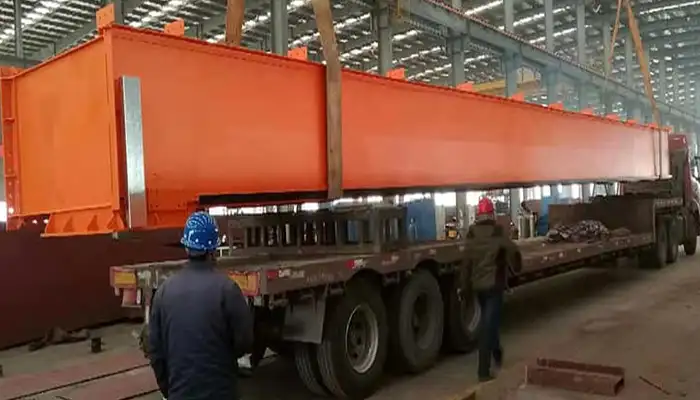
Proposed Gantry Crane Solution
To address these challenges, a dual 70-ton gantry crane system was designed specifically for synchronized bridge beam lifting operations.
Each gantry crane was engineered with a 70-ton rated lifting capacity, and both units were integrated into a tandem lifting control system capable of handling a combined working load of 120 tons with safety margin.
The system was equipped with high-performance industrial components to ensure reliability under heavy-duty construction conditions:
- ABB motors were selected to ensure stable torque output during low-speed precision lifting
- SEW gearboxes provided durable transmission performance for long-duration bridge lifting cycles
- Schneider electrical components ensured stable control system operation under variable load conditions
- Yaskawa frequency inverters enabled smooth acceleration and deceleration, reducing load swing during beam handling
Since the construction site lacked stable industrial power supply, a diesel generator set was integrated as the primary power source, ensuring continuous crane operation without dependency on grid infrastructure.
Synchronized Tandem Lifting System
The most critical feature of this solution is the synchronized tandem lifting system, which is specifically designed for heavy bridge beam lifting operations where two 70-ton gantry cranes must behave as one unified lifting machine.
In this project, both gantry cranes are integrated into a master–slave synchronized control architecture and operated through a single industrial remote control system. This allows the operator to manage two independent cranes from one interface, without the need for separate coordination between two operators, which is often a major safety risk in traditional dual-crane lifting.
How the synchronization works in real operation
During bridge beam lifting, both cranes continuously exchange real-time operational signals through the control system. The system synchronizes key parameters such as:
- Lifting speed of each hoisting mechanism
- Hook height position (vertical synchronization)
- Travel movement along the runway or ground track
- Load distribution feedback from each crane
This ensures that both cranes move in perfectly matched motion throughout the entire lifting cycle.
When lifting a 120-ton precast bridge beam, even a small deviation in lifting speed or hook height between two cranes can create uneven load sharing. This can lead to dangerous side forces, beam twisting, or structural stress on the crane girder. The synchronized control system eliminates this risk by automatically correcting any imbalance in real time.
Independent and tandem operation flexibility
Another important feature is operational flexibility. The system is designed with two working modes:
- Independent mode: each 70-ton gantry crane can operate separately for normal lifting tasks such as equipment handling, material transfer, or positioning work
- Tandem lifting mode: both cranes are electronically locked into synchronized operation for heavy bridge beam lifting up to 120 tons
Switching between these modes is seamless and controlled directly from the remote system, allowing the operator to adapt quickly to different construction stages without mechanical adjustment.
Precision control for bridge erection applications
In bridge erection projects using launching gantry systems or beam transport vehicles, installation accuracy is extremely critical. The synchronized lifting system ensures that the beam remains level during lifting, traveling, and lowering phases.
This is particularly important when positioning the beam onto bridge piers, where millimeter-level alignment affects the structural integrity of the entire bridge span. The system minimizes longitudinal tilt, lateral sway, and rotational movement during the lifting process.
Safety and stability improvements
Compared with traditional dual-crane operation controlled by two separate operators, this synchronized system significantly improves safety by:
- Eliminating communication delay between operators
- Preventing uneven load distribution during lifting
- Reducing dynamic swing of long-span precast beams
- Ensuring controlled lowering during final installation
- Providing continuous load balancing throughout the operation
For bridge construction contractors, this system directly reduces the operational risk during high-value lifting operations and improves overall installation efficiency.
Engineering value in real projects
In practical bridge construction environments, especially where large precast beams are involved, the synchronized tandem lifting system effectively replaces the need for a single ultra-heavy crane while maintaining similar lifting capability and precision.
It provides a safer, more flexible, and more cost-efficient solution for projects involving bridge erection machinery, beam transport systems, and large-scale infrastructure lifting operations.
Problems Solved in This Project (Crane Buyer FAQ – Natural Search Language Integrated)
This section answers frequently asked questions related to the challenges of lifting and handling heavy precast bridge beams using gantry cranes, addressing common concerns in bridge construction projects.
A: Two 70-ton gantry cranes are used in synchronized tandem lifting mode to safely handle the full 120-ton bridge beam load.
- This approach is commonly applied in bridge construction projects where buyers look for "twin crane lifting system for heavy bridge girders" instead of purchasing a single ultra-heavy crane.
- Both cranes share the load evenly, making it suitable for infrastructure projects with limited equipment capacity or modular crane deployment strategies.
A: Safety is achieved through a synchronized crane control system operated by a single remote interface.
- The system continuously aligns hook height, lifting speed, and travel movement to prevent imbalance during "dual crane synchronized lifting of precast concrete beams."
- This is especially important in long-span bridge erection work where uneven lifting can cause beam twisting or structural stress during installation.
A: A diesel generator power system is used to provide independent and stable operation for both gantry cranes.
- This setup is widely used in "bridge erection projects in remote areas without grid electricity," ensuring continuous lifting operations.
- It allows the cranes to operate normally in highway, railway, or river-crossing bridge construction zones where electrical infrastructure is not available.
A: Precision is ensured through frequency inverter control combined with synchronized motion control between both cranes.
- This allows smooth lifting and controlled lowering, often required in "bridge girder positioning on pier caps using tandem gantry cranes."
- It minimizes swing and ensures accurate placement, which is critical for bridge erection machinery and launching gantry workflows.
Conclusion
This twin 70-ton gantry crane solution demonstrates a practical and flexible engineering approach for modern bridge construction projects where heavy precast beam lifting is required but a single ultra-large crane is not feasible.
By combining synchronized tandem lifting technology, high-end industrial components, and a diesel-powered independent system, the solution ensures safe, stable, and precise handling of 120-ton bridge beams in challenging outdoor environments.
For crane buyers in bridge construction, infrastructure development, or launching gantry operations, this type of dual-crane synchronized system offers a cost-effective and operationally flexible alternative to oversized single-crane solutions while maintaining high safety and installation accuracy standards.