40 Ton Marine Travel Lift for Yacht Handling Solution
Client Background and Project Overview
The client works in a marina, handling yachts on a daily basis. Their main tasks include lifting boats out of the water, moving them to maintenance areas, and placing them back when needed.
This is routine work, not occasional lifting. During busy seasons, the equipment may be used many times a day.
The working environment has some clear limitations:
- Narrow movement paths inside the marina
- Fixed gate sizes that the equipment must pass through
- Shared space with transport vehicles and trailers
- Outdoor conditions, including humidity and salt air
In simple terms, the travel lift must move smoothly within an already crowded and restricted space. There is very little room for error in size or layout.
The lifting object is yachts. Unlike steel or containers, yachts require more careful handling.
They are sensitive to pressure and surface damage. Also, the weight is not always evenly distributed, which makes balance important during lifting.
Basic lifting requirements include:
- Maximum lifting capacity: 40 tons
- Use of soft lifting belts to protect the hull
- Multi-point lifting to keep the load balanced
- Stable movement during lifting and traveling
In real use, the focus is not only on lifting the weight. The key is to lift without damaging the yacht and keep it stable at all times.
The project moved quite quickly because the client provided clear requirements from the beginning. This reduced unnecessary discussions and helped speed up the process.
Main timeline:
- Inquiry received: June 24, 2022
- Technical solution confirmed: within 1 month
- Production and delivery: 110 working days
- Final delivery: completed as scheduled
A clear starting point made a big difference. When the requirements are well defined early on, the whole process becomes smoother—from design to delivery.
Key Lifting Challenges
The biggest constraint in this project is space. The marina layout is already fixed, and the travel lift has to work within it.
There are strict limits on width, height, and movement paths. The equipment must pass through specific gates and move along narrow routes without blocking other operations.
Key space challenges include:
- Limited width for equipment travel
- Fixed gate dimensions that cannot be changed
- Restricted turning and positioning areas
- Need to align with existing yard layout
In this case, even a small mismatch in size could make the equipment unusable. So dimensions are not just a reference—they are critical.
Yachts are high-value assets, and even minor damage can be costly. Safety is not only about lifting the load, but also about protecting the structure of the yacht.
Unlike standard industrial materials, yachts cannot handle concentrated pressure or uneven lifting forces.
Main safety considerations:
- Even load distribution to avoid hull deformation
- Use of soft lifting belts instead of rigid tools
- Stable lifting with minimal sway or tilt
- Controlled lifting speed for precise handling
A stable lift is more important than a fast lift. Any sudden movement or imbalance can create risk.
The equipment is used frequently, so efficiency matters. Slow or complicated operation can quickly affect the daily workflow of the marina.
The goal is to make lifting and movement simple and repeatable.
Key efficiency requirements:
- Quick setup and lifting process
- Easy operation, preferably with remote control
- Smooth coordination with transport vehicles
- Minimal downtime between lifting cycles
In daily operation, small delays add up. A simple and reliable system helps keep the yard running smoothly.
The equipment operates outdoors, close to the sea. This brings additional challenges that must be considered during design.
Salt air, humidity, and weather exposure can affect both structure and electrical components.
Environmental factors include:
- Corrosion risk from saltwater and humid air
- Need for durable coatings and materials
- Preference for electric systems to avoid emissions
- Compliance with marina environmental standards
Electric drive systems are often preferred in this type of environment. They reduce pollution risk and are easier to maintain over time.
Customized Marine Travel Lift Solution
Based on the client's requirements, a marine travel lift was selected. This type of equipment is commonly used in marinas because it can handle both lifting and short-distance transport in one system.
The rated capacity is 40 tons, which matches the maximum yacht weight handled on site. However, the design is not based on capacity alone. Stability, lifting method, and movement control are all considered together.
Key selection points:
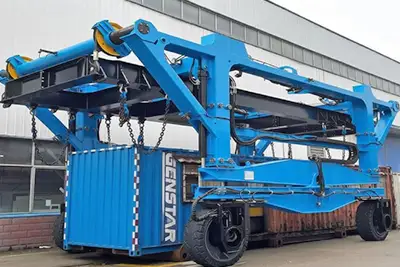
- Equipment type: Marine travel lift (rubber tyred)
- Rated capacity: 40 tons
- Suitable for lifting and transporting yachts
- Designed for frequent daily use in marina operations
This type of solution allows the client to handle launching, retrieval, and repositioning without needing additional lifting equipment.
The main dimensions and power configuration are defined based on the actual site conditions and operational needs.
Core specifications:
- Power supply: 400V / 50Hz / 3 phase
- Total length: 6 m
- Total width: 5.1 m
- Total height: 5 m
- Internal clear width: 3 m
- Lifting height: 4 m
These parameters are not standard values. They are adjusted to ensure the equipment can move through the marina and operate within limited space.
When selecting a travel lift, buyers should not only look at capacity. Dimensions and clearance often decide whether the equipment can be used effectively on site.
The lifting system is designed for stability and controlled operation. Instead of a single lifting point, multiple hoisting units are used.
Main configuration details:
- 4 fixed electric winch hoisting mechanisms
- Supports 2-point or 4-point synchronized lifting
- Transverse spacing between side hoists: 2.4 m
- Longitudinal spacing between front and rear hoists: 5 m
- Equipped with 2 dedicated lifting belts
This setup helps distribute the load evenly. It also allows flexibility when handling different yacht sizes.
In practice, multi-point lifting reduces the risk of tilting or uneven stress. It is especially important for long or irregular-shaped loads like yachts.
One of the most important parts of this project is adapting the equipment to the site. The design is adjusted to match real working conditions, not just general specifications.
Key custom design considerations:
Truck size: up to 4 m height and 3 m width
- Allow transport trucks to pass underneath
- Ensure the travel lift can pass through existing gates
Gate 1: 5.1 m width × 8 m height
Gate 2: 5.3 m width × 5.1 m height
- Maintain enough internal clearance for yacht handling
- Keep overall dimensions within strict limits
In many projects, this is where problems happen. Equipment is selected first, and site constraints are checked later.
In this case, the process is reversed. The design starts from the site, and the equipment is built around it. This approach avoids installation issues and ensures smooth operation from day one.
Advantages for Marina Operations
Handling yachts requires careful control. The system is designed to reduce risk during every lift.
- Multi-point lifting keeps the load balanced
- Soft lifting belts protect the hull surface
- Stable lifting reduces sway and sudden movement
- Better control during both lifting and travel
This helps avoid damage and keeps operations predictable.
The equipment is used frequently, so smooth operation makes a real difference.
- Remote control simplifies operation
- Quick lifting and positioning
- Less manual coordination needed
- Works together with transport vehicles easily
In daily use, this means less waiting time and faster turnaround.
Marina environments often have strict environmental requirements.
- Fully electric system, no fuel emissions
- Reduced risk of oil leakage
- Lower noise compared to diesel equipment
- Suitable for modern marina standards
This makes the equipment easier to operate in regulated areas.
The design focuses on reliable, long-term use.
- Simple structure, easier maintenance
- Electric system reduces running costs
- Durable design for outdoor conditions
- Adapted to actual site, avoiding future modifications
Over time, this helps reduce maintenance issues and unexpected costs.
Problems Solved in This Project (FAQ)
Yachts are sensitive to pressure and surface contact. Standard hooks or rigid lifting tools are not suitable.
- Use of soft lifting belts to protect the hull
- Multi-point lifting to spread the load evenly
- Controlled lifting speed to avoid sudden stress
This ensures the yacht is lifted safely without deformation or scratches.
Yachts do not have uniform weight distribution, which can cause tilting.
- 4-point lifting system with synchronized control
- Option to use 2-point or 4-point lifting depending on size
- Balanced load distribution during lifting and traveling
This keeps the load stable and reduces the risk of shifting.
Marina layouts are fixed, and space is often restricted.
- Overall dimensions designed based on actual site measurements
- Travel lift width and height matched to gate sizes
- Internal clearance optimized for both equipment and load
This avoids the common issue of equipment not fitting on site.
Transport trucks need to move freely in the same area.
- Structure designed with enough clearance underneath
- Supports trucks up to 4 m high and 3 m wide
- No need to stop lifting operations for vehicle movement
This improves overall workflow inside the marina.
Frequent operation requires a simple and reliable control method.
- Remote control system for better visibility and safety
- Reduced need for manual coordination
- Smooth and precise control during lifting and moving
Operators can handle the equipment with less effort and more control.
Outdoor coastal environments have strict standards.
- Fully electric system with no emissions
- Reduced noise during operation
- Lower risk of oil leakage compared to hydraulic systems
This makes the equipment suitable for environmentally sensitive locations.
Many projects slow down due to repeated revisions.
- Clear requirements defined at the beginning
- Faster technical confirmation process
- Reduced back-and-forth during design
This helped complete the project on schedule.
Request a Custom Marine Lifting Solution
Send An Inquiry to Yuantai Better Crane
If your marina has similar lifting needs, a standard solution may not fit your site. Travel lifts are usually defined by actual working conditions, not just capacity.
You can share your requirements, and we will help you check feasibility and propose a suitable solution.
Typical support includes:
- Layout-based equipment sizing
- Lifting method selection for different yacht types
- Clearance and passage checking (gates, routes, vehicles)
- Power supply and control system configuration
A clear discussion at the beginning can save a lot of time later.
Required Parameters from Buyer
To prepare an accurate solution and quotation, the following information is usually needed:
Basic Lifting Requirements:
- Maximum yacht weight (tons)
- Typical yacht dimensions (length, width, height)
- Lifting frequency (daily usage)
Site Conditions:
- Available width and height for equipment movement
- Gate dimensions (width and height)
- Ground condition (concrete, asphalt, load-bearing capacity)
- Outdoor or indoor use
Operational Requirements:
- Required lifting height
- Need for vehicles passing underneath (truck size)
- Travel distance and movement path
- Preferred control method (remote or cabin)
Power Supply:
- Voltage and frequency available on site
Providing these details early helps avoid design changes and ensures the equipment will fit and work properly once delivered.