Filter Zone Crane Systems for Water Treatment Plants
Long Travel and Multi-Basin Coverage Design – Complete Engineering Guide
Filter zone crane systems are not limited by lifting capacity, but by how smoothly and reliably they can travel across long parallel filtration basins—often 60 meters or more—while maintaining stable access, precise positioning, and uninterrupted maintenance workflow across multiple treatment zones.
Key Takeaways
- Filter zones in water treatment plants are typically arranged in long, parallel basins requiring extended crane travel
- Long travel crane design is mainly about accessibility and stability, not heavy lifting
- Multi-basin coverage demands flexible crane systems such as monorail, hybrid bridge, or segmented structures
- Synchronization of travel motion is critical for smooth operation over long distances
- Modular segmentation improves maintenance efficiency and reduces plant downtime
- Structural deflection control is essential in long-span crane runway design
- Environmental factors like humidity and corrosion must be addressed in system design
Engineering Context: Why Filter Zones Need Special Crane Design
Filter zones in water treatment plants are commonly arranged in long, narrow, and parallel basin structures. Each basin contains filtration equipment such as valves, media layers, and mechanical components that require frequent inspection and maintenance.
Unlike conventional workshop cranes, the challenge in these environments is not lifting heavy loads, but ensuring continuous and stable access across long distances. Crane travel lengths can easily exceed 30–60 meters or more, especially in large municipal treatment facilities.
The operational requirement is simple in concept but complex in execution: one crane system must be able to serve multiple basins efficiently without disrupting ongoing treatment processes.
Core Engineering Challenge: Long Travel Stability and Access Control
In filter zone crane systems, the key challenge is ensuring smooth, stable, and accurate travel over long runway distances, often extending across multiple filtration basins.
As travel distance increases, several issues become more pronounced:
- Rail alignment becomes increasingly sensitive over long spans
- Structural deflection gradually increases with distance
- Wheel load distribution may become uneven
- Vibration and slight sway can reduce positioning accuracy
Because of these factors, the design priority shifts from lifting capacity to consistent motion stability, precise alignment, and reliable long-distance travel performance.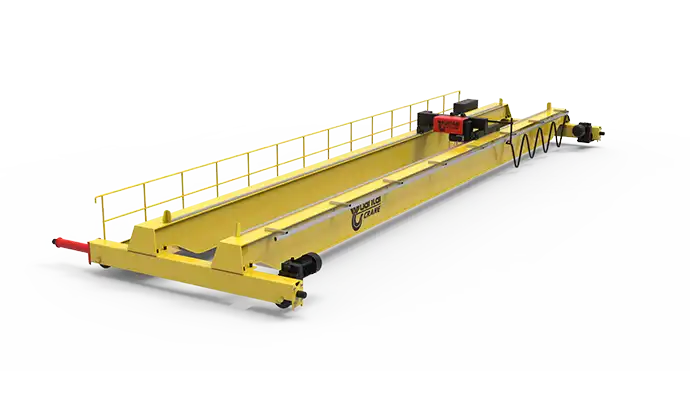
Crane System Configurations for Multi-Basin Coverage
Filter zones in water treatment plants are rarely uniform in layout. Basins may be arranged in long linear rows or multi-row configurations, which directly influences the crane system selection. The goal is to achieve reliable coverage across all filtration units while balancing structural simplicity, flexibility, and long-term maintenance efficiency.
Monorail crane systems are typically used in filtration zones where basins are arranged in a straight, linear sequence. The crane travels along a single rail path, providing a direct and predictable movement route across all connected basins.
This configuration is commonly selected when the plant design prioritizes simplicity and linear maintenance flow.
Key Characteristics:
- Single-direction travel along a fixed rail line
- Straightforward mechanical structure with fewer moving components
- High efficiency for repetitive maintenance routes
Suitable Applications:
- Filtration basins arranged in continuous linear rows
- Maintenance tasks such as valve inspection, filter media handling, or routine cleaning
- Projects with limited budget or minimal cross-basin operational requirements
Engineering Limitation:
The main constraint is lack of flexibility. When multiple parallel basin rows exist, access becomes restricted because the system cannot shift laterally between different working zones. This reduces operational adaptability in complex plant layouts.
Light bridge crane hybrid systems extend the functionality of monorail systems by integrating partial bridge movement capability. This allows the crane not only to travel longitudinally along basins but also to access adjacent filtration rows.
This configuration is designed for facilities where basin layouts are not strictly linear and operational flexibility is required.
Key Characteristics:
- Combination of longitudinal rail travel and transverse bridge coverage
- Ability to reach multiple basin rows from a single crane system
- Improved workspace coverage without full heavy-duty bridge crane structure
Operational Advantages:
- Enhanced cross-basin accessibility for maintenance teams
- Greater flexibility in handling equipment positioned in different basin zones
- Reduced need for multiple dedicated cranes
Application Scenarios:
- Medium to large water treatment plants
- Facilities with staggered or multi-row filtration basin layouts
- Systems requiring frequent switching between adjacent treatment units
This configuration significantly improves operational efficiency where basin access points are distributed across a wider area rather than aligned in a single row.
In large-scale water treatment plants, filtration zones can extend over very long distances, often exceeding the practical limits of a single continuous crane runway. In such cases, modular multi-segment bridge systems are adopted.
Instead of relying on one long-span structure, the system is divided into multiple functional sections, each operating as an independent or semi-independent working zone.
Key Design Concept:
- Long travel distance is segmented into manageable operational modules
- Each segment supports localized crane movement and maintenance tasks
Engineering Benefits:
- Reduced structural deflection across long spans due to load segmentation
- Improved stability and load distribution across multiple support points
- Lower stress concentration on runway beams and supporting structures
Operational Advantages:
- Easier maintenance scheduling without full system shutdown
- Independent operation of different basin sections
- Better adaptability for phased plant expansion or future capacity upgrades
Ideal Use Cases:
- Large municipal or industrial-scale water treatment plants
- Facilities with extended filtration corridors or multi-stage treatment lines
- Plants designed for future expansion or incremental capacity growth
Across all three configurations, the selection is driven by one core requirement: ensuring stable, efficient, and flexible access to all filtration basins. Monorail systems prioritize simplicity, hybrid bridge systems balance flexibility and structure, while modular segment systems are designed for large-scale, long-distance operational control.
Synchronized Travel Control for Long-Distance Operation
In filter zone crane systems with long travel distances, stability cannot be achieved by mechanical structure alone. As the runway extends across multiple filtration basins, precise motion control becomes critical to ensure smooth, aligned, and safe operation.
Synchronized travel control is therefore used to coordinate all driving mechanisms so the crane moves as a single, stable system rather than independent wheel groups.
Long travel cranes typically use multiple drive motors distributed along the bridge or end carriages. Frequency inverter control ensures each motor runs at matched speed and torque, preventing uneven pushing forces along the runway.
Instead of abrupt starts or stops, the system applies controlled ramp-up and ramp-down curves. This reduces mechanical shock, limits structural stress on long spans, and maintains load stability during movement across basin sections.
Over long distances, even slight differences in wheel speed can cause skewing. Anti-skew systems continuously monitor wheel alignment and automatically adjust motor output to keep both sides synchronized and prevent rail wear or structural binding.
With synchronized travel control in place, the crane achieves:
- Stable movement across extended filtration basins
- Reduced rail and wheel wear caused by uneven loading
- Improved positioning accuracy during maintenance tasks
- Lower structural stress on long-span runway beams
- Safer operation in continuous or high-frequency working cycles
In long-distance filter zone applications, synchronized control is what transforms a mechanically long crane into a precise, stable, and predictable maintenance system, ensuring consistent performance across the entire treatment layout.
Modular Maintenance Segmentation Strategy
In modern filter zone crane systems, one of the most effective design approaches is to avoid treating the entire filtration area as a single continuous working space. Instead, the plant is divided into modular maintenance sections that align with basin layout and operational cycles.
This segmentation approach is especially important in long travel crane systems, where multiple filtration basins operate in parallel and continuous uptime is critical.
Rather than relying on a single uninterrupted working range, the crane system is organized into defined operational zones. Each zone corresponds to a group of filtration basins or a specific maintenance area, allowing the crane to serve targeted sections without affecting the rest of the plant.
Work can be carried out in one basin or zone while adjacent basins continue normal operation. This is particularly valuable in continuous-flow water treatment systems where downtime must be minimized.
By isolating maintenance zones, inspection and repair work becomes more controlled and efficient, avoiding unnecessary interruption of the entire filtration process.
Plant operators can plan maintenance based on individual basin conditions rather than shutting down large sections at once. This supports more precise and efficient maintenance planning.
Segmented operation reduces idle time, improves equipment utilization, and ensures that crane operation aligns closely with real maintenance demand rather than full-area coverage requirements.
Modular segmentation transforms a long travel crane system from a single continuous access machine into a structured maintenance tool. It aligns crane movement with real operational needs, making long filtration zones easier to manage, more efficient to maintain, and less disruptive to water treatment processes.
Structural Design Considerations for Long Span Travel
Long travel crane systems in filter zone applications place continuous stress on runway structures due to extended span lengths, frequent operation, and multi-basin coverage requirements. Structural design therefore becomes a key factor in ensuring long-term stability, accuracy, and durability.
Unlike standard workshop cranes, these systems must maintain alignment and load stability over much longer distances, often in corrosive and high-humidity environments typical of water treatment facilities.
To control deflection over long spans, runway beams must be structurally reinforced. The goal is to maintain consistent rail alignment and minimize vertical or lateral deformation during crane movement.
This typically involves:
- Optimized beam sizing based on span and load distribution
- Reinforcement at high-stress zones such as support points and mid-span areas
- Controlled deflection design to maintain smooth long travel motion
Material selection plays a critical role in structural reliability. High-strength structural steel is commonly used for runway beams and supporting frameworks to improve rigidity without excessive weight increase.
This helps to:
- Improve overall stiffness of long-span structures
- Reduce long-term fatigue under repeated operation
- Enhance load-bearing consistency across multiple basin sections
In long filtration plant structures, temperature variation can cause expansion and contraction along the crane runway. Without proper compensation, this can lead to rail misalignment or structural stress.
Expansion joints are introduced to:
- Absorb thermal movement along extended runway lengths
- Prevent cumulative stress in steel structures
- Maintain rail alignment stability under varying environmental conditions
When travel distances exceed practical limits for a single-span structure, intermediate supports are introduced to divide the load.
This approach:
- Reduces bending stress on runway beams
- Improves structural stability over very long distances
- Allows safer and more controlled crane travel across extended filtration zones
Filter zones in water treatment plants expose crane structures to constant humidity, chemical vapors, and potential corrosion agents. Protective surface treatment becomes essential for long-term durability.
Typical protection strategies include:
- Anti-corrosion coating systems for steel structures
- Sealed or protected rail surfaces
- Weather-resistant finishes for outdoor or semi-exposed installations
Structural design in long travel filter zone cranes is not only about strength, but about maintaining alignment stability, controlled deflection, and long-term resistance to environmental degradation, ensuring reliable operation across the full lifecycle of the water treatment plant.
Environmental and Operational Conditions in Filter Zones
Filter zones in water treatment plants create one of the most demanding operating environments for crane systems. Unlike standard industrial workshops, these areas combine high humidity, chemical exposure, and near-continuous operation, all of which directly influence crane reliability and service life.
Filtration basins are continuously surrounded by moisture, often at near-saturation levels. Over time, this accelerates corrosion on exposed metal parts and increases the risk of electrical insulation degradation.
Key design implications:
- Sealed or protected electrical enclosures
- Moisture-resistant motor and gearbox configurations
- Anti-condensation protection for control components
Depending on the treatment process, air around filtration zones may contain chlorine compounds, ammonia traces, or other reactive substances. These accelerate corrosion on steel structures, electrical contacts, and mechanical joints.
To mitigate this, crane systems require:
- Corrosion-resistant coatings on structural steel
- Sealed cable and connector systems
- Protective treatments for exposed fasteners and rail components
Unlike intermittent industrial cranes, filter zone cranes often operate repeatedly throughout the day for inspection, cleaning, and maintenance tasks.
This leads to:
- Increased wear on travel wheels and rails
- Higher thermal load on motors and braking systems
- Greater fatigue stress on mechanical components
As a result, components must be designed for high duty cycle operation, not occasional use.
Water treatment plants cannot easily stop operations for maintenance. This creates strict constraints on downtime and repair scheduling.
Engineering consequences include:
- Requirement for quick-access maintenance design
- Modular replacement of critical components
- High reliability expectations for long uninterrupted operation
To operate reliably in this environment, crane systems must prioritize long-term protection over short-term performance optimization.
Key design focus areas:
- Corrosion-resistant materials and coatings
- Sealed and humidity-protected electrical systems
- Heavy-duty motors designed for continuous operation
- Reinforced travel mechanisms for long service life
In filter zone applications, crane performance is defined by environmental resistance as much as mechanical design. A well-designed system must remain stable and reliable under constant humidity, chemical exposure, and continuous operation, ensuring uninterrupted support for critical water treatment processes.
Key Questions This Guide Solves
This section addresses the most common engineering and selection questions related to crane systems used in long filter basin layouts of water treatment plants, focusing on coverage, stability, and maintenance efficiency.
Conclusion
Filter zone crane systems in water treatment plants require a fundamentally different design approach compared to standard industrial cranes. The primary engineering focus is not lifting performance but long-distance travel stability, multi-basin accessibility, and operational continuity.
A well-designed system integrates synchronized travel control, modular segmentation, and structurally optimized runway design to ensure smooth operation across extended filtration areas. When properly engineered, these crane systems significantly improve maintenance efficiency, reduce downtime, and enhance the long-term reliability of water treatment operations.