Single vs double girder hoists: choose the right crane system
Single Girder vs Double Girder Electric Wire Rope Hoists: Which One is Right for Your Crane System?
Single Girder vs Double Girder Wire Rope Hoists: Practical Guide
Choosing between a single girder hoist and a double girder hoist is not just a technical formality. It directly shapes how your entire crane system performs in daily operation.
In many projects, the hoist is treated as a component. In reality, it defines the crane's lifting behavior, structural demand, and long-term operating cost. Get it right, and the crane runs smoothly for years. Get it wrong, and small mismatches turn into ongoing mechanical problems.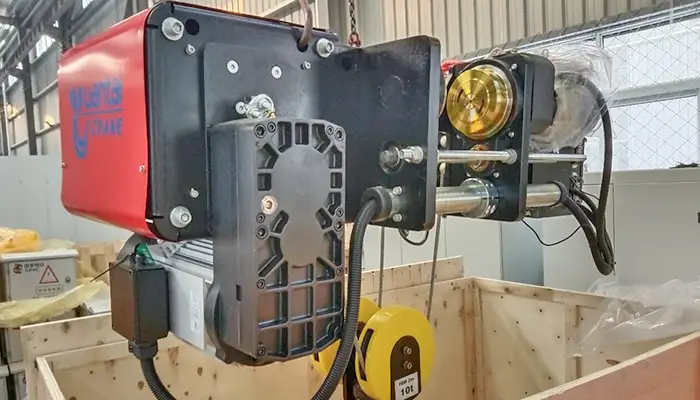
Single girder electric wire rope hoist
A properly selected electric wire rope hoist influences more than just lifting weight. It affects the entire working environment:
- Load capacity
Not only the rated tonnage, but the safety margin under real working conditions. Dynamic load, impact factors, and frequent starts all matter. - Lifting height
The hoist structure determines the hook approach distance and effective lifting clearance. In low workshop roofs, even 300–500 mm makes a difference. - Building clearance
Single girder and double girder systems create different headroom requirements. Poor selection may force structural changes to the building or reduce usable lifting height. - Crane cost
A single girder hoist system usually requires less structural steel and simpler runway beams. A double girder system involves higher fabrication cost, but supports heavier duty cycles. - Long-term maintenance
Gearbox load distribution, brake wear, rope reeving design, and trolley stability all depend on girder configuration. These factors determine maintenance intervals and spare parts consumption.
In short, hoist choice shapes both short-term procurement cost and long-term operational expense.
This is where real problems begin. A mismatch between hoist type and girder structure often shows up months after installation.
- Reduced lifting height
Installing a standard single girder hoist in a facility that requires maximum hook height often results in insufficient clearance. The crane works, but it cannot lift to full required height. - Structural overload
Placing a higher-duty application on a single girder setup can overstress the main beam. Deflection increases. Fatigue life decreases. Maintenance frequency rises. - Premature gearbox and brake wear
When duty classification is underestimated, brakes overheat and gear reducers operate near capacity continuously. Failure does not happen on day one — it shows up after repeated cycles. - Over-investment or under-specification
Some buyers select a double girder wire rope hoist crane simply to "be safe," even when 8–10 tons in a moderate workshop could run efficiently on a single girder system.
On the other hand, cost-driven under-specification leads to early equipment replacement.
Neither extreme is efficient.
At the center of every project is a practical decision:
Should you choose a single girder hoist or a double girder hoist?
The answer depends on:
- Required lifting capacity (0.5–20 tons vs 5–80 tons range)
- Duty classification (light workshop use vs heavy manufacturing cycles)
- Span length and structural deflection limits
- Available headroom in the building
- Future load expansion plans
There is no universal choice. The correct configuration aligns with actual operating conditions — not assumptions, not habit, and not just initial budget.
Structural Fundamentals – How They Differ
A single girder hoist and a double girder hoist may use similar electric wire rope hoist mechanisms, but their structural layout is fundamentally different. That structural difference affects lifting height, load distribution, crane stability, and long-term durability.
Understanding how each configuration works helps avoid under-design or unnecessary overspending.
In a single girder wire rope hoist crane, the hoist is supported by one main beam. The trolley typically runs either on the top flange of the girder (top-running) or is suspended beneath it (underslung). In both cases, the hoist body is positioned directly under the beam.
Structural Characteristics
- Hoist mounted below a single girder
- Load transferred through one main beam
- Compact arrangement with lower total crane self-weight
- Reduced wheel loads and lighter runway beam requirements
- Limited hook approach and lifting height due to structural position
Because the hoist sits below the girder, the maximum hook height is restricted by the beam depth. In buildings with limited roof clearance, this can reduce effective lifting space.
Best Suited For
- Capacity range: 0.5–20 tons
- Duty class: Light to medium (M3–M5)
- Moderate spans
- Intermittent operation
This configuration is common in workshops, warehouses, fabrication shops, and assembly plants where loads are controlled and working cycles are not continuous. It offers cost efficiency and structural simplicity when heavy-duty performance is not required.
In a double girder wire rope hoist crane, the trolley travels on rails mounted on two parallel main girders. The hoist is positioned between the girders rather than hanging below them.
This structural arrangement changes load distribution and lifting geometry.
Structural Characteristics
- Trolley travels on rails across two girders
- Hoist positioned between beams
- Higher achievable hook position
- Improved rigidity and reduced deflection
- More balanced load distribution
By placing the hoist between the girders, the hook can rise higher compared to a single girder system within the same building height. The dual-beam structure also improves resistance to bending and fatigue under repeated heavy loads.
Best Suited For
- Capacity range: 5–80 tons
- Duty class: Medium to heavy (M5–M8)
- Long spans
- High-frequency or continuous operation
Double girder electric wire rope hoists are commonly used in heavy manufacturing plants, steel handling facilities, and shipyards where higher loads and stricter structural demands apply.
A single girder hoist provides a lighter, economical solution for moderate applications. A double girder hoist provides higher lifting height, better load stability, and improved fatigue resistance for heavy-duty environments.
The decision should be based on actual working conditions—capacity, span, duty cycle, and building clearance—rather than tonnage alone.
Capacity Comparison (Core Decision Factor)
Capacity is usually the first number buyers look at. But in overhead crane design, tonnage alone does not tell the whole story. A 10 ton single girder hoist and a 10 ton double girder hoist are not equal in performance or durability. The difference lies in duty class, span, working frequency, and structural layout.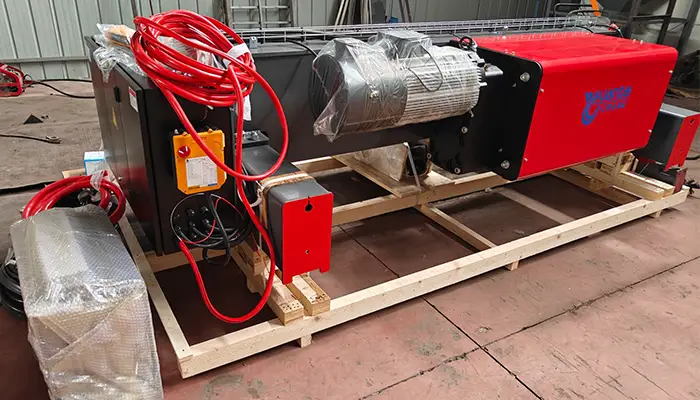
double girder electric wire rope hoist 3 ton to 80 ton
Below is a practical comparison based on real industrial applications.
| Parameter | Single Girder Hoist | Double Girder Hoist |
|---|---|---|
| Typical Capacity | 0.5–20 tons | 5–80 tons |
| Duty Class | Light to Medium (M3–M5) | Medium to Heavy (M5–M8) |
| Lifting Height | Moderate | High |
| Span Compatibility | Small–Medium span | Medium–Large span |
| Frequency | Intermittent | High frequency |
Capacity Overlap Zone: 5–20 tons
This is where many buyers hesitate.
Decision depends on:
- Required duty cycle
- Span length
- Required hook height
- Industrial environment
Typical Capacity
- Single girder hoist: 0.5–20 tons
- Double girder hoist: 5–80 tons
Single girder electric wire rope hoists dominate the lower tonnage range. Double girder systems are commonly selected once loads exceed 20 tons or where future expansion is expected.
Duty Class
- Single girder hoist: Light to Medium duty (M3–M5)
- Double girder hoist: Medium to Heavy duty (M5–M8)
Duty class reflects how often the hoist lifts and how heavily it is loaded during operation. Frequent high-load cycles favor double girder systems.
Lifting Height
- Single girder: Moderate lifting height
- Double girder: Higher achievable hook position
Double girder hoists sit between beams, using building height more efficiently, which is critical when vertical clearance is limited.
Span Compatibility
- Single girder: Small to medium spans
- Double girder: Medium to large spans
Long spans require better rigidity; double girders reduce bending stress and maintain stability over long runways.
Operating Frequency
- Single girder: Intermittent use
- Double girder: High-frequency or continuous operation
High production environments demand strong structural rigidity and durable drive systems, which double girder hoists provide.
This is where most decision delays happen. Both single girder hoists and double girder hoists operate within the 5–20 ton range. On paper, either option may meet the rated load requirement. In practice, the correct choice depends on operating conditions.
Many buyers initially focus only on tonnage. But a 12 ton crane in a light workshop and a 12 ton crane in a high-cycle industrial plant require very different structural support.
What Should Drive the Decision?
- Required duty cycle
How many lifting cycles per hour? Continuous high-load work favors double girder systems. - Span length
Longer spans increase beam deflection. Structural rigidity becomes more important for long runways. - Required hook height
Is building height limited? Double girder hoists provide better vertical utilization. - Industrial environment
Heat, dust, vibration, and impact increase mechanical stress. Heavy manufacturing benefits from double girder stability.
In short, capacity selection is not just about “how many tons.” It is about how that load is lifted, how often it is lifted, and under what structural conditions. That is the real decision point.
Application-Based Selection Guide
- Typical loads: machinery parts, steel plates
- Capacity range: 1–10t
- Limited headroom
- Moderate use frequency
Recommended:
✔ Single girder electric wire rope hoist
Cost-efficient and structurally sufficient.
- Material movement, palletized goods
- 0.5–5t typical range
- Long travel, moderate lifting
Recommended:
✔ Single girder hoist system
Lower capital investment and simpler installation.
- Steel structures, molds, equipment
- 10–50t typical range
- Higher safety margin required
Recommended:
✔ Double girder hoist
Better rigidity and fatigue resistance.
- Large fabricated sections
- Long spans
- Harsh environment
- 20–80t and above
Recommended:
✔ Double girder electric wire rope hoist for large cranes
Essential for structural strength and lifting height.
Headroom & Lifting Height Analysis
Overview:
Headroom refers to the vertical distance between the crane runway (or bridge girder) and the floor of the workspace. Lifting height is the maximum vertical distance a crane can lift a load. Optimizing both is crucial in facilities where vertical space is limited, as it directly affects the efficiency and feasibility of material handling.
- Hook Position: On single girder cranes, the hoist is mounted below the girder, which inherently lowers the hook position relative to the bridge.
- Reduced Lifting Height: Because the hoist sits beneath the beam, the maximum lifting height is limited, reducing the usable vertical travel of the hook.
- Building Constraints: Achieving the desired lifting height may require higher roof structures or taller building sections, which increases construction or renovation costs.
- Practical Implication: Single girder cranes are simpler and more cost-effective but may not fully utilize limited headroom in tight industrial spaces like rolling mills or small workshops.
- Hoist Location: On double girder cranes, the hoist is installed between the girders, allowing the hook to be positioned closer to the bridge.
- Higher Hook Position: This configuration maximizes lifting height without increasing building height.
- Same Building, More Height: Within the same facility height, a double girder crane can lift taller loads or handle larger stacks of materials, making it ideal for high-volume steel plants or billets handling.
- Practical Implication: For facilities with strict vertical limits, double girder cranes optimize material handling without costly structural modifications, ensuring full utilization of available space.
- If your workshop or mill has low ceilings or strict headroom restrictions, a double girder crane may be the most efficient solution, even if the initial cost is higher.
- Single girder cranes are suitable for lighter-duty operations where full lifting height is not critical.
- Consider hoist size, hook approach, and load height during crane selection to avoid operational limitations.
Cost Structure Comparison
When comparing a single girder hoist and a double girder hoist, cost is more layered than the initial quotation. The purchase price is only one part of the equation. Structural steel usage, installation complexity, and long-term wear all influence total ownership cost.
A lower price at the beginning does not always mean lower cost over ten years. And a higher upfront investment does not automatically mean overspending. Let's break it down clearly.
| Cost Element | Single Girder | Double Girder |
|---|---|---|
| Initial Investment | Lower | Higher |
| Structural Steel | Less | More |
| Installation | Simpler | More complex |
| Maintenance | Lower | Slightly higher |
| Lifecycle (heavy duty use) | Shorter | Longer |
Cost Optimization Rule:
- Do not select double girder solely for prestige.
- Do not select single girder solely for low cost.
Match structure to duty class.
- Single girder hoist – Lower
- Double girder hoist – Higher
A single girder wire rope hoist crane requires one main beam, lighter end trucks, and typically a simpler trolley system. This reduces fabrication cost and shipping weight.
A double girder system includes two main beams, rail installation on top of girders, and a heavier-duty trolley assembly. Material cost and manufacturing time increase accordingly.
For budget-sensitive projects with moderate duty requirements, the single girder system is often financially practical.
- Single girder – Less structural steel
- Double girder – More structural steel
Single girder cranes exert lower wheel loads. This can reduce requirements for runway beams and supporting building columns.
Double girder cranes distribute load better but require more steel in the bridge structure itself. In long-span applications, this additional rigidity becomes necessary, not optional.
- Single girder – Simpler installation
- Double girder – More complex alignment and assembly
Single girder systems are lighter and easier to lift into position. Rail alignment is straightforward, and on-site assembly time is shorter.
Double girder cranes require:
- Precise rail installation on both girders
- Careful trolley alignment
- Greater lifting capacity for installation equipment
Installation time and labor cost increase slightly, especially in confined industrial buildings.
- Single girder – Generally lower maintenance in light-duty use
- Double girder – Slightly higher maintenance volume, but stronger durability
In low-frequency workshops, single girder electric wire rope hoists operate well within design stress levels. Maintenance is basic: rope checks, lubrication, brake inspection.
In heavy-duty operations, however, a single girder hoist may experience faster wear if operated near maximum capacity. A properly matched double girder hoist, although structurally heavier, often shows better long-term durability under repeated load cycles.
Maintenance cost should therefore be evaluated based on actual duty class—not just crane type.
- Single girder – Shorter lifecycle under heavy continuous loads
- Double girder – Longer operational lifespan in high-duty environments
When lifting cycles are frequent and loads are near rated capacity, structural fatigue becomes a real concern. Double girder wire rope hoist cranes are designed to handle this repetitive stress with reduced deflection and better load distribution.
Over time, this translates into:
- Lower structural fatigue
- More stable trolley operation
- Reduced risk of premature beam deformation
In heavy manufacturing or high-cycle environments, lifecycle cost often favors the double girder system despite higher initial investment.
- Do not select a double girder hoist purely for image, assumption, or "just in case" thinking. If your application is 8–10 tons with moderate frequency, a single girder system may be entirely sufficient.
- Do not select a single girder hoist solely to reduce upfront cost if the duty class is high. Short-term savings can lead to structural reinforcement, early component replacement, or even crane upgrade within a few years.
The correct approach is practical: match the crane structure to the required duty class, span, lifting height, and real working frequency. That balance—not the lowest quote—delivers the most economical solution over the crane's service life.
Technical Selection Checklist (Buyer-Oriented)
Before choosing between a single girder hoist and a double girder hoist, step back and evaluate the real operating conditions. Many selection errors happen because decisions are made too quickly—often based only on rated tonnage. A structured technical review reduces risk and improves long-term performance.
Below are the critical points every buyer should confirm.
Start with the real load, not just the nominal figure on paper. Consider the heaviest item that will ever be lifted under actual production conditions.
- What is the maximum actual load weight?
- Are loads consistent, or do they vary?
- Is there dynamic impact during lifting or positioning?
- Has a reasonable safety margin been included?
Example: Lifting a 16 ton machine component with occasional shock loading may justify evaluating a more robust configuration rather than choosing a basic 16 ton-rated hoist.
Span influences structural behavior more than many expect. As span increases, deflection and beam stress increase as well.
- What is the clear distance between runway rails?
- Is the span within typical workshop dimensions?
- Will load positioning accuracy be sensitive to beam deflection?
Long spans often favor a double girder wire rope hoist crane, especially for heavier loads.
Headroom limitations can control the entire crane configuration. A few hundred millimeters can decide whether equipment fits into the building workflow.
- What is the total required hook travel?
- Is roof height restricted?
- Does the application require maximum vertical clearance?
If headroom is tight, a double girder hoist—positioned between the beams—typically provides higher usable lifting height than a single girder system.
Duty classification reflects how intensively the crane operates over time. It is not just about weight, but about frequency and load percentage.
- How many lifting cycles occur per hour?
- Are most lifts close to rated capacity?
- Is the operation continuous throughout the shift?
A 12 ton hoist in M3 duty behaves very differently from a 12 ton hoist in M6 duty. Higher duty classes demand stronger structural support.
Frequent starts and stops increase mechanical wear. Brake systems, gear reducers, and wire ropes all respond differently under repeated loading.
- Is the crane used occasionally or throughout the entire shift?
- Are there peak production periods?
- Does the hoist operate near full capacity regularly?
High-frequency applications usually justify a more rigid and durable double girder configuration.
Environmental conditions influence structural and mechanical reliability. Heat, dust, and outdoor exposure increase stress on components.
- Is the crane exposed to high temperatures?
- Is dust or abrasive material present?
- Will the crane operate outdoors in rain or wind?
Harsh environments often demand stronger structures and better load stability over time.
- Is production expected to scale up?
- Will heavier equipment or materials be introduced later?
- Would crane replacement disrupt workflow?
Planning for moderate future growth can prevent costly structural upgrades later.
- Load ≤ 20 tons
- Span moderate
- Intermittent or light-to-medium duty
- Standard workshop or warehouse environment
Under these conditions, a single girder electric wire rope hoist offers dependable operation with lower structural cost.
- Load > 20 tons
- Long spans
- High lifting height required
- Medium-to-heavy duty (M5 and above)
- Continuous or high-frequency operation
In these environments, a double girder hoist provides better load distribution, reduced deflection, and improved fatigue resistance.
After confirming these technical parameters, the selection typically becomes logical rather than emotional.
Common Buyer Mistakes
Choosing between a single girder hoist and a double girder hoist is usually straightforward when technical conditions are clear. Problems arise when key factors are overlooked. Below are common mistakes seen in real industrial projects—most of them avoidable with proper evaluation.
Capacity is important, but it is not the only factor that defines crane performance. Many buyers assume that if both configurations are rated for 10 or 15 tons, either one will perform equally well.
- Tonnage does not reflect duty cycle
- It does not indicate structural rigidity
- It does not show how the crane handles frequent starts and stops
A 15 ton electric wire rope hoist in light workshop duty is very different from one in continuous production. Selecting only by load rating can lead to premature wear or structural stress.
Crane systems are long-term investments. Production requirements often increase after installation.
- Will heavier materials be introduced later?
- Is capacity expected to increase within a few years?
- Would upgrading the crane require structural changes?
Replacing or modifying a crane later can cost far more than planning slightly ahead at the start. A marginal capacity upgrade early can prevent full system replacement later.
Duty classification is frequently underestimated because it is less visible than tonnage. But in practice, duty cycle determines wear rate.
- How many lifts per hour?
- How often is the hoist near full load?
- Is operation continuous across shifts?
An M3-rated single girder hoist operating in what is effectively M6 conditions will experience accelerated brake, gearbox, and rope wear. Over time, maintenance cost rises and reliability drops.
- What is the total available building height?
- How much hook travel is actually required?
- Does process equipment require maximum clearance?
Because a double girder hoist sits between beams, it can achieve greater lifting height within the same building structure. Ignoring this factor can lead to reduced operational flexibility.
- What about main girder strength?
- Runway beam requirements?
- Installation complexity?
- Long-term maintenance under actual load conditions?
A lower-priced single girder hoist may increase structural stress in heavy-duty use. A higher-priced double girder system may reduce lifecycle maintenance cost. The correct evaluation looks at the entire wire rope hoist crane system, not just one component.
When 5–20 Tons Becomes a Critical Decision
The 5–20 ton range is where most hesitation happens. On paper, both a single girder hoist and a double girder hoist can handle the load. In practice, the correct choice depends on how the crane will actually be used.
This overlap zone is not about capacity alone. It is about structural demand, duty class, and operational precision.
If the working environment is controlled and production demand is stable, a single girder electric wire rope hoist often delivers reliable performance without unnecessary structural cost.
This is generally suitable when:
- Span is less than 25 meters
Shorter spans limit beam deflection and reduce structural stress on a single girder. - Duty class is M3–M4
Light to medium duty means lifting cycles are not continuous and loads are not consistently near rated capacity. - The project is budget sensitive
A single girder wire rope hoist crane requires less structural steel and simpler installation, keeping total investment lower. - Lifting is non-critical to continuous production
For example, maintenance work, component handling, or periodic material movement.
Under these conditions, upgrading to a double girder system may increase cost without adding practical benefit.
When application conditions become more demanding, the structural margin matters. This is where a double girder wire rope hoist crane becomes the safer long-term solution.
It is typically recommended when:
- Span exceeds 25 meters
Longer spans increase deflection. Two girders provide better load distribution and reduce bending stress. - Duty class is M5 or above
Medium to heavy duty means frequent lifting cycles and higher mechanical fatigue. Structural rigidity becomes critical. - High-frequency or production-critical lifting
In manufacturing lines where downtime is costly, durability and stability outweigh initial savings. - Precision positioning is required
Double girder systems provide improved stability during trolley travel and load positioning, especially for heavy molds, steel components, or large assemblies.
In these cases, what appears as a higher upfront investment often translates into better lifecycle stability and reduced structural wear.
When evaluating a 10 ton or 15 ton application, the question is not, “Can it lift the load?” Both configurations can.
The better question is, “How often, how far, and under what stress will it lift that load?”
Once span, duty class, and production importance are clearly defined, the appropriate structure usually becomes obvious.
Final Recommendation – Match Engineering to Reality
When it comes to selecting between a single girder and a double girder hoist, there is no universally “better” choice. The right option always depends on actual working conditions rather than assumptions or habit.
Single Girder Hoists
Single girder electric wire rope hoists are ideal when simplicity and cost-efficiency matter most. They are well-suited for:
- Workshops and light fabrication shops
- Warehouses and storage facilities
- Moderate lifting capacities (up to 20 tons)
- Intermittent or light-duty operations
In these environments, a single girder system provides reliable performance, easier installation, and lower initial investment without compromising safety.
Double Girder Hoists
Double girder hoists excel when loads are heavier, spans are longer, or operational demands are high. They are typically chosen for:
- Heavy manufacturing plants
- Steel processing facilities
- Shipyards and large fabrication yards
- High-frequency, heavy-duty lifting
Although the upfront cost is higher, double girder systems offer better structural rigidity, higher hook clearance, reduced deflection, and longer service life. In demanding industrial environments, these benefits outweigh the initial investment.
The final choice should match engineering to reality. Consider capacity, span, duty class, lifting height, frequency, and environment. When the crane structure aligns with actual working conditions, you achieve reliable performance, longer lifecycle, and optimal cost-efficiency.
It’s not about which system is “better” on paper—it’s about which one fits your operation and stands up to real-world demands.