Water Plant Crane Design Principles to Reduce Cost & Risk
Water Plant Crane Design Principles That Reduce Cost and Operational Risk
Most Important Takeaway
A properly designed water plant overhead crane is not about lifting capacity alone—it is about reducing long-term costs, avoiding downtime, and ensuring reliable maintenance access across the entire plant.
Key Takeaways
This guide helps you:
- Avoid overspending on unnecessary crane specifications
- Prevent early failure caused by corrosion and harsh environments
- Ensure full crane coverage for all maintenance areas
- Select the right overhead crane capacity for water treatment plants
- Reduce operational risk through better layout and redundancy planning
Why Crane Design Directly Impacts Cost and Operational Risk
In a water plant overhead crane system, the crane is not used frequently. Most of the time it stays idle, sometimes for weeks or even longer. But when maintenance work is required, it immediately becomes a critical piece of equipment. At that moment, there is no backup option in most cases. The crane either performs properly, or the maintenance process stops. This usually happens during real working situations such as: - Equipment replacement like pumps, motors, and valves - Emergency repairs when unexpected failures occur - Shutdown maintenance where heavy components must be lifted safely and quickly In practice, the crane is not about daily usage. It is about being fully reliable when it is finally needed. single girder overhead crane for your reference 1- 20 ton
In a water plant overhead crane system, the crane is not used frequently. Most of the time it stays idle, sometimes for weeks or even longer. But when maintenance work is required, it immediately becomes a critical piece of equipment. At that moment, there is no backup option in most cases. The crane either performs properly, or the maintenance process stops. This usually happens during real working situations such as:
- Equipment replacement like pumps, motors, and valves
- Emergency repairs when unexpected failures occur
- Shutdown maintenance where heavy components must be lifted safely and quickly
In practice, the crane is not about daily usage. It is about being fully reliable when it is finally needed.
The main issue is that crane design problems are not easy to notice during installation. Everything may look correct at first. The crane moves, lifts, and passes basic testing without concern. But real problems only appear when actual maintenance work begins.
Typical cost and risk issues include:
Rework and modifications
- Additional beams or structural supports needed after installation
- Extra lifting points added to reach real equipment positions
- Unplanned changes that increase total project cost
Maintenance delays
- Crane cannot directly access certain equipment
- Repositioning is required multiple times for a single lifting task
- Temporary lifting tools are used to compensate for poor coverage
Unexpected downtime
- Crane failure during critical lifting operations
- Delay in repairing pumps or key treatment systems
- Maintenance work cannot continue until lifting issues are solved
These problems are often not visible during design or installation. They appear only during real operation, when the cost of fixing them is much higher.
When selecting a water plant overhead crane, the real decision goes beyond the initial purchase price or technical specification sheet. It is about how the crane performs over its full service life under real plant conditions.
Key focus areas include:
Total lifecycle cost
- Purchase price is only the starting point
- Future costs include modifications, repairs, and downtime losses
- Poor design often leads to higher long-term spending
Reliability under real operating conditions
- Stable performance after long idle periods
- Resistance to humidity and corrosive environments in water treatment plants
- Smooth operation during urgent maintenance work
Practical maintenance efficiency
- Direct access to all required lifting points
- Reduced need for temporary lifting tools or manual adjustments
- Faster response during equipment failure situations
In practical terms, the goal is not just to select a crane that can lift loads on paper. It is to choose a system that reduces surprises during operation and keeps maintenance work stable, predictable, and efficient over time.
Principle 1: Match Crane Duty to Intermittent Maintenance Use
In a water plant overhead crane system, one of the most common mistakes is choosing the wrong duty classification. This directly affects both cost and long-term reliability. When the crane is over-specified, it is designed for heavy, continuous industrial use that the water plant does not actually need. In this case, you end up paying for higher-grade motors, structures, and components that will rarely be fully utilized. The result is simple: unnecessary capital cost without real operational benefit. On the other hand, if the crane is under-specified, the equipment may not be built with enough stability for real maintenance conditions. Even though usage is infrequent, the crane must still perform reliably every time it is activated. Inadequate duty design can lead to overheating, mechanical wear, or inconsistent performance when the crane is suddenly required for lifting work. So the risk is on both sides—overspending or reduced reliability.
In a water plant overhead crane system, one of the most common mistakes is choosing the wrong duty classification. This directly affects both cost and long-term reliability. When the crane is over-specified, it is designed for heavy, continuous industrial use that the water plant does not actually need. In this case, you end up paying for higher-grade motors, structures, and components that will rarely be fully utilized. The result is unnecessary capital cost without real operational benefit. On the other hand, if the crane is under-specified, the equipment may not be built with enough stability for real maintenance conditions. Even though usage is infrequent, the crane must still perform reliably every time it is activated. Inadequate duty design can lead to overheating, mechanical wear, or inconsistent performance when the crane is suddenly required for lifting work. So the risk is on both sides—overspending or reduced reliability.
For most water treatment plant crane applications, the working condition is intermittent rather than continuous. The crane may sit idle for long periods and only operate during maintenance windows.
Because of this, the design focus should stay practical and stable rather than overly complex:
- Intermittent operation is usually suitable for A3–A4 duty classification, which matches maintenance-driven usage rather than production cycles
- The hoisting system should be kept simple and durable, avoiding unnecessary high-speed or heavy-duty industrial configurations
- Mechanical components should prioritize stable restart performance after idle periods rather than high-frequency operation
The goal is not to build the strongest crane on paper, but to build one that works reliably when it is needed, even after long downtime.
To make the right decision, the buyer needs to clearly define how the crane will actually be used in the plant.
First, confirm real usage frequency, not estimated production-style assumptions
- How many times per week or month will lifting actually occur
- Whether the crane is mainly for scheduled maintenance or emergency use
Second, avoid selecting production-grade crane designs unless there is a clear industrial requirement
- High-duty cranes increase cost without improving practical value in most water plant environments
- Complex systems may also require more maintenance even when usage is low
In practice, the best decision is usually the simplest one: match the crane duty level to real maintenance needs, not theoretical operating intensity.
Principle 2: Prioritize Corrosion Protection to Avoid Early Failure
In a water plant overhead crane environment, corrosion is one of the most common and least visible problems. The crane is constantly exposed to humidity, condensation, and in many cases chemical vapors from treatment processes. Over time, these conditions slowly affect both electrical and mechanical parts. Moisture and chemicals usually do not cause sudden failure on day one. Instead, they gradually create hidden damage in key areas such as:
Electrical failures
- Moisture entering control panels or junction boxes
- Short circuits or unstable signal transmission
- Motor insulation degradation over time
Structural corrosion
- Rust forming on steel beams and exposed connections
- Weakening of surface protection layers
- Increased wear on bolts, joints, and supporting structures
These issues develop slowly, but once they reach a certain point, they start affecting reliability during actual maintenance work.
In a water plant overhead crane environment, corrosion is one of the most common and least visible problems. The crane is constantly exposed to humidity, condensation, and in many cases chemical vapors from treatment processes. Over time, these conditions slowly affect both electrical and mechanical parts. Moisture and chemicals usually do not cause sudden failure on day one. Instead, they gradually create hidden damage.
Electrical failures
- Moisture entering control panels or junction boxes
- Short circuits or unstable signal transmission
- Motor insulation degradation over time
Structural corrosion
- Rust forming on steel beams and exposed connections
- Weakening of surface protection layers
- Increased wear on bolts, joints, and supporting structures
These issues develop slowly, but once they reach a certain point, they start affecting reliability during actual maintenance work.
When corrosion protection is not properly considered at the design stage, the cost usually shows up later in operation rather than at purchase.
Common cost consequences include:
Frequent repairs
- Replacing damaged electrical components
- Repainting or re-coating corroded steel parts
- Unplanned maintenance work during plant operation
Shortened equipment lifespan
- Hoist and motor systems wearing out earlier than expected
- Structural parts losing durability over time
- Overall crane service life reduced compared to design expectation
In practice, corrosion does not always stop the crane from working immediately, but it steadily increases maintenance cost and reduces long-term value.
To reduce these risks, corrosion protection must be considered as part of the core crane design, not as an optional upgrade.
Key design points include:
Anti-corrosion coating systems suitable for water plant environments
- Typically C3 to C5 protection levels depending on humidity and chemical exposure
- Multi-layer surface treatment for steel structures
Sealed motors and electrical systems
- Electrical components with IP55 or higher protection rating
- Sealed enclosures to prevent moisture ingress during idle periods
Protection of wire rope and mechanical components
- Coated or treated wire ropes to reduce rust formation
- Protected hook assemblies and exposed moving parts
- Regular lubrication points designed for humid conditions
The focus is not only on preventing rust, but on keeping the entire system stable during long idle periods.
From a buyer's perspective, corrosion control should be clearly defined before purchasing the crane, not adjusted later on site.
Specify environmental conditions in detail
- Indoor or semi-outdoor installation
- Humidity level and chemical exposure type
- Presence of chlorine or other corrosive gases
Confirm protection standards before purchase
- Coating grade (C3, C4, or C5) based on real conditions
- Electrical protection rating (IP level) for motors and control systems
- Material and surface treatment of key components
A clear specification at the beginning helps avoid early degradation and reduces long-term maintenance burden. In water plant applications, corrosion protection is not just about appearance—it directly determines how long the crane can stay reliable in real working conditions.
Principle 3: Optimize Crane Coverage for Full Maintenance Access
In a water plant overhead crane system, one of the most overlooked design issues is incomplete coverage. On paper, the crane may look fully capable. The span seems correct, the runway is installed, and everything appears to match the layout. But in real operation, small gaps in coverage become real problems during maintenance.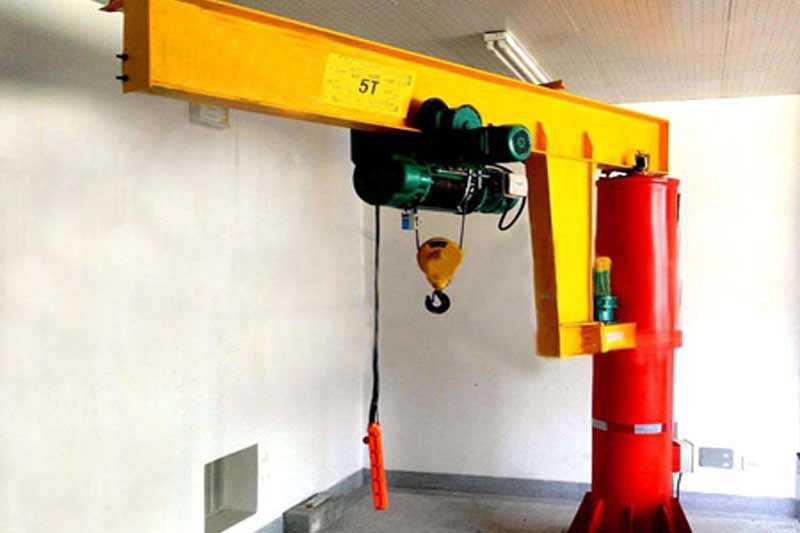
Floor mounted jib crane for limited space
When coverage is not properly planned, the most common issues are:
- Inaccessible equipment
- Certain pumps, valves, or motors cannot be reached directly by the hook
- Equipment is located outside the effective lifting zone
- Maintenance teams are forced to find alternative lifting methods
Unsafe lifting methods
- Workers may use chain blocks or temporary gantries
- Lifting is done at awkward angles or restricted positions
- Increased risk during emergency maintenance work
These problems usually do not appear during installation. They only become clear when actual maintenance starts, especially in tight pump rooms or long treatment channels.
In a water plant overhead crane system, one of the most overlooked design issues is incomplete coverage. On paper, the crane may look fully capable. The span seems correct, the runway is installed, and everything appears to match the layout. But in real operation, small gaps in coverage become real problems during maintenance. When coverage is not properly planned, the most common issues are inaccessible equipment and unsafe lifting methods.
- Certain pumps, valves, or motors cannot be reached directly by the hook
- Equipment is located outside the effective lifting zone
- Maintenance teams are forced to find alternative lifting methods
- Workers may use chain blocks or temporary gantries
- Lifting is done at awkward angles or restricted positions
- Increased risk during emergency maintenance work
These problems usually do not appear during installation. They only become clear when actual maintenance starts, especially in tight pump rooms or long treatment channels.
When crane coverage is not properly designed, the cost impact is not always immediate, but it builds up over time during operation.
Typical cost consequences include:
Additional lifting tools or modifications
- Extra portable hoists or manual lifting devices required
- Site-added beams or anchor points to reach missing areas
- Small design gaps turning into permanent field modifications
Increased labor time
- More repositioning of the crane during a single maintenance task
- Extra setup time before lifting operations can begin
- Slower response during emergency repairs
In daily operation, this does not always stop production, but it increases workload and reduces maintenance efficiency. Over time, it becomes a hidden operational cost.
To avoid these issues, crane coverage must be planned based on real maintenance activity, not just building layout drawings.
Key design considerations include:
Proper span and runway length
- The crane should fully cover all maintenance zones
- Runway alignment must allow smooth travel across the entire plant
- No area should be left partially outside the working range
Hook coverage across all service areas
- The hook position must reach every pump, valve, and lifting point
- Lateral and longitudinal movement must match actual equipment layout
- Turning or repositioning should not be required for basic maintenance tasks
Good coverage design is not about maximum span. It is about making sure every required point can be reached directly and safely.
Before finalizing a water plant crane design, the buyer should actively verify coverage based on real equipment positions inside the plant.
Map all lifting points in the plant
- Identify every pump, motor, and maintenance target
- Include both normal and emergency replacement points
- Mark actual lifting positions, not only equipment locations
Ensure no blind zones remain
- Check if any equipment falls outside crane reach
- Confirm full hook coverage during full travel range
- Validate access under real maintenance conditions, not only drawings
This step is often skipped, but it is one of the most important checks. Once the crane is installed, coverage issues are difficult and expensive to fix. A properly planned layout ensures that maintenance work stays smooth, safe, and predictable over the long term.
Principle 4: Select the Right Capacity Based on Actual Loads
In a water plant overhead crane system, crane capacity is one of the most sensitive decisions because it directly affects both cost and safety. Many buyers tend to either overestimate or underestimate the real lifting requirement, and both situations create long-term problems. When the crane is oversized, the structure, hoisting system, and electrical components are all designed for higher loads than actually needed in a water treatment plant. In practice, this means you are paying for extra steel strength and higher-rated components that will rarely be used. The result is a higher investment without real operational benefit. On the other hand, if the crane is undersized, the risk is more serious. The crane may not be able to safely handle the actual maintenance loads, especially during emergency lifting of heavy pumps or motors. This creates operational limitations and can also introduce safety concerns during lifting work. So the balance here is not optional—it directly affects both cost efficiency and safe operation.
In a water plant overhead crane system, crane capacity is one of the most sensitive decisions because it directly affects both cost and safety. Many buyers tend to either overestimate or underestimate the real lifting requirement, and both situations create long-term problems. When the crane is oversized, the structure, hoisting system, and electrical components are all designed for higher loads than actually needed in a water treatment plant. In practice, this means you are paying for extra steel strength and higher-rated components that will rarely be used. The result is a higher investment without real operational benefit. On the other hand, if the crane is undersized, the risk is more serious. The crane may not be able to safely handle the actual maintenance loads, especially during emergency lifting of heavy pumps or motors. This creates operational limitations and can also introduce safety concerns during lifting work. So the balance here is not optional—it directly affects both cost efficiency and safe operation.
For most water treatment plant crane applications, the lifting requirements are relatively stable and predictable compared to heavy manufacturing industries.
In real projects, the majority of lifting tasks fall within:
- 1 ton to 10 ton overhead crane range
This range typically covers:
- Pumps and pump assemblies
- Valves and pipeline components
- Sludge handling equipment
- Motors and auxiliary mechanical systems
Only in larger or specialized facilities will the requirement go beyond this range. In most cases, the loads are not extremely heavy, but they require stable and controlled lifting rather than high-capacity industrial lifting systems.
The correct capacity selection should always be based on real working conditions, not estimated assumptions or general industry standards.
Key design considerations include:
Real equipment weights
- Actual weight of pumps, motors, and valves must be confirmed
- Sludge systems and assembled components should be evaluated as complete lifting units, not individual parts
- Maintenance replacement scenarios should be considered, not just initial installation weights
Safety margin of 20–30%
- A reasonable buffer should be included to handle unexpected variations
- This margin helps cover aging equipment, water accumulation, or minor load changes during maintenance
- It also improves operational safety during emergency lifting situations
Capacity selection is not about choosing the highest number. It is about choosing a stable and practical range that matches real plant needs.
To avoid incorrect capacity selection, the buyer needs to take a structured approach before finalizing the crane specification.
Collect accurate load data
- Confirm the maximum weight of each individual equipment item
- Include complete assemblies, not just single components
- Verify with actual supplier data or engineering drawings
Plan for future equipment upgrades
- Consider whether pumps or systems may be replaced with larger models later
- Check if the plant has expansion plans or process upgrades
- Ensure the selected crane can handle reasonable future changes without modification
In practical terms, selecting the right capacity is not just about current needs. It is about making sure the overhead crane for water plant maintenance remains useful, safe, and flexible throughout the full service life of the facility.
Principle 5: Ensure Redundancy to Protect Continuous Operation
In a water plant overhead crane system, redundancy is often ignored during early planning, but it becomes very important when something goes wrong. The main issue is simple: the crane is not just supporting maintenance—it is often the only lifting tool available in a critical area. If the crane fails during maintenance work, everything can stop immediately. Pumps may already be disassembled, parts may be mid-lift, or heavy equipment may be waiting to be installed. At that moment, even a small mechanical or electrical failure can interrupt the entire maintenance process. This is not a theoretical situation. It happens in real plants when:
- The hoist cannot start after long idle periods
- Electrical faults occur in control systems during lifting
- Mechanical wear prevents safe lifting operation
- A single crane is assigned to a key maintenance zone
When there is no backup system, the maintenance work has to pause until the crane is repaired.
In a water plant overhead crane system, redundancy is often ignored during early planning, but it becomes very important when something goes wrong. The main issue is simple: the crane is not just supporting maintenance—it is often the only lifting tool available in a critical area. If the crane fails during maintenance work, everything can stop immediately. Pumps may already be disassembled, parts may be mid-lift, or heavy equipment may be waiting to be installed. At that moment, even a small mechanical or electrical failure can interrupt the entire maintenance process. This happens in real plants when:
- The hoist cannot start after long idle periods
- Electrical faults occur in control systems during lifting
- Mechanical wear prevents safe lifting operation
- A single crane is assigned to a key maintenance zone
When there is no backup system, the maintenance work has to pause until the crane is repaired.
When redundancy is not considered, the cost does not appear immediately during procurement. It appears later, during operation, especially in unexpected situations.
The most common cost consequences include:
Delayed repairs
- Maintenance schedules are interrupted because lifting is not possible
- Equipment replacement takes longer than planned
- Work that should take hours can stretch into days
Potential plant disruption
- In critical areas, such as pumping stations, delays can affect system stability
- Maintenance bottlenecks may impact downstream treatment processes
- Emergency work becomes more expensive due to time pressure and temporary solutions
In practice, the cost of downtime is usually much higher than the cost of adding backup capability during design.
To reduce operational risk, redundancy should be considered as part of the crane system design, not as an afterthought.
Common backup approaches include:
Secondary crane systems
- A backup crane installed in parallel or adjacent zones
- Provides alternative lifting capability when the main crane is unavailable
Dual hoist systems
- Two hoists on the same crane or runway system
- Allows continuous operation even if one hoist requires maintenance
Emergency manual operation
- Manual lifting options for low-frequency emergency use
- Provides basic functionality when power or control systems fail
The goal is not to duplicate everything, but to ensure that critical lifting functions are still available when one system is down.
Before finalizing a water plant crane system, the buyer should carefully evaluate what happens if the crane is not available during a key maintenance task.
Evaluate risk of single crane dependency
- Identify whether a single crane supports an entire process area
- Check if any critical equipment relies on only one lifting point
- Consider how often emergency lifting scenarios may occur
Consider distributed crane systems
- Divide lifting responsibility across multiple zones if possible
- Avoid relying on one crane for all maintenance operations
- Design layout so that failure of one crane does not stop all maintenance work
In real operation, redundancy is not about luxury—it is about keeping maintenance work continuous and avoiding unnecessary downtime when the crane is unexpectedly out of service.
Integrating All Principles into a Cost-Effective Crane Solution
In many water plant overhead crane projects, the most common mistake is treating crane selection as a simple equipment purchase. Buyers often focus only on capacity, price, or delivery time, and the crane is selected as a standalone item without fully considering how it will work inside the plant. At first, this approach seems practical. You get a quotation, compare specifications, and make a decision. But the problem appears later, when the crane is installed and used in real maintenance work. Because the crane was not planned as part of the full system, small gaps start to show up. It may not fully match the plant layout, it may not align with actual maintenance routes, or it may not perform well under the real environmental conditions inside the water treatment area. These issues usually do not stop operation immediately, but they gradually increase maintenance difficulty and cost over time.
In many water plant overhead crane projects, the most common mistake is treating crane selection as a simple equipment purchase. Buyers often focus only on capacity, price, or delivery time, and the crane is selected as a standalone item without fully considering how it will work inside the plant. At first, this approach seems practical. You get a quotation, compare specifications, and make a decision. But the problem appears later, when the crane is installed and used in real maintenance work. Because the crane was not planned as part of the full system, small gaps start to show up. It may not fully match the plant layout, it may not align with actual maintenance routes, or it may not perform well under the real environmental conditions inside the water treatment area. These issues usually do not stop operation immediately, but they gradually increase maintenance difficulty and cost over time.
A more reliable way to design a water plant crane system is to treat it as part of the entire operation, not just a single machine. The crane should be planned together with how the plant actually works on a daily basis. This means aligning the crane design with three key factors:
Plant layout
- The crane must match the physical arrangement of pump rooms, tanks, and treatment zones
- Runway length, span, and coverage should follow real equipment positions
- No lifting point should be left outside the working range
Maintenance workflow
- Understand how equipment is removed, repaired, and reinstalled in practice
- Design hook access based on real maintenance steps, not only drawings
- Reduce unnecessary repositioning during lifting tasks
Environmental exposure
- Consider humidity, chemicals, and temperature conditions in the plant
- Select corrosion protection and electrical protection accordingly
- Ensure stable operation even after long idle periods
When these three points are considered together, the crane becomes part of the maintenance system rather than an isolated tool.
When crane design is aligned with real plant conditions instead of being treated as a separate purchase, the benefits become clear over time.
Lower total cost of ownership
- Fewer modifications after installation
- Reduced repair frequency
- Longer service life under real working conditions
Reduced operational risk
- Fewer unexpected failures during maintenance
- More stable performance in emergency situations
- Less dependency on temporary lifting solutions
Improved maintenance efficiency
- Faster access to equipment
- Smoother lifting operations
- Less time wasted on repositioning or workaround methods
In practical terms, a well-integrated overhead crane for water treatment plants does not just lift equipment. It supports the entire maintenance process in a stable and predictable way, which is what actually reduces long-term cost and operational risk.
Conclusion: Reducing Cost and Risk Starts with the Right Design Decisions
For crane buyers, the real value of a water plant crane system is not just in the technical specifications. It is in how well the crane actually supports daily maintenance work and long-term stable operation in real plant conditions.
A crane that looks good on paper but does not fit the plant will always create hidden cost later. The safer approach is to focus on how the crane will be used in real maintenance situations, not only how it is described in drawings or datasheets.
If you pay attention to a few key points during selection, you can avoid most common problems:
- Proper duty selection that matches intermittent maintenance use
- Corrosion resistance suitable for humid and chemical environments
- Full coverage design that reaches all maintenance areas
- Accurate capacity based on real equipment weights
- Redundancy planning to avoid single-point failure
When these points are correctly planned, your overhead crane for water treatment plant will perform more reliably in daily operation and during emergency maintenance.
In practical terms, the result is simple:
- Lower lifecycle cost
- More reliable performance
- Reduced downtime risk
In the end, the right crane design is not an extra cost. It is a practical decision that helps you avoid future problems and keep your plant running with fewer interruptions.