7.5 Ton Explosion-Proof Crane for Nigeria Oil & Gas Industry
Brief Introduction
Oilfield maintenance workshops handle heavy equipment every day, from pumps and motors to industrial valves, compressors and gearbox assemblies. Moving these components requires a reliable overhead lifting system, especially when the workshop operates in an area where flammable gases or vapors may be present.
For an oilfield equipment maintenance company in Nigeria, Yuantai Crane supplied a 7.5 ton LB single-girder explosion-proof overhead crane for workshop material handling. The crane features a 17-meter span, 9-meter lifting height, Ex d IIB T4 explosion-proof configuration and IP55 protection.
The project also included 72 meters of P22 steel runway rails, explosion-proof hoisting and traveling mechanisms, and wireless remote control.
This was not the customer's first purchase from Yuantai Crane. In 2024, the company had already purchased several explosion-proof wire rope hoists. The latest order expanded the supply from individual hoisting equipment to a complete explosion-proof overhead crane system.
Below, we look at the project requirements, crane design, explosion-proof specifications and runway rail supply, along with some important points buyers should check when purchasing an explosion-proof crane for an oil and gas facility.
Project Overview: 7.5 Ton Explosion-Proof Crane for an Oilfield Workshop
The customer operates an equipment maintenance workshop serving the oilfield industry. Its daily work involves lifting and moving heavy machinery components for inspection, servicing and repair.
A 7.5 ton overhead crane was selected to handle these loads across the workshop. Since explosion protection was part of the project requirements, the crane needed an appropriate explosion-proof configuration rather than a standard industrial lifting arrangement.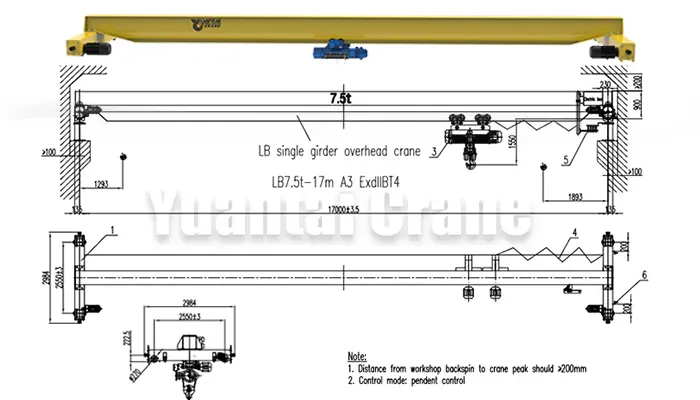
Workshop Lifting Applications
The crane is intended for handling different types of industrial equipment and machinery components, including:
- Oilfield pumps and motors: Lifting equipment for inspection, maintenance and replacement.
- Industrial valves: Moving heavy valve assemblies during servicing.
- Compressors: Handling machinery components during repair work.
- Gearboxes: Lifting drive components for inspection or replacement.
- Heavy machinery parts: Moving other workshop equipment that requires overhead lifting.
For this type of workshop, an overhead crane provides coverage across the working area and allows maintenance teams to move heavy components between different workstations.
Main Technical Specifications
The following table summarizes the main requirements and configuration of the Nigeria explosion-proof crane project.
|
Parameter |
Specification |
|
Project Location |
Nigeria |
|
Industry |
Oil & Gas |
|
Crane Type |
LB Single-Girder Explosion-Proof Overhead Crane |
|
Lifting Capacity |
7.5 Ton |
|
Span |
17 m |
|
Lifting Height |
9 m |
|
Duty Classification |
A3 |
|
Explosion-Proof Rating |
Ex d IIB T4 |
|
Protection Grade |
IP55 |
|
Hoisting Equipment |
Explosion-Proof Wire Rope Hoist |
|
Hoisting Speed |
7 m/min |
|
Trolley Travel Speed |
20 m/min |
|
Crane Travel Speed |
20 m/min |
|
Control Method |
Wireless Remote Control |
|
Power Supply |
380V / 50Hz / 3Ph |
|
Runway Rail |
P22 Steel Rail |
|
Total Rail Length |
72 m |
Three Main Considerations for This Project
There were three important points to address when configuring this explosion-proof overhead crane:
- Explosion protection: The hoist, traveling mechanisms and relevant electrical equipment needed to match the specified explosion-proof requirements.
- Crane structure: The single-girder bridge needed to meet the 7.5 ton lifting capacity, 17-meter span and required operating conditions.
- Complete system supply: The customer also required runway rails and engineering documents to coordinate local installation.
Cooperated Customer: From Explosion-Proof Hoists to a Complete Overhead Crane
There was already a business relationship between the Nigerian customer and Yuantai Crane before this project.
In 2024, the customer purchased several explosion-proof wire rope hoists from Yuantai Crane. For the new requirement, the customer needed a complete overhead crane rather than individual hoisting equipment.
What Was Included in the New Order?
The supply scope expanded to cover the main crane system and its associated equipment:
- 7.5 ton LB single-girder explosion-proof overhead crane.
- Explosion-proof wire rope hoisting equipment.
- Explosion-proof trolley travel mechanism.
- Explosion-proof crane travel mechanisms.
- Explosion-proof electrical configuration.
- Wireless remote control.
- 72 meters of P22 steel runway rails.
- Engineering drawings and relevant installation information.
For buyers sourcing explosion-proof cranes from China, this project also illustrates the difference between purchasing a standalone explosion-proof hoist and purchasing a complete overhead crane system.
When ordering a complete crane, the bridge structure, hoist, trolley, end carriages, travel motors, electrical controls and runway requirements all need to be coordinated.
Customized Design: 7.5 Ton LB Single-Girder Explosion-Proof Overhead Crane
The main equipment supplied for this Nigeria project was an LB-type single-girder explosion-proof overhead crane.
With a 7.5 ton rated capacity, 17-meter span and 9-meter lifting height, the crane was configured for material handling and maintenance operations inside the customer's workshop.
Why Choose an LB Single-Girder Explosion-Proof Crane?
A single-girder overhead crane uses one main bridge girder to support the hoisting and trolley arrangement. Compared with a double-girder design, it generally has a simpler bridge structure and can be a suitable choice when the lifting capacity, span and operating conditions allow.
For this project, the single-girder arrangement was selected according to the customer's lifting requirements and the crane's design conditions.
The main considerations included:
- 7.5 ton lifting capacity: Suitable for the specified workshop lifting requirements.
- 17-meter span: Designed around the required distance between the runway rails.
- 9-meter lifting height: Provides the required vertical hook travel.
- Explosion-proof hoist: Configured for the specified hazardous-area protection requirements.
- Explosion-proof travel mechanisms: Used for trolley and crane movement.
One point worth mentioning: a 7.5 ton crane does not automatically have to be single girder or double girder. The decision depends on span, structural strength, deflection limits, wheel loads, duty classification and building conditions.
Complete Explosion-Proof Crane Configuration
|
Component |
Configuration |
|
Bridge Structure |
Single Girder |
|
Hoisting Equipment |
Explosion-Proof Wire Rope Hoist |
|
Hoist Travel |
Explosion-Proof Trolley |
|
Crane Travel |
Explosion-Proof Travel Mechanism |
|
Electrical System |
Explosion-Proof Electrical Configuration |
|
Control |
Wireless Remote Control |
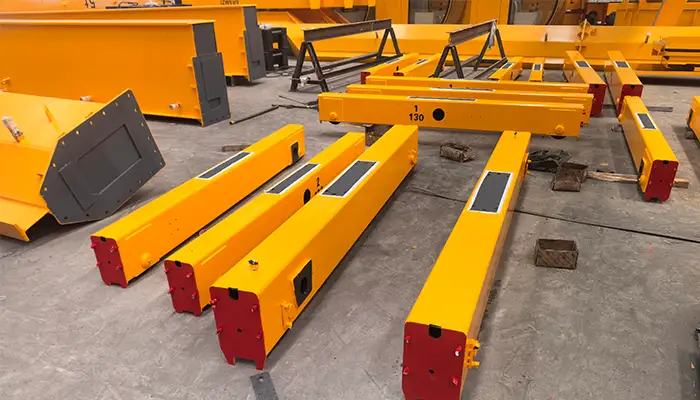
end carriages and main girder of the LB series of single girder explosion proof overhead crane
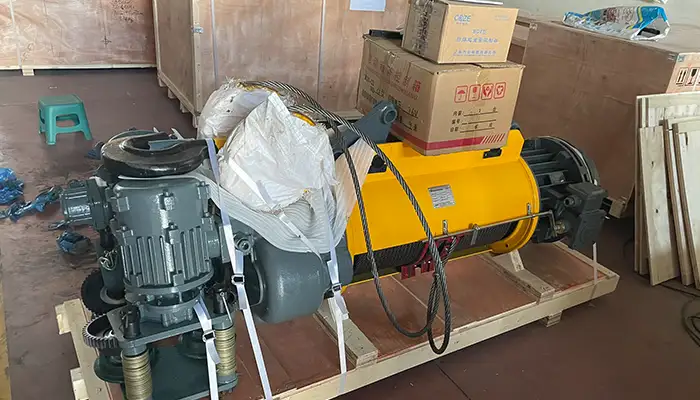
YT-BCD explosion proof wire rope electric hoist
Complete Technical Specifications of the 7.5 Ton Crane
|
Parameter |
Specification |
|
Crane Type |
LB Single-Girder Explosion-Proof Overhead Crane |
|
Rated Capacity |
7.5 Ton |
|
Span |
17 m |
|
Lifting Height |
9 m |
|
Duty Classification |
A3 |
|
Explosion-Proof Rating |
Ex d IIB T4 |
|
Protection Grade |
IP55 |
|
Hoisting Speed |
7 m/min |
|
Trolley Travel Speed |
20 m/min |
|
Crane Travel Speed |
20 m/min |
|
Power Supply |
380V / 50Hz / 3Ph |
|
Control Method |
Wireless Remote Control |
|
Runway Rail |
P22 Steel Rail |
|
Total Rail Length |
72 m |
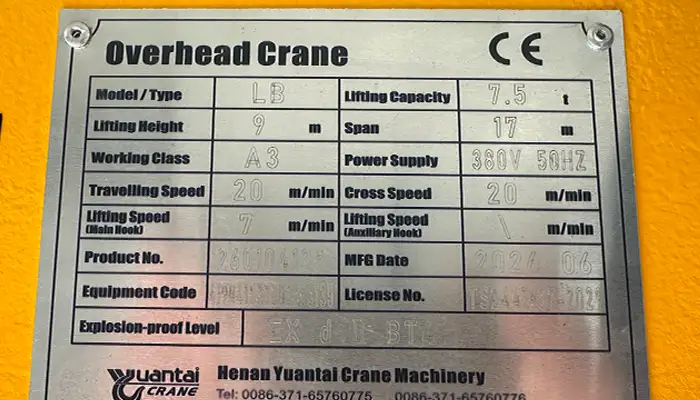
Explosion-Proof Protection: Ex d IIB T4 and IP55 Explained
When purchasing an explosion-proof crane for an oilfield workshop, buyers should pay close attention to the protection markings. They are not just technical labels on a nameplate. They help determine whether the equipment is suitable for the hazardous conditions at the installation site.
This project specified Ex d IIB T4 explosion protection and IP55 ingress protection. Here is what these ratings mean.
|
Marking |
Meaning |
|
Ex |
Explosion protection marking |
|
d |
Flameproof enclosure protection |
|
IIB |
Gas group classification |
|
T4 |
Maximum equipment surface temperature of 135°C |
Ex d – Flameproof Enclosure
Ex d refers to the flameproof enclosure protection concept. The enclosure is designed to withstand an internal explosion and prevent the ignition of the surrounding explosive atmosphere under the specified conditions.
This protection concept is commonly used for electrical equipment in hazardous industrial environments.
IIB – Gas Group
Gas groups classify explosive gases according to their ignition characteristics and equipment protection requirements. IIB covers gases with more demanding requirements than IIA, while IIC has more stringent requirements than IIB.
The required gas group must be checked against the actual gases that may be present at the installation site.
T4 – Temperature Class
T4 means the maximum permitted equipment surface temperature is 135°C under the applicable operating conditions.
This matters because the surface temperature of electrical equipment must remain below the ignition temperature of the surrounding gas or vapor.
Do not select an explosion-proof crane based on the Ex marking alone. The equipment must match the hazardous-area classification of the workshop.
- Hazardous area zone: Is the equipment intended for Zone 1 or Zone 2?
- Gas group: Does the site require IIA, IIB or IIC protection?
- Temperature class: Is T4 suitable for the gases present?
- Certification: Do the certificates cover the actual equipment being supplied?
- Applicable standards: Which local and international explosion-protection standards must be followed?
For example, an Ex d IIB T4 crane should not automatically be considered suitable for every oil and gas facility. The final equipment selection must be checked against the site's hazardous-area documentation.
IP55 is an ingress protection rating under IEC 60529. It describes how well an enclosure resists dust and water entering the equipment.
|
IP Rating |
Protection |
|
IP5X |
Dust-protected. Limited dust ingress is permitted, but it must not interfere with satisfactory operation. |
|
IPX5 |
Protected against water jets from any direction under specified test conditions. |
For an industrial overhead crane, IP55 protection can help protect electrical equipment from dust and water splashes commonly encountered in workshop environments.
Keep in mind that IP55 does not mean completely dust-tight, waterproof or corrosion-proof. If the crane will operate outdoors, near the coast or in a chemically aggressive environment, additional environmental protection may be needed.
An explosion-proof overhead crane is a complete lifting system. Checking only the hoist is not enough when evaluating the equipment configuration.
Depending on the crane design and hazardous-area requirements, the following components may need explosion-protected configurations:
- Explosion-proof wire rope hoist and hoisting motor.
- Explosion-proof trolley travel motor.
- Explosion-proof crane travel motors.
- Electrical control components and enclosures.
- Cables and electrical accessories.
- Other electrical equipment installed on the crane.
Buyers should request the relevant explosion-protection certificates, nameplate information and equipment documentation. They should also check which components are covered by each certificate. A certificate for an individual explosion-proof hoist does not automatically certify the entire overhead crane.
Crane Duty Classification, Travel Speeds and Remote Control
Explosion protection is only one part of crane selection. The crane must also match the actual workload of the maintenance workshop.
For this project, the specified duty classification was A3, with a hoisting speed of 7 m/min and trolley and crane travel speeds of 20 m/min.
Duty classification describes how frequently and intensively a crane is expected to operate. It is not determined by lifting capacity alone.
Two 7.5 ton overhead cranes can have very different duty requirements. One may lift a heavy component only a few times a day, while another may handle loads continuously across several working shifts.
Before selecting the duty class, consider the following:
|
Factor |
What to Consider |
|
Lifting Frequency |
Number of lifting cycles per hour or shift. |
|
Average Load |
How often the crane operates close to its rated capacity. |
|
Operating Hours |
Hours of operation per day. |
|
Working Shifts |
One shift or multiple shifts per day. |
|
Load Spectrum |
Distribution of light, medium and heavy loads. |
|
Expected Service Life |
Expected operating period and maintenance requirements. |
A3 was the specified classification for this Nigeria project. For another oilfield workshop, the appropriate duty class should be determined from actual operating conditions and the applicable crane design standard.
The crane uses three main movements to position loads within the workshop.
|
Movement |
Speed |
Function |
|
Hoisting |
7 m/min |
Raising and lowering loads. |
|
Trolley Travel |
20 m/min |
Moving loads across the bridge. |
|
Crane Travel |
20 m/min |
Moving loads along the runway. |
Hoisting speed affects how quickly a component can be raised or lowered. Trolley and crane travel speeds determine how quickly the load moves horizontally across the workshop.
For maintenance operations that require careful positioning, buyers may also consider variable-frequency control or additional positioning features, depending on the application.
The crane is operated by wireless remote control. This gives the operator more flexibility when moving around the working area.
Some practical advantages include:
- Flexible operator positioning during lifting operations.
- A better view of the load and surrounding working area.
- Convenient control of hoisting, trolley travel and crane travel.
For hazardous-area installations, the remote control equipment and associated electrical components must also meet the applicable explosion-protection requirements.
72 Meters of P22 Runway Rails for the Explosion-Proof Crane System
The runway system is an important part of any overhead crane installation. It supports the crane and provides the travel path for longitudinal movement.
For this Nigeria project, Yuantai Crane also supplied 72 meters of P22 steel runway rails.
Supplying the crane and runway rails together made it easier to coordinate the equipment specifications and installation information within one project.
Crane wheels and runway rails work as a matched mechanical system. Their specifications and installation dimensions need to be checked together.
There are several reasons why buyers should pay attention to the runway rail arrangement:
- Wheel and rail compatibility: The wheel profile and rail dimensions must match the crane design.
- Runway alignment: Incorrect rail alignment can affect crane travel and wheel loading.
- Installation arrangement: Rail joints, fastening methods and supporting structures need to be considered.
- Technical coordination: Supplying the crane and rails together can reduce coordination between different suppliers.
When purchasing overhead crane runway rails, do not focus only on the rail price per meter. The rail profile, dimensions and installation conditions are equally important.
|
Item |
What to Check |
|
Rail Profile |
Rail type, dimensions and nominal weight. |
|
Rail Length |
Total length and joint arrangement. |
|
Wheel Compatibility |
Compatibility between the crane wheels and rail profile. |
|
Fastening |
Rail clips, fastening arrangement and supporting structure. |
|
Installation |
Runway alignment and installation tolerances. |
The actual rail arrangement should always be confirmed against the approved runway drawings.
For overseas crane projects, equipment delivery is only part of the work. The local engineering and installation team also needs technical information before preparing the workshop.
For this project, the engineering documentation included:
- Structural foundation layout drawings.
- Crane wheel load data.
- Electrical schematics.
- Relevant installation information.
These documents help the local team review the runway arrangement, prepare the supporting structure and coordinate the electrical installation.
If you are purchasing an overhead crane from a Chinese manufacturer, it is worth discussing the required engineering documents before confirming the order. It is much easier to identify missing information during the quotation and design stage than during installation.
What Should Buyers Know Before Purchasing an Explosion-Proof Overhead Crane?
Choosing an explosion-proof crane for an oilfield workshop involves more than comparing lifting capacity and supplier prices. The equipment must meet the lifting requirements and the hazardous-area conditions at the installation site.
It depends on the installation location.
Some oil and gas facilities have classified hazardous areas where flammable gases or vapors may be present. In these areas, standard electrical equipment may introduce potential ignition sources.
Before purchasing a crane, buyers should confirm whether the installation location is classified as Zone 1, Zone 2 or a non-hazardous area.
If the crane operates in a classified hazardous area, its electrical and mechanical configuration must meet the applicable requirements. A standard overhead crane should not be assumed suitable simply because it has the required lifting capacity.
A 7.5 ton single-girder overhead crane with a 17-meter span requires proper engineering evaluation. The lifting capacity and span alone are not enough to determine whether the design is suitable.
The manufacturer should consider:
- Main girder strength and deflection.
- Wheel loads and end carriage design.
- Hoist and trolley arrangement.
- Duty classification.
- Runway beam capacity.
- Building structure and installation conditions.
Some projects may be suitable for a single-girder crane, while others may require a double-girder design. The final decision should be supported by engineering calculations.
These markings describe different types of protection.
|
Marking |
Purpose |
|
Ex d IIB T4 |
Explosion protection, gas group and temperature classification. |
|
IP55 |
Protection against dust and water ingress. |
One does not replace the other. Depending on the installation environment, an explosion-proof crane may need both appropriate explosion protection and ingress protection.
Not necessarily. A3 may be suitable for some maintenance applications, but the actual duty requirement depends on the frequency and intensity of crane operation.
Buyers should provide the average load, lifting cycles, operating hours and number of shifts so the manufacturer can recommend the appropriate duty classification.
Purchasing the overhead crane and runway rails from one supplier can simplify technical coordination.
The crane wheel dimensions, rail profile, runway arrangement and installation requirements need to be compatible. When the equipment comes from different suppliers, the buyer may need to coordinate drawings and technical specifications between them.
For overseas projects, a combined supply arrangement can make procurement and engineering communication easier.
If you are requesting an explosion-proof overhead crane quotation from a Chinese manufacturer, prepare the following information as far as possible.
|
Information |
Details Required |
|
Lifting Capacity |
Maximum lifting load in ton. |
|
Span |
Distance between runway rail centers. |
|
Lifting Height |
Required hook lifting height. |
|
Runway Length |
Total crane travel distance. |
|
Duty Classification |
Lifting frequency, average load and working hours. |
|
Hazardous Area |
Zone 1 / Zone 2, where applicable. |
|
Gas Group |
IIA / IIB / IIC. |
|
Temperature Class |
Required temperature class, such as T4. |
|
Power Supply |
Voltage / Frequency / Phase. |
|
Installation Environment |
Indoor / Outdoor. |
|
Certification |
Required local or international standards. |
|
Workshop Drawings |
Building layout, runway and supporting structure information. |
Even if you do not have every detail ready, you can send the available specifications and workshop drawings first. The engineering team can review the information and identify what else is needed before preparing a technical proposal and quotation.
Explosion-Proof Crane Manufacturer: Other Lifting Equipment for Hazardous Areas
Different oil and gas applications require different lifting arrangements. A maintenance workshop may need a single-girder overhead crane, while a larger production facility may require a double-girder crane or another type of lifting equipment.
As an explosion-proof crane manufacturer and supplier, Yuantai Crane can provide different lifting configurations according to project requirements.
Explosion-proof single-girder overhead cranes are used in industrial workshops where the lifting capacity, span and working conditions are suitable for a single-girder arrangement.
They can be configured with explosion-protected hoists, trolley mechanisms and electrical components according to the required hazardous-area classification.
For higher lifting capacities, larger spans or more demanding operating conditions, a double-girder explosion-proof overhead crane may be a better choice.
The design can be customized according to lifting capacity, lifting height, duty classification, workshop dimensions and hazardous-area requirements.
Not every customer needs a complete overhead crane. Some projects only require an explosion-proof electric wire rope hoist or chain hoist for equipment replacement, crane modification or integration into an existing lifting system.
When requesting an explosion-proof hoist price, buyers should provide the lifting capacity, lifting height, operating frequency, installation arrangement and required explosion-protection marking.
Depending on the site layout and application, other equipment may also be considered:
- Explosion-proof jib cranes.
- Explosion-proof gantry cranes.
- Explosion-proof wire rope hoists.
- Explosion-proof chain hoists.
- Customized hazardous-area lifting systems.
Whether you need an individual explosion-proof hoist or a complete overhead crane system, the equipment should be selected according to the actual lifting requirements and hazardous-area classification.
Get a Quote for a Customized Explosion-Proof Overhead Crane
Looking for a 7.5 ton explosion-proof overhead crane or another customized lifting system for an oilfield, chemical plant or hazardous industrial workshop?
Yuantai Crane can help review your lifting requirements and prepare a suitable equipment configuration, including the crane structure, explosion-proof hoist, traveling mechanisms, electrical system and runway rail arrangement.
When contacting our engineering team, please provide the following information:
- For Engineering Managers: Lifting capacity, span, lifting height, duty classification and workshop drawings.
- For HSE Managers: Hazardous-area zone, gas group, temperature class and required explosion-protection certification.
- For Procurement Managers: Required crane configuration, technical specifications, delivery destination and requested commercial terms.
Whether you are purchasing an explosion-proof single-girder crane, a double-girder overhead crane or an individual explosion-proof hoist, providing the correct project information helps us prepare a more accurate technical and commercial offer.
Contact Yuantai Crane's engineering team for a customized explosion-proof crane quotation. Send us your crane specifications and workshop drawings for an initial technical review.