Rail Mounted Gantry Cranes for TBM Muck Removal
Yuantai Solution
Boost TBM tunneling efficiency with rail mounted gantry cranes for continuous muck removal, automated operation, and improved tunnel spoil handling.Most Important Takeaway
Rail mounted gantry cranes (RMGs) streamline TBM muck removal, reduce bottlenecks, and maximize tunnel excavation productivity through continuous, automated, and integrated material handling.
- Integrating gantry cranes with TBM muck cars improves spoil handling efficiency.
- Automated and remote-control systems enable continuous-duty operation.
- Rail alignment and precise travel systems prevent delays and operational errors.
- Proper crane configuration and capacity selection optimize material flow.
- RMGs reduce project downtime and increase overall tunneling productivity.
Questions Solved
Efficiency in TBM muck removal systems mainly comes from keeping spoil moving without interruption between the TBM face and surface transport. When a rail mounted gantry crane for TBM muck removal is properly integrated with muck cars and conveyors, it removes waiting time between excavation and spoil discharge.
- Align crane cycle time with TBM advance rate.
- Reduce intermediate handling steps in tunnel spoil transfer.
- Use stable rail travel and coordinated loading points.
Different tunnel projects require different tunnel spoil handling crane configurations depending on space, load, and excavation output. There is no single standard setup.
In practice:- Compact tunnels often use single girder or lighter rail mounted gantry systems.
- Larger diameter TBMs typically require double girder gantry cranes for higher load stability.
- High-output projects may use automated or remote-control gantry cranes for continuous operation.
A TBM muck removal gantry crane must work as part of a full logistics chain, not as an isolated machine. Integration with muck cars, conveyor belts, and hoppers is essential to maintain steady flow.
In practice:- Synchronize crane lifting with muck car arrival cycles.
- Connect crane operation with conveyor discharge timing.
- Design loading/unloading points to reduce repositioning time.
Continuous tunneling requires equipment that matches both load demand and operating rhythm. In most projects, rail mounted gantry cranes are selected in the 20–50 ton range depending on spoil volume.
In practice:- 20–32 ton for standard metro or utility tunnels.
- 40–50 ton for large TBM diameter and heavy rock spoil.
- Double girder or continuous-duty designs for stable long-term operation.
Automation in an automated tunnel gantry crane system improves both operational consistency and worker safety, especially in confined tunnel environments.
In practice:- Reduces manual handling in hazardous underground zones.
- Keeps spoil flow consistent with TBM excavation speed.
- Allows remote operation from safer control locations.
- Minimizes errors during lifting, travel, and unloading cycles.
Introduction
TBM Tunneling Challenges and Spoil Removal
Tunnel boring machines (TBMs) can excavate large volumes of soil and rock, but handling the resulting muck is a major challenge. Delays in spoil removal can slow the TBM, increase downtime, and stretch project timelines.
Key Points:
- Spoil varies in size, weight, and moisture.
- Slow muck removal directly reduces TBM productivity.
- Conventional methods like conveyors or trucks often struggle in confined tunnels.
Why Rail Mounted Gantry Cranes Matter
Rail mounted gantry cranes (RMGs) lift and move TBM spoil efficiently along rails, directly integrating with muck cars or conveyors. This ensures continuous spoil flow and reduces idle time.
Practical Benefits:
- Fast, controlled lifting of 20–50 ton loads.
- Works in confined spaces or uneven floors.
- Supports single girder, double girder, automated, or remote-control operation.
Continuous Operation and Automation
Continuous-duty RMGs keep spoil moving day and night. Automated and remote systems coordinate with TBMs to maintain steady excavation while improving safety and efficiency.
Takeaways:
- Reduces downtime and human error.
- Maintains consistent spoil flow with TBM excavation rate.
- Enhances safety by keeping operators away from heavy loads.
Key Considerations for TBM Muck Removal Cranes
In a rail mounted gantry crane for TBM muck removal, the first thing buyers usually focus on is how well the crane connects with TBM muck cars and spoil wagons. If the interface is not smooth, the whole tunnel spoil handling system slows down. A well-matched setup allows direct loading and unloading without extra repositioning, which keeps the muck removal cycle stable. In long tunnels, even small delays at this point can interrupt TBM advance.
- Direct coordination between gantry crane and muck cars reduces handling steps.
- Stable loading cycle supports continuous TBM excavation.
- Better interface design helps avoid spoil overflow and re-handling.
A TBM muck removal gantry crane does not work alone; it is part of a wider spoil logistics chain. This usually includes conveyors, hoppers, transfer points, and muck trains inside the tunnel.
When these systems are not synchronized, bottlenecks appear quickly. The crane may wait for empty cars, or cars may wait for crane lifting. Matching crane lifting speed with spoil discharge rate is essential for stable operation.
Practical points:- Coordination between crane, conveyor, and muck car system improves flow stability.
- Balanced cycle time avoids congestion in tunnel logistics.
- Supports continuous spoil discharge from TBM face.
For any rail mounted gantry crane used in tunnel spoil handling, rail alignment is a basic but critical factor. The crane runs on fixed rails, so even small installation errors can affect travel smoothness.
Poor alignment can lead to uneven wheel load, vibration during travel, or difficulty in positioning over muck cars. Over time, it also increases wear on wheels and rail surfaces.
Practical points:- Accurate rail installation ensures stable crane travel in long tunnel sections.
- Proper alignment reduces mechanical stress and maintenance frequency.
- Improves positioning accuracy during muck lifting and dumping cycles.
The travel system of a rail mounted gantry crane for TBM applications is designed to handle repetitive movement under heavy load. It typically includes motor-driven wheels, bogie systems, and controlled acceleration to ensure stability.
In tunnel environments, travel performance is not just about speed—it is about controlled movement under full load of wet soil or rock spoil.
Practical points:- Motorized travel system ensures smooth movement under heavy muck loads.
- Stable bogie design reduces impact on crane structure.
- Controlled acceleration prevents load swing during operation.
In tunnel boring machine muck removal systems, cranes often operate in continuous cycles, matching TBM excavation speed. This means the crane must be designed for continuous-duty (often 24/7) operation without performance drop.
Heat buildup, mechanical wear, and electrical load are key design concerns. Proper duty classification, cooling, and component selection become important for long tunnel projects.
Practical points:- Continuous-duty gantry crane design supports uninterrupted TBM advance.
- Wear-resistant components reduce downtime in long-duration projects.
- Thermal and electrical design stability ensures reliable operation.
Modern automated tunnel gantry cranes are increasingly used in TBM projects where efficiency and safety are priorities. Depending on project level, cranes may be semi-automatic, fully automated, or remote-controlled.
These systems can be linked with TBM control and monitoring systems to coordinate spoil discharge, crane movement, and muck car positioning. This reduces manual intervention inside confined tunnel environments.
Practical points:- Remote-control gantry crane systems improve operator safety in confined tunnels.
- Automation helps maintain consistent spoil handling speed.
- Integration with TBM systems supports synchronized excavation and muck removal flow.
Typical Capacities & Configurations
In a rail mounted gantry crane for TBM muck removal system, capacity selection is closely linked to tunnel diameter, excavation rate, and spoil density. Most projects do not rely on a single standard size, because TBM output varies from soil to hard rock conditions.
For practical tunnel spoil handling, capacities are usually selected in the 20 ton to 50 ton range. This covers most medium to large tunneling projects, including metro tunnels, water diversion tunnels, and utility corridors.
Typical capacity range:
- 20 ton – suitable for small to medium TBM sections and lighter spoil flow
- 32 ton – commonly used in standard metro and utility tunneling projects
- 40 ton – for higher output TBM muck removal systems with heavier spoil volume
- 50 ton – used in large diameter tunnels with continuous spoil discharge requirements
These capacities are selected to match the TBM excavation cycle so that spoil removal does not slow down tunneling progress.
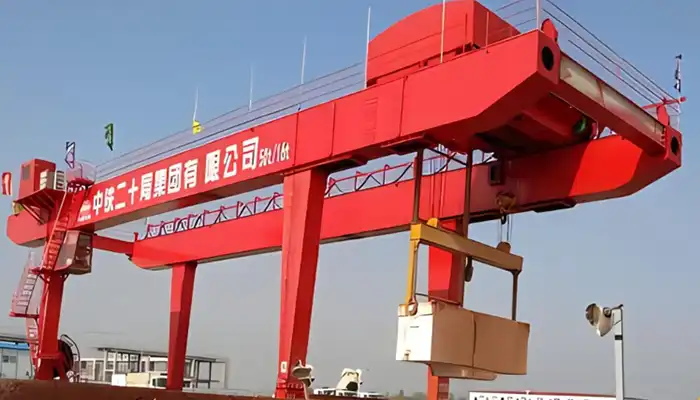
The rail mounted gantry crane (RMG) is the most commonly used solution in TBM muck handling systems. It runs along fixed rails parallel to the tunnel or station base, allowing stable and repetitive lifting of muck cars or containers.
It is widely chosen because it balances load capacity, travel stability, and installation flexibility.
Key practical points:
- Works well in structured tunnel layouts with defined rail tracks
- Suitable for continuous spoil transfer between TBM and transport system
- Reliable option for long-term tunnel construction projects
A double girder gantry crane for TBM muck removal is used when higher lifting capacity and longer spans are required. The double girder structure provides better load distribution and improved rigidity, especially when handling heavy spoil containers or uneven loads.
This configuration is often selected in large underground stations or wide tunnel cross-sections.
Key practical points:
- Higher structural strength for heavy-duty tunnel spoil handling
- Better stability under 40–50 ton lifting conditions
- Suitable for wider rail spans and complex tunnel logistics layouts
An automated tunnel gantry crane is designed for continuous-duty TBM operations where manual handling is limited or not efficient. It can operate in coordination with TBM output systems, conveyors, and muck cars.
Automation helps maintain a steady spoil flow without waiting cycles between excavation and transport.
Key practical points:
- Supports unmanned or semi-unmanned tunnel operations
- Improves synchronization between TBM and spoil removal system
- Reduces dependence on manual coordination in underground environments
A remote-control gantry crane for TBM muck handling is commonly used in confined or safety-sensitive tunnel zones. Operators control lifting and travel from a safe location, often outside the immediate tunnel working area.
This configuration is especially useful in projects with limited visibility or restricted access conditions.
Key practical points:
- Improves operator safety in confined tunnel environments
- Allows flexible control during muck loading and unloading cycles
- Suitable for complex tunnel geometry and limited working space
Buyer Benefits & Value
A rail mounted gantry crane for TBM muck removal keeps spoil moving smoothly from the tunnel face to transport systems. By handling muck directly from TBM spoil cars, it prevents backups and delays that would otherwise slow excavation.
- Minimizes idle time between excavation and spoil transport.
- Ensures consistent flow of muck even in high-volume TBM projects.
- Reduces manual handling, lowering the chance of errors or delays.
Continuous operation is critical for TBM projects. With automated or remote-control gantry cranes, spoil removal matches the excavation rate, allowing TBMs to advance without interruption.
Practical points:- Maintains steady tunnel progress day and night.
- Synchronizes crane operation with conveyors, hoppers, and muck cars.
- Reduces stoppages caused by inefficient spoil handling.
Efficient spoil handling directly impacts project timelines and costs. By keeping TBMs moving and minimizing downtime, rail mounted gantry cranes improve overall productivity.
Practical points:- Faster spoil removal translates to shorter project duration.
- Reduces labor costs by limiting manual intervention in muck handling.
- Optimizes the use of tunnel equipment and TBM cycles.
Handling heavy spoil underground is inherently risky. Using remote-control or automated tunnel gantry cranes reduces the need for operators in hazardous areas and minimizes the risk of accidents or spoil spillage.
Practical points:- Keeps personnel away from moving loads and confined spaces.
- Reduces the chance of equipment damage caused by human error.
- Provides reliable, controlled lifting in uneven or confined tunnels.
Practical Takeaways for Buyers
When selecting a rail mounted gantry crane for TBM muck removal, there are a few practical points that make a real difference in tunnel projects. These decisions affect efficiency, safety, and overall project cost.
Key Takeaways:
- Select the right crane capacity: Match the crane load to TBM diameter, spoil volume, and material density. Smaller TBMs may only need 20–32 ton cranes, while large-diameter tunnels or heavy rock spoil require 40–50 ton capacities.
- Check rail alignment: Precise installation of travel rails is essential for smooth crane movement and consistent muck handling. Misalignment increases wear and can slow down spoil transport.
- Consider automation: Automated or remote-control cranes reduce labor requirements, keep operators safe, and ensure continuous spoil flow in long tunnels.
- Match crane type to project layout: Single girder cranes are compact and fit in tight tunnels, while double girder cranes handle heavier loads and longer spans more reliably.
These points help buyers make informed decisions, ensuring that the TBM muck removal gantry crane integrates effectively with the tunnel spoil handling system, supports continuous excavation, and reduces bottlenecks.
Rail mounted gantry cranes are critical for modern TBM projects, ensuring smooth muck removal, continuous tunneling, and optimized productivity. Selecting the right configuration, capacity, and automation level directly impacts project efficiency, safety, and cost-effectiveness.