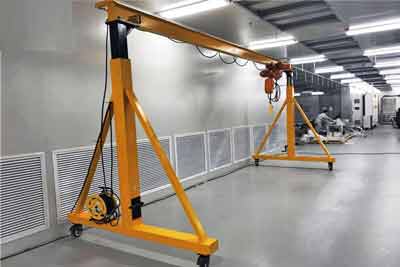
2 Ton Portable Gantry Crane with Adjustable Height 6 to 9 M
Portable gantry crane for sale. 2-ton gantry crane with 6–9 m adjustable height, dual hoists, and safe, stable operation for workshops, maintenance tasks.
A Practical Guide for Buyers and Engineering Teams
Introduction
A 2 ton gantry crane with a large lifting height of 6 to 9 meters is built for jobs where ordinary portable gantry cranes simply cannot reach. When your work involves lifting equipment above tall machines, moving loads in open yards, or handling materials in areas with limited lifting tools, this type of crane gives you the height and flexibility you need. It’s a practical solution for buyers who want more reach without moving into heavy, fixed overhead crane systems.
Where a Tall 2-Ton Gantry Crane Is Commonly Used
You’ll see this kind of crane in many places. Some users need it every day, while others rely on it only when a specific piece of equipment must be lifted high or aligned precisely.
- Equipment assembly workshops: Useful when technicians must lift motors, pumps, molds, or fixtures above large machines.
- Warehouse loading and unloading: Helps when racking systems or tall storage shelves limit the use of forklifts.
- Outdoor work sites: Ideal for locations without existing lifting equipment, such as small construction sites, HVAC installation, or machinery relocation.
- Maintenance and repair areas: When workers must remove or install components at height, especially in power plants, chemical plants, or processing facilities.
Why Extra Height Requires More Safety and Stability
A tall gantry crane behaves differently from a low one. Once you extend the structure to 6–9 meters, the frame is more sensitive to movement, wind, uneven ground, and sudden load shifts. That’s why these cranes often include:
- Stabilizing winches or cable systems: These reduce swaying when the frame is raised.
- Reinforced columns and base beams: The crane needs stronger side frames to stay rigid when reaching full height.
- Controlled hoist movement: Smooth and synchronized lifting avoids pulling the crane off balance.
In short, the added height gives you more capability, but it also means you must pay closer attention to stability and operating conditions. Buyers who understand these details can choose the right setup and avoid issues during installation and daily use.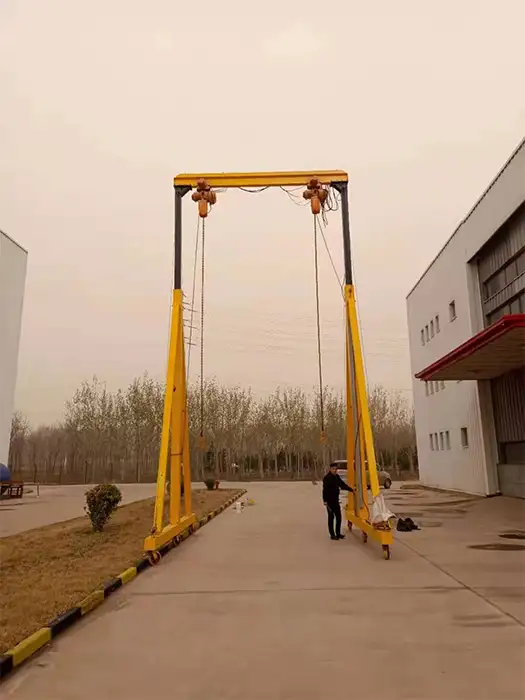
2 ton portable gantry crane for sale
Key Technical Specifications of the 2-Ton Portable Gantry Crane
A portable gantry crane with a 2-ton lifting capacity and a 6–9 meter adjustable height needs to be built with the right combination of strength, stability, and usability. The specifications below give a clear picture of what buyers should confirm before placing an order, especially when the crane will be used in tall or open-area environments.
This crane is designed to safely lift and move loads up to 2,000 kg.
- Suitable for pumps, motors, molds, mechanical parts, and general maintenance work.
- Buyers should also consider the actual load plus accessories, such as lifting slings and special fixtures.
The height range is one of the standout features.
- Ideal for tall machinery, elevated installation zones, and outdoor sites.
- The adjustable design provides flexibility for different job conditions.
- At full height, users should secure stabilizing cables or winches to reduce frame sway.
An A-frame gantry provides a simple, strong, and stable structure.
- Height adjustment can be manual or winch-assisted.
- Reinforced side frames allow safe operation at maximum elevation.
- The cross beam is engineered to support both single and dual hoist setups.
This setup can use:
- Single electric chain hoist for general lifting
- Double electric chain hoists for long or tall loads requiring better load balance
Dual hoists are often paired with a synchronized control system to prevent tilting.
The crane and hoists operate on standard industrial power.
- Suitable for factories, shipyards, heavy workshops, and outdoor work areas with industrial electrical access.
- Other voltages can be customized for overseas users.
Depending on the work environment, buyers can choose:
- Fixed feet for stable, stationary use
- Heavy-duty caster wheels for mobility across workshop floors or level outdoor areas
Caster wheels can include brakes and steering functions for easier positioning.
A central control panel ensures smoother and safer lifting, especially when using dual hoists.
- Supports simultaneous up/down movement
- Reduces the risk of uneven lifting
- Includes emergency stop, limit controls, and overload protection
Core Design Features
A 2-ton portable gantry crane with a 6–9 meter lifting height needs more than just a strong frame. At this height, even small movements or uneven lifting can affect stability. The design features below explain how the crane maintains strength, steadiness, and smooth operation during daily use.
When the crane rises to 6–9 meters, the structure must stay firm and aligned. This requires more than a standard gantry frame.
Reinforced Columns and Extended Vertical Beams
- The legs are built with thicker steel sections to handle bending forces at full height.
- Extra bracing helps the crane maintain rigidity, especially during outdoor use or long lifting cycles.
Strengthened Joints and Bolted Connections
- High-strength bolts and reinforced joint plates reduce vibration and movement.
- These joints are designed to withstand repeated height adjustments without loosening over time.
Structural Requirements at Full Height
- The frame must resist swaying caused by wind, uneven ground, or load shifts.
- A properly engineered tall gantry will keep its shape even when operating near its maximum capacity.
- Buyers should confirm ground conditions because a tall structure always performs better on flat, solid flooring.
Adjusting the height manually on a tall crane can be difficult, so a winch-assisted system makes the process easier, safer, and more controlled.
Manual or Mechanical Winches on Both Sides of the Base Beam
- Each side is equipped with a winch connected to steel wire ropes.
- This setup provides balanced lifting when adjusting the legs.
Functions of the Winch System
- Height Adjustment: Allows the user to raise or lower the frame smoothly without sudden drops or uneven movement.
- Prevents Column Sway: The cables hold the columns firmly during adjustment, especially when working alone or in windy conditions.
- Stabilizes the Gantry During Height Changes: The winch creates constant tension in the wire ropes, keeping both sides aligned as the crane reaches the desired height.
Steel Wire Rope Tensioning for Alignment
- The ropes act as stabilizing lines that keep both legs straight.
- Once the crane reaches the working height, users can tighten the winches to lock the structure more securely.
A tall gantry crane needs extra measures to stay steady when fully extended. The anti-sway system plays a key role in day-to-day use.
Twin Winches for Cable Tightening
- Two winches apply tension to the stabilizing steel cables after the crane is raised.
- This helps the frame stay firm during lifting operations.
Safe Operation at Maximum Height
- With the cables tightened, the gantry is less sensitive to small movements or unexpected load shifts.
- This is especially useful during precise lifting or when working outdoors.
Reduced Forward/Backward Movement
- The anti-sway design keeps the crane from rocking in the direction of the load.
- It creates a more controlled environment, improving both safety and lifting accuracy.
Hoisting and Control System
A tall 2-ton gantry crane needs a hoisting setup that is smooth, predictable, and easy to manage. At heights of 6–9 meters, even a slight difference in lifting speed can tilt the load or pull the frame off balance. The hoisting and control system is designed to avoid these issues and keep daily work simple and safe.
When the crane is equipped with one or two electric chain hoists, the control panel becomes the "steady hands" behind the operation. Everything is managed from a central distribution and control panel, so the operator does not need to monitor each hoist separately.
How the Synchronized System Works
- The control panel regulates the hoists' up and down movements at the same time.
- It keeps both sides lifting at a consistent speed, which is especially important when operating at tall heights.
- This reduces twisting forces on the beam and prevents the load from tilting forward or backward.
Why Synchronization Matters at 6–9 Meters
- Uneven lifting becomes more noticeable and more dangerous the higher you go.
- A small imbalance at floor level can become a big swing at 9 meters.
- Synchronized control keeps the lifting motion stable and predictable.
Optional Dual-Hoist Setup
- For long, awkward, or tall loads, you can use two electric chain hoists on the same beam.
- The system allows both hoists to move together, making it easier to align valves, pumps, long plates, or equipment during installation.
A good lifting system is not only about control—it must also protect the user and the equipment. The safety interlocks built into the hoisting system help stop accidents before they happen.
Overload Protection
- The hoist monitors its load and stops automatically if the weight exceeds the safe limit.
- This prevents damage to the hoist motor and protects the beam and frame from overstress.
Emergency Stop System
- A quick-access emergency stop button cuts the power to the hoists immediately.
- It's useful in unexpected situations, such as load shifting, sudden vibration, or nearby personnel entering the lifting area.
Limit Switches for Lifting Height
- Upper and lower limit switches prevent the hook from running too high or too low.
- This reduces mechanical wear and avoids hitting the hoist body or allowing slack in the chain.
Safety Considerations
Working with a 2-ton gantry crane at 6–9 meters demands more attention than operating a low-height unit. The crane is taller, the center of gravity is higher, and the margin for error becomes smaller. A few simple habits and checks can make daily operation much safer and smoother.
When the crane is raised to its full height, stabilizing cables are not optional—they're part of the safe-use setup.
- The cables help the frame resist forward and backward movement.
- They reduce swaying caused by wind, uneven floors, or sudden load shifts.
- Tightening the cables after height adjustment makes the entire structure more rigid during lifting.
Without proper cable tension, even a small movement at ground level can turn into a noticeable sway at 9 meters.
A quick pre-operation check can prevent most problems. These inspections don't take long and make the crane safer to use.
Daily or Before-Use Checks
- Make sure both winches operate smoothly without slipping.
- Inspect steel wire ropes for broken strands, rust, or flattening.
- Confirm that both legs are standing straight and aligned.
- Check that bolted joints are tight—tall gantries experience more vibration over time.
Weekly or Periodic Checks
- Lubricate winch mechanisms and wire ropes.
- Inspect the tension system that stabilizes column alignment.
- Verify that the hoist and control panel are functioning normally.
A tall gantry crane performs best on firm, level ground. If the crane is mobile, locking the wheels is an important step.
- Caster wheel locks should always be engaged before any lifting begins.
- On smooth floors, consider using anti-slip pads or ground anchors for extra stability.
- Outdoors, confirm that the ground is solid. Soft soil or uneven surfaces increase the risk of movement.
If the crane is used frequently at full height, some buyers prefer a semi-fixed setup with anchor points.
Even though the crane is rated for 2 tons, it should be tested and used responsibly.
- Always follow the Safe Working Load (SWL) marking on the hoist and the beam.
- Perform a load test after installation or major adjustments.
- Avoid side pulling or dragging loads—this introduces forces the crane wasn't designed for.
- Keep lifting smooth and controlled, especially at tall heights where small swings can become larger quickly.
Applications
A 2-ton gantry crane with a lifting height of 6–9 meters is versatile and finds its place in a variety of practical work environments. Its combination of mobility, height, and stability makes it a solid choice whenever lifting needs go beyond standard equipment.
Large Workshop Equipment Installation
- Perfect for moving heavy machinery such as pumps, motors, or mold frames into position.
- The adjustable height allows technicians to align equipment precisely without improvising with blocks or chains.
- Reduces the risk of damage to both the equipment and the workshop floor.
Maintenance Lifting in Power Plants and Industrial Facilities
- Useful for routine service, inspection, or replacement of components at height.
- Ideal for turbines, compressors, or other equipment where overhead cranes are not available or installation is temporary.
- The stability system ensures safety even when lifting in tight or elevated spaces.
Outdoor Work Where Forklift Height Is Insufficient
- Handles loads that forklifts cannot reach, such as rooftop units, tall storage racks, or outdoor assembly areas.
- The gantry’s adjustable height and optional caster wheels make it easy to reposition across open yards or construction sites.
- Wind and uneven surfaces are managed better thanks to stabilizing cables and robust frame design.
Temporary or Mobile High-Reach Lifting
- Ideal for jobs that don’t justify permanent cranes.
- Can be quickly assembled, adjusted, and moved as project needs change.
- Suitable for short-term construction projects, facility upgrades, or temporary workshops.
Buyer Checklist
| Item | Checkpoints | Notes |
|---|---|---|
| Lifting Height | Maximum height needed | 6 m / 7.5 m / 9 m Check for overhead obstacles |
| Use Location | Indoor or outdoor | Outdoor requires wind resistance and corrosion protection |
| Hoist Type | Electric chain hoist or wire rope hoist | Chain: easier maintenance Wire rope: better for tall/heavy loads |
| Power Supply | Voltage available | Typically 380V 50Hz 3-phase Ensure compatibility with hoist/control |
| Mobility | Fixed or with caster wheels | Fixed: stable Wheels: easy to move |
| Height Adjustment Frequency | How often height changes | Frequent → winch-assisted Occasional → manual may suffice |
| Safety and Certification | Meets safety standards | Check overload protection Emergency stop Limit switches |
Conclusion
A 2-ton gantry crane with 6–9 m adjustable height is a practical choice for any work that requires lifting above normal reach. It offers flexibility to handle different load sizes and positions, while maintaining stability even at full height.
The dual-winch stabilization system keeps the frame steady, preventing sway and ensuring the crane remains secure during operation. At the same time, synchronized hoist control allows smooth, balanced lifting, reducing the risk of tilting or uneven loads.
In short, this crane provides a safe, reliable, and efficient solution for workshops, maintenance sites, outdoor projects, or any application where high-reach lifting is needed.