Hydropower Gantry Crane Solutions for Dams & Water Intakes
Gantry Crane Solutions for Hydropower & Dam Projects
Customized Gantry Crane Systems for Stop Logs, Sluice Gates, Spillways & Water Intake Structures
Hydropower projects require lifting equipment for installing and removing stop logs, handling maintenance gates, lifting trash racks and moving equipment around water-control structures. The crane arrangement depends on the lifting task, travel route, available installation space and the structure supporting the equipment.
Yuantai Crane develops customized gantry crane systems for hydropower and dam applications. Depending on the project, the system can include a gantry structure, electric wire rope hoist, travelling trolley, travel drives, power supply, control system and application-specific lifting attachments.
|
Crane Type |
Gantry Crane for Hydropower Station |
|
Crane Structure |
Gantry Crane for Lifting, Opening and Closing Gates |
|
Lifting Capacity |
80–500 ton |
|
Span |
8–16 m (small span) |
|
Lifting Height |
Customized according to dam and gate dimensions |
|
Working Duty |
High working class recommended due to heavy intermittent loads |
|
Hoisting System |
Low Lifting Speed (1–5 m/min) for Heavy Gate Operations |
|
Lifting Attachments |
Customized Attachments for Gate Lifting and Positioning |
|
Control System |
Pendant / Cabin Control (customized) |
|
Safety Systems |
Overload Protection, Limit Switches, Emergency Stop (standard configuration) |
|
Operating Environment |
Hydropower Stations, Dam Crest, Outdoor Environment |
|
Power Supply |
380V / 50Hz / 3Ph or customized |
|
Typical Applications |
Gate Lifting & Opening/Closing, Installation & Maintenance of Hydropower Equipment |
|
Final Configuration |
Customized according to load capacity, span, lifting height, gate dimensions and site conditions |
Share your load capacity, gate dimensions, span and lifting height with our engineering team. We can help configure a gantry crane for your hydropower station application. Get a Hydropower Station Gantry Crane Solution
Where Are Gantry Cranes Used in Hydropower Projects?
Gantry cranes are suitable for locations where loads must be lifted and moved along a defined runway or across a work area. Their configuration depends on the required lifting positions and the available space around the water-control structure.
Dam Crest & Spillway Operations
Dam crest and spillway areas may require lifting equipment for stop logs, maintenance gates, removable barriers and other components used during inspection or repair work.
A rail-mounted gantry crane can travel along a prepared runway to serve multiple lifting positions, provided the runway and supporting structure are designed for the crane loads.
Typical applications include:
- Moving stop logs between a designated storage area and the installation position.
- Lifting removable gate panels for inspection, replacement or maintenance.
- Transporting maintenance components along the dam crest.
- Serving several spillway openings when the crane travel path and lifting arrangement allow access to each opening.
- Positioning loads where fixed lifting equipment cannot cover all required locations.
The crane layout must account for the width of the dam deck, the location of parapets and handrails, access roads, drainage channels and other equipment. Where the crane travels close to an opening or an edge, the design must also address travel limits, load positioning and operating clearances.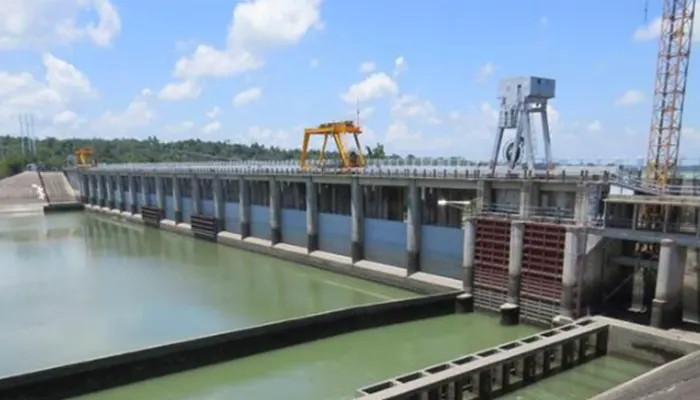
Double girder gantry crane for handling stop logs and maintenance gates at dams and spillways
Water Intake Structures
Water intake structures may contain trash racks, stop logs, bulkheads and gates that require periodic removal for inspection, cleaning or maintenance. These components can be located below the deck or inside narrow intake bays.
A gantry crane may serve the intake bays from a deck-mounted or ground-supported runway, depending on the facility layout.
Typical lifting tasks include:
- Removing and reinstalling stop logs during maintenance operations.
- Handling trash racks when their dimensions and lifting points suit the crane arrangement.
- Moving removable bulkheads between storage and installation positions.
- Lifting maintenance components from designated access platforms.
- Serving multiple intake bays along a common travel route.
The required lifting height must be calculated from the lowest pickup position to the highest required placement position. The design must also allow for the lifting beam or attachment, hook approach, gate dimensions and any obstructions above the opening.
For submerged components, the lifting procedure must specify when the load can be picked up and moved safely. Water pressure, trapped water, suction, debris and other operating conditions may affect the removal procedure and must be assessed by the project team.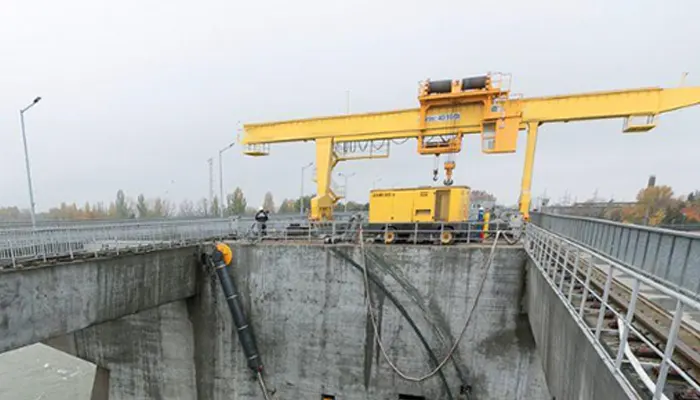
Single girder gantry crane for lifting stop logs, trash racks and bulkheads at hydropower water intake structures
Sluice Gates & Maintenance Gates
Sluice gates and maintenance gates have different operating requirements. Some gates are raised and lowered by dedicated fixed hoists, while removable maintenance gates and stop logs may be handled by a travelling crane.
A gantry crane can be considered when the task requires lifting and transporting removable components between several positions.
Typical applications include:
- Lifting removable gate panels out of their slots.
- Moving maintenance gates to a designated storage area.
- Handling gate components during inspection or replacement.
- Transporting lifting beams and other maintenance equipment.
- Serving multiple gate bays where the runway provides sufficient coverage.
The crane and lifting attachment must match the gate's approved lifting points and load distribution. Gate weight alone is not enough to establish the required lifting capacity: lifting beams, hooks and other attachments must also be considered, along with applicable design allowances.
Where a gate is operated vertically by a fixed hoist, the gantry crane should not be assumed to replace that mechanism. The two systems may serve different tasks.
Tailrace & Draft Tube Areas
Tailrace and draft tube areas may require the removal of stop logs or bulkheads to access equipment for inspection and maintenance. A gantry crane can be considered where the site has a suitable deck, runway and lifting route.
Possible applications include:
- Removing and installing stop logs at accessible draft tube openings.
- Handling removable bulkheads during maintenance.
- Moving components between the lifting position and a designated storage area.
- Providing lifting coverage across several openings along the same runway.
The engineering review must establish the load pickup and landing elevations, available headroom, crane travel limits and access for maintenance personnel. Where the load is below deck level, the crane must provide enough hook travel and clearance to complete the lifting operation.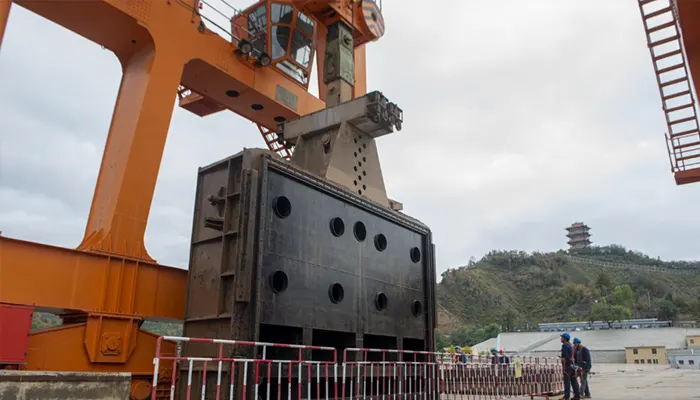
Which Gantry Crane Configuration Fits Your Hydropower Project?
The selection depends on whether the crane must follow a fixed runway, move across a prepared surface or serve a large lifting area. The required capacity, span, lifting height, travel distance and installation conditions determine the configuration.
Rail-Mounted Gantry Crane
A rail-mounted gantry crane travels on rails fixed to a prepared foundation, concrete deck or supporting steel structure. It is suitable for projects where the crane must serve several defined lifting positions along a permanent route.
Typical design considerations include:
- Runway layout: Determine the travel distance, rail gauge, end positions and access to each lifting location.
- Wheel loads: Calculate the loads transmitted through the wheels to the rails, supporting deck and foundations.
- Rail alignment: Check straightness, elevation, rail joints, fastening and tolerances.
- Travel control: Specify travel speed, braking, end stops and travel limits according to the operating requirements.
- Environmental exposure: Select suitable coatings and electrical protection for outdoor moisture and corrosion conditions.
This configuration may suit dam crest and water intake projects with a fixed travel route. The existing deck must be verified before rails are installed.
Rubber-Tyred Gantry Crane
A rubber-tyred gantry crane moves on tyres rather than fixed rails. It may be considered when the site requires movement between designated areas and the surface can support the crane.
Before choosing this arrangement, check:
- Whether the ground or deck can withstand wheel loads and local contact pressure.
- Whether the crane has enough turning and manoeuvring space.
- Whether slopes, joints, drainage channels or uneven surfaces affect travel.
- How the crane will be positioned and secured during lifting.
- Whether movement near water edges or openings requires additional operating controls.
A rubber-tyred design is not automatically suitable for a dam deck. Surface strength, geometry, gradients and operating clearances must be verified for the proposed crane.
Single-Girder or Double-Girder Gantry Crane
The main girder arrangement affects the crane's structural design, hoist installation, headroom and load capacity.
- Single-girder gantry crane: May suit lighter loads and simpler lifting tasks when the span, duty and required lifting height are within the design limits.
- Double-girder gantry crane: May be suitable for heavier loads, larger spans or configurations requiring a different hoist and trolley arrangement.
- Customized lifting arrangement: The trolley, hoist and lifting attachment can be selected around the load dimensions, pickup position and required hook travel.
The decision should be based on structural calculations and operating requirements, not lifting capacity alone. The total suspended load, duty classification, wheel loads, wind exposure and available headroom can all affect the design.
Key Engineering Challenges in Hydropower Gantry Crane Design
Hydropower sites often have existing civil structures, limited installation space and lifting positions that cannot be changed easily. These conditions must be addressed before the crane configuration is finalized.
Lifting Capacity & Load Characteristics
The rated capacity must cover the heaviest load the crane is required to lift under the specified operating conditions.
Confirm the following information:
- Maximum load weight, including the component being lifted.
- Weight of the lifting beam, hooks, clamps or other attachments.
- Load dimensions, centre of gravity and lifting-point arrangement.
- Whether loads may be unevenly distributed between lifting points.
- Required operating frequency and duty classification.
For stop log handling, confirm whether the crane will lift individual logs or multiple logs using a common lifting beam. The arrangement changes the suspended load, lifting-point forces and required hook configuration.
Span, Travel Distance & Lifting Positions
The crane span is the distance between the gantry's supporting travel lines. The travel distance is the length of the route along which the gantry moves. These are separate dimensions and must be specified independently.
The site layout should identify:
- Required lifting positions and the distance between them.
- Pickup, transfer, storage and landing locations.
- The location of each gate bay or intake opening.
- Obstructions such as handrails, columns, pipes and access platforms.
- Required end clearances and limits of travel.
For a long runway serving several openings, verify that the hoist can reach each required lifting point without the gantry structure, trolley or suspended load interfering with the surrounding structure.
Lifting Height & Headroom
The lifting height must be based on the full operating sequence, not just the height of the gate or stop log.
Check:
- The lowest pickup elevation.
- The highest required landing or storage elevation.
- The vertical distance needed to clear the opening or guide slots.
- The height of the lifting attachment and suspended load.
- The available space above the load and below the gantry girder.
If the component must be lifted clear of guide slots before travelling horizontally, the lifting height must accommodate that movement. Insufficient hook travel can prevent the crane from completing the operation even when the rated capacity is adequate.
Existing Structures, Rails & Foundations
A gantry crane transfers its loads through the wheels, rails or tyres into the supporting structure. The supporting deck or foundation must be checked for the resulting forces.
The assessment should cover:
- Concrete deck thickness, reinforcement and condition.
- Foundation dimensions and load-bearing capacity.
- Rail supports, anchorage and connection details.
- Wheel loads and their distribution along the travel route.
- Local effects near deck edges, openings and existing joints.
- The need for additional steelwork or structural reinforcement.
Do not assume that an existing dam deck, platform or concrete wall can support a gantry crane because it already carries other equipment. A qualified structural assessment is required to verify the proposed crane loads and connection details.
Outdoor Conditions & Corrosion Protection
Cranes installed on dams, spillways and water intake structures may be exposed to rain, condensation, high humidity and corrosion. Wind may also affect crane stability and operation.
Specify the actual site conditions, including:
- Indoor or outdoor installation.
- Temperature range and humidity.
- Exposure to rain, spray, standing water or corrosive substances.
- Required coating system and corrosion protection.
- Electrical enclosure protection appropriate to the exposure.
- Wind loads and any required storm parking or securing arrangement.
The required protection level depends on the location and exposure. The specification should identify the actual environmental conditions rather than relying on a general description such as “outdoor use.”
6. Hoist, Power Supply & Control System
The hoist and trolley must suit the lifting task, while the power and control arrangement must support the crane's full travel route.
Confirm:
- Electric wire rope hoist or another suitable lifting mechanism.
- Required lifting and travelling speeds.
- Power supply voltage, frequency and phase.
- Cable reel, festoon or another suitable power supply arrangement.
- Pendant control, radio remote control or a specified operating station.
- Required brakes, overload protection, emergency stop and travel limits.
For long travel distances, the cable arrangement must allow the gantry to move through its full range without excessive tension, snagging or interference. The control system should also allow the operator to position loads accurately at the required lifting points.
Information Required for a Hydropower Gantry Crane Project
Provide the following details so the proposed arrangement can be assessed against the actual lifting task and site conditions.
- Lifting capacity: ______ tons. Example: 10 tons
- Crane span: ______ m. Example: 12 m
- Travel distance: ______ m. Example: 40 m
- Lifting height: ______ m. Example: 8 m
- Load type and dimensions: ______. Example: Stop logs, 3 m long
- Required lifting positions: ______. Example: Three intake bays and one storage area
- Installation arrangement: ______. Example: Rail-mounted on an existing concrete deck
- Power supply: ______. Example: 400 V, 50 Hz, 3-phase
- Working environment: ______. Example: Outdoor installation with high humidity
- Structural drawings available: ______. Example: Deck layout, foundation drawings and rail support details
- Applicable standards or project specifications: ______. Example: Project-specific design requirements and local safety regulations
Site layout drawings, photographs and details of the loads to be handled are especially useful during the initial engineering review.
Customized Gantry Crane Solutions for Hydropower Projects
Yuantai Crane can assess the required lifting capacity, span, travel distance, lifting height, load characteristics and site conditions to develop a suitable gantry crane configuration. The proposed scope may include the gantry structure, hoisting and travelling mechanisms, electrical controls, power supply and lifting attachments.
For projects involving stop logs, maintenance gates or trash racks, the handling sequence and attachment design must be checked alongside the crane itself. Structural support conditions must also be verified before installation.
Discuss Your Hydropower Crane Project
Share your site layout, load details, lifting positions and operating requirements with Yuantai Crane to discuss a suitable gantry crane solution.
FAQs About Hydropower Gantry Cranes
What loads can a hydropower gantry crane handle?
Depending on its design, a gantry crane may handle stop logs, removable gates, bulkheads, trash racks and maintenance equipment. Capacity and attachment selection depend on the actual load and lifting arrangement.
Can a gantry crane be installed on an existing dam deck?
Potentially. The deck, foundations, rails, anchorage and supporting structure must be assessed by qualified structural engineers for the proposed crane loads. Reinforcement or additional supports may be necessary.
Is a gantry crane suitable for outdoor hydropower applications?
Yes, if it is designed for the site's actual exposure. Coatings, electrical protection, wind conditions, braking and storm securing arrangements should be specified where applicable.
Can one gantry crane serve multiple intake bays?
Yes, if the crane's span, travel route, hoist reach and lifting capacity cover all required positions. The layout must account for obstructions, end clearances and the handling sequence at each bay.
How do I choose between a gantry crane and a fixed gate hoist?
A gantry crane is generally considered when loads must be lifted and transported between positions. A fixed gate hoist is generally used to raise and lower a gate along a dedicated path. The required operation determines whether one system or both are needed.