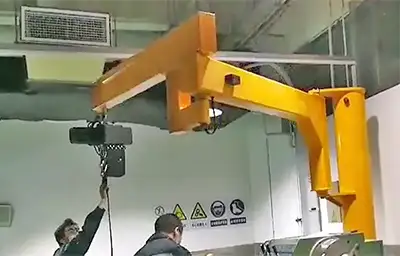
Articulating Jib Crane for Maintenance Workshops
Maintenance Lifting in Confined Industrial Spaces with Articulating Jib Crane Systems
In industrial maintenance and repair workshops, confined space lifting is one of the most common and practical challenges in daily operations. Maintenance lifting work is usually carried out inside existing production facilities, where machines are already installed, pipelines are fixed, and structural steel frames limit movement. In real industrial projects, this means the lifting path is rarely open or direct. Typical maintenance lifting applications involve motors, pumps, valves, reducers, and gearboxes in the 250 kg–500 kg range, where the difficulty comes more from restricted access and tight equipment layouts than from weight alone. In many cases, operators need a controlled lifting solution that can handle irregular removal paths, limited clearance, and time-sensitive equipment repair work without interrupting production flow.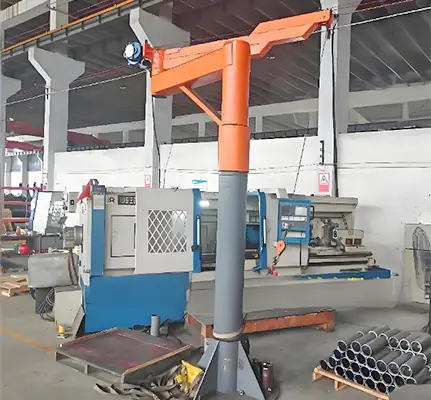
articulating jib crane for sale
In maintenance workshop lifting operations, confined space conditions are the most common limitation faced by technicians and operators. Equipment is often installed close to walls, steel structures, or inside machine assemblies where traditional overhead crane access is restricted or unavailable. In practical industrial maintenance scenarios: - Equipment installed close to walls, machine frames, or structural steel supports - Limited overhead clearance in maintenance service zones and repair workshops - Restricted lifting paths in retrofit or aging industrial facilities - Difficulty using standard overhead crane systems in narrow work areas
In real maintenance and repair workshop lifting operations, common loads include industrial motors, pumps, valves, reducers, and gearboxes. These components typically fall within the 250 kg–500 kg maintenance lifting range, especially in medium industrial plants and mechanical service workshops. Practical application examples include: - Motor removal from machine bases during scheduled maintenance shutdowns - Pump lifting in pipeline-connected industrial systems - Gearbox and reducer extraction in mechanical repair workshops - Valve assembly handling in confined industrial maintenance zones
Unlike production line lifting, maintenance lifting often requires irregular movement paths due to existing equipment constraints. In many industrial repair projects, components cannot be lifted vertically in a straight line and instead require side pulling, rotation, or staged removal. In real workshop conditions: - Pumps trapped between piping systems and structural supports - Motors requiring tilting before extraction from coupling points - Gearboxes needing partial sliding before vertical lifting - Valve assemblies requiring controlled rotation during removal
An articulating jib crane for maintenance workshops is widely used in confined industrial environments where standard lifting systems cannot reach or maneuver effectively. The multi-joint arm structure allows controlled movement around obstacles such as pipes, machines, and structural steel frames. In practical industrial maintenance use: - Supports controlled removal of motors, pumps, and gearboxes in tight spaces - Enables side reach and angled lifting in confined repair zones - Improves flexibility in maintenance lifting without moving fixed equipment - Suitable for occasional-duty lifting operations in repair workshops
Challenges in Maintenance and Repair Lifting Operations in Confined Industrial Environments
In real industrial maintenance and repair workshop lifting work, operators face a very different set of conditions compared to standard assembly line handling. Maintenance lifting is often unpredictable because it takes place around installed machinery, fixed piping systems, and structural steel frameworks that cannot be moved or adjusted. In practical industrial projects, the main difficulty is not only lifting capacity but access control, load orientation, and safe movement path inside confined service areas. This becomes especially critical when handling motors, pumps, valves, reducers, and gearboxes in the 250 kg–500 kg maintenance lifting range.
One of the most common issues in maintenance and repair lifting operations is restricted working space around installed machinery. Equipment is often placed close to walls, structural columns, or inside dense mechanical layouts where movement is already limited. In practical industrial maintenance conditions: - Narrow access areas around pumps, motors, and industrial equipment - Limited space for crane hook positioning and load adjustment - Fixed machine layouts that cannot be relocated during repair work - Reduced flexibility in lifting path planning
In many maintenance workshop lifting scenarios, a direct vertical lifting path is not available. Components such as gearboxes, pumps, and motors are often trapped within machine frames or connected to fixed systems. Practical challenges include: - Obstructed vertical lifting due to machine housings or frames - Need for angled lifting or side extraction before vertical movement - Complex load positioning during removal from installed systems - Increased dependence on flexible lifting systems such as articulating jib cranes
Maintenance lifting operations are frequently affected by surrounding infrastructure such as piping systems, cable trays, and structural steel supports. These elements create physical barriers that limit crane movement and load extraction paths. In real industrial repair environments: - Pumps connected to pipeline systems restricting removal direction - Motors surrounded by electrical and mechanical assemblies - Gearboxes installed within dense machine structures - Limited clearance for safe load rotation and extraction
In maintenance and repair lifting tasks, components are often partially dismantled before removal. This can shift the center of gravity and create unstable load conditions during lifting. Practical implications include: - Motors or pumps becoming unbalanced after partial disassembly - Increased need for controlled lifting and positioning - Requirement for precise load handling to avoid tilting - Higher risk during initial lifting phase in confined spaces
During maintenance lifting, one of the most practical risks is collision between the load and surrounding structures. Because equipment is often removed from tight locations, even small movement errors can lead to contact with nearby machines or supports. In real workshop conditions: - Risk of contact with pipes, frames, or adjacent machines - Limited visibility during load extraction from confined areas - Tight swing radius in maintenance lifting zones - Need for slow, controlled movement using flexible lifting systems
Articulating Jib Crane for Maintenance Workshop Use in Confined Industrial Lifting
In industrial maintenance and repair workshop lifting operations, an articulating jib crane is widely used where standard straight-line lifting systems cannot operate effectively. Maintenance environments are often restricted by installed machinery, piping systems, and structural steel, which makes direct vertical lifting difficult or sometimes impossible. In practical industrial projects, this type of workstation lifting solution is applied in repair zones, service bays, and mechanical maintenance areas where controlled movement of motors, pumps, gearboxes, and valve assemblies in the 250 kg–500 kg range is required.
The main feature of an articulating jib crane in maintenance workshop use is its multi-joint arm structure. This design allows the crane to operate in areas where rigid lifting systems cannot reach or where movement is blocked by surrounding equipment. In practical maintenance lifting applications: - Multi-joint arm enables movement around machine frames and structural obstacles - Suitable for confined service zones with limited lifting clearance - Allows flexible reach into tight equipment spaces during repair work - Supports controlled lifting where straight-line hoisting is not possible
In real maintenance workshop lifting operations, articulating jib cranes are commonly used for handling medium-weight mechanical components. These include motors, pumps, gearboxes, reducers, and valve assemblies, typically within the 250 kg–500 kg working range. Practical applications include: - Motor removal and installation during scheduled maintenance shutdowns - Pump lifting in pipeline-connected industrial systems - Gearbox and reducer handling in mechanical repair workshops - Valve assembly positioning in confined maintenance environments
One of the key advantages of articulating jib crane systems in maintenance environments is their ability to support controlled removal of components from tight equipment frames. In many repair scenarios, parts cannot be lifted vertically due to surrounding structural limitations. In practical industrial conditions: - Controlled extraction of motors from machine bases and couplings - Pump removal from confined pipeline-connected installations - Gearbox handling from enclosed mechanical housings - Reduced risk of collision during slow, guided lifting movement
In maintenance workshop lifting operations, space constraints often prevent repositioning of fixed lifting equipment. Articulating jib cranes solve this limitation by allowing side pulling and flexible load movement without relocating the crane base. Practical benefits include: - Side reach capability for loads positioned behind obstacles or machine frames - Repositioning of components within confined maintenance zones - Reduced need to move heavy equipment or install temporary lifting systems - Improved flexibility in repair workshop layout conditions
In real industrial maintenance workshop design, articulating jib cranes are typically installed close to repair bays, machine foundations, or dedicated maintenance platforms. This positioning allows operators to access equipment quickly during repair and servicing operations. In practical use: - Installed near machine foundations for direct maintenance access - Used in repair bays for frequent equipment servicing tasks - Integrated into maintenance platforms for elevated work areas - Supports efficient workflow in confined industrial repair environments
Manual vs Electric Hoist in Maintenance and Repair Workshop Lifting Operations
In industrial maintenance and repair workshop lifting operations, the choice between manual hoists and electric hoists depends on real working conditions rather than theory. Maintenance lifting is often irregular, sometimes urgent, and frequently carried out in confined spaces where motors, pumps, valves, reducers, and gearboxes in the 250 kg–500 kg range must be removed or installed under time pressure. In practical industrial projects, maintenance teams select lifting equipment based on access conditions, load behavior, power availability, and required precision during repair work.
In many maintenance workshop lifting operations, manual chain hoists are used for occasional or emergency repair work. These systems are simple, mechanical, and do not rely on electrical power, making them suitable for remote or limited-access service areas. In practical industrial applications: - Suitable for occasional maintenance lifting tasks with low frequency use - No power supply required in remote industrial repair zones - Simple structure allows quick deployment in confined maintenance areas - Reliable operation in field repair environments with unstable conditions
Electric hoists are commonly used in maintenance workshop lifting environments where speed, control, and precision are required. They are particularly useful when handling heavier components or when multiple maintenance operations are performed in a single shift. In real industrial maintenance conditions: - Faster lifting and lowering of motors, pumps, and gearboxes - Better control during alignment and installation tasks - Reduced operator effort in repetitive maintenance lifting work - Suitable for frequent service operations in industrial repair workshops
In maintenance and repair lifting tasks, load control is often more important than lifting speed. Components such as pumps, motors, and valve assemblies require precise alignment during removal and reinstallation. Practical considerations include: - Controlled movement during installation of mechanical components - Stable load positioning in confined maintenance spaces - Reduced risk of misalignment during equipment reassembly - Improved accuracy in 250 kg–500 kg maintenance lifting operations
In real industrial maintenance workshops, it is common to use both manual and electric hoists depending on the task, location, and urgency. There is no single solution that fits all maintenance lifting scenarios. In practical applications: - Manual hoists used for remote or occasional repair lifting tasks - Electric hoists used for frequent and time-sensitive maintenance work - Selection depends on site access conditions and power availability - Combination use improves flexibility in confined maintenance environments
Portable Lifting Solutions for Field Maintenance and Repair Operations
In industrial maintenance and repair workshop lifting work, not all service locations are suitable for fixed crane installation. Many maintenance tasks take place inside existing production systems, inside confined machine zones, or in temporary shutdown areas where equipment access changes frequently. In practical industrial projects, portable lifting solutions are widely used to support motors, pumps, valves, reducers, and gearboxes in the 250 kg–500 kg range when fixed lifting infrastructure is not available or not practical to install.
Mobile gantry cranes are commonly used in field maintenance environments where lifting points change from one location to another. They provide a flexible and adjustable lifting solution for repair workshops and industrial service zones. In practical applications: - Suitable for maintenance lifting in changing work locations - Easy repositioning around production equipment and machinery - Used for motors, pumps, and medium-weight components - Practical for temporary repair and shutdown maintenance work
Portable A-frame lifting structures are used in maintenance workshop lifting operations where simple, stable, and transportable lifting support is required. These systems are often deployed in field repair work where equipment must be lifted without permanent installation. Practical use cases include: - Field maintenance lifting in remote industrial zones - Temporary lifting support during equipment repair shutdowns - Handling pumps, motors, and gearboxes in service environments - Quick setup for urgent maintenance operations
Wheeled jib cranes are used in maintenance workshop lifting environments where localized mobility is required within a limited service area. They provide a compact lifting solution for small repair zones and confined industrial spaces. In real industrial conditions: - Used for localized maintenance lifting near machines and workstations - Easy movement within workshop floors for repair flexibility - Suitable for repetitive service tasks in confined areas - Supports controlled handling of 250 kg–500 kg components
Chain block and beam setups are widely used as temporary lifting solutions in maintenance and repair operations. They are simple, cost-effective, and suitable for quick deployment in confined or temporary service areas. Practical applications include: - Temporary lifting support during equipment repair work - Emergency maintenance lifting in production shutdowns - Handling motors, pumps, and mechanical assemblies - Flexible setup in areas without permanent crane systems
Portable lifting systems are selected in maintenance workshop lifting operations when fixed crane installation is not possible or not practical. These conditions are common in both small facilities and large industrial plants. In real industrial projects: - Maintenance areas that change frequently during production cycles - Equipment located in isolated or hard-to-access zones - Temporary repair zones inside operating production facilities - Situations where permanent crane installation is not feasible
Lifting Points and Safe Load Connection Practices in Maintenance Workshop Lifting Operations
In industrial maintenance and repair workshop lifting work, safe load handling depends heavily on correct lifting point selection and rigging practices. Unlike standard production components, maintenance equipment such as motors, pumps, valves, reducers, and gearboxes in the 250 kg–500 kg range is often exposed to wear, corrosion, and partial dismantling before lifting begins. In practical industrial projects, this means lifting points cannot be assumed—they must be inspected, verified, and selected based on real condition at the job site.
In maintenance workshop lifting operations, motors are typically handled using certified lifting eyes or dedicated frame hooks. These lifting points are designed to support safe vertical lifting and controlled movement during removal and installation. In practical industrial applications: - Motors lifted using manufacturer-certified lifting eyes - Frame hooks used when lifting points are integrated into motor housing - Inspection required before each maintenance lifting operation - Avoid using non-rated points for 250 kg–500 kg motor handling tasks
Pump lifting in maintenance workshop environments often requires balanced multi-point rigging due to irregular shape and uneven weight distribution. Without proper balance, pumps can tilt during lifting and create safety risks. Practical use includes: - Two-point or multi-point lifting for pump body stability - Load balancing to prevent tilting during extraction - Controlled movement during pipeline-connected pump removal - Improved safety in confined maintenance lifting environments
In maintenance and repair lifting operations, gearboxes and reducers require careful center-of-gravity alignment before removal. These components often become unstable when partially disconnected from connected shafts or supports. In real workshop conditions: - Load center must be identified before lifting starts - Adjustment of lifting point position to maintain balance - Reduced risk of sudden tilting during gearbox extraction - Stable handling during 250 kg–500 kg maintenance lifting tasks
Valve maintenance lifting is often complicated by direct connection to piping systems, which restrict movement and create irregular load conditions. Careful rigging is required to avoid damage to both the valve and connected pipeline. Practical considerations include: - Restricted movement due to fixed pipeline connections - Need for gradual release before lifting begins - Controlled rigging to avoid stress on pipe joints - Safe extraction from confined maintenance workshop areas
In industrial maintenance workshop lifting practice, safety is based on strict verification and controlled operation rather than speed. Every lifting operation must follow basic mechanical and structural safety rules. Key safety practices include: - Always verify rated load capacity of lifting points before use - Avoid uneven side loading during lifting and movement - Confirm structural integrity of equipment before extraction - Maintain controlled tension and smooth movement during lifting process
Safe Removal Paths and Movement Control Strategy in Maintenance Workshop Lifting Operations
In industrial maintenance and repair workshop lifting operations, the most difficult part of the job is often not the vertical lifting itself, but the safe removal of equipment from confined spaces. Motors, pumps, valves, gearboxes, and reducers in the 250 kg–500 kg range are frequently installed inside machine enclosures, pipeline systems, or structural frames where clearance is extremely limited. In practical industrial projects, successful maintenance lifting depends on how well the removal path is planned, controlled, and executed in real working conditions.
In maintenance workshop lifting operations, planning the removal path before lifting begins is a critical step. Without a clear understanding of movement space, even correctly lifted loads can become unsafe during extraction. In practical industrial applications: - Mapping available clearance around equipment before lifting - Identifying obstacles such as frames, pipes, and adjacent machines - Planning step-by-step extraction sequence for confined components - Reducing risk of collision during maintenance lifting operations
In confined maintenance lifting environments, controlling the swing radius of the articulating jib crane is essential for safe movement. The multi-joint arm allows flexible motion, but it still requires operator awareness of surrounding obstacles. Practical considerations include: - Ensuring crane arm movement stays within safe swing radius limits - Avoiding contact with nearby structures during load movement - Adjusting arm position for narrow extraction routes - Supporting controlled movement in 250 kg–500 kg lifting operations
One of the most common risks in maintenance lifting is collision between the load and surrounding equipment. This risk increases significantly in confined workshop environments where space is shared with active machinery and fixed installations. In real industrial conditions: - Risk of contact with pipes, frames, and machine housings - Tight clearance between lifting path and surrounding structures - Need for slow, controlled movement during extraction - Continuous operator monitoring during load handling
In maintenance workshop lifting operations, controlled speed is more important than lifting speed. Equipment must be moved slowly and steadily to avoid sudden load shifts or accidental contact with nearby structures. Practical applications include: - Gradual lifting during initial extraction phase - Controlled horizontal movement in confined maintenance zones - Reduced speed when passing narrow openings or obstacles - Improved safety in 250 kg–500 kg maintenance lifting tasks
In real industrial maintenance environments, removal paths are rarely clean or straight. Operators must deal with multiple physical and operational constraints during lifting and extraction. Common challenges include: - Narrow exits from machine enclosures limiting load movement - Obstructions from pipes, structural frames, or supports - Limited visibility during internal equipment extraction - Requirement for load rotation during removal process
Key Questions Solved in Maintenance Workshop Lifting and Repair Operations
In industrial maintenance and repair workshop lifting work, most operational problems are repeated across different facilities, regardless of industry type. Whether dealing with motors, pumps, valves, gearboxes, or reducers in the 250 kg–500 kg range, the core challenges always relate to confined space access, safe load control, and removal path planning. In practical industrial projects, these questions come up during almost every maintenance shutdown, repair job, or equipment replacement task inside real production environments.
In maintenance workshop lifting operations, safe handling of heavy components in confined spaces depends on controlled movement and proper lifting equipment selection. The main challenge is limited access around installed machinery and restricted vertical lifting paths. In practical industrial applications: - Use of flexible lifting systems such as articulating jib cranes - Controlled load movement in narrow maintenance zones - Careful planning of lifting direction before operation - Reduced manual strain during 250 kg–500 kg component handling
When equipment is installed close to walls, machine frames, or structural supports, standard overhead lifting methods may not work effectively. Maintenance workshop lifting requires adaptable systems that can operate within restricted geometry. Practical solutions include: - Articulating jib crane systems for obstacle navigation - Side reach capability for tight installation zones - Compact lifting solutions for confined maintenance layouts - Controlled movement without relocating fixed equipment
In maintenance and repair lifting operations, the choice between manual and electric hoists depends on site conditions, urgency, and load behavior. Both systems are commonly used in industrial workshop environments. In real applications: - Manual hoists for occasional or remote maintenance lifting tasks - Electric hoists for faster and more controlled equipment handling - Selection based on power availability and repair urgency - Combined use depending on maintenance scenario requirements
Safe removal of mechanical components in maintenance workshop lifting requires controlled extraction and correct load balancing. Motors, pumps, and gearboxes often require different handling strategies depending on installation conditions. Practical methods include: - Center-of-gravity alignment before lifting begins - Multi-point lifting for pump stability - Controlled tilting for motor and gearbox extraction - Slow movement through confined maintenance spaces
Portable lifting systems are widely used in maintenance workshop lifting when fixed crane installation is not available or practical. These systems support flexible field operations in temporary or changing work environments. In practical industrial use: - Mobile gantry cranes for flexible repair positioning - Portable A-frame systems for field maintenance work - Wheeled lifting units for localized service areas - Chain block setups for temporary lifting support
In maintenance and repair lifting operations, correct identification of lifting points and removal paths is essential for safe execution. Unlike standardized production components, maintenance equipment may have wear, corrosion, or partial disassembly conditions. In real workshop practice: - Use certified lifting eyes and structural lifting points - Confirm load balance before extraction - Map removal path before starting lifting operation - Ensure controlled movement through confined maintenance zones