Articulating Jib Crane for Assembly Line Ergonomics
Key Takeaways of Articulating Jib Crane for Assembly Line Ergonomics
Articulating jib crane for assembly lines improves ergonomic lifting, reduces repetitive strain, and boosts productivity in compact workstation assembly tasks.
Main Questions Solved in Assembly Line Ergonomic Material Handling
- How to reduce repetitive manual lifting in assembly line operations
- How to improve ergonomics and operator safety in compact workstations
- How to handle 50–500 kg components efficiently in fast cycle production
- How to optimize workstation layout for smooth material flow
- How to integrate lifting aids like vacuum lifters and manipulators
- How to increase productivity without redesigning the entire production line
In industrial assembly line material handling systems, many production challenges are repeated across different factories, especially where manual lifting is still part of daily operations. Operators working with pumps, motors, valves, electrical cabinets, and automotive components often face the same practical issues related to fatigue, cycle time stability, and workstation layout efficiency. This section addresses the most common technical and operational questions found in real assembly workshop environments, particularly where articulating jib crane systems and compact workstation lifting solutions are applied.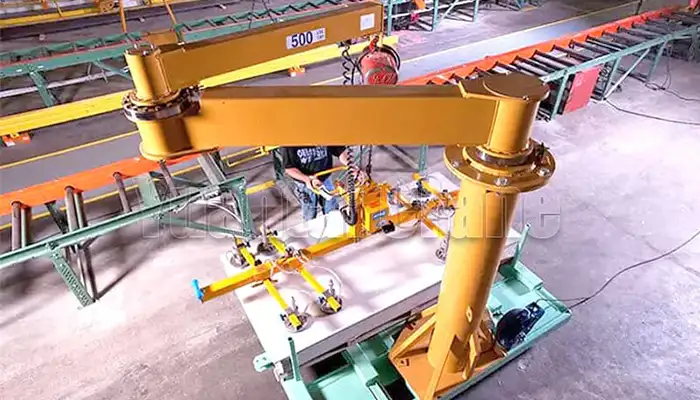
Yuantai articulating jib crane for sale
Operator fatigue in assembly line lifting tasks is mainly caused by continuous manual handling and repetitive motion across long production shifts. When lifting is performed without assistance, strain builds up in the shoulders, back, and arms, affecting both safety and productivity. In practical workshop applications: - Use of articulating jib crane reduces direct manual lifting load - Loads are transferred into controlled mechanical movement systems - Operators maintain stable posture during repetitive pick-and-place cycles - Fatigue levels are reduced in continuous 50 kg–500 kg handling tasks
For compact assembly workstation environments, space-efficient lifting systems are required to support repetitive operations without obstructing workflow. Articulating jib cranes are commonly used because they provide flexible movement within limited working areas. Practical selection considerations: - Suitable for workstation-based assembly line layouts - Works well in confined production cells with limited swing space - Supports precise handling in repetitive industrial operations - Ideal for medium-light components such as motors, valves, and panels
Ergonomic improvement in assembly line material handling focuses on reducing manual strain during repetitive installation tasks. Components such as pumps, motors, valves, and electrical cabinets require both lifting support and positioning accuracy. In real industrial environments: - Load weight is supported by crane system instead of operator body - Reduced bending and overextension during positioning tasks - Improved alignment accuracy during installation and assembly - Safer handling in repetitive workstation operations
Not all factories require full automation systems to improve production speed. In many assembly lines, installing a workstation crane system provides a practical way to increase handling speed without major production upgrades. Practical improvements include: - Faster lifting and positioning in repetitive cycle operations - Reduced manual effort during each pick-and-place movement - Stable handling speed across different operators - Improved workflow efficiency without changing entire production line
Articulating jib crane systems are often combined with different lifting assist devices depending on the material type and assembly requirement. This improves flexibility in multi-product production environments. Common integrated devices include: - Vacuum lifters for sheet metal panels and electrical cabinets - Mechanical grippers for irregular industrial components - Load balancers for near-weightless manual positioning - Precision manipulators for alignment-sensitive assembly tasks
Workstation layout optimization is a key factor in improving assembly line efficiency. Proper positioning of lifting equipment ensures smoother material flow and reduces unnecessary operator movement. In practical design: - Crane mounting position aligned with operator working zone - Swing radius matched with assembly point locations - Clearance maintained for surrounding equipment and fixtures - Vertical height adjusted for ergonomic lifting angles
Ergonomic Material Handling in Assembly Lines with Articulating Jib Crane Systems
In modern manufacturing and assembly line production, ergonomic material handling solutions are increasingly important for improving workflow efficiency and reducing operator fatigue. Workstations handling repetitive lifting tasks such as pumps, valves, motors, electrical cabinets, and automotive components often rely on compact lifting equipment to maintain stable production flow. An articulating jib crane for assembly lines is widely used in these environments because it supports repetitive lifting cycles, compact workstation layouts, and controlled movement within limited space. In practical industrial applications, this type of workstation jib crane helps reduce manual lifting strain while improving production line consistency in 50 kg–500 kg material handling operations.
In assembly line material handling systems, repetitive lifting cycles are one of the main productivity constraints. Operators often perform continuous pick-and-place operations involving medium-light industrial components such as gearboxes, pumps, valves, and electrical control panels. Without lifting assistance, these repetitive movements increase physical strain and reduce cycle stability over long production shifts. Key practical considerations include: - High-frequency lifting cycles in compact assembly workstation layouts - Manual handling fatigue during continuous production line operations - Reduced consistency in repetitive assembly tasks without mechanical assistance - Need for stable load positioning in 50 kg–500 kg handling range
Ergonomic workstation design in industrial assembly environments focuses on reducing unnecessary operator movement and maintaining lifting tasks within safe reach zones. In compact production cells, operators frequently handle components at different heights and positions, which increases strain on shoulders and lower back if done manually. In real workshop applications: - Articulating jib crane systems reduce overreaching and bending - Operator work zones are optimized for natural arm movement range - Load positioning is kept within ergonomic lifting height levels - Workstation layouts are adjusted for smoother assembly line flow
In many manufacturing plants, space limitation is a key challenge in assembly line design. Compact jib crane systems are often used where forklifts or overhead bridge cranes cannot operate efficiently. The articulating arm design allows movement around obstacles such as fixtures, benches, and partially enclosed workstation areas. Practical application features include: - Suitable for compact assembly workstation and cell manufacturing layouts - Flexible installation in floor-mounted or column-mounted configurations - Multi-directional movement for complex assembly positioning tasks - Efficient use of limited industrial floor space in production workshops
Modern assembly line lifting systems often combine articulating jib cranes with auxiliary handling devices to improve precision and reduce manual effort. This is especially useful in electrical cabinet assembly, sheet metal handling, and automotive component positioning where surface protection and accuracy are required. Common integrated solutions include: - Vacuum lifters for sheet metal, panels, and electrical enclosures - Mechanical grippers for irregular-shaped industrial components - Load balancers for near-weightless manual positioning - Precision manipulators for alignment-sensitive assembly operations
Assembly Line Challenges in Repetitive Lifting Work
In many industrial assembly line operations, repetitive lifting work is part of the daily production rhythm. Operators handle continuous pick-and-place tasks where components such as pumps, valves, motors, electrical cabinets, and automotive parts are lifted, positioned, and installed across multiple workstation steps. In practical manufacturing environments, this repetitive cycle creates predictable but often underestimated production challenges, especially in compact workstation layouts and high-mix assembly line production systems.
In repetitive lifting cycle operations, assembly line operators are required to perform continuous manual handling throughout the shift. Even when individual components are not extremely heavy, the repeated lifting motion creates physical strain over time, especially in shoulder, back, and wrist areas. Typical issues in real workshop conditions include: - Continuous repetitive lifting of 50 kg–500 kg components in workstation-based assembly lines - Increased musculoskeletal load from repeated bending and reaching movements - Reduced operator endurance during long production shifts - Higher risk of handling fatigue in high-cycle manufacturing environments
Inefficient material flow is a common issue in assembly line production, especially when manual lifting is used as the primary handling method. Without proper lifting assistance systems such as a workstation jib crane or articulating jib crane, operators spend more time moving materials than assembling them. Practical production impacts include: - Delays in transferring components between adjacent assembly stations - Unbalanced workflow between upstream and downstream production processes - Increased walking distance for operators during material repositioning - Reduced efficiency in compact assembly cell layouts and lean production systems
In assembly line environments where manual lifting is used, positioning accuracy becomes difficult to maintain consistently. When operators handle components manually under repetitive conditions, small positioning errors can accumulate and affect final assembly quality. Common practical challenges include: - Misalignment during installation of motors, valves, and electrical cabinets - Difficulty maintaining precision in repetitive pick-and-place assembly tasks - Increased rework due to positioning deviations in tight workstation setups - Reduced consistency in high-volume assembly line production environments
Fatigue is a direct result of repetitive lifting cycles in assembly line operations. As working hours increase, operator performance gradually declines, especially in manual handling tasks that require repeated force and precise positioning. In real production environments: - Cycle time increases during later stages of production shifts - Operator concentration decreases during repetitive assembly tasks - Physical fatigue affects handling speed and accuracy - Output stability becomes inconsistent across long operating hours
Compact workstation environments often concentrate multiple assembly tasks into limited space. When manual lifting is used in these conditions, safety risks increase due to restricted movement zones and overlapping operator activities. Key safety concerns include: - Higher probability of strain injuries in confined assembly cell layouts - Collision risks between operators and materials during manual handling - Reduced visibility during lifting and positioning in tight work areas - Increased risk of dropped loads in congested workstation environments
Articulating Jib Crane for Compact Workstation Handling
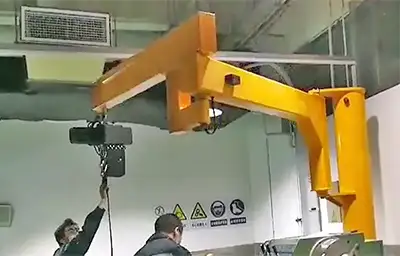
In modern assembly line material handling systems, an articulating jib crane is widely used as a compact workstation lifting solution designed for repetitive lifting cycles and confined production environments. Unlike traditional fixed-radius jib cranes, this type of articulated arm system uses a multi-joint structure that allows operators to move loads around obstacles such as fixtures, benches, tooling stations, and partially blocked work areas. In practical industrial applications, it is commonly deployed in assembly lines handling 50 kg–500 kg components such as pumps, motors, valves, electrical cabinets, and automotive parts where precision positioning and smooth workflow are required.
The core structure of an articulating jib crane is its multi-joint arm system, which provides flexible movement in multiple directions within a limited workstation area. This design is especially useful in compact assembly line layouts where fixed-radius lifting equipment cannot reach all working points. In real workshop use: - Articulating arm allows movement around assembly fixtures and obstacles - Operators can reach confined areas without repositioning the crane base - Suitable for workstation crane applications with limited floor space - Supports smooth handling in repetitive assembly cycle operations
In most industrial applications, articulating jib cranes are designed for light-to-medium duty material handling, typically within the 50 kg to 500 kg load range. This makes them suitable for repetitive lifting tasks that do not require heavy overhead crane systems but still demand precise control. Typical assembly applications include: - Handling pumps, motors, and gear units in mechanical assembly lines - Positioning electrical cabinets and control panels during installation - Supporting automotive component assembly in workstation-based production cells - Repetitive pick-and-place operations in compact manufacturing environments
One of the main advantages of an articulating jib crane in assembly line environments is its ability to provide multi-directional movement within a confined workspace. This helps operators complete complex handling tasks without repositioning materials or adjusting their working stance repeatedly. Practical benefits in industrial use: - Smooth movement across multiple assembly points within a single workstation - Reduced interference with surrounding machinery and production equipment - Improved handling flexibility in compact workstation layouts - Better control during precise component positioning tasks
In real assembly line operations, the use of articulating jib crane systems directly improves workstation efficiency by reducing manual handling effort and improving cycle consistency. Operators spend less time repositioning loads and more time focusing on assembly tasks, which helps stabilize production flow. Key operational improvements include: - Reduced walking distance and operator repositioning during lifting cycles - Faster handling time in repetitive pick-and-place operations - Improved consistency in assembly line production output - Better utilization of compact workstation space in industrial environments
Ergonomics and Operator Safety Improvement in Assembly Line Lifting
In assembly line material handling environments, ergonomics and operator safety are not secondary considerations. They directly affect productivity, cycle stability, and long-term workforce reliability. An articulating jib crane system is commonly introduced in workstation-based production areas to reduce manual lifting load and improve ergonomic working conditions in repetitive lifting cycles. In practical industrial use, especially in compact assembly line layouts handling pumps, motors, valves, and electrical enclosures, the system helps shift the physical burden of lifting from the operator to controlled mechanical movement.
In ergonomic workstation design, lifting tasks are ideally performed within defined operator reach zones to reduce unnecessary stretching and body strain. An articulating jib crane supports this principle by allowing loads to be positioned within natural arm movement range during repetitive assembly operations. Practical implementation includes: - Positioning lifting points within ergonomic reach zones of the operator - Reducing excessive lateral or overhead reaching during material handling - Supporting smooth pick-and-place motion in compact assembly line environments - Maintaining consistent handling posture across repetitive lifting cycles
One of the most common ergonomic issues in manual assembly line work is repeated bending and overextension when lifting components from pallets or low positions. Over time, this contributes to fatigue and increased risk of strain-related injuries. In real workshop applications: - Operators avoid deep bending when lifting heavy or awkward components - Reduced shoulder and back strain during repetitive lifting cycles - More stable posture maintained during continuous workstation operations - Improved safety in compact production cells with limited movement space
In assembly line environments, positioning accuracy is critical when installing components such as electrical cabinets, motors, and valve assemblies. Articulating jib cranes help neutralize load weight during positioning, allowing operators to guide components with controlled force instead of full manual lifting effort. Practical effects include: - Reduced manual force required during alignment and installation tasks - Improved control when positioning components in tight assembly spaces - Smoother adjustment during fine assembly operations - Better repeatability in high-volume production environments
Repetitive lifting without mechanical assistance is one of the leading causes of musculoskeletal disorders in assembly line workers. Over time, this affects productivity, increases absenteeism, and reduces operational stability. In practical industrial environments: - Lower risk of shoulder, back, and wrist injuries in repetitive lifting tasks - Reduced cumulative strain from long shift production cycles - Improved worker comfort in continuous assembly operations - More stable workforce performance across extended production schedules
Repetitive Cycle Efficiency and Production Flow in Assembly Line Lifting
In assembly line material handling systems, production efficiency is closely tied to cycle time stability. When operators perform repetitive lifting tasks across multiple workstations, even small delays in each pick-and-place action can accumulate and disrupt the overall production rhythm. In practical industrial environments, especially in assembly lines handling pumps, motors, valves, electrical cabinets, and automotive components, maintaining consistent cycle time becomes a key factor in output control. Articulating jib crane systems are widely used to stabilize these repetitive lifting cycles and improve overall workstation flow in compact manufacturing layouts.
In repetitive assembly line operations, each lifting cycle includes grabbing, moving, positioning, and releasing components. Without mechanical assistance, these steps require manual effort that slows down overall cycle time. In practical workshop applications: - Articulating jib crane systems reduce manual lifting time per cycle - Faster positioning of 50 kg–500 kg components in workstation environments - Smoother handling of pumps, motors, and electrical enclosures - Improved repeatability in high-frequency production tasks
One common issue in manual assembly line lifting is speed inconsistency across shifts. Operators naturally slow down during long working hours due to fatigue, which affects production balance. In real industrial conditions: - Articulating jib crane supports consistent handling speed throughout shifts - Reduced variation in operator performance during long production cycles - More predictable workstation output in assembly line planning - Improved stability in high-volume manufacturing environments
In compact workstation layouts, manual lifting often requires operators to reposition loads multiple times before final installation. This adds unnecessary steps that slow down assembly flow and increase physical effort. Practical improvements include: - Direct load movement into required assembly position without extra handling steps - Reduced operator walking distance between lifting and installation points - More efficient use of compact assembly workstation space - Smoother material flow in repetitive production environments
Assembly line production depends on synchronized movement between workstations. If one station slows down due to lifting delays, it affects the entire production chain. In real manufacturing environments: - Articulating jib crane helps balance workload between adjacent stations - Supports smooth transfer of components in multi-stage assembly processes - Reduces bottlenecks caused by manual material handling delays - Improves coordination in continuous production line workflows
Workstation Layout and Space Optimization in Assembly Line Lifting Systems
In modern assembly line material handling design, workstation layout and space utilization play a critical role in overall production efficiency. Factories working with compact production cells often face space limitations while still needing to handle repetitive lifting tasks for components such as pumps, motors, valves, electrical cabinets, and automotive assemblies. In these environments, articulating jib crane systems are widely integrated into workstation layouts to improve material flow without interfering with operator movement or surrounding equipment.
The mounting position of an articulating jib crane directly affects its efficiency in assembly line operations. In compact workstation layouts, correct placement ensures that lifting operations align with operator workflow and reduce unnecessary movement. In practical industrial applications: - Floor-mounted or column-mounted installation depending on workstation structure - Positioning close to primary assembly work zone for efficient access - Integration into existing production line without major layout changes - Optimized placement for repetitive lifting cycle operations
In workstation crane design, swing radius alignment is essential for ensuring smooth and efficient material handling. If the crane arm cannot reach all required assembly points, operators are forced to reposition loads manually, reducing productivity. Practical considerations include: - Matching crane arm reach with workstation layout and assembly positions - Ensuring full coverage of pick-and-place points within production cell - Avoiding interference between swing radius and adjacent workstations - Supporting smooth movement in repetitive assembly line operations
Compact assembly environments often include multiple fixtures, tools, and machines operating within limited space. Proper clearance planning ensures that articulating jib cranes can operate safely and efficiently without obstruction. In real workshop conditions: - Adequate clearance between crane arm and surrounding machinery - Avoidance of collision points with fixtures and production tools - Safe movement path for repetitive lifting cycles - Improved safety in dense workstation layouts
Vertical height configuration is an important factor in ergonomic workstation crane design. Incorrect height settings can increase operator strain and reduce efficiency during repetitive lifting tasks. Practical optimization includes: - Setting lifting height within ergonomic reach zones of operators - Reducing overhead strain during positioning of 50 kg–500 kg components - Supporting smooth vertical movement in assembly line operations - Improving accuracy in component placement during installation tasks
Integration with Vacuum Lifters and Manipulators in Assembly Line Systems
In modern assembly line material handling environments, lifting efficiency is no longer achieved by a single device alone. Instead, articulating jib crane systems are increasingly combined with auxiliary lifting tools to handle different shapes, surfaces, and weight distributions. In practical industrial applications, especially in workstation-based assembly of pumps, motors, valves, electrical cabinets, and automotive components, this integrated approach improves flexibility and reduces manual handling effort across repetitive lifting cycles in the 50 kg–500 kg range.
Vacuum lifting systems are widely used in assembly line environments where flat or smooth surfaces need to be handled safely and efficiently. When integrated with an articulating jib crane, they allow operators to lift and position large surface-area components without direct manual gripping. In practical workshop use: - Handling sheet metal panels in electrical cabinet assembly lines - Positioning flat doors, covers, and enclosure plates - Safe lifting of smooth-surface industrial components - Reduced risk of surface damage during repetitive handling cycles
Mechanical grippers are used when components cannot be lifted using vacuum systems due to irregular shapes, surface texture, or weight distribution. Combined with articulating jib crane systems, they provide controlled handling for complex assembly parts. Typical industrial applications include: - Lifting irregular-shaped mechanical components such as pump housings and gear units - Handling heavy or unevenly balanced parts in assembly line operations - Supporting secure grip during repetitive pick-and-place cycles - Improving control in confined workstation environments
Load balancers are commonly integrated into workstation lifting systems to reduce the effective weight felt by the operator. This allows components to be positioned with minimal physical effort during precision assembly tasks. In real assembly environments: - Near-weightless handling effect during repetitive positioning operations - Improved control when aligning motors, valves, and electrical components - Reduced operator fatigue in continuous production shifts - Smoother movement during fine adjustment tasks in assembly lines
Precision manipulators are used in assembly line environments where accurate alignment is required during installation or fitting processes. When paired with articulating jib cranes, they allow controlled multi-axis movement for sensitive assembly tasks. Practical use cases include: - Alignment of electrical cabinets and control panels during installation - Positioning of precision mechanical assemblies in production lines - Controlled adjustment during tight tolerance assembly operations - Improved repeatability in high-precision manufacturing environments
Productivity Gains in Assembly Operations Using Articulating Jib Cranes
In modern assembly line material handling environments, productivity is closely linked to how efficiently repetitive lifting tasks are performed at each workstation. When articulating jib crane systems are properly integrated into compact assembly layouts, they help stabilize handling speed, reduce manual effort, and improve overall production flow. In practical industrial applications involving pumps, motors, valves, electrical cabinets, and automotive components, these improvements are often reflected directly in cycle time consistency and workstation output quality, especially in the 50 kg–500 kg handling range.
In repetitive assembly line operations, operator fatigue is one of the main factors affecting productivity decline over long production shifts. Articulating jib cranes reduce physical lifting load, allowing operators to focus more on positioning and assembly rather than manual force application. In real workshop conditions: - Lower physical strain during repetitive lifting cycles - Improved operator endurance across long production shifts - More stable working posture in workstation-based assembly tasks - Reduced fatigue-related performance variation
Cycle time efficiency is a critical factor in assembly line performance. When manual lifting is replaced or assisted by articulating jib crane systems, each pick-and-place operation becomes faster and more controlled. Practical improvements include: - Reduced time required for lifting and positioning components - Smoother handling of 50 kg–500 kg parts in workstation environments - More consistent cycle execution in repetitive production tasks - Improved overall throughput in assembly line systems
In assembly operations, accurate component placement is essential for maintaining product quality and reducing rework. Articulating jib cranes provide controlled movement that improves positioning precision during installation tasks. In practical applications: - More stable alignment of motors, valves, and electrical cabinets - Reduced positioning errors in repetitive assembly processes - Better control during fine adjustment and installation tasks - Improved consistency in high-volume production environments
In traditional manual lifting environments, some assembly tasks require more than one operator to safely handle components. With workstation jib crane systems, a single operator can often complete the same task more efficiently. Practical benefits include: - Reduced need for additional manpower in lifting operations - Single-operator handling of medium-light industrial components - More efficient labor allocation across production lines - Lower operational cost in repetitive assembly tasks
Consistency is a key requirement in assembly line production. Variations in manual handling can lead to inconsistent positioning, assembly errors, and quality fluctuations between batches. In real production environments: - Stable handling conditions across all shifts - Reduced variation in assembly accuracy between operators - Improved repeatability in repetitive workstation tasks - More reliable output quality in continuous production systems
Application Areas in Industrial Assembly for Articulating Jib Crane Systems
In industrial assembly line material handling, articulating jib crane systems are widely applied across different manufacturing sectors where repetitive lifting, compact workstation layouts, and controlled positioning are required. These workstation lifting solutions are especially suitable for handling medium-light components such as pumps, motors, valves, electrical cabinets, and mechanical assemblies within the 50 kg–500 kg range. In practical production environments, the focus is not only on lifting capacity, but on improving handling accuracy, reducing operator fatigue, and maintaining stable assembly line flow across repetitive cycles.
In automotive manufacturing environments, assembly lines involve continuous handling of engines, gear units, and structural components. Articulating jib cranes are used to support repetitive lifting tasks within compact workstation layouts, where precision and cycle consistency are critical. In practical applications: - Handling automotive subassemblies in workstation-based production lines - Supporting repetitive pick-and-place of medium-weight components - Improving positioning accuracy during installation processes - Reducing manual strain in high-cycle automotive assembly operations
Electrical cabinet and control panel manufacturing requires careful handling of flat, heavy, and often delicate components. Articulating jib crane systems combined with vacuum lifters are commonly used to improve lifting safety and positioning accuracy. Practical use cases include: - Lifting and positioning electrical enclosures and cabinet housings - Supporting sheet metal handling in control panel assembly lines - Reducing surface damage during repetitive lifting operations - Improving alignment accuracy during installation and wiring processes
HVAC equipment production involves handling large panels, compressors, and mechanical assemblies in repetitive assembly line processes. Compact workstation crane systems help improve handling efficiency in confined production areas. In real industrial environments: - Handling HVAC units and subcomponents during assembly processes - Supporting repetitive lifting in compact production cells - Improving workflow between fabrication and assembly stations - Enhancing safety during medium-weight component handling tasks
Pump and valve manufacturing workshops rely heavily on precise positioning and repetitive assembly operations. Articulating jib cranes provide controlled lifting that supports alignment-sensitive installation tasks. Practical benefits include: - Handling pump housings, impellers, and valve assemblies in workstation environments - Improving precision during alignment and installation processes - Reducing operator fatigue in repetitive lifting cycles - Supporting stable production flow in mechanical assembly workshops
In general mechanical fabrication and light industrial production, material handling requirements vary across different product types and workstation layouts. Articulating jib crane systems provide flexible lifting support for a wide range of repetitive assembly tasks. In practical use: - Suitable for small batch and high-mix production environments - Supporting repetitive lifting in fabrication and assembly processes - Improving handling efficiency in compact workshop layouts - Enhancing overall productivity in light industrial manufacturing systems
Conclusion
Articulating jib cranes provide a practical solution for repetitive assembly work where ergonomics, space efficiency, and cycle time consistency are critical. By supporting controlled lifting of 50–500 kg components within compact workstation environments, they reduce manual strain, improve operator safety, and enhance production flow.
When integrated with vacuum lifters, manipulators, and optimized workstation layouts, they become a core element of modern ergonomic assembly systems that balance productivity with human-centered design.