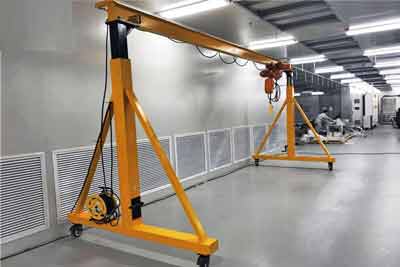
Portable Gantry Crane Applications in Industry Use
Most Important Takeaway
Portable gantry cranes provide a flexible, trackless lifting solution that replaces fixed overhead systems in working environments where mobility, fast setup, and multi-zone lifting are required.
- How to lift and move steel coils safely without fixed cranes
- How to speed up injection mold changing in production lines
- How to handle heavy machinery during maintenance without downtime delays
- How to improve warehouse material flow in tight or changing layouts
- How to reduce reliance on forklifts and external lifting services
- How to improve ROI for small and medium industrial facilities
Questions This Topic Solves
In industrial projects, buyers usually do not start with equipment specifications. They start with practical problems on the workshop floor. Portable gantry cranes are often considered after these operational challenges appear in daily work.
In steel service centers, coils are heavy and often stored in tight layouts where forklifts alone are not always precise enough. Efficient movement requires controlled lifting and stable positioning.
In practical use, portable gantry cranes are placed near storage zones or loading areas to lift coils safely and move them between trucks, racks, and processing lines.
Injection mold change requires precise alignment and controlled lifting because molds are heavy and sensitive components. Any imbalance during lifting can affect installation safety and production quality.
A portable gantry crane is commonly used to lift molds from storage or pallets and position them directly into injection molding machines, reducing manual handling risks and improving control.
Many maintenance areas are not equipped with fixed overhead cranes, especially in older factories or multi-purpose workshops. This creates challenges when lifting motors, pumps, or gearbox assemblies.
Portable gantry cranes solve this by being moved directly to the repair location, allowing maintenance teams to lift and reinstall heavy components without relocating the equipment.
Warehouses with changing layouts or multiple working zones require lifting equipment that can adapt quickly. Fixed systems are often limited to one area and cannot support dynamic operations.
Portable gantry cranes are suitable because they can be repositioned across different zones such as loading docks, storage aisles, or packaging areas depending on daily workflow needs.
In many factories, lifting costs are not only related to equipment purchase but also to installation, downtime, and external crane rental. Safety risks during manual or improvised lifting also increase operational cost over time.
Portable gantry cranes help reduce these costs by providing a reusable lifting solution that can be deployed across different tasks while improving controlled handling and reducing accident risks.
Introduction: Role of Portable Gantry Cranes in Modern Industry
Portable gantry cranes are used in workshops and production sites where lifting tasks do not stay in one fixed position. In many industrial projects, the layout changes, machines are relocated, or work zones are expanded. A fixed overhead crane is not always practical in these situations.
Portable gantry crane for different industrial uses
In operating conditions, a trackless mobile gantry crane gives a simple answer: lift, move, and position heavy loads without rail installation or building modification. It is often used in steel workshops, mechanical repair areas, and warehouse handling zones where flexibility matters more than permanent structure.
- Suitable for indoor and outdoor workshop lifting tasks where floor space must stay open and flexible.
- Works without runway beams or fixed rail systems, making it easier to deploy in existing factory layouts.
- Common in maintenance areas, production lines, and logistics storage points where lifting demand changes from time to time.
- Often selected for small and medium industrial facilities that need controlled lifting without high infrastructure cost.
Typical Industrial Use Conditions for Portable Gantry Cranes
In many factories, lifting work is not constant. One day it may be steel coil movement, another day it may be equipment repair or mold replacement. In such cases, a portable gantry crane is placed where the work happens, used, then moved again. Simple, but very practical in daily operations.
Portable gantry cranes are often moved between different working zones depending on production needs. In steel processing shops or fabrication plants, lifting points are rarely fixed. Operators simply bring the crane to the job location and start lifting.
This is especially useful in workshops where space is shared between welding, assembly, and repair work. One crane can serve multiple stations during the same shift.
- Used in multi-station production floors where lifting demand changes frequently
- Reduces need for permanent overhead crane coverage across the whole workshop
- Supports temporary lifting tasks during equipment installation or relocation
Steel coil handling is one of the most common applications. Coils are heavy, round, and not easy to control with manual tools. Forklifts are used often, but they are not always the safest option for precise placement.
A portable gantry crane allows controlled vertical lifting and slow horizontal movement, which reduces the risk of coil damage or floor impact during handling.
- Used for loading and unloading steel coils from trucks or storage racks
- Supports feeding coils into slitting, cutting, or stamping machines
- Improves safety in narrow warehouse aisles where forklifts have limited movement space
Injection molding factories often face frequent mold changes. Each mold can be very heavy, and precise alignment is required during installation. Time matters because production downtime directly affects output.
In practical use, a portable gantry crane is placed near the molding machine, used to lift the mold safely, and then moved away after the job is completed. It is a straightforward method, but it reduces dependency on fixed lifting systems. Check more on mold handling gantry cranes for the particular industrial uses.
- Used for lifting molds from storage racks or pallets
- Helps align molds with injection molding machine platens during installation
- Reduces machine downtime during mold change operations
Maintenance work in industrial facilities is not predictable. One day it may be a gearbox repair, another day a motor replacement. A portable gantry crane gives maintenance teams a lifting tool they can bring directly to the repair site.
In warehouse logistics, the same equipment is used for loading, unloading, and repositioning heavy goods when forklift access is limited or when precision placement is required.
- Supports lifting of motors, pumps, gearboxes, and heavy machine parts during repair work
- Used in warehouse loading zones for handling heavy or irregular cargo
- Reduces reliance on external lifting services and improves on-site independence
Steel Coil Handling in Industrial Operations
Steel coil handling is one of the most common lifting tasks in steel service centers, fabrication workshops, and warehouse logistics zones. In practical operations, coils are not only heavy, but also unstable in shape, which makes controlled lifting a necessary requirement rather than an option.
Portable gantry cranes are often used here because they can be positioned directly at the loading area or storage zone without requiring fixed rails. In industrial projects, this flexibility helps operators handle coils safely and with better control.
Steel coils are typically heavy cylindrical materials stored in tight warehouse layouts or production yards. The handling process requires stability during lifting and slow movement during transfer.
In many facilities, space between storage racks is limited. This makes precise lifting equipment more practical than general-purpose material handling tools.
- Heavy cylindrical loads requiring stable vertical lifting and controlled horizontal movement
- Narrow warehouse aisles where forklift turning radius is limited
- Frequent loading and unloading cycles between trucks, storage, and processing lines
In steel processing operations, portable gantry cranes are used as a flexible lifting point that can be moved close to where the coil is stored or processed. Operators do not need to wait for fixed crane availability.
This is especially useful in workshops where coil handling happens in different zones during the same working shift.
- Moving steel coils from delivery trucks directly into storage areas
- Feeding coils into slitting machines, cutting lines, or stamping equipment
- Positioning raw material close to production lines for faster workflow
The main value of using a portable gantry crane in coil handling comes from better control and reduced handling risk. Instead of relying only on forklifts, operators gain a more stable lifting method.
In practical warehouse and steel service center operations, this directly improves safety and reduces product damage during movement.
- Improves lifting safety compared to manual handling or forklift-only transport
- Reduces surface damage, dents, and coil deformation during transfer
- Improves overall workflow efficiency in steel processing and logistics areas
Injection Mold Changing in Manufacturing
Injection mold changing is a routine but critical operation in plastic manufacturing plants. In production environments, every changeover directly affects output, so the lifting process needs to be stable, controlled, and fast. There is usually no room for error or delay.
Portable gantry cranes are commonly used in these workshops because they can be moved directly to the injection molding machine area. In practical terms, this avoids dependence on fixed overhead cranes and helps operators manage mold handling at the exact point of need.
Injection molding machines often operate in compact layouts where multiple units are placed side by side. The molds used in these machines are heavy precision components that require careful lifting and alignment.
In many factories, overhead crane coverage is limited or shared between different production zones. This creates delays during mold change operations if lifting equipment is not immediately available.
- Heavy precision molds requiring stable vertical lifting and controlled positioning
- Limited overhead lifting coverage in production workshops or shared crane systems
- Production downtime pressure during frequent mold change cycles
In practical factory use, a portable gantry crane is positioned close to the injection molding machine. Operators use it to lift molds from storage racks or transport pallets and move them into position for installation.
This method allows direct lifting at the working point, which reduces waiting time and improves coordination between maintenance and production teams.
- Lifting molds from storage racks, pallets, or maintenance areas
- Aligning molds precisely with injection molding machine platens
- Supporting safe removal and installation during mold changeover operations
The main improvement comes from reducing downtime and improving handling precision. In production environments, even small delays during mold change can affect daily output targets.
By using a portable gantry crane, factories gain a flexible lifting solution that can be moved between different machines as needed.
- Reduces mold change downtime and improves production continuity
- Improves alignment accuracy during mold installation in machines
- Removes dependence on fixed overhead crane systems in each machine zone
Machinery Maintenance and Equipment Repair
Machinery maintenance work in industrial facilities is rarely predictable. One day it may be a motor replacement, the next day a gearbox repair or pump alignment. In workshop conditions, lifting requirements change depending on the equipment breakdown or service schedule.
Portable gantry cranes are commonly used in these situations because they can be moved directly to the maintenance area. In practical terms, this means the lifting tool goes to the problem, instead of moving the machine to a fixed crane position.
Maintenance teams often work with a wide range of equipment sizes and weights. The lifting conditions are not standard, and the working space is often limited or blocked by surrounding machinery.
In many factories, repair work happens in narrow bays or inside production halls where equipment cannot be easily moved. This creates a need for flexible lifting support.
- Heavy components such as motors, pumps, gearboxes, and machine assemblies requiring controlled lifting
- Confined workshop or on-site repair spaces with limited movement area
- Emergency breakdown situations requiring fast lifting response without planning delays
In maintenance operations, a portable gantry crane is positioned above or beside the equipment being serviced. It allows technicians to lift heavy parts safely without needing a fixed overhead crane system.
This is especially practical in plants where maintenance tasks are spread across different machines and production areas.
- On-demand lifting directly at the equipment repair location
- Safe removal of heavy mechanical components during disassembly work
- Controlled reinstallation of parts during equipment reassembly and alignment
The main advantage in maintenance work is time and control. Equipment downtime is expensive in industrial operations, so faster lifting and safer handling directly improve productivity.
A portable gantry crane also reduces dependency on external lifting services, which is important when urgent repairs are required.
- Reduces downtime during machine servicing and repair operations
- Improves safety during heavy component disassembly and installation
- Eliminates reliance on external crane rental or fixed overhead crane availability
Warehouse Logistics and Material Handling
Warehouse operations today are not fixed or predictable. Storage layouts often change, product types vary, and loading tasks shift depending on daily orders. In practical logistics environments, this creates a need for flexible lifting equipment that can adapt to different working zones.
Portable gantry cranes are commonly used in warehouses because they can be moved directly to the required lifting point. In operation, this reduces dependency on forklifts alone and improves handling control for heavy or irregular goods.
In many warehouses, material flow changes throughout the day. Incoming shipments, storage adjustments, and outbound deliveries all require different handling approaches. The lifting requirement is rarely the same twice.
This is where flexible lifting systems become important, especially when working space is limited or constantly reorganized.
- Heavy pallets, machinery parts, and irregular industrial goods requiring controlled lifting
- Dynamic storage layouts that change based on inventory and order demand
- High-frequency inbound and outbound logistics operations requiring fast handling cycles
In practical warehouse use, portable gantry cranes are placed where lifting tasks are needed most. They are often used near loading docks, storage aisles, or packaging zones depending on workflow requirements.
This flexibility allows operators to handle heavy goods without relying only on forklifts or fixed overhead lifting systems.
- Loading and unloading trucks with controlled lifting of heavy goods
- Repositioning inventory within storage zones and racking systems
- Supporting order preparation, packaging, and dispatch operations
The main improvement in warehouse operations comes from better traffic flow and safer handling of heavy goods. Forklifts are still widely used, but they are not always suitable for precise lifting in narrow spaces.
A portable gantry crane adds an extra lifting option that can be deployed where needed, reducing bottlenecks in material handling.
- Reduces forklift congestion and lowers collision risk in busy warehouse lanes
- Improves lifting capability in narrow aisles and restricted working areas
- Allows flexible adaptation when warehouse layout or storage zones change
Industrial Value and Return on Investment
In industrial projects, equipment decisions are rarely based only on lifting capacity. Cost, flexibility, and daily usability matter just as much. Portable gantry cranes are widely selected because they balance these factors in a practical way.
Instead of building fixed crane structures, many factories use portable gantry systems to handle multiple lifting tasks across different zones. This reduces infrastructure pressure and keeps the system usable even when production layouts change.
- Lower investment cost compared to overhead crane systems that require building support structures and runway installation
- One crane can be used in multiple working areas, reducing the need for duplicated lifting equipment in the same facility
- No need for permanent structural modification, which makes installation faster and suitable for rented or evolving workshop spaces
In daily operation, the value becomes more visible over time. Workflows are smoother because lifting equipment can move with the job. Operators do not wait for a fixed crane, and maintenance teams can respond directly on site.
In practical terms, this improves productivity in small but consistent ways. Less waiting time, fewer handling errors, and more stable material flow across different departments.
- Reduces material handling time during loading, unloading, and internal transfer operations
- Improves workflow continuity in production lines where lifting tasks are frequent but not fixed in location
- Reduces downtime during equipment changeover and maintenance activities
- Lowers product damage risk through more controlled lifting and positioning
Conclusion
Portable gantry cranes play a critical role in industries that require adaptable lifting systems rather than fixed infrastructure. Their application across steel coil handling, injection mold changing, machinery maintenance, and warehouse logistics demonstrates their ability to improve operational flexibility, reduce downtime, and enhance overall material handling efficiency in industrial environments.