Trackless vs Rail Gantry Cranes Comparison Guide
Trackless vs Rail-Type Gantry Cranes – Which Is Better for Workshop Material Handling?
In industrail workshop operations, the choice between trackless and rail-type gantry cranes is not about lifting capacity alone, but about whether the facility needs fixed high-frequency production flow or flexible multi-zone material handling.
- How installation cost changes total project investment
- Why mobility directly affects workshop productivity
- How maintenance differences impact long-term operating cost
- Why infrastructure requirements determine project flexibility
- Which system fits fixed production lines vs changing layouts
Questions This Topic Solves
In industrail workshop planning, the decision between rail-mounted gantry crane systems and trackless portable gantry cranes is usually not made from catalog data alone. It comes from practical problems on site—cost pressure, layout limits, and how often the production line changes. This section reflects the industrail questions buyers ask before investing in a lifting system.
The decision depends on how stable the workshop operation is. In fixed production environments where lifting paths do not change, rail-mounted systems are often used. In contrast, workshops with changing tasks or multiple working zones tend to choose trackless portable gantry cranes.
In practical projects, this is not a theoretical choice. It is based on whether the workshop needs a fixed lifting route or flexible movement between different work areas.
Rail-mounted systems require civil construction, rail alignment, and structural installation before use. This increases both time and project cost. Trackless systems operate directly on existing floors, which reduces installation complexity.
In industrail industrial budgeting, this difference often becomes a key factor when comparing total project investment.
Workshops with changing layouts or mixed production tasks often need lifting equipment that can move with the workflow. Rail systems are limited to fixed paths, while trackless cranes can be repositioned as needed.
In practical use, this makes portable gantry cranes more suitable for multi-task and multi-zone operations.
Rail systems require ongoing inspection of rails, wheel contact surfaces, and structural alignment. Trackless systems focus more on wheels, frames, and basic mechanical maintenance.
Over time, rail systems involve more infrastructure-level maintenance, while trackless systems are simpler to service in typical workshop environments.
Infrastructure plays a major role in total cost of ownership. Rail systems require fixed installation and civil work, which increases upfront investment and long-term structural dependency. Trackless systems reduce infrastructure needs and allow easier relocation.
In industrail industrial planning, this affects not only cost but also how flexible the workshop remains in future expansion or layout changes.

Introduction: Two Material Handling Approaches in Workshops
In many industrial workshops, lifting systems are not chosen in theory first. They are chosen based on how the floor actually runs day to day. Some factories run steady production lines. Others change layout, move machines, or handle different jobs in the same space. In both cases, gantry crane systems are used, but not in the same way.
There are generally two directions in workshop material handling equipment. One is the rail mounted gantry crane system, fixed in place with a defined travel path. The other is the trackless portable gantry crane, which moves freely on industrial wheels across the workshop floor. In industrail projects, this difference affects not only lifting work, but also how the whole site is organized.
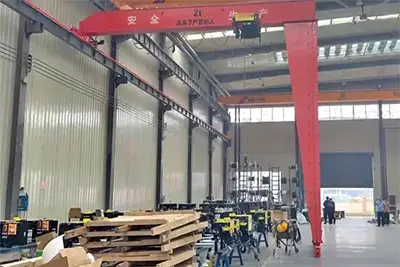
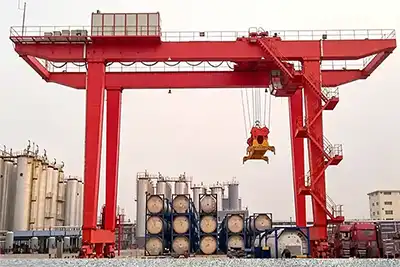
Rail mounted gantry crane systems are built on fixed ground rails or runway beams. Once installed, the movement direction is defined, and the crane works within that set path. This type is common in production lines where the lifting area does not change for a long time.
In practical industrial use, this system is often found in structured workshops, steel processing lines, or assembly zones where operations repeat in the same position every day. The layout is stable, and the crane follows a predictable route.
- Uses fixed ground rail or runway beam structure for controlled movement
- Suitable for high-frequency lifting in stable production line environments
- Requires permanent workshop planning before installation and commissioning
Trackless portable gantry cranes work differently. Instead of fixed rails, they use wheeled frames that run directly on the workshop floor. In industrail operations, this means the crane can be moved to wherever lifting is needed at that moment.
This is often seen in maintenance workshops, mixed production facilities, and warehouse areas where the working zone changes. One day it may be machine repair, another day it may be steel handling or mold lifting. The same crane can be moved and reused in different locations.
- Runs on industrial wheels directly on concrete workshop floors without rail installation
- Supports multi-zone lifting tasks such as maintenance, assembly, and material handling
- Suitable for workshops where layout changes or production tasks vary frequently
In industrail industrial projects, the decision between rail and trackless systems is not only about equipment type. It is about how the workshop actually works. Some plants need stable, repeatable lifting paths. Others need mobility and quick adjustment.
There is no single answer that fits all factories. A steel processing line may benefit from a fixed rail system. A maintenance workshop or mixed production site may find more value in a portable system that can move between jobs.
- Rail system fits stable production flow with repeated lifting positions
- Trackless system fits changing layouts and multi-location lifting tasks
- Selection depends on workshop structure, production cycle, and space usage
In industrail projects, engineers and buyers usually look at cost, layout stability, and how often the lifting task changes. A fixed rail system requires planning from the beginning. A trackless system can be added later without major structural change.
That is why many small and medium workshops choose portable gantry cranes first. It is simpler to deploy, and it allows the workshop to adjust later if production expands or changes.
- Rail systems require early-stage infrastructure planning and permanent installation
- Trackless systems reduce civil work and can be deployed directly on existing floors
- Choice depends on long-term production stability and workshop flexibility needs
Installation Cost and Infrastructure Requirements in Gantry Crane Systems
In industrail workshop planning, installation cost is usually the first thing buyers calculate. Not only the crane price, but also the foundation work, layout modification, and time needed before the system can actually start running. This is where rail-type and trackless gantry cranes show a clear difference.
Rail-mounted systems require structured construction work before operation. Trackless portable gantry cranes, on the other hand, are designed to work directly on existing workshop floors. The gap between these two approaches is not small, especially in projects where budget and installation time are limited.
Rail-type gantry crane systems need proper groundwork before installation. The rails must be aligned carefully, and the foundation must be strong enough to support long-term load and movement. In practice, this means civil work is always part of the project.
This type of installation is often used in factories that already have a fixed production layout. Once installed, the system stays in place for years, serving the same working area without major changes.
- Ground rail installation requires precise alignment and leveling work across the full travel path
- Civil foundation preparation is needed to ensure load stability and long-term structural safety
- Higher upfront cost due to engineering, materials, and construction labor requirements
- Longer installation and commissioning time before the crane becomes operational
Trackless gantry crane systems are built for direct use on standard workshop floors. In most cases, there is no need for rail installation or structural modification. The system is assembled, checked, and put into service in a much shorter time.
This makes it suitable for workshops where production starts quickly or where lifting tasks appear in different locations over time. It is often used in maintenance zones, warehouse areas, and small production facilities.
- No rail installation or runway beam construction required for operation
- Simple assembly process with faster deployment into working condition
- Lower initial investment compared to rail-based infrastructure systems
- Commonly used in rented workshops, temporary sites, and flexible production areas
When comparing both systems in industrail projects, the total cost is not only about equipment price. It includes construction work, installation time, and how flexible the system will be in future operations. These factors often decide the final investment choice.
In many workshops, especially small and medium factories, reducing infrastructure work is a key reason to choose trackless systems instead of rail-mounted designs.
- Rail systems increase total project cost due to civil engineering and structural installation
- Trackless systems reduce dependence on construction work and site modification
- Final selection often depends on budget control, facility ownership, and long-term usage plans
Mobility and Workshop Flexibility in Gantry Crane Systems
In industrail workshop operation, mobility is often what decides whether a lifting system fits long-term production needs or not. Some facilities run fixed production lines where the lifting path never changes. Others adjust layout depending on orders, equipment, or maintenance work. These two situations lead to very different requirements for crane movement.
Rail-mounted gantry cranes follow a fixed path. Trackless portable gantry cranes move freely across the workshop floor. This difference sounds simple, but in practice it changes how the entire material handling process is organized on site.
Rail-mounted cranes move only along installed rails or runway beams. The direction is fixed from the beginning, and the crane cannot operate outside that defined path. In stable production environments, this works well because the workflow is predictable.
However, in workshops where layout changes happen, this fixed movement becomes a limitation. Any adjustment in production flow may require redesign or additional infrastructure work.
- Movement restricted strictly to rail direction or predefined travel path
- Limited flexibility when workshop layout or production zones change
- Requires structural modification or redesign if production line is reconfigured
Trackless portable gantry cranes are designed for direct movement on workshop floors without rail guidance. In daily industrial use, this means the crane can be pushed or repositioned to different working areas based on actual lifting demand.
This is especially useful in maintenance zones, multi-purpose workshops, and warehouses where lifting tasks are not fixed in one position. The same crane can serve different departments in one facility.
- Can be repositioned across multiple workshop zones depending on lifting requirements
- Supports changing production layouts, maintenance tasks, and temporary lifting points
- Suitable for multi-task operations in small and medium industrial facilities
In industrail industrial projects, both systems are used depending on how stable the production process is. A rail system fits well when the lifting path is fixed and repeated every day. A trackless system fits better when tasks change frequently across different areas.
In many workshops, this is not a theoretical choice. It is based on how often machines move, how often maintenance happens, and how flexible the production schedule needs to be.
- Rail systems support stable, repeatable production line operations
- Trackless systems support flexible and changing workshop environments
Maintenance Requirements and Lifecycle Effort in Gantry Crane Systems
In industrail industrial use, maintenance is not just about fixing breakdowns. It is about how often the system needs attention, how complex the inspection work is, and how much downtime is caused during service. Over time, these factors directly affect operating cost and workshop efficiency.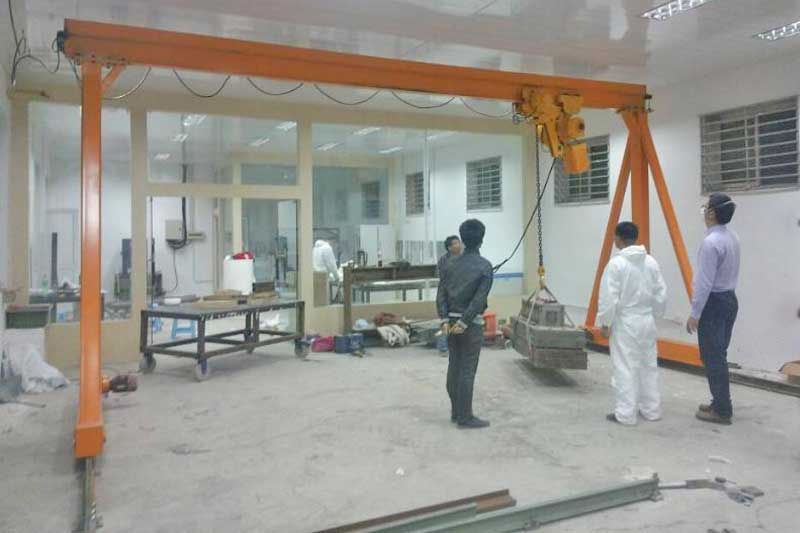
Rail mounted small gantry crane for sale
Rail-mounted gantry cranes and trackless portable gantry cranes have very different maintenance patterns. One is tied to fixed infrastructure and requires structural checks. The other is simpler in structure and focuses mainly on mechanical wear parts.
Rail-type gantry cranes operate on fixed ground tracks or runway beams. Because of this structure, maintenance is not limited to moving parts only. The entire rail system must be monitored to ensure safe and stable operation over time.
In industrail workshop conditions, this type of maintenance is usually scheduled at intervals, especially in high-frequency production environments where wear accumulates faster.
- Rail alignment inspection to ensure smooth and stable crane movement along the track
- Wheel and rail contact wear checks to prevent uneven operation or vibration issues
- Runway beam structural inspection to confirm long-term load-bearing safety
Trackless gantry cranes are simpler in structure. They do not rely on rails or fixed infrastructure, so maintenance is mainly focused on wheels, frame connections, and lifting components.
In practical use, this makes daily inspection easier for workshop teams. Maintenance can often be done in-house without specialized infrastructure checks.
- Wheel and caster inspection to ensure smooth movement across workshop floors
- Frame bolt tightening and lubrication for stable structural performance
- Routine load safety checks before lifting operations
Over the long term, maintenance requirements directly influence total operating cost. Rail systems often require more structured inspection planning due to their fixed infrastructure. This adds to long-term maintenance workload.
Trackless systems reduce this burden because they do not depend on rails or runway beams. In many workshops, this simplicity is one reason they are preferred for flexible operations.
- Rail systems require higher infrastructure-based maintenance planning and inspection cycles
- Trackless systems reduce long-term service complexity and simplify daily upkeep
Long-Term Operational Efficiency in Workshop Gantry Crane Systems
In industrail industrial projects, efficiency is not only measured by lifting speed. It is also about how consistently the system performs over months and years, how well it matches production flow, and how much time is lost when layouts or tasks change. Over time, these small factors decide whether a system fits the workshop or becomes a limitation.
Rail-mounted gantry cranes and trackless portable gantry cranes show different efficiency patterns. One is designed for stable and repetitive work. The other is designed for changing and mixed-use environments where lifting tasks are not fixed in one place.
Rail-type gantry cranes perform best when the production process is stable and repeated. In these environments, the crane follows the same path every day, and the lifting points rarely change. This makes operations predictable and smooth.
In many steel processing lines or assembly workshops, this setup helps maintain steady output. However, the efficiency depends on the condition that the workflow does not change frequently.
- High efficiency in continuous and repetitive production line operations
- Optimized movement along fixed and consistent load paths
- Less suitable for workshops where layout or product type changes often
Trackless portable gantry cranes are designed for environments where lifting tasks move between different zones. In industrail workshop use, this means one crane can serve multiple machines or working areas during the same production cycle.
This reduces idle time between tasks and improves utilization, especially in workshops where maintenance, assembly, and material handling happen in the same space.
- One crane system can serve multiple workshop zones depending on lifting demand
- Reduces idle time between lifting operations by moving directly to the work point
- Supports changing production layouts and mixed industrial workflows
In industrail industrial application, both systems improve efficiency, but in different ways. Rail systems improve consistency in fixed production environments. Trackless systems improve utilization in flexible and changing workshop conditions.
The actual decision depends on whether the factory values stable production flow or adaptive multi-task operation over time.
- Rail systems maximize efficiency in structured and stable factory layouts
- Trackless systems maximize equipment utilization in variable and multi-purpose environments
Infrastructure Dependency and Investment Risk in Gantry Crane Systems
In industrail workshop planning, infrastructure is often the hidden cost that decides whether a lifting system feels flexible or locked in. Some systems require permanent structural changes before they can even operate. Others can be placed directly into existing workshop space and adjusted later if production changes.
This difference becomes more important over time. Not on the first day of installation, but when the workshop expands, layout shifts, or production demand changes. At that point, infrastructure dependency starts to affect investment risk.
Rail-mounted gantry crane systems depend heavily on fixed civil and structural work. Once the rails are installed and aligned, the system becomes part of the building structure. In practice, this means changes are not easy after installation.
In many industrial projects, this works well for stable factories. But in facilities that expect growth or layout changes, the same fixed structure can become a limitation over time.
- Fixed installation reduces flexibility for future workshop layout changes
- Requires stronger reliance on civil engineering design and structural planning
- Less suitable for rented workshops or facilities that plan expansion or relocation
Trackless portable gantry cranes do not rely on permanent rails or structural modifications. They operate directly on standard concrete workshop floors, which makes them easier to deploy in industrail working environments.
In practice, this means the crane can be used in one area today and moved to another area tomorrow without construction work or layout changes.
- Works directly on existing workshop floors without rail infrastructure
- Can be relocated or repositioned as production or maintenance needs change
- Reduces long-term risk tied to fixed infrastructure investment
When looking at investment in industrail industrial projects, the key point is not only initial purchase cost. It is also how the equipment behaves when the factory changes over time. This is where infrastructure dependency becomes important.
Rail systems are usually treated as long-term fixed infrastructure investment. Trackless systems are treated more as flexible equipment that can grow with the workshop.
- Rail systems represent long-term fixed infrastructure investment with limited flexibility
- Trackless systems represent scalable equipment investment with adaptable usage across different workshop stages
Conclusion: Choosing the Right System for industrail Workshop Needs
In practical industrial use, rail-type gantry cranes are best suited for fixed, high-volume production environments where workflow remains stable over time. Trackless portable gantry cranes, however, are more suitable for workshops that require flexibility, multi-zone lifting, and reduced infrastructure cost.
The final decision depends on whether the operation values structured efficiency or adaptable material handling capability in long-term production planning.