Wireless Remote Control Safety in Gantry Crane Systems
How Wireless Remote Control Improves Safety in Mobile Gantry Crane Drive Systems
Wireless remote control significantly improves mobile gantry crane safety by allowing operators to work from a safe distance while maintaining precise control over braking, movement, and emergency stopping, which directly reduces accident risk and improves operational stability.
- Reduces operator exposure to suspended loads and moving crane zones
- Improves emergency response through instant stop control
- Enhances braking precision and load stability during movement
- Increases operator efficiency and single-person control capability
- Improves compliance with industrial lifting safety requirements
Questions This Topic Solves
Wireless remote control in mobile gantry crane systems is often evaluated based on practical site problems rather than theory. The following questions reflect real operational concerns from workshops, fabrication plants, and industrial yards where lifting safety, control stability, and workflow efficiency are daily requirements.
Wireless remote control improves safety mainly by allowing the operator to stay away from high-risk zones during lifting and movement operations. Instead of standing near the load or travel path, the operator controls the crane from a safer distance with full visibility.
This reduces exposure to suspended loads, moving wheels, and pinch points, which are common sources of workplace accidents in real industrial environments.
Remote operation removes the need for fixed-position control, which often forces operators to stay close to the crane structure. With wireless control, the operator can reposition based on the load situation and working environment.
This flexibility improves visibility and reduces time spent in unsafe zones, especially during load alignment, travel direction changes, and tight-space operations.
Wireless crane systems include an integrated emergency stop function that immediately cuts movement commands when activated. Once triggered, travel, lifting, and lowering functions are stopped without delay.
In addition, fail-safe logic ensures that if signal is lost, the crane automatically enters a safe stop condition to prevent uncontrolled movement.
Yes, when wireless control is combined with VFD-driven motors and electromagnetic braking systems, braking performance becomes more controlled and predictable.
Smooth start and stop control reduces sudden acceleration and deceleration, which directly helps minimize load swing and mechanical shock during operation.
Remote operation improves efficiency by reducing the need for multiple personnel during lifting tasks. A single operator can manage movement, positioning, and stopping directly from the ground using a handheld controller.
This reduces coordination delays, shortens lifting cycles, and improves workflow continuity in repetitive industrial handling tasks.
Introduction: Evolution of Mobile Gantry Crane Control
Mobile gantry crane systems, especially trackless and rubber-tyred types, have gradually shifted from traditional pendant control toward wireless remote control systems integrated with electric drive wheels and VFD (variable frequency drive) technology. In earlier setups, operators needed to stay close to the crane, often walking alongside the load during movement. This close-range operation increases exposure to moving wheels, swinging loads, and restricted working space risks.
Wireless remote control changes this operating method. The operator can now manage crane travel, lifting, and stopping functions from a safe distance with better visibility and freedom of movement. This is particularly important in workshops, warehouses, and outdoor industrial yards where space is limited and multiple activities happen in the same area.
In modern mobile gantry crane drive systems, wireless control is often combined with VFD soft start, electric drive wheels, and braking systems to ensure smoother motion and more stable load handling. The result is a more controlled lifting process with reduced mechanical shock and improved operational safety.
Today, wireless remote control is widely adopted in portable gantry cranes, adjustable height gantry cranes, and light-to-medium duty industrial lifting systems, where flexibility, safety, and precise movement control are all required in daily operations.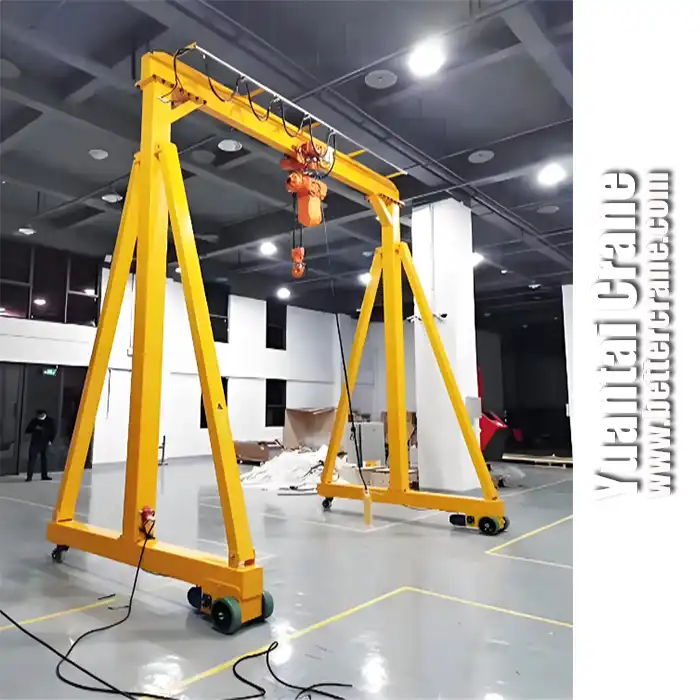
Portable gantry cranes with wireless remote controlled driveing wheel systems
Safety Distance and Operator Protection
Wireless remote control improves the safety behavior of mobile gantry crane systems by changing where the operator needs to stand during lifting work. Instead of staying close to the crane structure, the operator can work from a controlled distance while still managing all movement functions in real time. This simple change directly reduces exposure to the most active and risky working zones.
Wireless remote control allows the operator to manage mobile gantry crane movement without standing near the lifting area. In practical operation, control is carried out from a safer working position away from the load path, drive wheels, and crane travel zone.
This reduces direct exposure to moving equipment during lifting, lowering, and horizontal travel cycles, especially in busy workshop or outdoor yard environments.
Maintaining distance from the crane structure helps reduce contact with suspended loads and moving mechanical parts. In real workshop conditions, this is a practical way to reduce common lifting risks during daily operation.
- Less exposure to suspended load instability during lifting and movement
- Reduced risk near wheel travel zones and structural pinch points
- Safer handling during sudden braking or directional change of the crane
- Improved protection in narrow or congested working areas
In many industrial sites, these risks are not theoretical—they appear during routine lifting cycles when space is limited or visibility is reduced.
Wireless operation allows the operator to move freely around the working area and choose the best position for observing the lifting process. This helps maintain a clear line of sight to the hook, load, and crane travel direction.
In practical use, better visibility supports more controlled operation. The operator can adjust speed and positioning more accurately, especially during alignment, lowering, and load placement tasks.
This reduces blind spots and improves coordination between operator judgment and crane movement in real workshop conditions.
Emergency Stop Function and Fail-Safe Control Logic
In mobile gantry crane operations, safety is not only about normal movement control but also about how quickly the system reacts when something goes wrong. Wireless remote control systems are designed with built-in emergency stop and fail-safe logic to ensure the crane can be brought under control immediately in abnormal situations. This is especially important in trackless gantry crane drive systems where the equipment may be moving across open or shared industrial areas.
A key safety function is the emergency stop (E-stop) command available directly on the wireless transmitter. With a single press, the operator can immediately cut crane movement, stopping travel, lifting, or lowering functions without delay.
In practical use, this function is critical during unexpected load movement, obstacle detection, or operator error correction.
- One-button shutdown from handheld remote controller
- Immediate stop of travel motors and lifting actions
- Fast response during unstable load conditions
- Useful in tight workshop and high-traffic crane zones
Wireless systems are designed with fail-safe logic to handle communication interruptions. If the signal is lost or disturbed, the system automatically shifts into a safe stop condition rather than continuing movement.
This design prevents uncontrolled crane travel, which is a key safety requirement in modern industrial lifting systems.
- Automatic stop during signal loss or interference
- Prevents unintended crane movement without operator input
- Stabilizes system behavior in unstable communication environments
- Supports safer operation in industrial electromagnetic conditions
The emergency stop function does not work alone. It is typically integrated with other crane safety systems to ensure full protection during abnormal conditions. This coordination helps the crane enter a controlled and stable state when faults occur.
In real industrial setups, this includes coordination with overload protection, limit switches, and anti-collision systems.
- Overload protection prevents lifting beyond rated capacity
- Limit switches control end travel positions of crane movement
- Anti-collision devices reduce risk in multi-crane working areas
- Combined logic ensures system-wide protective shutdown when needed
This layered safety structure is widely used in modern wireless-controlled gantry crane drive systems to maintain stable and predictable behavior even under fault conditions.
Braking Performance and Motion Stability
In mobile gantry crane drive systems, braking performance is directly related to how safely and smoothly the crane can start, move, and stop under load. When wireless remote control is combined with VFD-driven motors and electromagnetic braking systems, the motion becomes more controlled and predictable in real working conditions. This is especially important in trackless gantry cranes operating across workshop floors, outdoor yards, or uneven surfaces.
Wireless control systems allow the operator to manage speed changes more precisely through VFD (variable frequency drive) control. Instead of abrupt switching between start and stop, the crane follows a controlled acceleration and deceleration curve.
In practical operation, this reduces stress on both the mechanical structure and the load being lifted.
- Smooth speed adjustment during travel and positioning
- Reduced impact load on gear reducers and drive wheels
- More stable crane movement during directional changes
- Better control in precision positioning tasks
One of the most noticeable improvements in wireless-controlled systems is the reduction of sudden movement impact. Smooth start-stop control helps limit load swing, especially when handling long, heavy, or asymmetrical materials.
This improves both safety and handling accuracy in daily lifting work.
- Lower risk of load swinging during start or stop
- Reduced structural vibration in crane frame
- Less mechanical shock on wheels and transmission system
- Improved stability during horizontal load transfer
In many workshop applications, this leads to more consistent positioning, especially during assembly or installation work where alignment matters.
In emergency situations, braking systems must respond immediately to wireless stop commands. Modern mobile gantry crane systems are designed to activate electromagnetic braking and motor cut-off without delay.
This helps prevent uncontrolled movement, especially when working on uneven ground or slight inclines where rollback risk exists.
- Instant braking response from remote emergency command
- Prevents rollback or unintended crane drift
- Stabilizes crane position during sudden stop conditions
- Enhances safety in outdoor or non-level working environments
This braking reliability is a key part of safe operation in wireless-controlled gantry crane systems used in real industrial projects.
Operator Efficiency and Workflow Improvement
Wireless remote control changes how mobile gantry crane systems are operated in daily industrial work. Instead of staying at a fixed control point or relying on multiple workers to guide movement, a single operator can manage travel, lifting, and positioning directly from a handheld transmitter. In real workshop and yard operations, this reduces coordination delays and simplifies the overall workflow.
With wireless operation, one person can complete tasks that previously required both a crane operator and ground signal personnel. This is commonly seen in portable gantry crane systems used in fabrication shops, maintenance areas, and assembly lines.
The operator controls movement, lifting, and positioning directly without depending on constant hand signals or verbal communication.
- One operator handles lifting and travel functions together
- Reduced need for dedicated signal personnel on the ground
- Faster response during positioning and alignment adjustments
- More efficient execution of repetitive lifting cycles
In production environments where materials are moved repeatedly—such as steel fabrication, machinery assembly, or warehouse logistics—wireless control helps streamline operations. The crane can be repositioned more quickly, and lifting cycles become more continuous.
This reduces idle time between lifting steps and improves overall handling flow in daily operations.
- Faster material transfer between workstations
- Reduced waiting time for signal coordination
- Better suitability for repetitive batch lifting tasks
- More consistent operation in assembly and loading processes
Because the operator is not tied to a fixed control station, they can move freely within the working area. This flexibility helps maintain a clear view of the load, hook, and crane travel direction during operation.
In practical use, this improves alignment accuracy and reduces unnecessary stops caused by blind spots or poor observation angles.
- Operator can reposition for improved load visibility
- Better alignment during lifting and placement tasks
- Reduced fatigue compared to stationary control operation
- More stable decision-making during continuous movement cycles
This flexibility is especially useful in mobile gantry crane systems operating in confined workshops or shared industrial spaces where visibility conditions change frequently.
Safety Compliance and Industrial Risk Reduction
Wireless remote control in mobile gantry crane systems is closely connected to modern industrial safety management. In practical operations, the main value is not only smoother handling, but also reducing operator exposure to hazardous lifting zones, moving wheels, and suspended loads. This directly supports safer working practices in workshops, warehouses, and outdoor industrial yards.
To allowe operators to control the crane from a distance, wireless systems significantly reduce time spent inside dangerous working zones. These zones typically include load travel paths, wheel movement areas, and lifting points where unexpected motion can occur.
In real projects, this separation helps lower the probability of accidents caused by proximity to moving equipment.
- Less time spent near suspended loads and crane travel paths
- Reduced exposure to pinch points and mechanical movement areas
- Safer operation in shared workspaces with forklifts and workers
- Lower risk during unexpected load movement or positioning errors
Wireless-controlled gantry cranes support modern safety expectations in material handling systems. Many industrial safety frameworks focus on controlled motion, operator protection, and fast emergency response.
These systems help facilities maintain safer operational behavior without adding complexity to daily lifting tasks.
- Supports structured safety operation procedures in factories
- Improves compliance with internal safety inspection requirements
- Encourages controlled and predictable crane movement
- Enhances emergency response readiness during abnormal operation
In practical use, this means the crane system behaves more consistently under different load and working conditions, which is important for routine safety management.
Factories and workshops that adopt wireless remote-controlled gantry crane systems often see more stable handling performance during daily lifting cycles. This is mainly due to improved visibility, better distance control, and more predictable movement behavior.
While results vary by application, common improvements include:
- Fewer accidents related to operator proximity
- More stable load handling during repetitive lifting tasks
- Improved consistency in crane movement and positioning
- Better control during complex or congested working environments
In practical operation, reducing small operational risks over time has a direct impact on overall site safety performance.
System Integration in Modern Gantry Crane Design
Wireless remote control is no longer a standalone function in mobile gantry crane systems. In modern designs, it is integrated directly into the full drive and control architecture, working together with VFD (variable frequency drive) systems, braking units, and electrical protection components. In practical industrial use, this integration is what allows stable and coordinated crane behavior during real lifting operations.
Wireless control works closely with VFD soft start drive systems to manage crane movement in a controlled way. Instead of sudden starts or stops, the system follows a regulated speed curve that improves stability during travel and load handling.
This is especially important in trackless gantry crane systems where the crane moves freely across workshop floors.
- VFD controls smooth acceleration and deceleration
- Wireless commands adjust speed and direction in real time
- Reduced mechanical shock during start-stop cycles
- More stable load movement during positioning tasks
In modern gantry crane systems, wireless control is also linked with braking systems and electrical protection modules. This ensures that when an operator issues a command—normal or emergency—the entire system responds in a synchronized way.
In real operation, this coordination improves safety and system reliability.
- Electromagnetic braking responds instantly to stop commands
- Overload protection prevents unsafe lifting conditions
- Limit switches control end travel boundaries
- Electrical protection ensures stable shutdown during faults
This layered control structure reduces unpredictable movement and keeps the crane in a controlled state under different working conditions.
Wireless control becomes even more important in modern mobile gantry crane designs such as trackless rubber-tyred systems and modular adjustable-height structures. These cranes are designed for flexible movement and fast deployment in different working environments.
Wireless operation supports this flexibility by removing fixed control constraints.
- Suitable for trackless mobility on indoor and outdoor floors
- Works with polyurethane-coated wheels for smooth travel
- Supports modular crane assembly and repositioning
- Improves handling efficiency in multi-site industrial use
In practical applications, this combination allows the crane system to adapt to different workshop layouts and working conditions without changing the core control method.
Conclusion
Wireless remote control is not just a convenience feature in mobile gantry crane systems—it is a core safety and control technology. By increasing operator distance, improving emergency stop response, stabilizing braking performance, and enhancing operational efficiency, it significantly reduces workplace risks while improving handling precision.
As industrial lifting environments become more complex and safety standards more demanding, wireless control systems are becoming a standard configuration in modern mobile gantry crane drive solutions.