20/10 Ton Double Girder Overhead Crane in Philippines
20/10 Ton QDX Double Girder Overhead Crane for a Factory in the Philippines
A factory that needs to lift loads of up to 20 tons may also need a smaller hoist for handling lighter components, equipment, and materials. In this case, a 20/10 ton double girder overhead crane with main and auxiliary hoists can be a practical choice.
For a customer in the Philippines, Yuantai Crane supplied a customized QDX double girder overhead crane with a 20-ton main hoist and a 10-ton auxiliary hoist. The crane has a 6.8 m span, lifting heights of 14.29 m and 14.74 m, and a 400V, 60Hz, 3-phase power supply.
The project involved several important design requirements, including a relatively short crane span, high lifting height, two different hoisting capacities, and electrical compatibility with the factory's power supply.
Below, we look at the crane configuration and the main points buyers should consider when selecting a similar 20-ton overhead crane for their factories in the Philippines.
Project Overview: 20/10 Ton Overhead Crane in the Philippines
The customer required an overhead crane capable of handling both heavy and lighter loads within the factory. Instead of installing two separate cranes, the selected solution uses one double girder bridge with two hoisting mechanisms.
Yuantai Crane supplied a QDX double girder overhead crane equipped with a 20-ton main hoist and a 10-ton auxiliary hoist.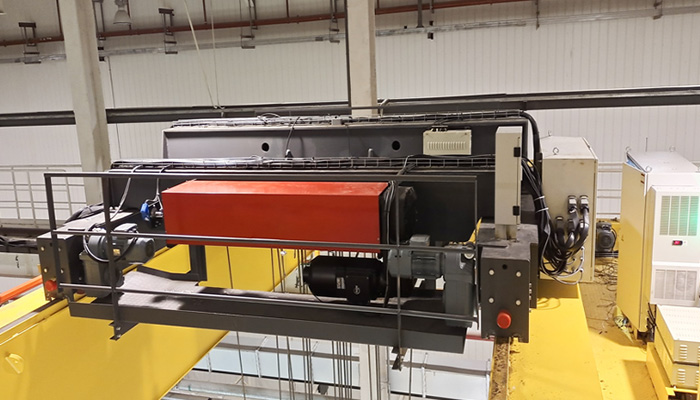
Technical Specifications
| Parameter | Specification |
|---|---|
| Project Location | Philippines |
| Manufacturer | Yuantai Crane – China |
| Crane Model | QDX Double Girder Overhead Crane |
| Main Hoist Capacity | 20 ton |
| Auxiliary Hoist Capacity | 10 ton |
| Crane Span | 6.8 m |
| Main / Auxiliary Lifting Height | 14.29 m / 14.74 m* |
| Power Supply | 400V, 60Hz, 3-phase |
| Hoisting Arrangement | Main and Auxiliary Hoists |
The respective lifting heights should be confirmed against the approved technical drawing.
What Makes This Crane Configuration Different?
The main feature of this project is the combination of a 20-ton main hoist and a 10-ton auxiliary hoist.
The main hoist handles heavier materials, while the auxiliary hoist is used for loads that do not require the full 20-ton capacity. Both hoists are installed on the same crane system, allowing the factory to carry out different lifting tasks without changing cranes.
The 6.8 m span and lifting heights of more than 14 m also make this a customized configuration rather than a typical standard-size overhead crane.
For buyers planning a similar installation, it is important to check the factory runway dimensions, hook positions, lifting height, and available headroom before confirming the crane design.
Why Choose a 20/10 Ton Double Girder Overhead Crane?
A 20/10 ton overhead crane has two hoisting capacities:
- 20-ton main hoist: For heavier machinery, steel structures, and production materials.
- 10-ton auxiliary hoist: For lighter components, equipment positioning, and maintenance work.
This arrangement is useful in factories where the lifting requirements vary throughout the production process.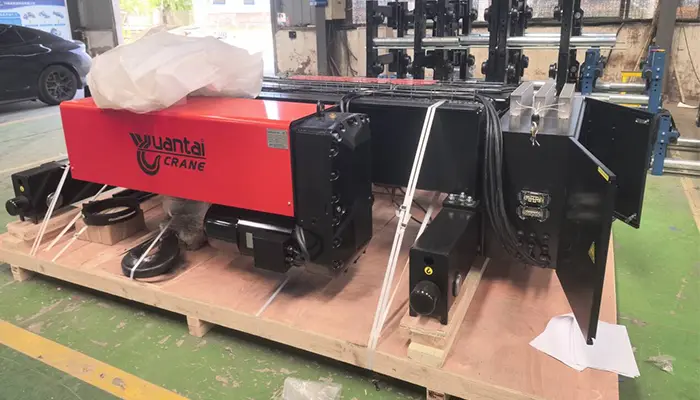
20 ton main hook and 10 ton axuliary hook wire rope crab hoist trolley for the Philippines
20-Ton Main Hoist for Heavy Loads
The 20-ton main hoist is designed to handle the heavier materials and equipment in the factory.
Typical applications include:
- Lifting industrial machinery and production equipment.
- Handling fabricated steel structures and large components.
- Moving heavy materials between production areas.
- Installing or maintaining heavy equipment.
When selecting a 20-ton industrial overhead crane, buyers should consider the maximum load, lifting frequency, and working duty. The hoist should be selected according to the actual operating conditions rather than lifting capacity alone.
10-Ton Auxiliary Hoist for Lighter Loads
The 10-ton auxiliary hoist provides another lifting option for everyday factory operations.
For example, when handling a 5-ton or 8-ton component, the operator may use the auxiliary hoist instead of the 20-ton main hoist, provided the load and operating conditions are within its rated capacity.
Typical uses include:
- Lifting smaller machinery and components.
- Positioning parts during equipment assembly.
- Handling lighter production materials.
- Carrying out maintenance and installation work.
The main and auxiliary hoists may have different lifting speeds and lifting heights. Their hook positions and operating arrangements should be checked against the factory's actual lifting process.
Can the two hooks work together?
This depends on the crane design. Some double girder cranes are configured for specific two-hook lifting operations, such as turning or positioning long components. However, simultaneous operation should never be assumed to be permitted simply because two hoists are installed on the same trolley.
If the customer needs to lift or turn one load using both hooks, the manufacturer must check the load distribution, hook spacing, hoist synchronization, and allowable loading conditions.
Why Use a Double Girder Crane?
A double girder overhead crane has two main bridge girders supporting the trolley and hoisting equipment.
For a 20/10 ton crane, this arrangement provides a suitable structural platform for installing the main and auxiliary hoists. It also offers greater flexibility in trolley and hoist configuration than many standard single girder arrangements.
The QDX design is a low-headroom double girder configuration. Its hoisting and trolley arrangement is designed to make better use of the available vertical space.
This is particularly useful in factories where the required hook lifting height is high but the building height is limited.
High Lifting Height: 14.29 m and 14.74 m
The lifting height is one of the important specifications in this Philippines project.
The crane has two specified lifting heights: 14.29 m and 14.74 m, corresponding to the two hoisting positions according to the final design.
For a factory requiring a lifting height of more than 14 m, the manufacturer needs to consider the complete crane arrangement, including the hoist, trolley, bridge girders, and available building clearance.
Before ordering a high-lift overhead crane, buyers should check the following:
- Required hook height: The vertical distance from the factory floor to the highest required hook position.
- Building height: The available space between the floor, roof structure, and crane runway.
- Crane headroom: The space occupied by the bridge girder and hoisting mechanism.
- Hook approach: The minimum distance between the hook and the surrounding building structure.
- Wire rope arrangement: The reeving system and drum capacity must accommodate the required lifting height.
What Should You Check for a 14 m or Higher Lifting Height?
Wire rope length and hoist drum capacity become important when the lifting height increases.
The hoist drum must accommodate enough wire rope for the full hook travel, including the required reeving arrangement and safety wraps. The rope diameter, number of falls, drum dimensions, and sheave arrangement all affect the final hoist design.
For buyers comparing different 20-ton overhead crane manufacturers, it is worth asking for the hoist technical specifications rather than comparing lifting height alone.
The hook approach and overall trolley height should also be shown on the general arrangement drawing. These dimensions help determine whether the crane will fit the existing factory building.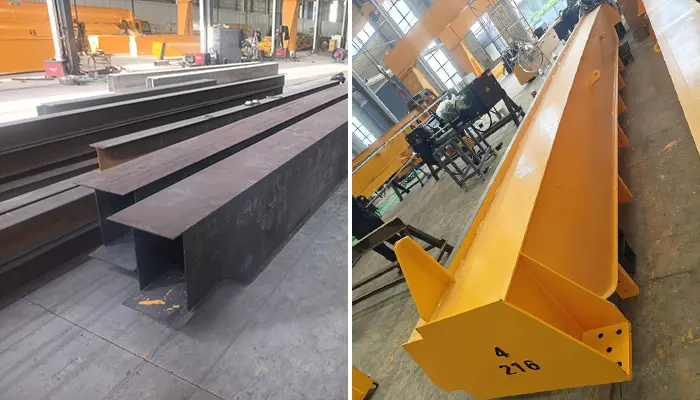
crane main girder with 6.8 m span for the project
6.8 m Crane Span: A Customized Double Girder Design
The crane span in this project is 6.8 m.
Crane span refers to the distance between the centerlines of the two runway rails. It determines the bridge girder length and is one of the main dimensions used in overhead crane design.
For a 20-ton double girder overhead crane, the span affects the girder structure, trolley arrangement, wheelbase, and crane wheel loads.
A 6.8 m span is shorter than the commonly used 7.5–31.5 m span range of standard overhead crane configurations, so the manufacturer needs to confirm the structural and mechanical arrangement for this particular installation.
A shorter span does not mean that all crane components can simply be reduced in size. The bridge girders, end carriages, trolley, and wheel arrangement must still be checked against the rated lifting capacity and operating conditions.
What Information Is Needed to Design the Crane Span?
If you are installing a 20-ton overhead crane in an existing factory in the Philippines, prepare the following information:
- Distance between the runway rail centerlines.
- Runway beam dimensions and rail specifications.
- Supporting column arrangement.
- Available clearance at both ends of the runway.
- Existing runway beam and column load capacity.
Why Are Crane Wheel Loads Important?
The crane's total weight and the lifted load are transferred to the runway through the crane wheels.
The actual wheel loads change according to the trolley position, lifted load, and crane structure. When the trolley moves toward one side of the bridge, the load distribution between the crane wheels also changes.
For this reason, the manufacturer should provide a wheel load diagram showing the maximum and minimum wheel loads.
If you are replacing an existing crane or installing a new 20-ton overhead crane on an existing runway, have the runway beams, rails, supporting columns, and connections checked against the proposed crane loads.
A crane may fit the runway dimensions but still require structural modifications if the existing building cannot support its wheel loads.
400V, 60Hz, 3-Phase Power Supply for the Philippines
Electrical specifications should be confirmed before manufacturing an overhead crane.
This project requires a 400V, 60Hz, 3-phase power supply. The hoisting motors, trolley travel motors, crane travel motors, and electrical control system must all be selected to match the specified supply.
For customers in the Philippines purchasing an overhead crane from China, it is important not to assume that every manufacturer's standard electrical configuration will match the factory's power supply.
The following details should be confirmed:
- Rated voltage: 400V.
- Frequency: 60Hz.
- Power supply: 3-phase.
- Hoisting motor specifications.
- Trolley and crane travel motor specifications.
- Control voltage and electrical protection.
- VFD requirements, if variable speed control is needed.
- Pendant or radio remote control.
Why Does 60Hz Matter?
Motor speed and performance are related to the supply frequency.
A motor designed for 50Hz should not automatically be connected to a 60Hz supply without checking its rated voltage, frequency, speed, and operating conditions.
The same applies when a 60Hz motor is used on a 50Hz supply.
For this Philippines project, the motors and electrical components should be configured for 400V, 60Hz operation. If VFDs are used, their ratings and parameters must also match the selected motors and power supply.
When requesting an overhead crane quotation, always provide the actual site voltage and frequency. This avoids unnecessary electrical modifications after delivery.
How to Select a 20-Ton Overhead Crane for Your Factory in the Philippines
If you are planning to purchase a 20-ton overhead crane, the following information will help the manufacturer recommend the right configuration.
Determine the Required Lifting Capacity
Start with the maximum weight of the materials or equipment that the crane needs to lift.
If most loads are below 10 tons but some operations require up to 20 tons, a 20/10 ton overhead crane may be worth considering.
If all lifting operations require only one capacity, a conventional 20-ton single-hoist crane may be a simpler solution.
Confirm the Crane Span
Measure the distance between the runway rail centerlines.
For an existing workshop, provide the runway beam drawings or site measurements so the manufacturer can check the bridge girder and end carriage arrangement.
Specify the Required Lifting Height
Provide the required hook height for the main and auxiliary hoists separately.
Also indicate the building height, runway level, and any equipment or structures that could affect the crane's movement.
Choose the Right Working Duty
Crane duty classification depends on how frequently the crane operates and the loads it handles.
Important factors include:
- Average lifted load compared with rated capacity.
- Number of lifting cycles per hour.
- Daily operating hours.
- Load spectrum.
- Expected service life.
For example, a maintenance workshop that operates one shift and handles occasional heavy loads has different duty requirements from a production workshop where the crane operates continuously.
The manufacturer should recommend the appropriate ISO, FEM, or GB working classification based on the actual working conditions.
Do not automatically select a higher duty class simply because the crane has a 20-ton capacity. A higher classification may increase the cost of the hoisting mechanism, motors, brakes, and other components without providing a practical benefit if the crane does not need that operating level.
Check the Power Supply
Confirm the factory's actual electrical supply before ordering.
For this project, the required configuration is 400V, 60Hz, 3-phase.
If the factory uses a different voltage or frequency, inform the manufacturer at the inquiry stage.
Consider Transportation and Installation
When purchasing a customized overhead crane from China, buyers should also consider how the crane will be transported and installed.
Ask the manufacturer to provide:
- Overall shipping dimensions.
- Individual component dimensions and weights.
- Packing list and shipping arrangement.
- Installation drawings.
- Electrical connection requirements.
- Commissioning and testing requirements.
For factories in the Philippines, the port of discharge and inland transportation route should be considered when planning the shipment. If any crane components are oversized, confirm the local transportation and handling arrangements before shipment.
Frequently Asked Questions About 20/10 Ton Overhead Cranes
Q1. What is the difference between a QD and a QDX double girder overhead crane?
QD and QDX refer to different double girder crane configurations.
A conventional QD crane generally uses an open winch trolley arranged above the bridge girders. A QDX crane uses a low-headroom arrangement designed to reduce the vertical space occupied by the hoisting mechanism.
The actual headroom advantage depends on the crane capacity, lifting height, trolley design, and hook arrangement. Buyers should compare the general arrangement drawings rather than relying on the model name alone.
Q2. What is the difference between a 20-ton and a 20/10 ton overhead crane?
A standard 20-ton overhead crane has one main hoisting capacity of 20 tons.
A 20/10 ton overhead crane has two hoists: a 20-ton main hoist and a 10-ton auxiliary hoist.
The additional hoist is useful when the factory handles different load weights or requires separate lifting operations for heavier and lighter components.
Q3. Can a 20/10 ton overhead crane lift 30 tons using both hooks?
Not automatically.
The 20-ton and 10-ton ratings are the individual rated capacities of the two hoists. They should not simply be added together to obtain a 30-ton lifting capacity.
If both hooks need to lift the same load simultaneously, the manufacturer must specifically design and approve the arrangement, including the load distribution, hoist synchronization, and crane structural capacity.
Q4. What is the required runway beam for a 20-ton overhead crane?
There is no single runway beam size suitable for every 20-ton overhead crane.
The required beam depends on the crane span, wheelbase, maximum wheel loads, rail arrangement, runway length, and supporting column structure.
The manufacturer should provide the crane wheel load data so that a structural engineer can check the existing runway or design a suitable new one.
Q5. Can a 20-ton QDX overhead crane operate on 400V, 60Hz power?
Yes, provided the motors, electrical components, and control system are configured for 400V, 60Hz, 3-phase operation.
The electrical specifications should be confirmed before manufacturing, including motor nameplate ratings and VFD compatibility where applicable.
Q6. How much does a 20-ton overhead crane cost in the Philippines?
The price of a 20-ton overhead crane depends on several factors, including:
- Single girder or double girder design.
- Crane span and lifting height.
- Main and auxiliary hoist configuration.
- Working duty classification.
- Hoisting and travel speeds.
- Electrical components and control system.
- Runway beams, installation, and transportation scope.
A 20/10 ton QDX double girder crane will generally have a different price from a standard 20-ton single-hoist crane because of its additional hoisting equipment and customized configuration.
For an accurate quotation, provide the lifting capacity, span, lifting height, working duty, and power supply.
Q7. What maintenance does a 20/10 ton overhead crane require?
Regular inspection helps keep the crane in good working condition.
Important maintenance items include:
- Wire ropes, hooks, and sheaves.
- Hoist brakes and travel brakes.
- Limit switches and overload protection.
- Hoisting and travel motors.
- Crane wheels and rail conditions.
- Electrical cables and control systems.
- Bridge girders, end carriages, and structural connections.
The wire ropes should be inspected according to the applicable inspection and discard criteria, such as ISO 4309. Inspection frequency should follow the crane manufacturer's maintenance instructions and the actual operating conditions.
Get a Customized 20/10 Ton Overhead Crane Quotation in the Philippines
Looking for a 20-ton overhead crane for your factory in the Philippines?
Yuantai Crane manufactures customized single girder and double girder overhead cranes for industrial workshops, manufacturing plants, steel factories, warehouses, and other material handling applications.
Whether you need a standard 20-ton overhead crane or a 20/10 ton double girder crane with main and auxiliary hoists, we can prepare a crane configuration based on your lifting requirements and factory conditions.
To help us prepare a suitable technical proposal and quotation, please provide:
- Lifting capacity (ton).
- Crane span (m).
- Required lifting height (m).
- Working duty or operating frequency.
- Power supply (V/Hz/Ph).
- Factory layout or runway beam drawings, if available.
Contact Yuantai Crane for a customized 20-ton overhead crane solution in the Philippines.