Why Crane Capacity Misleads Buyers of Overhead & Gantry Crane
Most Important Takeaway
Focusing only on crane capacity (tonnage) can mislead buyers and engineers, resulting in inefficient operations, higher maintenance costs, and potential safety hazards. Effective crane selection requires evaluating duty cycle, working environment, lift height, span, speed, precision, and total cost of ownership, not just the rated load.
Key Takeaways in Bullet Points
- Rated capacity (SWL) is only one factor in crane selection; it does not guarantee operational efficiency.
- Load type and distribution impact safe lifting and crane performance.
- Duty cycle and lifting frequency determine crane lifespan and reliability.
- Lift height, span, and hoist travel affect crane design and workflow efficiency.
- Environmental factors like outdoor exposure, dust, temperature, and corrosion influence long-term performance.
- Operational speed and precision directly affect productivity in steel yards, ports, or construction sites.
- Total cost of ownership includes maintenance, energy consumption, and downtime—over- or under-specifying increases costs.
Introduction: Why Crane Capacity Alone Can Be Misleading
Rated capacity, also known as Safe Working Load (SWL), defines the maximum weight a crane can safely lift under standard conditions. While it is an important specification, many buyers assume that a higher tonnage crane automatically performs better, which is not always the case.
Quick Buyer Reference Table
| Crane Type | Typical Capacity Range | Key Limiting Factor |
|---|---|---|
| Single Girder Bridge Crane | 1–20 t (up to 32 t in special designs) | Span, hook height, deflection |
| Double Girder Bridge Crane | 5–100+ t | Structure rigidity, duty class |
| Underslung (Under-Running) Crane | 0.5–10 t (up to 15 t special) | Runway beam strength |
| European-Type Single Girder Crane (Hoist Trolley) | 1–20 t | Headroom, wheel load, duty optimization |
| European-Type Double Girder Crane (Hoist Trolley) | 5–80 t | Hook approach, duty class |
| European-Type Double Girder Crane (Open Winch Trolley) | 20–200+ t | Structural design, duty cycle |
| Explosion-Proof Bridge Crane | 1–50 t | Explosion-proof compliance level |
| Grab Bucket Overhead Crane | 5–100 t | Grab self-weight + material |
| Magnetic Overhead Crane | 3–50+ t | Magnet dead weight, power safety |
| Foundry / Metallurgical Crane | 10–350 t | Safety class, redundancy, duty |
- Operational Inefficiencies: Workflow bottlenecks and slower material handling.
- Increased Maintenance & Downtime: Overstressed components wear faster, leading to higher service costs.
- Premature Wear of Components: Hoists, gears, and motors degrade sooner than expected.
- Safety Risks: Potential accidents or overload incidents for personnel and equipment.
- Highlight why rated capacity alone is insufficient for decision-making.
- Explain the practical specifications that affect crane performance, reliability, and lifespan.
- Help buyers choose cranes that maximize productivity, operational safety, and cost-effectiveness.
Applications Covered: Steel mills, ports, construction yards, manufacturing facilities, and open-air production systems.
Takeaway: A holistic approach to crane selection—considering duty cycle, load type, environmental factors, span, lift height, speed, and precision—ensures better ROI, safer operations, and long-term reliability.
Crane Capacity
Crane capacity, also called Safe Working Load (SWL), defines the maximum weight a crane can lift safely under ideal conditions. Manufacturers include a safety factor in this rating to account for unexpected stresses, minor misalignments, or slight overloading during normal operation.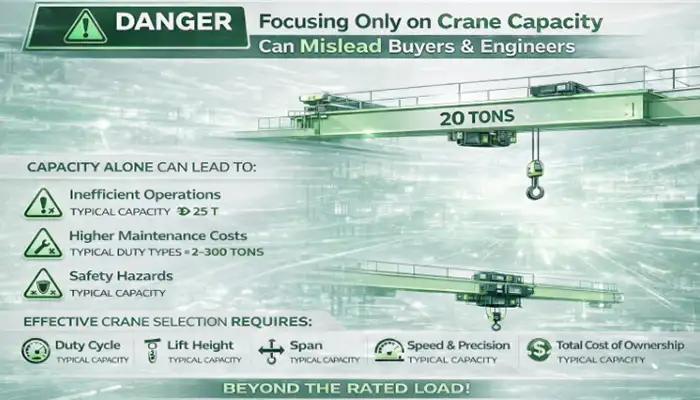
- Structural strength of girders, end trucks, and runway beams.
- Hoist and trolley motor ratings for lifting and traveling.
- Design standards and safety codes (ISO, FEM, CMAA, or CE certifications).
- Testing and simulations, including static and dynamic load tests.
- A 20-ton crane may be underutilized if your actual loads are 5–10 tons, leading to higher initial costs and energy consumption.
- A high-capacity crane may lack precision or speed, slowing workflow.
- Focusing only on tonnage ignores environmental suitability, duty cycle, span, and lift height, which often matter more in daily operations.
Beyond Capacity: What Buyers Must Consider
A crane's rated capacity is just one piece of the puzzle. Real-world performance depends on multiple operational, environmental, and design factors. For overhead cranes, gantry cranes, steel mill cranes, and outdoor bridge cranes, ignoring these can lead to inefficiency, higher costs, and safety risks.
Why It Matters: The type and distribution of the load impact both safety and crane performance.
Key Points:
- Single vs. Multiple Loads: Handling multiple loads simultaneously requires careful planning to avoid overloading the crane.
- Center of Gravity Variations: Off-center lifting can stress hoists, trolleys, and bridge structures.
- Dynamic vs. Static Loads: Moving or swinging loads increase mechanical stress and affect hoist selection.
Why It Matters: How often a crane operates determines its durability and maintenance needs.
Key Points:
- Light, Moderate, or Heavy Duty: Duty rating reflects operational intensity.
- Impact on Lifespan: Frequent lifts near maximum capacity accelerate wear on motors and gears.
- Maintenance Planning: Higher duty cycles require more frequent inspections.
Buyer Tip: Always match the crane's duty class to your workflow for reliability and cost efficiency.
Why It Matters: Hook height and span affect crane selection, structural design, and operational efficiency.
Key Points:
- Hook Height: Determines how high loads can be lifted safely.
- Bridge Span: Impacts trolley design and bridge stability.
Crane Type Relevance:
- Top-running cranes: Ideal for heavy loads and long spans.
- Underhung cranes: Cost-effective for lighter loads with shorter spans.
- Single vs. Double Girder: Double girders provide more stability and load capacity.
Why It Matters: Environmental conditions directly influence crane durability and safety.
Key Points:
- Indoor vs. Outdoor: Outdoor cranes face weather, temperature extremes, dust, and moisture.
Industrial Settings:
- Steel mills → high heat, dust, and scale.
- Shipyards → saltwater and corrosion.
- Construction yards → dust, dirt, and uneven surfaces.
Protective Measures: Coatings, hoist covers, and explosion-proof hoists extend crane lifespan.
Buyer Tip: Evaluate environment-specific cranes to minimize downtime and maintenance costs.
Why It Matters: Speed and control affect workflow more than capacity alone.
Key Points:
- Hoist speed, trolley travel, and bridge movement influence efficiency.
- Positioning accuracy is critical for safe handling in tight or hazardous areas.
Buyer Tip: Even cranes with adequate capacity can slow operations if they lack precise control or speed.
Why It Matters: The cheapest or highest-capacity crane may not be the most cost-effective.
Key Points:
- Energy usage rises with over-specification.
- Under-capacity cranes create bottlenecks and higher maintenance costs.
- Consider both upfront investment and long-term operational costs.
Case: Why Capacity Alone Isn't Enough
These examples highlight how focusing solely on crane capacity can lead to inefficiencies, higher maintenance costs, and safety risks in real-world industrial settings.
Scenario: A 20-ton overhead crane was installed in a manufacturing yard.
Problem: The crane was rarely used near full capacity, but its low hoist and bridge speed slowed daily workflow.
Impact: Production delays, underutilized investment, and longer cycle times.
Buyer Insight: When selecting cranes, consider operational speed, precision, and actual load requirements—not just maximum tonnage.
Scenario: A crane rated for maximum tonnage was installed in an outdoor steel yard.
Problem: The crane experienced premature corrosion due to dust, moisture, and high heat.
Impact: Early component failures, unexpected maintenance costs, and downtime.
Buyer Insight: Factor in environmental conditions, protective coatings, and hoist covers when selecting outdoor cranes.
Scenario: A single-girder crane with sufficient rated capacity was installed for a steel handling operation.
Problem: The crane's span did not match the facility layout, limiting trolley travel and creating bottlenecks.
Impact: Operational inefficiency, uneven load handling, and reduced productivity.
Buyer Insight: Ensure hook height, bridge span, and crane type align with your facility layout and lifting requirements.
Even cranes with the right tonnage can underperform if speed, environmental protection, and span are ignored. A holistic approach—matching crane specifications to actual operational needs— ensures efficiency, safety, and long-term cost savings.
Practical Buyer Checklist: Key Questions for Selecting the Right Crane
When selecting an overhead crane, gantry crane, or steel mill crane, rated capacity is only part of the picture. Use this checklist to ensure your crane meets performance, safety, and cost expectations.
Question to Ask: What is the actual maximum load per lift, and how is it distributed?
Considerations:
- Single vs. multiple loads
- Center of gravity variations
- Static vs. dynamic loads
Buyer Insight: Uneven or swinging loads can stress hoists and trolleys, affecting crane safety and efficiency.
Question to Ask: How often will the crane be used, and what is its duty class?
Considerations:
- Light, moderate, or heavy-duty classification
- Daily lift count and percentage of rated capacity used
- Maintenance schedule implications
Buyer Insight: Matching crane duty cycle to operational needs ensures longevity and reduces downtime.
Question to Ask: Does the crane reach all required lifting points efficiently?
Considerations:
- Hook height for safe clearance
- Bridge span and trolley travel distance
- Top-running vs. underhung cranes; single vs. double girder
Buyer Insight: Incorrect span or height can create workflow bottlenecks, even if capacity is sufficient.
Question to Ask: Will environmental conditions affect crane performance or lifespan?
Considerations:
- Indoor vs. outdoor operation
- Exposure to dust, heat, moisture, or corrosive substances
- Protective coatings, hoist covers, explosion-proof hoists
Buyer Insight: Environmentally adapted cranes reduce maintenance costs and prevent premature failure.
Question to Ask: Are speed and accuracy adequate for the workflow?
Considerations:
- Hoist speed, trolley travel, and bridge movement
- Positioning precision for assembly or material placement
Buyer Insight: Cranes with sufficient capacity but poor speed or precision can slow operations and reduce productivity.
Question to Ask: What are the long-term costs of operation and maintenance?
Considerations:
- Energy consumption and efficiency
- Maintenance frequency and downtime
- Lifetime ROI vs. upfront purchase cost
Buyer Insight: Evaluating TCO prevents overspending on over-spec cranes or underperformance with under-spec cranes.
Conclusion: Look Beyond Capacity for Smarter Crane Selection
Key Message: Rated crane capacity is only one part of the equation. Selecting a crane based solely on tonnage can lead to inefficiency, higher costs, and safety risks.
Holistic Factors to Consider:
- Duty cycle & usage frequency: Ensures durability and reduces downtime.
- Working environment: Adapts the crane to indoor/outdoor conditions, dust, heat, moisture, and corrosion.
- Lift height, span, and travel: Matches facility layout and operational needs.
- Operational speed & precision: Optimizes workflow and productivity.
- Maintenance & total cost of ownership: Balances upfront investment with long-term efficiency.
Buyer Takeaway: A comprehensive approach—evaluating capacity alongside these critical factors—ensures:
- Higher operational efficiency and workflow productivity
- Reduced maintenance and lifecycle costs
- Safer lifting and material handling for personnel and equipment
- Better ROI for industrial applications such as steel mills, ports, construction yards, and outdoor production systems
Final Insight: Don’t let the rated tonnage be the only deciding factor. Smart crane selection is about matching the equipment to real-world operational needs, ensuring long-term value, safety, and efficiency.
Frequently Asked Questions: Why Crane Capacity Alone Isn't Enough
A: Rated capacity (SWL) only indicates the maximum weight a crane can lift under ideal conditions. Focusing solely on tonnage ignores other factors such as duty cycle, operational speed, precision, lift height, span, and environmental conditions, which directly impact efficiency, safety, and long-term reliability.
Key Insight for Buyers: A crane with the right capacity but mismatched operational parameters can slow workflow, increase maintenance costs, and reduce ROI.
- Duty Cycle: Frequent lifting near maximum capacity increases wear on motors, gears, and hoists.
- Lift Type: Single, multiple, or dynamic loads affect stress distribution and hoist selection.
- Working Environment: Dust, heat, moisture, corrosion, and outdoor exposure impact crane longevity.
Buyer Insight: Considering these factors ensures the crane performs reliably under real operational conditions.
- Hook height and bridge span – determines reach and workflow efficiency.
- Operational speed and precision – affects cycle times and placement accuracy.
- Duty cycle rating – ensures durability and reduces downtime.
- Environmental adaptation – protects against corrosion, dust, heat, and moisture.
- Total cost of ownership (TCO) – balances purchase cost, energy, and maintenance.
Buyer Insight: Holistic evaluation of these specifications is more important than chasing higher tonnage alone.
- Evaluate actual load requirements and distribution.
- Match crane type and duty cycle to operational needs.
- Factor in environment, span, hook height, and layout.
- Consider speed, precision, and control features.
- Analyze total cost of ownership.
Buyer Insight: By looking beyond rated capacity, buyers can select cranes that maximize efficiency, safety, and long-term ROI, especially for steel mill cranes, gantry cranes, and overhead cranes.