Power Requirement of Open Winch Double Girder Overhead Cranes
Explore how crane capacity and working duty impact total power needs. Plan electrical systems wisely for reliable double girder eot crane performance.
Introduction
Double girder overhead cranes are some of the most common and reliable lifting equipment used in a wide range of industries. Whether it's steel mills, manufacturing plants, shipyards, or warehouses, these cranes handle heavy loads with precision and safety. Their design, featuring two parallel girders, allows for lifting heavier weights over longer spans compared to single girder cranes.
Understanding how much power these cranes need to operate efficiently is crucial. Power isn’t just about running the motors; it impacts everything from the crane’s lifting capacity to its speed and durability. Analyzing power requirements based on the crane’s lifting capacity and working duty helps businesses choose the right crane that fits their needs without overspending or risking downtime.
Why power analysis matters:
- Ensures the crane performs smoothly under the expected workload
- Helps in planning electrical infrastructure properly
- Prevents unexpected power shortages or overloads during operation
- Guides in selecting motors and components that match operational demands
In short, knowing the power requirements upfront can save time, money, and trouble later on.
Understanding Power Requirement
When we talk about the “power requirement” of a crane, we mean the amount of electrical power the crane needs to perform its lifting and moving tasks effectively. This includes power for the hoist motors, trolley movement, and the crane’s travel along its runway.
It’s important to understand that power requirement is not exactly the same as power consumption. Power requirement refers to the rated or designed power that the crane’s motors need to run efficiently. Power consumption, on the other hand, is the actual energy used during crane operation, which can vary depending on the workload, frequency of use, and other factors.
Why is this difference important? Because manufacturers specify power requirements to ensure the crane is equipped with motors and components capable of handling the maximum expected load safely and reliably.
Key points to know:
- Power requirement is the rated power necessary for crane operation, usually given in kilowatts (kW)
- Power consumption is variable and depends on how often and how hard the crane works
- Overestimating power requirements can lead to unnecessary costs for motors and electrical infrastructure
- Underestimating power can cause motor overheating, breakdowns, or insufficient lifting performance
Getting the power requirement right means your crane will work well without wasting energy or risking premature failure. It’s a practical step for safe and cost-effective crane operation.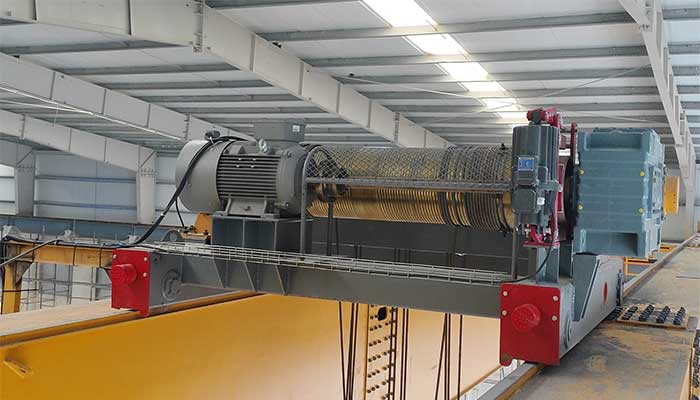
QDX types of double girder overhead crane with European style open winch for heavy lifting
Power Requirement by Crane Capacity
The power a double girder overhead crane needs depends heavily on its lifting capacity. Simply put, the heavier the load the crane must lift, the more powerful the motors need to be. But it’s not just about the weight — span, lifting height, and working duty also play a role. Let’s break it down by typical capacity groups.
Light Capacity Cranes (5t, 10t)
These cranes are common in small to medium-sized workshops, assembly lines, and light manufacturing plants. Their power requirements are relatively modest but must still be sufficient to handle frequent lifts and precise control.
- Typical crane power ranges from about 11 kW to 18 kW
- Motors for lifting usually range from 7.5 kW to 11 kW
- Auxiliary motors and travel motors consume smaller power, usually 0.55 kW to 2.2 kW
- Designed for fast, efficient lifting and travel speeds, often with frequent starts and stops
In this category, power demand is balanced with flexibility and efficiency.
Medium Capacity Cranes (16/20t, 32/50t)
Cranes in this range are used in heavier industrial settings such as steel plants, shipyards, and heavy machinery manufacturing. Their power requirements jump up significantly to handle larger weights and longer spans.
- Total crane power can range roughly from 30 kW to 80 kW
- Lifting motor power increases to 15 kW–45 kW depending on the specific capacity
- Travel and trolley motors are more powerful, often in the 2.2 kW to 7.5 kW range
- Variable speed controls are often employed to optimize performance and energy use
- These cranes operate with moderate to heavy working duty, requiring robust power support
Here, the power requirement reflects the need for greater lifting force and more durable components.
Heavy Capacity Cranes (100t, 150t, 200t and above)
At the top end, cranes lifting 100 tons or more are massive, used in heavy industries like steel rolling mills, shipbuilding, and large-scale construction. The power demand here is substantial, reflecting the sheer size and workload.
- Total power requirements can exceed 100 kW, often reaching 150 kW or more
- Main hoist motors can range from 45 kW to 55 kW or higher
- Auxiliary hoists and travel motors combined add significant additional power
- Heavy-duty designs require reliable, continuous power supply with safety margins
- These cranes typically have variable frequency drives (VFDs) for smooth operation
Power here is about ensuring steady, controlled lifting of extremely heavy loads without strain or downtime.
If you want, I can add a column for lifting height or span as well, or further break down the auxiliary motor powers. Just let me know!
How Lifting Capacity Influences Motor Power
- Direct correlation: The bigger the lifting capacity, the higher the motor power needed to lift and move the load safely.
- Span and height effects: Longer spans and higher lifts require stronger motors because of additional mechanical stress and energy needed.
- Working duty factor: Cranes used frequently or under heavy duty (A6, M6) need more power and robust motors than those used lightly.
- Safety margins: Manufacturers typically add extra power capacity to handle dynamic loads, acceleration, and safety requirements.
Understanding these factors helps in selecting a crane that matches your operational demands without overspending or risking underperformance.
Influence of Working Duty on Power Requirement
Understanding working duty classes is essential when selecting the right power for a double girder overhead crane. The duty class basically describes how often and how hard a crane will be working during its service life. Common classes like A5 and A6 represent medium to heavy duty cycles, and this has a direct impact on power needs.
For example, an A5 duty crane is designed for frequent use but with moderate lifting cycles, whereas an A6 crane handles more intense, continuous operation and heavier loads. This means cranes with higher duty classes require motors that are not only more powerful but also more robust to withstand the stresses over time.
Here’s how working duty affects power ratings and motor sizing:
- Higher duty class means increased power demand: Motors must handle longer running times, quicker accelerations, and more frequent stops.
- Larger safety margins: To ensure reliability, motors are sized larger to prevent overheating and mechanical wear.
- More advanced control systems: Variable frequency drives (VFDs) are often used to optimize power use and improve motor life.
To put it in perspective, a 10-ton crane with an A5 duty might need around 11 to 13 kW of total power, but the same crane with an A6 duty could require 16 to 18 kW or more. Similarly, medium capacity cranes like 20-ton units operating at A6 duty can see power requirements jump significantly compared to lighter duty applications.
Comparative Examples:
- 5t Crane, A5 Duty: Around 11.6 kW total power
- 5t Crane, A6 Duty: Around 16.5 kW total power
- 20t Crane, A5 Duty: Approximately 30.7 kW
- 20t Crane, A6 Duty: Around 41.2 kW
This difference highlights the importance of knowing the working duty when planning crane power requirements. Skimping here can lead to frequent breakdowns or unsafe operation, while oversizing unnecessarily drives up costs.
Other Key Factors Affecting Power Requirement
Besides capacity and working duty, several other factors play an important role in determining the power requirements of a double girder overhead crane. It’s not just about how much weight you lift, but also how far and how fast you move it.
Span Length and Lifting Height
The crane’s span—the distance between the two girders—affects the power needed mainly because a longer span means heavier girders and more structural mass to move. Likewise, a higher lifting height requires motors capable of working harder and longer to raise loads safely.
- Longer spans increase the weight of the crane itself, thus increasing power demand for crane traveling.
- Higher lifting heights often require stronger hoisting motors to maintain consistent speed and control over longer lifts.
Lifting Speeds, Trolley Speed, and Crane Travelling Speed
The speed at which the crane lifts, the trolley moves along the girders, and the crane itself travels on the runway also influence power requirements. Faster speeds mean higher acceleration forces and more power consumption.
- Higher lifting speeds require more powerful hoist motors.
- Faster trolley travel increases power needed for the trolley motors.
- Crane traveling speed affects the power consumption of the main crane motors, especially on long runways.
Main Hoist vs. Auxiliary Hoist Power Needs
Most double girder cranes come with a main hoist and an auxiliary hoist. The main hoist is designed for heavy loads and often runs at slower speeds, while the auxiliary hoist handles lighter loads at faster speeds.
- The main hoist motor is usually larger, with higher power ratings to lift heavy loads safely.
- Auxiliary hoists have smaller motors, designed for speed and efficiency rather than maximum load capacity.
- Power consumption varies accordingly, with the main hoist drawing more energy during heavy lifts, while the auxiliary hoist consumes less but operates more frequently for lighter tasks.
Power Supply Standards for Double Girder Overhead Cranes
When it comes to powering double girder overhead cranes, the power supply needs to be reliable and compatible with the crane’s motor requirements. Most industrial cranes around the world, especially those designed in or for Europe and Asia, use a standardized power supply to keep things consistent and safe.
Common Power Supply Parameters
- The standard power supply for these cranes is typically Three-phase AC, 380 volts, 50 Hz.
- This setup provides a balanced, efficient flow of electricity, which is crucial for heavy machinery like overhead cranes.
- Some regions might have slight variations (e.g., 400V or 415V), but 380V/50Hz remains the most common standard in many industrial environments.
Why Matching Power Supply Matters
It’s not just about plugging the crane in and turning it on. The power supply must match the crane’s specific power requirements to avoid:
- Motor overheating due to voltage mismatch
- Frequent tripping of circuit breakers or power interruptions
- Reduced efficiency and increased energy costs
- Potential damage to electrical components or controls
In short, a crane’s performance and safety hinge on ensuring that the power supply perfectly fits its power rating. Before installation, confirming compatibility with your local power grid and crane motor specifications is key to avoiding costly delays and repairs down the road.
Practical Advice for Crane Buyers and Operators
Buying or operating a double girder overhead crane isn’t just about picking the right lifting capacity. Power requirements play a huge role in making sure the crane runs smoothly and safely. Here are some practical tips to keep in mind.
Confirm Power Requirements with Manufacturers
- Always double-check the crane’s power ratings with the manufacturer before placing an order.
- Ask for detailed motor specifications, including starting current, rated power, and duty cycle.
- Getting this info upfront helps avoid surprises during installation or operation.
Plan Electrical Infrastructure Properly
- Make sure your facility’s electrical system can handle the crane’s power needs.
- This might mean upgrading transformers, switchboards, or wiring to prevent overloads.
- Proper planning avoids downtime and costly electrical faults.
Consider Duty Cycles and Operational Conditions
- The crane’s working duty (like A5, A6, ) affects how much power it will draw during normal use.
- If your operation involves frequent lifting or heavy loads, expect higher power demand.
- Factor this in when sizing electrical components and protective devices.
Prepare for Future Upgrades and Energy Efficiency
- Think ahead: if you plan to increase crane capacity or add more cranes, your power system should be ready.
- Look into energy-saving options like variable frequency drives (VFDs) which can lower power consumption and reduce wear.
- Investing in these technologies early can save money and headaches later on.
By following these simple but crucial steps, crane buyers and operators can ensure their investment pays off with reliable, efficient, and safe crane operation for years to come.
Conclusion
Power requirements for double girder overhead cranes aren’t one-size-fits-all. Both the crane’s lifting capacity and its working duty have a big say in how much power it needs to perform safely and efficiently.
Larger capacities and heavier duty cycles naturally demand stronger motors and higher power inputs. But it’s not just about raw numbers — understanding these details helps avoid overloading electrical systems, improves crane lifespan, and keeps operations running smoothly.
When planning your crane purchase or upgrade, don’t hesitate to lean on your supplier’s expertise. They can provide tailored power solutions that fit your specific needs and local conditions.
In the end, making well-informed decisions about power requirements sets the foundation for a crane setup that’s reliable, cost-effective, and built to last.