Double Girder Overhead Crane 10 to 50 T for UAE Steel Fabrication
10 to 50 ton double girder overhead cranes for handling Heavy Beams and Frames, to ensure safe, efficient handling in busy UAE steel fabrication plants.
Introduction
Steel Fabrication in the UAE: A Growing but Demanding Industry
The steel fabrication sector in the UAE continues to expand, supporting critical infrastructure, oil & gas, logistics, and modular construction projects. From Sharjah Industrial Area to Dubai Investment Park and Mussafah in Abu Dhabi, workshops and yards are busy around the clock, producing structural steel components like H-beams, columns, trusses, base frames, and skids.
Most of these fabrication companies deal with custom-built orders—large components, varied project timelines, and strict quality requirements. They’re not just cutting steel sheets; they’re lifting and assembling massive welded frames that need to be handled with precision and care.
Why Heavy Lifting Is at the Core of Steel Fabrication
You can have the best welders, the sharpest cutters, and the strongest steel, but if your lifting setup is weak, your entire operation suffers. Lifting isn’t just about moving steel from point A to B—it’s about controlling it during every stage of fabrication.
- Long beams and bulky frames need to be moved steadily and safely during welding and fitting.
- Lifting and shifting material inefficiently causes production delays, worker fatigue, and even damage to components.
- In busy UAE shops, lifting equipment must be both reliable and fast, without getting in the way of daily operations.
The Role of Double Girder Overhead Cranes
This is where double girder overhead cranes come in. These cranes are widely used across UAE fabrication workshops for one simple reason—they work well when the job gets heavy. Really heavy.
- They handle loads from 10 to 50 tons comfortably, often more with customization.
- They span across wide bays, lifting long beams and full frame structures without wobble or tipping.
- Their stable design and high hook height make them ideal for tall welding jigs and multi-step assembly processes.
To put it plainly, when you're dealing with big steel and tight schedules, a double girder overhead crane gives you the lifting backbone your workshop needs. In the next section, we’ll look at the typical types of these cranes used in steel fabrication shops throughout the UAE.
What Is a Double Girder Overhead Crane?
Basic Design and Components
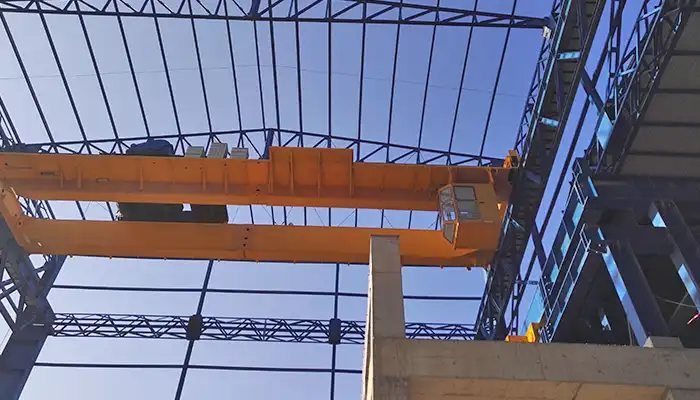
A double girder overhead crane is exactly what it sounds like—a crane with two parallel girders running across the span of your workshop or yard. These girders form the main bridge structure, and the crane trolley (which carries the hoist) runs on top of them.
The setup gives the crane more strength, better hook height, and greater lifting stability, especially when you’re dealing with long or heavy loads like steel beams and welded frames.
- Two main girders: Carry the weight and provide structural strength
- End carriages: Support the bridge and allow the crane to travel along the runway beams
- Trolley with hoist: Moves side-to-side and lifts the load vertically
- Control system: Can be pendant, radio remote, or cabin-operated depending on the application
- Power supply: Typically 415V, 50Hz, 3-phase in the UAE
This type of crane is typically installed on runway beams fixed to the building’s columns or support structure. Some newer systems also offer modular installation with bolt-on supports if retrofitting is needed.
Double Girder vs. Single Girder: Why Go Double?
At first glance, single girder cranes might seem similar, especially for lighter work. But when you compare the two in the context of UAE steel fabrication—where you're often lifting bulky items across long spans—the differences become clear.
Advantages of Double Girder Overhead Cranes:
- Higher Lifting Capacity: Easily handles 10–50 tons or more; single girders typically top out around 10–16 tons.
- Better Hook Height: Because the trolley sits on top of the girders, you get more vertical lift. Important in workshops with tall jigs or stacked operations.
- Greater Load Stability: The two-girder design distributes weight evenly—reducing swing and twist during lifting.
- Wider Spans: Suitable for workshops over 15 meters wide.
- Supports More Features: Easier to integrate walkways, platforms, and auxiliary hoists.
In short, if your steel plant lifts long, heavy, or critical structures on a daily basis, the double girder option is the safer and more reliable long-term investment. It's built for the kind of work most UAE fabrication shops handle every day.
Why Heavy-Duty EOT Cranes Are Essential for UAE Steel Workshops
Lifting Heavy Welded Beams and Frames—Not Just Once, But Repeatedly
In UAE steel fabrication shops, welded assemblies often weigh 10 to 30 tons, and some exceed that. We're talking about long-span H-beams, portal frames, box trusses, and complete modular skids—each requiring careful lifting during multiple fabrication steps: cutting, assembling, welding, surface treatment, and finally loading.
A forklift isn’t made for this. Manual hoists are far too slow. You need something built for the job.
- Heavy-duty EOT cranes, especially double girder models, are made to lift this kind of load safely and efficiently, every single shift.
- The crane distributes weight evenly across the girders, preventing sway or load twisting.
- Cranes also eliminate the need for multiple people or forklifts to "guide" beams—which reduces injury risk and handling errors.
High-Output Plants Need Lifting to Keep Up
In Sharjah’s Sajja Industrial Area, it’s not uncommon for mid-sized fabrication plants to turn out 15–25 tons of structural steel per day. In Dubai Investment Park, some modular builders are shipping out full prefabricated steel pods each week. That kind of volume needs a lifting system that matches pace.
- An EOT crane lets one operator move a frame across the bay in less than a minute.
- It reduces waiting time between workstations (which is often where productivity bottlenecks happen).
- You can run back-to-back lifting cycles all day without overloading the system.
In other words, your crane needs to be just as fast and consistent as your cutting machine or welding station.
Dealing with Long Spans and Heavy Loads
UAE fabrication shops are often set up in rented industrial units or custom-built sheds. The spans can vary from 10 to 30 meters or more. The loads aren’t just heavy—they’re long and awkward, often exceeding 8–12 meters in length.
A heavy-duty double girder crane deals with both.
- The bridge spans wide bays without sagging or flexing under load.
- The trolley hoist handles point loads, distributed loads, and even asymmetric frames—which are common in real-world fabrication.
- You can customize hook spacing, trolley type, and girder depth to suit your layout.
In short, when the job involves large steel components and fast project turnarounds, a heavy-duty EOT crane is no longer optional—it’s essential..jpg)
European style dobule girder overhead cranes
Precision Handling Features That Matter
Smooth Speed Control with Variable Frequency Drives
Lifting something heavy is one thing. Lifting it smoothly—without jerks, swaying, or slamming—is what really protects your steel, your workers, and your equipment. That’s where Variable Frequency Drives (VFDs) make a difference.
- VFDs control acceleration and deceleration, which helps when picking up large frames or placing beams into jigs.
- They reduce mechanical wear, which is helpful in hot, dusty UAE workshops where gearboxes already face stress.
- Most modern cranes include dual-speed or stepless speed as standard for both hoist and travel movement.
Accurate Load Positioning Is Key in Welding and Assembly
If your welder has to chase a beam with a chain block, that's time and precision lost. Double girder EOT cranes allow accurate placement of beams or welded parts on fixtures, welding tables, or even in final assembly areas.
- Operators can move the load millimeter by millimeter using slow-speed control.
- This is especially useful for multi-layer frame assemblies, where parts must align before tacking or bolting.
- Smooth lateral travel also helps avoid contact with nearby machines, tools, or structures.
Dual Hoist Systems for Lifting Long or Uneven Components
Many UAE steel fabricators now request twin hoists on the same trolley or independent trolleys on one bridge. This allows for synchronized lifting, which is ideal when dealing with:
- Long I-beams or trusses that sag if lifted from one point
- Large welded structures where the center of gravity isn't obvious
- Off-center loads that need tilting or controlled rotation
Dual hoist setups also provide more flexibility. If you're not using both hoists for long items, you can assign one for small parts or tools—essentially creating two cranes in one.
Benefits Specific to UAE Conditions
Designed for Tight Workshop Layouts with Limited Headroom
Many UAE steel workshops—especially in Sharjah Industrial Area, Ajman, or older facilities in Al Quoz, Dubai—were not originally designed for overhead cranes. Ceilings are often low, and steel beams or HVAC ducts eat up precious vertical space.
That’s why low-headroom double girder cranes are a preferred choice.
- The hoist trolley is mounted between or above the girders, giving extra hook travel
- Custom girder heights and compact end carriages allow installation in buildings with only 6–8 meters of internal clearance
- Adjustable crane spans help fit irregular workshop layouts or retrofit into existing steel structures
This means even small or mid-size plants can upgrade their lifting system without rebuilding the workshop.
UAE Power Supply Compatibility (415V, 50Hz, 3-Phase)
Electrical mismatches can delay installations or cause safety issues. All industrial-grade cranes supplied to UAE must be built to match 415V, 50Hz, 3-phase standards, which are standard across Sharjah, Dubai, Abu Dhabi, and other emirates.
- Ensures compatibility with local DB panels and MCC setups
- Reduces the risk of electrical faults or motor damage
- Makes integration with workshop automation systems smoother
Professional crane suppliers usually pre-test the control system, motors, and hoist panel to fit UAE specs before shipping, which saves time on-site.
Withstanding Harsh Heat, Dust, and Outdoor Exposure
The desert climate in the UAE is tough on equipment. Cranes installed in open yards or partially covered workshops must deal with:
- High daytime temperatures, often exceeding 45°C
- Airborne sand and fine dust that can clog motors and controls
- Humidity and salt exposure in coastal areas like Dubai or Ras Al Khaimah
To handle this, cranes used in UAE fabrication shops are typically equipped with:
- Anti-corrosion coatings (epoxy, hot-dip galvanizing, or marine-grade paint)
- IP55 or higher-rated enclosures for motors and control panels
- Heat-resistant cabling and insulated components for summer operation
- Optional covers or enclosures for hoists operating outdoors
This level of durability helps reduce breakdowns, keeps maintenance predictable, and protects your investment over the long term.
Case Examples from Sharjah and Dubai
Sharjah: 20-Ton Double Girder EOT Crane in Steel Beam Fabrication
A mid-sized steel fabrication company in Sharjah’s Sajja Industrial Zone upgraded from a 10-ton single girder crane to a 20-ton double girder EOT crane. They fabricate long-span H-beams, frames, and base skids for industrial buildings.
- The new crane spans 18 meters and serves four welding stations
- Equipped with dual-speed travel and hoisting for smooth movement
- Operator now lifts and places 12-meter beams without assistance—cutting manpower and increasing output
- Result: Lifting cycle time reduced by 30%, and workers reported fewer handling delays
Dubai: Double Girder Crane with Twin Hoists for Modular Construction
In Dubai Investment Park, a steel modular builder installed a custom 25-ton double girder crane with two independent hoists. The plant handles large modular pods and welded panel assemblies.
- Twin hoists lift long structures evenly, avoiding bending or twisting
- The crane is remotely operated, giving the worker full visibility while staying clear of the load
- Painted with UV- and salt-resistant coating due to proximity to coastal air
- Result: Safer beam alignment, improved control during lift-and-set operations, and a 40% reduction in rework caused by lifting deformation
These examples show that UAE fabricators are not just buying cranes—they’re choosing tools that solve real production issues, fit their local environment, and help grow their business with fewer interruptions.
How to Choose the Right Double Girder Crane for Your Plant
Choosing the right double girder overhead crane isn’t just about picking the biggest model—it’s about matching the crane to your daily operations, space, and safety needs. If you're running a fabrication plant in the UAE, here are the practical points you need to check before making a decision.
Start with the Basics: Capacity, Span, Lifting Height, and Duty Cycle
Every crane design starts with a few key numbers. Get these wrong, and the whole system may underperform—or worse, wear out too quickly.
- Capacity: What’s your heaviest load? In most UAE steel plants, that’s between 10 and 50 tons—but it could vary depending on your structural designs.
- Span: Measure the clear width of your workshop. Cranes can span anywhere from 10 to 35 meters, but custom spans are available.
- Lifting Height: Don’t guess here. You need to calculate the distance from the floor to the lowest obstacle, like a beam or pipe. Add clearance for the hoist.
- Duty Cycle: This is often overlooked. Is your crane used a few times a day—or constantly during two shifts? Class A5 or A6 is standard for fabrication, but A7 may be needed for high-throughput shops.
Fit the Crane to the Space You Have
Not every workshop in Sharjah or Dubai was built for heavy-duty cranes. You may have low ceilings, offset columns, or mixed-use bays. That’s where smart customization helps.
- Low-headroom designs: Great for buildings with only 6–8 meters of internal height
- Short end carriages: Allow wider coverage in tight bays
- Asymmetric girders or cantilevers: Useful when one side of the crane needs to clear a wall, mezzanine, or duct
- Runway installation on steel columns: Ideal if the building can’t support crane loads directly
- Remote or pendant control: Choose based on your workflow and space limitations
Your crane should match how you work—not the other way around.
Conclusion
Steel fabrication in the UAE moves fast, works heavy, and runs hot—literally and figuratively. That’s why double girder overhead cranes are the preferred choice across fabrication shops in Sharjah, Dubai, and Abu Dhabi. They lift more, span wider, and move steel with the kind of control and consistency busy plants need.
If you're still relying on forklifts, chain blocks, or single girder cranes to lift 10-ton beams or welded frames, it might be time to step up. A properly designed double girder crane can transform your workflow, reduce downtime, and make your plant safer for everyone on the floor.
Need help selecting the right crane for your shop?
We can provide:
- Custom crane layout proposals based on your workshop drawing
- Advice on lifting capacity, span, and duty cycle
- Full quotation including optional installation support in the UAE
Reach out today and let’s take a serious look at lifting smarter in your steel plant.