Why Explosion-Proof Crane Certifications Aren’t Recognized
Why Explosion-Proof Crane Certifications Are NOT Mutually Recognized — And Never Will Be
Most Important Takeaway
Explosion-proof crane certifications (ATEX, IECEx, CNEX) are not mutually recognized because they are rooted in different legal systems—not because of technical differences.: Even when technical requirements appear similar, legal enforceability, liability, and regulatory authority make mutual recognition structurally impossible.
- Explosion-proof crane certification is a legal compliance mechanism, not just a technical test
- ATEX, IECEx, and CNEX are tied to different jurisdictions and regulators
- “Technically equivalent” does not mean “legally acceptable”
- Local authorities cannot enforce foreign certificates
- Buyer risk lies in site approval, inspection, and liability, not in engineering theory
- Mutual recognition is structurally impossible and will not happen in the future
What Explosion-Proof Crane Certification Really Means
Explosion-proof crane certification is often treated as a technical label, similar to a motor rating or a component test report. In practice, it is nothing like that. An explosion-proof crane certificate is legal proof that a complete crane system complies with the mandatory safety rules of a specific country or region.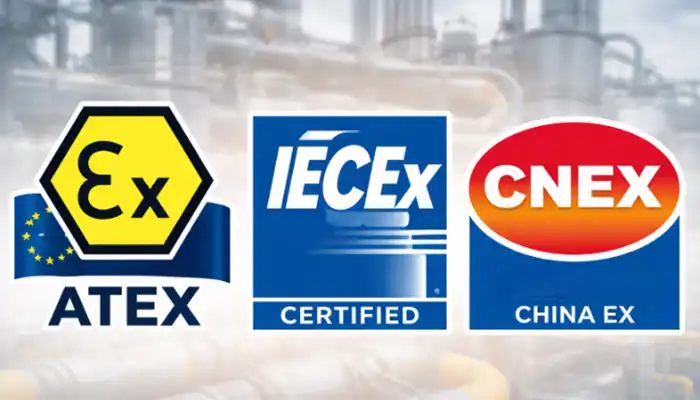
Certifications of Explosion proof overhead cranes
This matters because hazardous-area lifting equipment is regulated by law, not by preference. A crane without the correct certification may work mechanically, but it can still be illegal to install or operate.
From a regulatory point of view, explosion-proof certification answers one basic question:
Is this crane allowed to operate in a hazardous area under local law?
The certification confirms that the crane meets:
- The applicable hazardous area classification (gas, vapor, or dust)
- The mandatory safety framework of the jurisdiction where it will be installed
- The supervision and approval requirements of the local authority
This is why certificates are issued by authorized bodies, not by manufacturers themselves.
When certification documents mention these terms, they are referring to legal compliance, not marketing language:
- Explosion-proof overhead crane: A crane system approved for use in explosive or potentially explosive atmospheres
- Hazardous area crane compliance: Proof that the crane meets national or regional hazardous-area regulations
- Certified lifting equipment for Zone 1, Zone 2, or dust environments: Confirmation that the crane is suitable for specific gas or dust risk zones defined by law
Each of these terms links the crane directly to a regulated operating environment.
Explosion-proof cranes are typically used in facilities where flammable gas, vapor, or combustible dust can be present during normal operation or abnormal conditions, such as:
- Oil and gas processing plants
- Chemical production and storage facilities
- Refineries and petrochemical complexes
- Grain handling, sugar processing, and dust-prone industries
In these locations, even a single ignition source can cause serious damage. That is why cranes are not treated as ordinary lifting equipment.
Hazardous industrial environments are classified as high-risk areas by regulators. As a result:
- Equipment design is reviewed before installation
- Certification is checked during site inspection
- Responsibility is clearly assigned in case of accidents
Explosion-proof crane certification exists to control risk at a legal level. It is not optional, and it is not transferable by argument or technical comparison alone.
Structural Reasons Behind Non-Recognition of Certifications
Explosion-proof crane certifications are often compared side by side, as if they were different versions of the same technical approval. In reality, they are built on very different foundations. The lack of mutual recognition is not accidental, and it is not due to missing coordination. It comes from how these certifications are legally structured from the start.
Explosion-proof crane certifications do not exist as independent technical programs. Each one is tied directly to a legal and regulatory system that defines how safety is enforced, inspected, and punished when things go wrong.
| Certification | Root Authority |
|---|---|
| ATEX | European Union directives + CE legal framework |
| IECEx | International voluntary system (no legal enforcement power) |
| CNEX | China's national regulatory and licensing system |
At a high level, the root authorities look like this:
- ATEX: Based on European Union directives and enforced through the CE legal framework. Compliance is mandatory within the EU, and enforcement is carried out by national authorities.
- IECEx: Operates as an international technical certification scheme. It supports consistency in testing and assessment but does not have its own legal enforcement power.
- CNEX: Part of China's national regulatory and licensing system. Certification is linked to domestic supervision, inspection, and administrative control.
Each system exists to satisfy local law, not to achieve global equivalence. That distinction is critical. Even if test methods look similar on paper, the certificates are issued under different legal responsibilities and oversight mechanisms.
This is the fundamental reason mutual recognition cannot exist. A regulator cannot rely on a certificate that was never designed to function inside its legal system.
When regulators review explosion-proof crane documentation, they are not only checking technical safety. They are asking a much more practical question:
If an explosion occurs, who can we legally investigate, penalize, or prosecute?
Foreign certification bodies present immediate limits:
- They are outside local legal jurisdiction
- They cannot be compelled by domestic regulators
- They do not carry legal liability under local law
Without legal reach, enforcement becomes impossible. This is why inspectors and authorities are required to rely on certification systems they can legally control, supervise, and audit.
From a regulatory standpoint, accepting a foreign certificate without jurisdiction means accepting risk without authority. That is not a technical issue. It is a legal one, and it explains why each country or region insists on its own explosion-proof crane certification system.
Legal Systems vs. Certification Schemes (Why Buyers Get Confused)
Many buyers approach explosion-proof crane certification with the same mindset they use for ISO standards. That assumption causes most of the confusion. ISO and explosion-proof certification serve very different purposes, even though both involve audits, reports, and certificates.
ISO standards are mainly used as technical and management guidance. They help align design practices, production processes, and quality systems across countries. Adoption is often voluntary, and compliance alone does not decide whether equipment can be legally used on site.
Explosion-proof crane certification works differently:
- ISO standards: Provide technical references and best practices
Support design consistency
Do not grant legal permission to operate equipment - Explosion-proof certification: Acts as a regulatory enforcement tool
Determines whether a crane may be installed and commissioned
Is mandatory in hazardous areas
This distinction is easy to miss, especially for buyers who are new to hazardous-area equipment.
Another key difference is how responsibility is defined. Explosion-proof certification assigns accountability clearly and locally.
In any certification system, four parties are involved:
- Certification body: Verifies compliance and issues approval under its legal authority
- Manufacturer: Bears responsibility for design conformity and production consistency
- End user: Is responsible for correct selection, installation, and operation
- Local regulator or inspector: Enforces the law and approves or rejects equipment on site
The exact balance of these responsibilities changes from country to country. Some systems place more liability on manufacturers, others on operators or certification bodies.
Because responsibility, enforcement power, and legal liability are defined differently in each jurisdiction, certificates cannot simply be exchanged or "recognized" elsewhere. A foreign certificate may prove technical performance, but it does not transfer legal responsibility.
For buyers, this means one thing: a certificate is valid only where the legal system behind it is valid. Treating explosion-proof certification like an ISO document leads to costly misunderstandings during inspection, commissioning, or project handover.
Why "Technical Equivalence" Does NOT Mean Acceptance
This is the point where most buyer–supplier disagreements start. From the buyer's side, the thinking is often straightforward: the motor is flameproof, the brakes are certified, the controls meet the standard—so the crane should be acceptable. On paper, that sounds reasonable. In practice, it is not how explosion-proof approval works.
Explosion-proof certification is not granted by adding up certified parts. It is based on how the entire crane system behaves in a hazardous area.
Two common misunderstandings appear again and again:
- A flameproof motor does not automatically make the crane explosion-proof
- Certified components do not equal a certified explosion-proof crane
Regulators and certification bodies look at the crane as a complete operating system, not as a collection of parts. System-level certification typically covers:
- Hoisting mechanism: Including gearbox, wire rope or chain, drum, and load path behavior
- Electrical system: Motors, limit switches, control panels, wiring methods, and protection type
- Brakes and controls: Emergency response, braking reliability, and fault behavior
- Installation environment: Gas or dust zone classification, ventilation, and surrounding equipment
A crane may pass every individual component test and still fail system approval if interaction risks are not controlled.
Even when systems appear similar, certification schemes apply different rules once approval is granted. This is where practical compliance issues arise.
In daily practice, this is described as:
- Explosion-proof crane system certification
- Hazardous area crane inspection
Each scheme handles design control differently:
- ATEX: The approved design is locked after certification. Any modification—mechanical, electrical, or structural—requires reassessment.
- IECEx: Allows controlled flexibility, but only within clearly defined assessment rules and documented variation limits.
- CNEX: Follows China's inspection and supervision logic, with strong emphasis on consistency with approved drawings and documentation.
Because of these differences, even small design changes—such as a different cable routing, brake type, or enclosure detail—can invalidate approval. Technical similarity alone does not protect a crane during inspection. Acceptance depends on whether the final system matches what the certifying authority has approved.
Buyer-Side Risk Control Logic (What Really Matters)
When buyers step back and look at explosion-proof crane certification from a practical angle, the discussion becomes much simpler. Technical debates fade quickly once the crane arrives on site. What matters are a few very direct questions that affect cost, schedule, and responsibility.
From a buyer's point of view, the real risks are not about design theory or standard wording. They are about outcomes:
- Will the crane pass local inspection?: Inspectors check certificates against local law, not against technical arguments or foreign test reports.
- Will the crane be accepted during commissioning?: A crane that cannot be officially approved cannot be handed over, no matter how well it performs mechanically.
- Who pays if the crane is rejected?: Rework, replacement, or redesign costs usually fall on the buyer or project owner, not the regulator.
These are the questions that drive procurement decisions in hazardous-area projects.
Using a certificate that is described as "technically equivalent" often creates problems that appear late, when they are most expensive to fix:
- Customs clearance failure: Documentation may be questioned or rejected before the crane even reaches the site.
- On-site rejection by inspectors: Local authorities rely on recognized certification systems, not engineering explanations.
- Project delays and retrofit costs: Modifications after delivery are time-consuming and disruptive, especially in operating plants.
- Insurance refusal after incidents: In the event of an accident, insurers may deny claims if certification is not legally valid.
From a regulatory and risk-control standpoint, local certification is the only defensible position. Authorities, insurers, and project owners all rely on systems they can legally enforce.
For buyers, this means one clear rule: technical equivalence does not reduce legal risk. Only certification that is recognized and enforceable in the installation country protects the project, the schedule, and the investment.
Why Mutual Recognition Will Never Happen
It is tempting to think that the lack of mutual recognition between explosion-proof crane certifications is a temporary policy issue that could be solved with more coordination or new agreements. In reality, this is not a gap waiting to be fixed. It is a structural limitation built into how safety regulation works.
Mutual recognition fails because certification systems are anchored in national control mechanisms, not shared technical platforms. The core obstacles are straightforward:
- Different national legal systems: Each country defines safety obligations, penalties, and approval authority under its own laws. These legal systems are not interchangeable.
- Different liability frameworks: Responsibility after an accident is assigned differently from one jurisdiction to another. Certification bodies, manufacturers, and end users do not carry the same legal exposure in every country.
- Different enforcement authorities: Inspectors and regulators can only act within their legal reach. They cannot supervise, audit, or penalize foreign certification bodies.
- Explosion safety treated as national infrastructure risk: Hazardous-area safety is closely linked to public safety, industrial stability, and environmental protection. Governments do not delegate this level of control to external systems.
Standards can be harmonized. Test methods can be aligned. Terminology can be made consistent. None of this creates mutual acceptance.
Harmonization helps engineers speak a common technical language, but certification is about who has authority. As long as legal responsibility, enforcement power, and liability remain national, certificates must remain local.
This is why mutual recognition of explosion-proof crane certifications is not just unlikely. It is structurally impossible.
What Buyers Should Do Instead
When it comes to buying explosion-proof cranes, the smartest approach is practical, not theoretical. Instead of arguing about which certificate looks "better" on paper, buyers should focus on what will actually be accepted on site.
- The first thing to check is where the crane will be installed.
- Local law dictates which certification is required—nothing else matters for legal compliance.
- Don't pick a crane based on a preferred certificate first; start with the country and hazardous zone classification.
- Identify the recognized system for your location: ATEX for the EU, CNEX for China, IECEx for some international projects, etc.
- Ensure the crane is fully compliant under the local regulatory framework, not just technically similar.
- Check that the entire crane system is certified, not just individual components.
- Hoist, trolley, electrical system, brakes, controls, and installation setup all need approval.
- Component-only certification may look good, but it cannot substitute for full system approval.
- Don't wait until ordering to clarify certificates. Ask: "Which certifications do you legally support for my country?"
- Make sure the supplier can provide documentation recognized by local authorities.
- Early clarification prevents expensive delays, rework, and inspection rejection later.
FAQ: Explosion-Proof Crane Certifications
Q1: Why are ATEX, IECEx, and CNEX explosion-proof crane certifications not mutually recognized?: A: Each certification is embedded in its own legal and regulatory system. Authorities cannot enforce foreign certificates, and liability remains local. This structural difference makes mutual recognition impossible.
Q2: If technical standards are similar, why can’t certificates be accepted across countries?: A: Technical equivalence does not equal legal acceptance. Even if components or design meet the same tests, the certification must be issued under the local jurisdiction to be enforceable.
Q3: What is the difference between technical equivalence and legal acceptance?: A: Technical equivalence refers to meeting the same performance or test requirements. Legal acceptance means the certificate is recognized and enforceable by the local authorities for installation, inspection, and operation.
Q4: Who carries the risk if a non-recognized certificate is used?: A: The buyer or project owner usually bears the risk, including potential inspection rejection, rework costs, project delays, or insurance issues. Regulators cannot accept liability for foreign certifications.
Q5: How should buyers control compliance risk when purchasing explosion-proof cranes?: A:
- Start with the project location to identify required certifications.
- Verify system-level certification, not just components.
- Ask suppliers early: “Which certificates can you legally support for my country?”
- Focus on practical compliance, not just technical claims.
Conclusion: Certification Is About Authority, Not Preference
Explosion-proof crane certifications are not interchangeable, and they never will be. This is not a flaw—it is intentional. The system exists to make sure that hazardous-area equipment operates safely under the law and can be enforced by the proper authorities.
Why Non-Recognition Matters
- Protects regulators – ensures local authorities can enforce safety rules and hold parties accountable
- Protects end users – prevents installation of equipment that may seem safe but is legally unapproved
- Protects industrial safety systems – maintains high standards in high-risk environments such as chemical plants, refineries, and dust-hazard industries
Practical Advice for Buyers
Smart buyers stop arguing over which certificate “looks better” and focus on planning compliance from the start:
- Identify the required certification for the project location
- Verify system-level certification, not just components
- Ask suppliers early which certificates they can legally support
By taking these steps, buyers reduce risk, avoid delays, and ensure their cranes are legally accepted and safe to operate.