Free-Standing vs Wall Jib Cranes: 1–3 Ton Guide
Free-Standing vs. Wall-Travelling Jib Cranes: Pros and Cons (1 Ton, 2 Ton, 3 Ton)
Choosing the right jib crane type—free-standing or wall-travelling—is critical for optimizing workspace, lifting efficiency, and safety, especially for small to medium loads of 1–3 tons. The wrong choice can limit reach, reduce productivity, and increase installation costs.
Key Takeaways for Crane Buyers
- Space Optimization: Free-standing cranes are flexible for open areas, wall cranes save floor space in confined workshops.
- Load Capacity & Reach: Both types handle 1–3 ton loads, but span and rotation differ. Free-standing cranes often cover multiple workstations; wall cranes have limited pivot range.
- Installation & Cost: Wall-travelling cranes need strong structural support; free-standing cranes require floor-mounted foundations.
- Maintenance & Flexibility: Free-standing cranes are easier to move or expand; wall cranes are more permanent and may require structural modifications for upgrades.
- Safety Considerations: Overloading, obstruction, and proper anchoring are crucial for both types.
These points answer common buyer questions such as:
- “Can a jib crane serve multiple workstations efficiently?”
- “Do I need to reinforce walls for installation?”
- “What’s the safest way to lift 2–3 ton loads in a small workshop?”
Jib cranes are essential for precise lifting in workshops, warehouses, and industrial facilities. Choosing between a free-standing model and a wall-travelling setup depends on your workflow, available space, and lifting requirements. This guide focuses on 1 ton, 2 ton, and 3 ton capacities, helping buyers make informed decisions for small-to-medium operations.
Free-Standing Jib Cranes – Buyer's Guide
Free-standing jib cranes are supported by a sturdy floor-mounted column or pedestal, independent of wall structures. They provide flexibility for workshops where walls aren't reinforced or where cranes are needed in open production areas. Ideal for multi-station coverage, they adapt to changing workflows and layouts.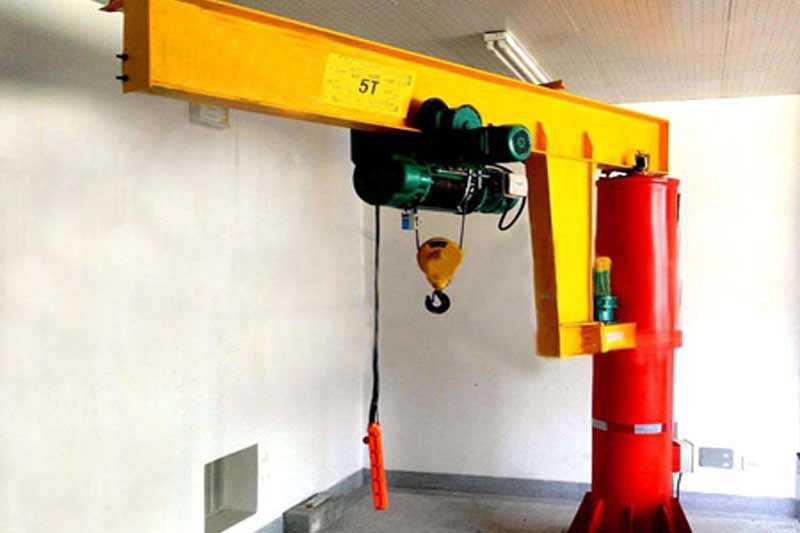 Freestanding jib crane
Free-standing jib cranes can be installed virtually anywhere, giving you flexibility in arranging your workspace. They are particularly useful in open areas where multiple workstations need material handling, or where the workflow changes from time to time.
- Floor-mounted design allows full 360-degree rotation in some models.
- No dependency on wall strength or structural reinforcements.
- Can be placed close to machines, assembly lines, or storage areas without major building modifications.
Free-standing jib cranes offer a lot of practical advantages, especially for small to medium workshops:
- Flexible positioning and rotation: You can move the jib arm to cover multiple workstations without changing the crane structure. Some models allow partial or full rotation depending on column design.
- Multi-station coverage: One crane can serve several machines, loading zones, or work areas, reducing the need for multiple smaller cranes.
- Easy relocation or expansion: If your production layout changes, a free-standing crane can be moved or upgraded more easily than a wall-mounted crane.
These pros make free-standing cranes ideal for workshops that are constantly evolving, or for operations where lifting points are not fixed.
Despite their flexibility, free-standing cranes come with certain considerations you should be aware of:
- Requires floor reinforcement: The column transfers the load to the floor, so concrete must be strong enough to handle repeated lifts. Without proper foundation, the crane may tilt or become unstable.
- Higher initial foundation cost: Installing a pedestal-mounted crane often involves pouring reinforced concrete pads, which can be more expensive upfront.
- Occupies valuable floor space: Unlike wall-mounted cranes, these cranes take up physical space, which could limit walkway areas or machine placement in tight workshops.
It's important to weigh these factors before committing to a free-standing model, especially in smaller workshops where every square meter counts.
- Workshops with open floors where wall mounting is not possible or practical.
- Facilities that need multi-station material handling, such as moving parts between assembly lines or storage zones.
- Temporary or semi-permanent lifting solutions, where flexibility and possible relocation are priorities.
If you need a crane that can adapt to your workshop layout and serve multiple areas without relying on wall structures, a free-standing jib crane is usually the right choice.
- Ensure concrete floors are reinforced to handle dynamic crane loads.
- Plan the crane location to avoid obstructing workflow and walkways.
- Confirm rotation clearance if the model allows 360-degree rotation.
- Check pedestal foundation regularly for cracks or settlement.
- Inspect rotation bearings or slewing rings for wear if full rotation is used.
- Lubricate moving joints and check hoist operation according to manufacturer guidelines.
- Always respect the rated load capacity of the crane.
- Ensure operators are trained on multi-station handling and rotation limits.
- Install warning signs or floor markings to prevent collisions with pedestrians or equipment.
Wall-Travelling (Wall-Mounted) Jib Cranes – Buyer's Guide
Wall-travelling jib cranes are attached directly to a reinforced wall or a sturdy column. They pivot around their mounting point, making them practical where floor space is tight or when a permanent lifting spot is needed. Ideal for repetitive tasks at a fixed workstation, they keep floors clear for other equipment and operations.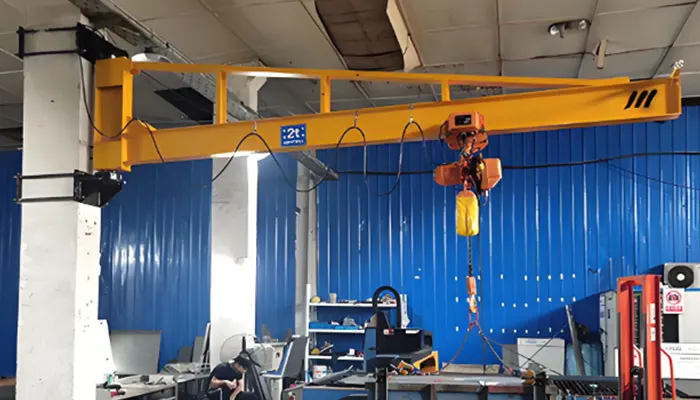
Wall-travelling cranes are designed for workshops where you can't dedicate space to a free-standing column. By anchoring to a wall, they maintain clear floors and allow smooth material handling at a single workstation.
- Mounted directly to existing walls or columns, requiring proper reinforcement.
- Pivoting design allows the jib arm to swing in a fixed arc.
- Ideal for stations where materials are frequently loaded or unloaded in the same area.
Wall-mounted cranes offer practical advantages for space-conscious operations:
- Saves floor space: With the column eliminated, the crane doesn't block walkways or storage areas. Useful in smaller workshops or areas with dense equipment layouts.
- Lower installation cost (if walls are strong): If walls are reinforced, installation can be less expensive than pouring a pedestal foundation for a free-standing crane.
- Perfect for repetitive tasks: For lifting at a single workstation multiple times a day, a wall-mounted crane keeps operations smooth and predictable.
These benefits make wall-mounted cranes a convenient option for many industrial and maintenance settings.
There are some limitations to keep in mind when considering a wall-mounted jib crane:
- Limited reach and rotation: The pivoting arm can only swing as far as the mounting point allows, which may not cover multiple workstations.
- Relocation is difficult: Moving the crane usually requires structural modifications and sometimes rebuilding the wall support.
- Wall reinforcement is essential: Safety depends on the strength of the wall or column; improper installation can lead to accidents or structural damage.
It's critical to have a professional assess the wall and anchor points before installation to avoid costly mistakes.
- Workshops with strong, reinforced walls capable of handling repeated loads.
- Single-workstation lifting tasks, where materials are consistently moved to and from the same spot.
- Areas where floor space is limited or must remain clear for other operations.
If you want a crane that keeps your floor open and handles repetitive lifting efficiently, and your walls are up to the task, a wall-mounted jib crane can be the right solution.
- Ensure the wall or column is structurally reinforced to handle dynamic crane loads.
- Check pivot arc clearance to avoid collisions with equipment or walls.
- Confirm anchor points follow manufacturer specifications for safe operation.
- Inspect mounting brackets and anchor bolts regularly for signs of loosening or fatigue.
- Lubricate pivot bearings according to manufacturer guidelines.
- Monitor hoist operation and wire rope condition periodically to prevent downtime.
- Never exceed the rated load capacity of the crane.
- Operators should be trained on pivoting limits and safe single-station operation.
- Use floor markings or barriers to keep pedestrians clear of swing paths.
Load Capacity Considerations: Floor-Mounted vs. Wall-Mounted Jib Cranes
Selecting the right crane capacity depends not only on the weight of the load but also on whether the crane is floor-mounted (free-standing) or wall-mounted. Below we break down 1 ton, 2 ton, and 3 ton jib cranes for both mounting types to help you make a practical choice for your workshop.
Floor-Mounted Jib Crane (Free-Standing)
Ideal for light lifting tasks and multi-station coverage in flexible workshops.
- Multi-station coverage: Serves several machines or work areas.
- Wide rotation: Some models allow full 360° rotation.
- Relocation possible: Can be moved or adjusted without major reconstruction.
- Foundation requirement: Reinforced floor or concrete pad needed.
Wall-Mounted Jib Crane
Best when space is limited and lifting happens repeatedly at a single workstation.
- Space-saving design: No column in the floor, keeping areas free.
- Fixed lifting point: Ideal for loading/unloading at one workstation.
- Consistent repetitive use: Perfect for small assembly tasks.
- Pivot limitation: Reach limited to mounting point arc.
Floor-Mounted Jib Crane (Free-Standing)
Works well in medium workshops handling moderate loads with multi-station coverage.
- Multiple workstation coverage: Moves parts between assembly, storage, or fabrication areas.
- Flexible placement: Can be installed wherever needed on the shop floor.
- Future-proof: Can be relocated or expanded if production layout changes.
- Reinforced foundation required: Strong floor support essential for 2-ton loads.
Wall-Mounted Jib Crane
Ideal for limited-floor-space workshops requiring repetitive lifting at a fixed location.
- Floor space saved: No pedestal required, freeing walking and working areas.
- Fixed lifting area: Repetitive tasks at the same workstation.
- Safe operation with wall reinforcement: Handles 2-ton loads reliably.
- Limited rotation: Arm's reach restricted by mounting point.
Floor-Mounted Jib Crane (Free-Standing)
Provides strength and flexibility for medium industrial workshops or small warehouses.
- Handles heavier loads: Suitable for pallets, machinery components, bundled materials.
- Covers multiple workstations: Can serve different areas without extra cranes.
- Flexible layout: Repositioned or upgraded if workflow changes.
- Strong foundation required: Reinforced concrete pads or heavy-duty flooring mandatory.
Wall-Mounted Jib Crane
Perfect for heavy lifting at a single workstation with limited floor space.
- Compact footprint: Saves floor space while lifting heavy loads safely.
- Single-station use: Best for repetitive tasks at one location.
- Requires reinforced walls: Critical to handle 3-ton loads.
- Limited reach: Pivoting range restricted to mounting point.
No matter which crane or mounting type you choose, always plan for a 20–30% safety margin above your typical load. This protects the crane, extends lifespan, and ensures safe operations.
Properly matching crane capacity with mounting type and workflow ensures efficiency, safety, and long-term reliability in your workshop.
- Verify floor reinforcement for free-standing cranes at 1–3 ton loads.
- Check wall strength and mounting points for wall-mounted cranes handling 1–3 ton loads.
- Ensure clear rotation and swing paths for safety and workflow efficiency.
- Inspect foundations, walls, and anchor points regularly.
- Lubricate rotation bearings and pivot joints according to load type.
- Check hoist ropes, hooks, and control operation periodically.
- Always respect the rated load capacity and apply a safety margin.
- Train operators on multi-station use for free-standing cranes and pivot limits for wall-mounted cranes.
- Mark floor and swing areas to prevent collisions or pedestrian accidents.
Installation & Workflow Factors for Jib Cranes
Installing a jib crane isn't just about picking the right capacity—it's about making sure it fits your workshop layout and workflow. Poor installation planning can lead to bottlenecks, safety issues, or expensive modifications later. Here's what to consider for both floor-mounted and wall-mounted jib cranes.
Before placing a free-standing crane, ensure the floor can handle the load. Even a 1-ton crane can stress weak concrete if lifts are frequent. Larger 2–3 ton cranes require reinforced pads or foundations to prevent tipping or settlement.
- Assess floor strength: Check concrete grade, thickness, and reinforcement. Weak floors may need additional pads or footings.
- Plan foundation layout: Determine the correct location and pad size to support the crane and allow full rotation.
- Workflow coverage: Position the crane so the jib arm reaches all intended workstations without blocking aisles or equipment.
- Future expansion: Ensure space around the foundation allows for moving or upgrading the crane later.
Wall-mounted cranes save floor space, but installation depends entirely on wall strength. Even light 1-ton cranes need solid anchoring, while 3-ton cranes require reinforced walls or columns.
- Check wall structural support: Ensure the wall/column can handle the maximum rated load plus dynamic forces from rotation.
- Anchor and reinforcement planning: Use proper bolts, brackets, and reinforcements to prevent sagging or structural failure.
- Span and rotation consideration: Ensure the jib arm reaches the intended work area without hitting obstructions.
- Future upgrades: Wall-mounted cranes are less flexible to move, so plan for potential workflow changes or increased lifting needs.
- Always map out the crane's reach and swing arc on the workshop floor before installation.
- Leave clearance for operators, forklifts, and other moving equipment to prevent collisions.
- Consider the frequency of lifts—frequent lifting may require anti-sway hoists or motorized rotation.
- Include a maintenance access plan so controls, bearings, and hoists are easy to inspect without disassembly.
- Verify foundations, walls, and anchors before operation.
- Ensure operators are trained on swing paths, rotation limits, and floor hazards.
- Maintain clear signage and floor markings around crane operation areas.
- Position cranes to minimize travel distance between lifting points.
- Consider multiple cranes or multi-station coverage for busy workshops.
- Plan lifting sequences to reduce interference with other equipment or personnel.
- Allow space for potential crane relocation, expansion, or higher capacity needs.
- Design foundations and mounting points to handle slight increases in lifting loads.
- Consider modular hoists or jib arms for easy upgrades.
Careful attention to installation and workflow ensures your crane is functional, safe, efficient, and ready for future changes in your production process.
Maintenance & Operational Tips for Jib Cranes
A jib crane isn't just installed and forgotten—regular maintenance and careful operation are key to keeping it safe and reliable. Whether you're using a floor-mounted or wall-mounted crane, small oversights can lead to downtime, extra repairs, or accidents.
Routine inspections help catch issues before they become serious problems. Focus on moving parts handling the load and rotation.
- Pivot points and bearings: Check for wear, cracks, or unusual noise indicating friction or misalignment.
- Hoists and hooks: Inspect for deformation, corrosion, or worn components that reduce lifting capacity.
- Structural bolts and anchors: Ensure fasteners are tight and foundations or wall mounts remain secure.
Proper lubrication keeps the crane operating smoothly and extends the life of moving components.
- Slewing mechanisms: Lubricate pivot points and gears to prevent stiffness or jerky movements.
- Wire ropes and chains (if applicable): Apply anti-rust lubricant to avoid corrosion and reduce wear.
Even the best crane can fail if not used correctly. Training your operators ensures both safety and efficiency.
- Avoid overloading: Never exceed the crane's rated capacity for the given reach.
- Correct lifting techniques: Ensure safe positioning, load balancing, and arc limitations.
- Proper movement: Avoid abrupt stops or sideways pulls that stress the hoist or jib arm.
- 1–3 ton electric hoists: Use a hoist rated for the crane's maximum load and lifting frequency. Electric hoists reduce manual strain and maintain consistent lift speed.
- Consider duty cycle: Select hoists rated for your workflow—light-duty for occasional lifts, medium-duty for repeated daily operations.
- Protective covers: If the crane operates in dusty or humid environments, consider hoist covers or weatherproofing to extend lifespan.
Schedule inspections, lubrication, and operator training at regular intervals—daily for high-use cranes, monthly for moderate use, and always after heavy lifts.
- Check hoist ropes, hooks, and chains for wear or damage.
- Inspect pivot bearings and slewing mechanisms for smooth rotation.
- Verify structural bolts, anchors, and foundation integrity.
- Lubricate moving parts according to manufacturer guidelines.
- Ensure control systems are responsive and properly calibrated.
Following these maintenance and operational tips ensures your crane stays safe, efficient, and reliable, whether floor-mounted or wall-mounted, for 1–3 ton loads.
FAQs – Crane Buyers' Most Common Concerns
When selecting a jib crane, buyers often have the same questions. These FAQs address real-world concerns about 1–3 ton floor-mounted and wall-mounted jib cranes, helping you make the right decision for your workshop.
Free-standing cranes are designed to be flexible, so they can serve more than one station. Coverage depends on the crane's span and rotation capability.
- Ensure the rotation radius doesn't exceed the crane's rated capacity.
- Plan layout so the arm reaches all required work areas safely without hitting walls, machines, or obstacles.
A wall-mounted crane saves floor space, which is one of its main advantages. Its lifting area is limited to the arc around the mounting point.
- Works best for single-station lifting tasks.
- Ideal if your workshop has tight walkways or dense equipment arrangements.
Wall strength is critical. A structural engineer should inspect the wall or column and verify the load-bearing capacity before installation.
- Reinforced walls or columns are usually required for 2–3 ton loads.
- Proper anchoring with the right bolts and brackets ensures long-term stability and safety.
It's possible to switch a wall-mounted crane to a free-standing model, but it requires additional foundation work and may involve relocating or adjusting equipment.
- A reinforced floor pad is needed for the new free-standing crane.
- Planning ahead reduces costs if future workflow changes are anticipated.
With regular maintenance and proper operation, 1–3 ton jib cranes can last 10–20 years. Lifespan depends on usage, load consistency, and environment.
- Daily inspection of pivot points, hoists, and structural parts keeps wear under control.
- Lubrication and proper handling significantly extend service life.
The floor must support concentrated loads to prevent tilting or settlement.
- Reinforced concrete pads are standard for 1–3 ton cranes.
- Ensure floor thickness and grade are sufficient for maximum load and dynamic lifting forces.
These FAQs cover the most common issues buyers face when choosing between floor-mounted and wall-mounted 1–3 ton jib cranes. Proper planning of layout, load, and structural support ensures safer, efficient operations and reduces costly modifications later.
Conclusion
Choosing the right jib crane comes down to matching the crane type to your space, workflow, and lifting needs. Free-standing (floor-mounted) cranes provide flexibility, allowing coverage of multiple workstations and easy relocation if your workshop layout changes. Wall-mounted cranes, on the other hand, save valuable floor space and work best for single-station lifting tasks.
For 1–3 ton cranes, it’s important to carefully consider installation conditions, structural support, and future workflow changes. Floor strength, wall reinforcement, and proper foundations are critical to safe operation. You should also factor in load requirements, rotation radius, and maintenance schedules to maximize efficiency and reduce downtime.
Taking the time to plan correctly ensures your crane will be safe, reliable, and cost-effective over the long term. A well-chosen jib crane not only supports your daily operations but also protects workers, prevents costly modifications, and improves overall productivity.
In short, the right choice today saves headaches tomorrow—whether you pick a free-standing crane for flexibility or a wall-mounted model to conserve floor space.