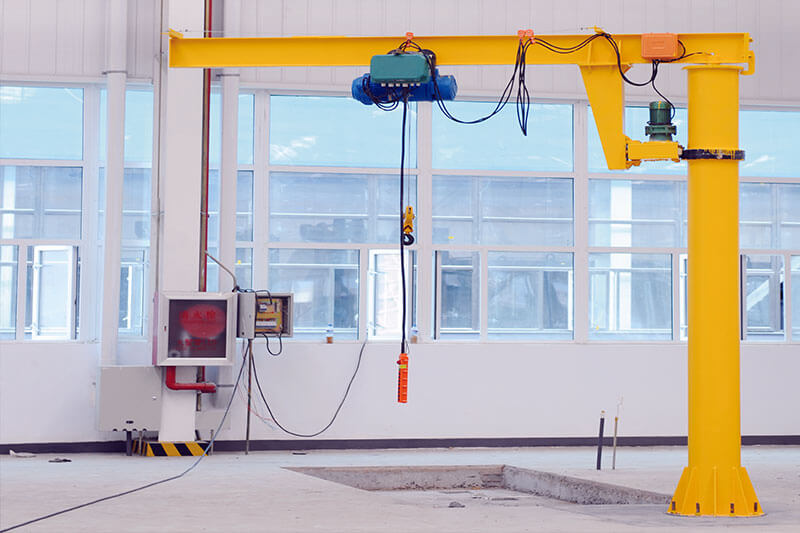
Industrial Jib Cranes for Efficient Workstation Lifting
Industrial Jib Cranes Tailored for Your Industrial Needs
Industrial jib cranes play a vital role in modern industries such as assembly lines, warehousing, steel fabrication, precision workshops, and heavy manufacturing. Their core advantage lies in localized lifting efficiency, spatial flexibility, and cost-effective material handling at the workstation level.
An industrial jib crane is defined by its rotating arm (jib), which pivots around a fixed mounting point to create a semicircular (180°) or full circular (360°) working envelope. Compared to overhead cranes that serve the entire workshop, jib cranes are designed for short-distance, high-frequency, repetitive lifting operations.
Because different working environments require different structural solutions, jib cranes are available in multiple configurations. Before purchasing, buyers typically ask:
- What exactly is an industrial jib crane?
- What types are available and how do they differ?
- How do I choose the correct jib crane for my site conditions?
This guide answers those questions clearly and systematically.
What Is an Industrial Jib Crane?
An industrial jib crane is a compact and highly efficient lifting solution designed to handle materials within a defined workstation area. It is commonly used where materials must be lifted, positioned, and transferred repeatedly over short distances.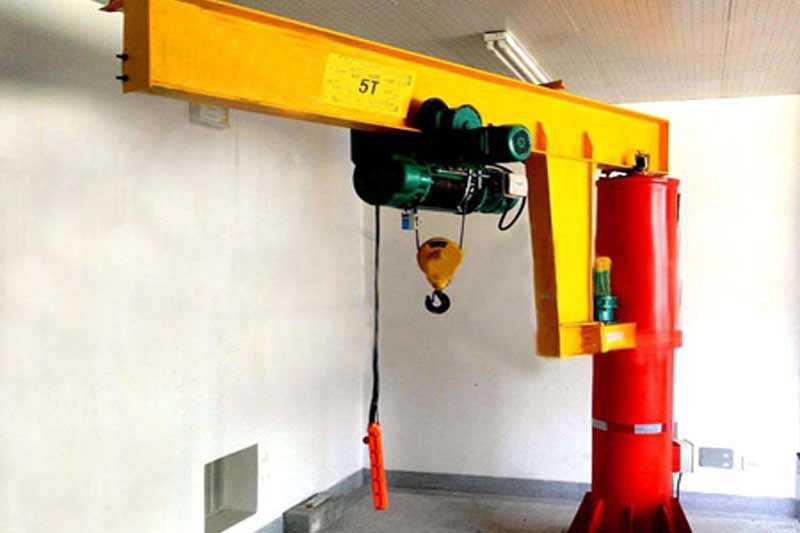
Unlike large overhead crane systems that cover an entire workshop, a jib crane focuses on localized lifting operations, making it ideal for improving productivity at specific workstations.
Industrial jib cranes are widely applied in:
- Local material transfer between work tables or machines
- Machine loading and unloading operations
- Component assembly processes
- Equipment maintenance areas
- High-frequency, repetitive lifting tasks
Because of their simple structure and flexible installation options, industrial jib cranes are especially suitable for production lines that require fast response and ergonomic material handling.
Key Structural Components of an Industrial Jib Crane
Although different types of industrial jib cranes exist (such as free-standing or wall-mounted), their core structural components remain similar.
The supporting structure provides stability and load-bearing capacity. It may include:
- A floor-mounted column (free-standing type)
- A wall bracket fixed to a structural column
- A rail system for wall-travelling types
The choice of supporting structure depends on building conditions and required load capacity.
The jib arm is the primary load-bearing beam that extends horizontally from the support structure.
Its functions include:
- Carrying the hoisting device
- Allowing smooth trolley movement
- Creating the working envelope (180° or 360° coverage)
The arm length directly determines the crane's coverage area.
The hoisting unit is responsible for lifting and lowering loads. Common options include:
- Electric chain hoist (widely used for light to medium duty applications)
- Electric wire rope hoist (used for heavier loads and higher lifting heights)
The hoist selection impacts lifting speed, durability, and total lifting capacity.
The slewing mechanism allows the arm to rotate around its fixed pivot point.
Rotation options include:
- Manual push rotation (suitable for lighter loads)
- Motorized rotation (recommended for heavy loads or high-frequency operations)
Depending on the crane type, the rotation range can be:
- 180° (typical for wall-mounted jib cranes)
- 360° continuous rotation (typical for free-standing jib cranes)
How Industrial Jib Cranes Differ from Overhead Cranes
While both are material handling systems, industrial jib cranes differ significantly from bridge cranes in design and application scope.
Jib Cranes:
- Do not require runway beams
- Require minimal building modification
- Focus on workstation-level lifting
- Offer lower initial investment
- Are easier to install and maintain
- Improve localized workflow efficiency
Overhead Cranes:
- Cover the entire workshop
- Require runway beams and structural reinforcement
- Suitable for heavy-duty, long-distance transport
- Higher installation cost
In many industrial facilities, jib cranes are used to support and relieve the main overhead crane system, reducing congestion and increasing overall productivity.
An industrial jib crane is not simply a smaller version of an overhead crane—it is a specialized workstation lifting tool designed to enhance efficiency, reduce labor strain, and optimize production flow within a defined operating area.
Common Types of Industrial Jib Cranes
Based on structural configuration, industrial jib cranes can be classified into five main types. Each has distinct load capacity, installation requirements, and operational coverage.
A free-standing jib crane is an independent column-mounted lifting solution anchored directly to a reinforced concrete foundation.
It does not rely on the building structure for support.
Key Characteristics:
- 360° × n continuous rotation
- Load capacity up to 10–16 tons (depending on design)
- Jib length up to 12 meters
- Suitable for heavy industrial duty
Advantages
- High structural rigidity and strong load capacity
- Covers full circular working area
- Flexible layout — can be installed anywhere in an open workspace
- Operates independently without structural reinforcement
- Simple design, low maintenance requirements
Limitations
- Higher initial investment
- Requires strong concrete foundation
- Occupies permanent floor space
- Precise installation leveling required (uneven anchor bolts can cause jib drifting)
Typical Applications
- Valve manufacturing workshops
- Steel plate handling with vacuum systems
- Port equipment lifting
- Machine loading areas
A wall-mounted jib crane is fixed to a building wall or structural column and operates within a 180° rotation envelope.
It transfers load forces directly to the building structure.
Key Characteristics:
- 180° rotation
- Typically under 3–5 tons load capacity
- Zero floor occupation
Advantages
- Saves valuable floor space
- Lower overall cost
- Ideal for narrow workshops
- Fast installation using through-bolts or clamp brackets
- Adjustable lifting height
Limitations
- Rotation limited to 180°
- Load limited by wall/column structure
- Requires structural calculation verification
- Can only be installed along workshop perimeters
Typical Applications
- Electrical manufacturing
- Precision instrument assembly
- Production line edge workstations
A wall-travelling jib crane runs along a horizontal rail mounted on the workshop wall or structural columns.
It creates rectangular coverage along an entire production line.
Key Characteristics
- Moves longitudinally
- Rail-mounted system
- No floor space occupied
Advantages
- Expands working range significantly
- Serves multiple workstations
- Operates beneath main overhead cranes without interference
- Efficient multi-layer vertical space utilization
Limitations
- Complex installation
- High building structural requirements
- Additional cost for rail system and electrification
- Requires precise structural alignment
Typical Applications
- Torque converter factories
- Machining workshops
- Production lines with continuous workflow
Articulating jib cranes use dual-joint arms, providing two independent pivot points.
This allows non-linear movement, ideal for obstacle-dense environments.
Key Characteristics
- Main arm + secondary arm
- Maneuvers around columns and machinery
- Highly precise positioning
Advantages
- Extremely flexible
- Reaches into tight or obstructed areas
- Ideal for high-frequency light assembly
- Multiple installation configurations
Limitations
- Lower lifting capacity (usually below 800 kg)
- Higher mechanical complexity
- Increased maintenance on rotational joints
Typical Applications
- Broadcasting equipment production
- Electrical workshops
- Precision assembly lines
Portable jib cranes use a counterweighted base instead of anchor bolts.
They do not require foundation installation.
Key Characteristics
- Forklift-relocatable
- Counterweighted base
- Quick plug-and-play setup
Advantages
- Highly mobile
- No civil foundation required
- Very short installation cycle
- Ideal for changing production layouts
Limitations
- Limited lifting capacity (usually ≤1 ton)
- Short jib length (≤4 meters)
- Large footprint due to counterweight base
Typical Applications
- Wheel handling workshops
- Airport maintenance
- Temporary lifting stations
Quick Technical Comparison Overview
Before selecting an industrial jib crane, it is helpful to compare the core technical parameters side by side. Load capacity, jib length, rotation type, and ideal application environment are the most critical factors influencing performance and investment value. The table below provides a simplified comparison to help you quickly identify which type best aligns with your workshop layout and operational requirements.
| Type | Max Load | Max Jib Length | Rotation | Best For |
|---|---|---|---|---|
| Free-Standing | Up to 16t | 12m | 360° | Heavy-duty independent stations |
| Wall-Mounted | Up to 5t | 6m | 180° | Space-saving edge workstations |
| Wall-Travelling | Up to 5t | 7m | Linear movement | Multi-station production lines |
| Articulating | Up to 0.5t | 6m | Dual-joint | Obstacle-dense precision workshops |
| Portable | Up to 2t | 4m | 360° | Temporary or mobile lifting |
This comparison clearly shows that there is no “one-size-fits-all” industrial jib crane. Free-standing cranes provide the highest load capacity and full rotation, making them suitable for heavy industrial stations. Wall-mounted and wall-travelling systems optimize space utilization, while articulating cranes prioritize flexibility in tight environments. Portable jib cranes offer unmatched mobility but with lower capacity.
The right choice ultimately depends on balancing load requirements, available installation structure, workspace dimensions, and operational frequency. A careful evaluation of these factors ensures your selected industrial jib crane delivers long-term stability, safety, and productivity.
How to Choose the Right Industrial Jib Crane
Selecting the right industrial jib crane requires careful consideration of operational needs, building constraints, and safety factors. A systematic approach ensures that the crane not only meets current production requirements but also accommodates future changes in workflow, load demands, or facility layout. Below is a structured 4-step engineering selection process that industrial buyers can follow to make a confident choice.
Before choosing a jib crane, determine the maximum lifting requirements. This includes:
- Maximum load weight of the material being lifted
- Weight of lifting attachments, such as hoists, magnets, or clamps
- Frequency of operation throughout the day
- Dynamic impact factor caused by sudden starts or stops
Engineering Recommendation:
- Select a rated capacity 15–20% higher than your maximum load to ensure safety and longevity.
- Avoid designing for full-load continuous operation, as this can reduce crane lifespan and increase maintenance.
The crane's operational reach is defined by its rotation and arm length. Consider:
- Required rotation degree (180° for wall-mounted, 360° for free-standing)
- Jib arm length (span) to reach workstations effectively
- Effective reach limitations, especially near obstacles
- Need for obstacle avoidance in crowded or column-heavy areas
Decision Logic:
- Need 360° full rotation? → Free-standing jib crane
- Need to save floor space? → Wall-mounted jib crane
- Need to maneuver around obstacles? → Articulating jib crane
- Need multi-station coverage along a line? → Wall-travelling jib crane
- Need to relocate between workstations? → Portable jib crane
Height is critical to ensure safe and efficient lifting. Measure:
- Height under boom (HUB) to accommodate maximum lifting height
- Hoist body height, including any attachments
- Clearance for load attachments
- Distance to overhead obstructions such as lighting, HVAC ducts, piping, or main overhead cranes
Verify that there is no interference with existing structures, which could limit lifting height or rotation.
Choose the hoist operation method and control system based on load and usage frequency:
- Manual operation: Suitable for loads under 1 ton and infrequent lifting
- Motorized slewing: Recommended for heavy loads, frequent rotation, or to reduce operator fatigue
Control options include:
- Pendant push-button
- Wireless remote control
- Gravity-sensing handle for articulating jib cranes
Why Proper Selection Matters
Choosing the right industrial jib crane goes beyond simply meeting lifting requirements. The selection process directly affects safety, efficiency, and long-term performance. A crane that is not properly matched to your workspace, load requirements, or structural conditions can lead to costly problems and operational disruptions.
Consequences of Choosing the Wrong Crane
When a crane is incorrectly selected, it can cause multiple issues that impact both the facility and the workforce. These problems include:
- Insufficient capacity – Lifting loads beyond the crane’s rated limit can cause hoist failure or structural damage.
- Cracking or damage to the foundation – If the foundation cannot handle the crane’s weight and dynamic forces, it may crack or become unstable.
- Excessive structural stress – Overloading or poor installation can weaken the crane’s column, jib, or slewing mechanism over time.
- Reduced equipment lifespan – Continuous operation under improper conditions accelerates wear and decreases overall service life.
- Safety risks for operators and personnel – A misapplied crane increases the risk of accidents, dropped loads, or other hazardous situations.
- Operational inefficiencies – Production slows down due to limited coverage, restricted rotation, or frequent downtime caused by maintenance issues.
Benefits of Proper Selection
Selecting the right crane ensures that your equipment functions efficiently, safely, and reliably. When engineered correctly, a properly chosen jib crane provides:
- Maximum productivity – Optimized positioning and coverage allow materials to be moved efficiently within the workspace.
- Extended equipment life – Correct capacity and installation reduce wear and prevent premature failure.
- Lower maintenance costs – Reliable operation minimizes the need for repairs and downtime.
- Safe and stable performance – The crane operates smoothly, keeping both operators and materials safe during lifting operations.
By carefully evaluating load, workspace, and operational requirements, industrial buyers can ensure that their jib crane delivers long-term performance, safety, and efficiency.
Custom Engineering Support
Every workshop has its own unique layout, structural characteristics, and operational workflow. Because of this, standard jib crane models may not always provide the performance or safety required for certain facilities.
Facilities that may require a customized approach include those with:
- Limited headroom that restricts safe lifting heights
- Complex obstacles such as columns, piping, or machinery
- Weak or non-standard column structures
- Uneven floor foundations
- High-frequency or heavy repetitive lifting
In these scenarios, relying on a standard crane could lead to safety risks, reduced efficiency, or premature wear.
Our engineering team, with experience exporting to over 100 countries, provides tailored solutions to ensure your jib crane fits your facility perfectly. Custom support includes:
- Verifying structural compatibility with your building
- Designing custom jib arm lengths for optimal coverage
- Providing foundation calculation guidance for safe installation
- Configuring cranes for special environmental conditions
- Optimizing workstation layouts for maximum efficiency
With this level of engineering support, your industrial jib crane can be fully adapted to your space, workflow, and lifting requirements, ensuring safety, efficiency, and long-term reliability.
Final Recommendation
Industrial jib cranes are specialized tools designed to enhance workstation efficiency. They are not one-size-fits-all solutions and must be carefully matched to your facility’s requirements.
Key factors to consider when selecting a jib crane include:
- Load characteristics – the weight, frequency, and type of materials being lifted
- Building structure – floor strength, column capacity, headroom, and ceiling constraints
- Production workflow – the arrangement of workstations, machinery, and material flow
- Future expansion plans – potential changes in layout, load requirements, or additional workstations
By selecting the right jib crane from the start, you can avoid costly modifications, downtime, and safety risks later, ensuring that your lifting operations remain efficient, safe, and reliable for years to come.