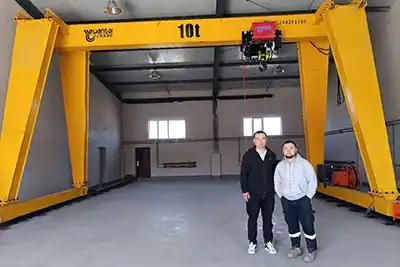
How a Gantry Crane Stands on One Rigid and One Hinged Leg
Rigid Leg vs. Flexible Leg — What You’re Really Seeing
If you’ve ever walked through a shipyard and stood under one of these massive shipyard gantry cranes, you might have noticed something that feels a bit “off.” One leg stands straight like a soldier; the other leans slightly, looking almost unsure of itself. But that’s not poor design — it’s intentional engineering.
How It Actually Works
- Rigid Leg (the straight one):
This leg is fixed directly to the main girder, creating a solid “L” shape. It carries the vertical load and maintains the crane’s lateral stability. It’s the strong, no-nonsense part that anchors the entire system. - Flexible Leg (the tilted one):
This one’s built with hinges on both the top and bottom, allowing for slight angular movement. Why? Because when the crane travels along the rails, temperature changes or uneven ground can create tiny misalignments. The flexible leg absorbs those without twisting the main structure.
In shipbuilding yards, where gantry cranes may stretch over 100 meters in span, that flexibility is not just convenient — it’s vital. Without it, the rails would suffer excessive stress, and the crane could jam or even deform over time.
Practical Insight for Buyers
If you’re sourcing a shipbuilding gantry crane, pay attention to how the flexible leg is designed:
- Check whether the hinge joints are sealed and protected from salt air or dust — coastal environments can wear them fast.
- Confirm the traveling mechanism under the flexible leg uses a floating or articulated design; that prevents wheel overload when moving on uneven tracks.
- Ask your supplier for finite element analysis (FEA) reports or drawings that show how the girder handles torsion between the two legs — it’s a quick way to judge whether the crane is truly engineered for long-span shipyard use.
In short, that “odd-looking” leg pair isn’t a flaw. It’s what makes the crane capable of working across vast docks, supporting massive blocks of hull steel, day after day — without cracking under the pressure.
Let’s Imagine the Force Model
Okay, let’s get a bit hands-on with mechanics. Imagine a horizontal force acting at the top of the gantry crane — maybe a gust of wind, or the crane moving slightly off track causing skew. How does this force travel through the massive steel frame?
If you were to draw a free-body diagram, here’s what you’d notice:
- Rigid Leg: This leg takes the full horizontal load. Think of it like a vertical cantilever beam, solidly fixed at the base. Every horizontal push at the top turns into a bending moment at the bottom. It’s the workhorse, keeping the whole frame stable.
- Flexible Leg: This one behaves differently. Because it’s hinged at both ends, it doesn’t carry bending moment at all. Instead, it handles only axial forces — one side in tension, the other in compression, depending on the force’s direction.
The neat part? Together, these two legs form a self-balanced frame. One side pushes, the other pulls, and the structure maintains equilibrium.
Practical Takeaways for Buyers and Engineers
- When evaluating a shipbuilding gantry crane, check if the rigid leg is designed to handle both vertical and horizontal forces without excessive bending.
- Look at the flexible leg connection: proper hinge design ensures that misalignment or thermal expansion won’t induce unintended stress.
- Ask for moment and axial force diagrams from the supplier — it shows exactly how forces distribute across the crane frame, confirming structural integrity.
- This setup is simple in mechanics but highly effective — even with a tilted flexible leg, the crane remains fully stable under realistic loads.
In short, the force travels exactly where it should. The rigid leg anchors the structure, the flexible leg compensates, and the whole crane stays balanced. It’s engineering at its quiet, practical best.
Even if the Flexible Leg Is Inclined
Here’s the interesting part: even if the flexible leg leans outward a bit, the whole structure still stands firm. Surprising at first, right? But mechanically, it makes perfect sense.
The reason lies in the load path — the way forces travel through the crane frame. The geometry changes slightly, shifting reaction forces at the bases, but the static determinacy of the system doesn’t change. In other words, the structure is still fully stable.
Why It Works
- Rigid Leg: Anchors the crane and carries both vertical and horizontal loads. It’s the backbone.
- Flexible Leg: Handles vertical load only, absorbing alignment errors, thermal expansion, or slight track irregularities.
- Combined Effect: One side pushes, the other pulls — equilibrium is maintained.
Even with the flexible leg tilted, the system behaves predictably. The crane stays upright, rails aren’t overloaded, and bending moments remain within design limits.
Practical Insights for Buyers and Engineers
- When assessing a gantry crane, don’t be alarmed by a slightly angled flexible leg. It’s intentional design, not a flaw.
- Verify the hinge and connection design: they must allow small angular movement without loosening or wearing prematurely.
- Ask suppliers for force diagrams or FEA analysis to see how the structure handles maximum horizontal and vertical loads.
From a pure statics perspective, it works perfectly. From an engineering point of view, it’s almost elegant — simple, strong, and reliable.
If you’ve mentally traced the bending-moment diagram, congratulations — you just explored a real-life mechanics lesson hidden in a giant steel frame. Now it probably doesn’t look so intimidating anymore.