Single Girder vs. Double Girder Top Running Cranes – Buyer’s Guide
Compare single and double girder top running cranes. Learn load capacities, span, hoist types, costs, and maintenance tips to choose the right crane for your workshop.
Single Girder vs. Double Girder Top Running Cranes – How Buyers Should Choose
The Role of Top Running Cranes
Top running overhead cranes are widely used in workshops, warehouses, and industrial plants. They travel on rails mounted at the top of runway beams, which allows them to cover the entire working area. From lifting steel components in fabrication shops to moving machinery in assembly lines, these cranes handle the jobs that go far beyond what forklifts or manual methods can do.
The Buyer’s Dilemma: Single vs. Double Girder
When it comes to choosing a top running crane, most buyers face the same question: single girder or double girder?
- Single girder cranes: generally lower in cost, lighter in structure, and easier to install.
- Double girder cranes: higher lifting capacities, greater durability, and more suitable for heavy-duty or long-span applications.
At first glance, both options can seem right. That’s why many buyers hesitate—spending too much can feel unnecessary, but underestimating future needs can lead to costly upgrades later.
Why This Guide Matters
The goal here is not to overwhelm you with technical terms, but to provide clear, practical guidance. By comparing single girder and double girder top running cranes, we’ll focus on the points that really affect your decision:
- Lifting capacity requirements now and in the future.
- The span and height of your workshop.
- How often and how hard the crane will be working.
- Your budget and the long-term value of the investment.
With these factors in mind, you’ll be able to choose the crane type that matches your facility and workload, ensuring both efficiency and cost control.
Understanding the Basics
Single Girder Top Running Crane
A single girder crane is built with just one main beam across the span. The hoist runs on the lower flange of this beam, which keeps the overall structure lighter and simpler. Because of its design, the crane requires less steel, is easier to install, and puts less stress on the building.
- Capacity & Span: usually handles 1–20 tons, with spans up to 25 meters.
- Best Fit: light to medium duty work, such as material handling in small factories, warehouses, assembly shops, and service bays.
Double Girder Top Running Crane
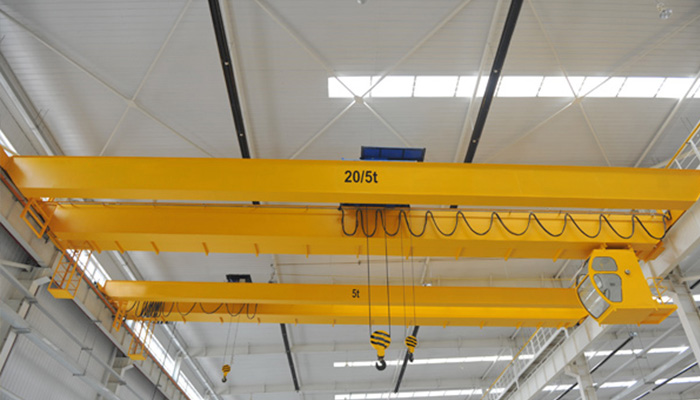
A double girder crane is built with two main beams. The hoist trolley runs on rails installed on top of the girders, giving the system greater strength and higher lifting ability. The extra girder also makes it possible to add walkways, platforms, or auxiliary hoists for more demanding operations.
- Capacity & Span: commonly designed for 10 tons to 500+ tons, with spans that can extend well beyond 25 meters.
- Best Fit: heavy-duty industries like steel production, shipbuilding, power plants, and large-scale manufacturing where cranes are used frequently and reliability is critical.
Key Differences Between Single and Double Girder Cranes
One of the clearest differences is how much weight each type can handle.
- Single girder cranes are generally used for lighter applications, handling loads from 1 ton up to about 20 tons. They are ideal for workshops and warehouses where lifting requirements are moderate.
- Double girder cranes, by contrast, are designed for heavy-duty lifting. They start at 10 tons and can reach 500 tons or more, making them the go-to choice for steel mills, shipyards, and other industries with demanding workloads.
The girder design also impacts how far and how high the crane can lift.
- Single girder cranes are well suited for short to medium spans (up to around 25 meters). Their design also limits the maximum lifting height since the hoist hangs below the girder.
- Double girder cranes can handle long spans over 25 meters and allow higher lifting heights because the hoist trolley runs on rails mounted on top of the girders. This makes them practical for large plants or workshops with tall equipment.
The choice of hoist often follows the girder design.
- Single girder cranes typically use underslung hoists, which run on the lower flange of the girder. They often come in electric chain or wire rope versions, depending on the lifting need.
- Double girder cranes usually carry a top-mounted wire rope hoist trolley. This design offers better stability, higher speeds, and more lifting height, which is essential for heavier loads.
The installation process and building conditions also play a big role in the decision.
- Single girder cranes are lighter, require less steel in the runway structure, and can be installed in workshops with limited headroom. They are easier to fit into smaller buildings without major modifications.
- Double girder cranes are heavier and need stronger runway beams and more overhead space. They may require additional civil work but provide more flexibility for future upgrades.
Price is often the first thing buyers notice, but it should be weighed carefully.
- Single girder cranes cost less in terms of material, installation, and overall investment. They are economical for lighter duties and smaller facilities.
- Double girder cranes come with a higher upfront cost, but the long-term value is in their durability, ability to handle continuous operation, and lower risk of overload or downtime in demanding industries.
How easy the crane is to maintain can affect long-term operating costs.
- Single girder cranes are simpler to inspect and maintain, with fewer components and less complex structures. Spare parts are generally easier to source and replace.
- Double girder cranes require more thorough inspections and a higher level of maintenance due to the larger number of components. However, they are built for heavy-duty use, and with proper servicing, they can last decades in tough environments.
| Feature | Single Girder Crane | Double Girder Crane |
|---|---|---|
| Load Capacity | 1–20 tons Good for lighter loads Small to medium workshops |
10–500+ tons Built for heavy-duty use Steel mills, shipyards |
| Span & Lift Height | Short to medium spans (~25 m) Limited lifting height |
Long spans (>25 m) Higher lifting height |
| Hoist Type | Underslung hoist Chain or wire rope |
Top-mounted wire rope hoist More stable and faster |
| Installation & Space | Lighter structure Easier to install Needs less headroom |
Heavier structure Requires stronger runway beams More overhead space |
| Cost | Lower upfront cost Good for small budgets |
Higher upfront cost Better long-term for heavy-duty use |
| Maintenance | Simple to inspect and maintain Spare parts easy to find |
More components Needs careful maintenance Lasts decades with care |
Buyer Considerations: How to Choose
When to Choose a Single Girder Crane
A single girder top running crane is often the most practical choice for workshops that don’t need heavy lifting. It’s lighter, easier to install, and more cost-effective, which makes it very attractive for smaller businesses or plants with limited budgets.
You should consider a single girder crane if:
- Your loads are generally under 20 tons.
- The span of your workshop is short to medium, usually below 25 meters.
- The crane will not run continuously but instead be used occasionally or for lighter cycles.
- You want to keep costs down on both the crane and the supporting building structure.
This type of crane is a good fit for workshops that handle materials occasionally, assembly lines for small machinery, and warehouses where the workload is steady but not excessive.
When to Choose a Double Girder Crane
If your workshop or factory handles heavy materials daily or you are planning for future growth, a double girder crane is a safer investment. With two main beams, the crane can lift higher and span farther, while also providing more stability under frequent or heavy loads.
You should consider a double girder crane if:
- Your loads are 20 tons or more, sometimes reaching hundreds of tons.
- You need long spans or greater lifting heights to clear tall equipment or cover a wide workshop.
- Your operation is continuous or heavy-duty, such as in steel mills, shipyards, foundries, or large-scale manufacturing plants.
- You want to prioritize stability, durability, and the ability to expand in the future.
Although the upfront investment is higher, double girder cranes pay off in industries where downtime or overloading could lead to costly delays and safety risks.
Overlooked Factors Buyers Should Check
Many buyers focus only on lifting capacity and cost when choosing between a single or double girder crane. However, some less obvious factors can have a big impact on performance and long-term value. Skipping these checks often leads to hidden costs later.
- Power Supply Compatibility
Before finalizing a crane, confirm that the workshop’s power supply matches the crane’s requirements. Voltage differences, frequency mismatches, or unstable power sources can affect hoist performance and even shorten equipment life. - Future Workshop Expansion or Load Upgrades
Think beyond today’s needs. If your workshop may expand, or if product weights are expected to increase, choosing a crane that allows upgrades or higher capacity later will save on replacement costs. - Local Fabrication Capability (for Crane Kits)
Some buyers prefer to purchase crane kits without the main girders to save on shipping and use local steel fabrication. If this is the case, make sure your team or local partner has the technical capability to fabricate girders accurately and safely. - Long-Term Maintenance Costs
The initial price is just one part of the investment. Regular inspections, spare parts availability, and repair costs should all be factored in. A crane that looks cheaper at first may turn out to be more expensive over its lifetime if maintenance is difficult or costly.
Cost vs. Value: Making the Smart Investment
Why the Lowest Price Is Not Always the Best Choice
When comparing single girder and double girder cranes, it’s tempting to look only at the purchase price. A single girder crane usually costs less upfront because it requires less steel, simpler installation, and lighter supporting structures. But going with the lowest bid can backfire if the crane cannot keep up with your workload, or if frequent repairs push up operating costs.
Balancing Budget with Safety, Efficiency, and Future Needs
A crane is not just a one-time purchase — it’s an investment in safe and efficient production. Choosing wisely means weighing the budget against long-term factors:
- Safety: A crane that’s under-sized for the job may overload and create serious risks.
- Efficiency: A crane with too little capacity or span may slow down material handling and affect productivity.
- Future needs: Spending slightly more today for a crane that can handle expansion tomorrow is often cheaper than replacing the entire system later.
Example Scenarios: Single vs. Double Girder ROI
- Small Workshop Example: A mechanical workshop lifting loads under 10 tons a few times a day may find a single girder crane provides the best return. The lower purchase cost and easy installation meet the workload without straining the budget.
- Steel Plant Example: A steel plant running 24/7 with loads over 20 tons is better served by a double girder crane. Even though the upfront cost is higher, the crane’s stability, higher capacity, and durability prevent downtime, making it more economical in the long run.
- Future Growth Example: A mid-sized factory lifting 15 tons today but planning to expand production to 25 tons within two years might choose a double girder design. The higher initial cost avoids the expense and disruption of upgrading later.
Conclusion
Choosing between a single girder and double girder top running crane doesn’t have to be confusing. The main differences come down to load capacity, span, lifting height, duty cycle, and installation requirements. Single girder cranes are lighter, easier to install, and cost-effective for lighter loads and shorter spans. Double girder cranes offer higher lifting capacity, longer spans, and durability for heavy-duty, continuous operations.
When making a decision, focus on what matters most for your workshop:
- Load – the weight of the materials you move regularly.
- Span & Height – the size of your facility and lifting requirements.
- Duty Cycle – how often and how hard the crane will work.
- Budget & Long-Term Value – not just initial cost, but maintenance and future needs.
Investing in the right crane ensures safer, more efficient operations and prevents costly downtime or upgrades in the future. For tailored advice and a detailed quotation based on your specific needs, contact Yuantai Crane. Our team can help you choose the crane that perfectly fits your workshop and workflow.