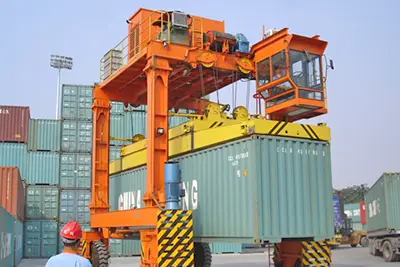
Straddle Carrier vs Mobile Gantry Crane |Best Heavy Lift Solution
Straddle Carrier vs. Mobile Gantry Crane: Which is Right for Your Project?
Most Important Takeaway
Choosing between a straddle carrier and a mobile gantry crane depends on your load type, route flexibility, handling speed, and overall cost efficiency. For high-volume container yards or irregular heavy-load transport, straddle carriers offer mobility and route adaptability, while mobile gantry cranes excel in precise lifting and fixed-lane operations.
Key Takeaways
- ✅ What equipment best fits my load types? Compare capacities and lifting styles for industrial containers, modular units, and oversized cargo.
- ✅ Which solution adapts better to yard or site layouts? Assess maneuverability in narrow lanes, multi-lane stacks, or complex industrial paths.
- ✅ How do operational costs compare? Understand energy consumption, maintenance, and crew requirements.
- ✅ Which provides more handling flexibility? Evaluate multi-directional travel, turning capabilities, and lifting configurations.
- ✅ Which equipment is more suitable for long-term investment? Consider lifespan, scalability, and site expansion potential.
Introduction
Handling heavy loads in industrial settings is rarely a one-size-fits-all task. Factories, steel mills, shipyards, and container terminals all have unique requirements. Some need to move massive slabs of steel across open yards. Others need to lift modular machinery in confined spaces. And still, others face the daily challenge of moving irregular, non-standard cargo safely and efficiently. Choosing the right equipment isn’t just about lifting capacity—it’s about adaptability, speed, and long-term cost.
Straddle carriers and mobile gantry cranes are two of the most commonly compared options in industrial lifting. Both are designed to move heavy loads, but each has its own strengths and limitations. Straddle carriers are self-propelled vehicles that straddle the load and transport it, often over long distances or across container yards. Mobile gantry cranes, on the other hand, are wheeled or rail-mounted frames that lift and move cargo along a defined path, providing precise placement for large or irregular items. The choice between them often comes down to the specifics of the load and the layout of the worksite.
In practical operations, there are three main challenges to consider:
- Yard transfer: Moving heavy loads across uneven surfaces, narrow lanes, or long distances requires equipment that can handle not just weight, but also route flexibility.
- Container handling: Terminals and storage yards often need equipment that can quickly move standard-sized containers while minimizing labor and time.
- Non-standard load handling: Many industrial projects involve irregular shapes or oversized cargo that doesn’t fit traditional lifting methods. Both straddle carriers and mobile gantry cranes can address these challenges, but in different ways. Knowing the operational environment and specific load characteristics is key to making the right choice.
Straddle Carrier Crane & Mobile Gantry Crane
When comparing straddle carriers and mobile gantry cranes, it’s important to know not just what they are, but how they actually operate on the ground. Both serve the same goal—moving heavy loads—but the way they move, lift, and handle cargo is very different. Understanding these differences helps buyers make informed decisions for their specific industrial needs.
Straddle Carrier
Straddle carriers are self-propelled vehicles designed to lift and transport heavy loads by straddling them. They don’t just lift—they pick up the load, move it, and place it in position, all in one operation. This makes them particularly useful in busy container yards, industrial storage areas, and projects handling oversized or irregular cargo.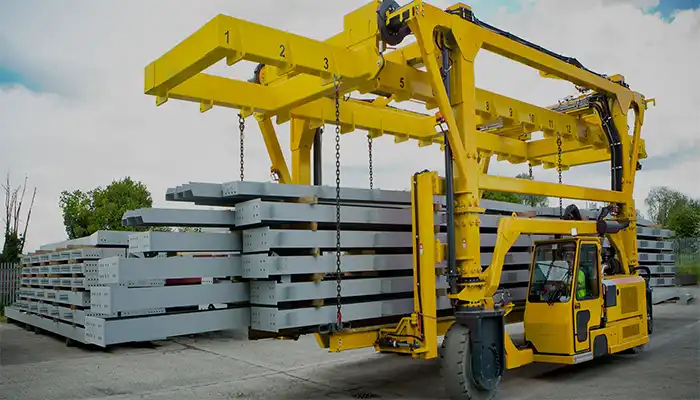
straddle carrier
- Versatile load handling: Straddle carriers can manage high-density containers, heavy modular units, and unusual shapes that don’t fit traditional lifting setups.
- Multi-directional movement: Unlike cranes fixed to rails or lanes, straddle carriers can move forward, backward, sideways, and even use crab-style steering to navigate tight spaces.
- Efficiency in yard operations: Because they combine lifting and transport in one machine, they reduce the need for multiple pieces of equipment or additional handling steps.
In practice, a straddle carrier excels when the worksite requires flexibility. It’s not just about carrying weight—it’s about being able to move that weight safely through complex routes.
Mobile Gantry Crane
Mobile gantry cranes are wheeled or rail-mounted lifting frames that operate along defined paths. They don’t usually move freely across open yards like straddle carriers. Instead, they provide precision lifting and placement, making them ideal for projects where accuracy is critical, such as industrial assembly lines, machinery installation, or modular construction sites.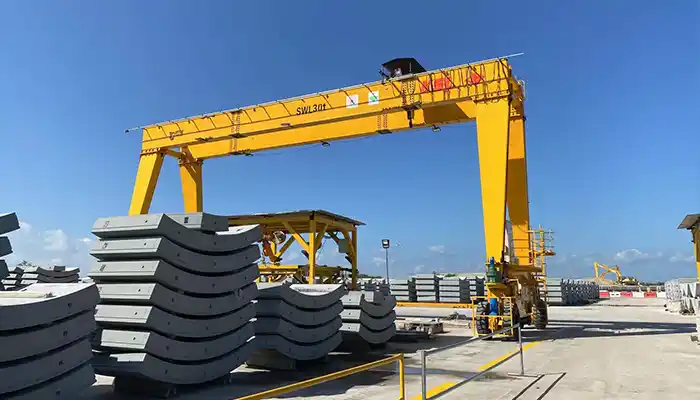
Rubber tyred mobile gantry cranes
- High lifting capacity: Mobile gantry cranes can handle extremely heavy loads with very accurate control, which is crucial when working with sensitive or oversized materials.
- Defined movement paths: Rails or guided wheels keep the crane on a fixed route, reducing the risk of accidental sway or misplacement during lifting.
- Precise load positioning: For industrial projects where alignment matters, mobile gantry cranes provide the control needed to safely place heavy modules or components exactly where they belong.
Mobile gantry cranes shine in projects where the environment is more controlled, and the loads need careful placement rather than long-distance transport. They’re built for reliability, repeatable accuracy, and lifting large weights safely.
Both types of equipment serve heavy industrial lifting, but the choice comes down to whether you need mobility and route flexibility or precision and defined-path lifting. The next sections will break down how these differences affect capacity, operational flexibility, and cost.
Straddle Carrier vs Mobile Gantry Crane Comparison
This section explores the practical differences between straddle carriers and mobile gantry cranes in industrial lifting operations. Understanding these factors helps buyers choose the most suitable equipment for their projects, considering load types, site conditions, operational flexibility, costs, and safety.
| Feature / Factor | Straddle Carrier | Mobile Gantry Crane | Practical Notes / Applications |
|---|---|---|---|
| Primary Function | Lift and transport loads across yards | Lift and place loads along defined paths | Straddle carriers combine lifting and transport; gantry cranes focus on precision placement |
| Load Capacity | Medium to heavy (20–60 tons typical; custom units higher) | Wide range (10 tons up to several hundred tons) | Straddle carriers ideal for containers and modular cargo; gantry cranes for oversized machinery or steel beams |
| Load Types | Containers, modular units, irregular or non-standard loads | Oversized machinery, steel beams, industrial modules | Straddle carriers handle multi-shaped cargo; gantry cranes handle precise and heavy loads |
| Movement / Route Flexibility | Multi-directional: forward, backward, sideways, crab steering | Limited: rail-mounted, guided wheels, or fixed paths | Straddle carriers excel in open yards; gantry cranes are best for repeatable lift-and-place tasks |
| Site Adaptability | Open yards, uneven surfaces, tight lanes | Smooth, prepared paths; rails or guides recommended | Straddle carriers better for variable terrain; gantry cranes need stable surfaces |
| Operational Flexibility | Adjustable spreaders, multi-lifting modes, integration with yard management systems | Specialized lifting rigs, precise positioning, semi-automation potential | Straddle carriers ideal for flexible workflow; gantry cranes ideal for controlled, high-accuracy tasks |
| Speed / Efficiency | Fast transport and stacking; reduces handling steps | Slower lateral movement; high lifting precision | Straddle carriers reduce multiple handling steps; gantry cranes excel in precise placement |
| Installation & Site Prep | Minimal foundation or site prep required | Higher foundation and rail/track preparation | Straddle carriers can operate in existing yards; gantry cranes often need reinforced surfaces |
| Cost Considerations | Higher upfront cost, lower long-term labor & site prep costs | Lower purchase cost, higher installation and foundation costs | Total cost of ownership favors straddle carriers in long-term, mobile operations |
| Maintenance | Moderate, depends on engine/power source (electric/diesel) | Moderate to high, depends on structural components and movement mechanisms | Regular inspections critical for both; gantry cranes require rail maintenance |
| Safety Considerations | Stability during travel, load sway management, visibility, minor terrain variations | Load sway control, operator visibility, fixed-path stability | Straddle carriers safer in open yards; gantry cranes safer in controlled lift zones |
| Best Applications | Container yards, port terminals, industrial yards with non-standard cargo | Steel workshops, modular building assembly, machinery plants | Hybrid approach can combine mobility of carriers and precision of gantry cranes |
| Automation Potential | High: GPS, yard management system integration, semi-autonomous operation | Medium: semi-automation, precision control for lifting tasks | Modern yards benefit from automated straddle carriers for high throughput; gantry cranes can integrate sensors for load accuracy |
Practical Insight:
- Choose straddle carriers if your operation requires yard mobility, container handling, and flexible load transport.
- Choose mobile gantry cranes if your operation demands high lifting capacity, precise placement, and structured workflows.
- Hybrid solutions provide the best of both worlds, particularly for projects with varied load types and site conditions.
When choosing between straddle carriers and mobile gantry cranes, understanding the load capacity is crucial. It's not just about how much weight a machine can lift—it's also about the type of load, how it needs to be moved, and the operational context.
Straddle Carriers
Straddle carriers typically handle medium-to-heavy loads, ranging from around 20 to 60 tons. Some custom-built units can lift even more, depending on project requirements.
- Practical load handling: Ideal for containers, modular units, and irregularly shaped cargo that needs to be transported across yards rather than just lifted.
- Integrated transport: Unlike cranes that lift and then require another vehicle for moving loads, straddle carriers combine lifting and transport in one machine.
- Flexibility over raw capacity: They may not match the absolute lifting limits of large gantry cranes, but they excel in moving heavy loads over varying routes efficiently.
In short, straddle carriers are about balancing weight capacity with operational flexibility. For industrial projects where loads need to travel long distances or navigate tight yards, they often outperform stationary or rail-guided cranes.
Mobile Gantry Cranes
Mobile gantry cranes cover a much wider capacity range—from around 10 tons for smaller units up to several hundred tons for heavy industrial applications.
- High-precision lifting: They are ideal when the priority is accurate placement rather than moving the load over long distances.
- Large and irregular loads: Perfect for oversized machinery, steel beams, or modular construction components that require controlled lifting.
- Defined-path efficiency: While they may not have the same route flexibility as straddle carriers, their ability to lift heavier loads safely is unmatched in many industrial projects.
Mobile gantry cranes are all about raw lifting power. They shine in settings where load weight exceeds the limits of most self-propelled vehicles, and precision placement is critical.
Non-Standard Loads
Both equipment types can handle irregular or non-standard cargo, but in different ways:
- Straddle carriers excel with modular units, containers, and items that must move across yards.
- Mobile gantry cranes excel with oversized machinery or components that require exact placement in confined industrial spaces.
Practical Insight
Choosing the right equipment is not just a matter of weight:
- If your project requires moving heavy loads across varying routes, prioritize flexibility—straddle carriers are better suited.
- If your project involves extremely heavy or oversized loads that need precise placement, prioritize raw capacity—mobile gantry cranes are more appropriate.
The type and shape of your load often determine which solution will deliver better efficiency, safety, and cost-effectiveness in the long run.
In industrial lifting, the path a machine can travel is just as important as how much it can lift. A crane or carrier that handles heavy loads perfectly may still struggle if the worksite is tight, uneven, or has complex lanes. Understanding how each type of equipment adapts to the working area is essential for efficiency and safety.
Straddle Carrier
Straddle carriers shine when the work environment is flexible but demanding. They are self-propelled and designed to move over open yards, navigate multiple lanes, and adjust to routes that aren't perfectly straight.
- Multi-directional movement: Forward, backward, sideways, and crab-style steering allows them to operate in narrow or congested spaces.
- Flexible yard operations: Ideal for container terminals, modular unit yards, and industrial areas with irregular layout.
- Adaptability to terrain: Can handle slight surface variations, small slopes, and uneven industrial floors better than fixed-path cranes.
In practice, if your project site has varying pathways, open storage areas, or requires maneuvering around other equipment, a straddle carrier offers unmatched flexibility.
Mobile Gantry Crane
Mobile gantry cranes are excellent for precision lifting but are more limited in route flexibility. They typically run on rails, guided wheels, or semi-fixed paths. This makes them very effective for repetitive lift-and-place tasks, but less adaptable to irregular routes or multi-directional travel.
- Defined-path efficiency: Rails or guides provide stability and precise load control, perfect for fixed industrial lanes or assembly operations.
- Optimized for repetition: Ideal for projects where the same lifting operation is performed continuously in a predictable route.
- Limitations: Not suitable for wide-open yards with irregular terrain or areas that require lateral movement beyond their guide paths.
Case Scenarios
- Tight industrial corridors: Straddle carriers navigate narrow lanes more easily than rail-based gantry cranes.
- Multi-lane stacking: Straddle carriers can travel sideways and adjust positioning, while mobile gantry cranes require pre-planned routes.
- Irregular terrain or uneven surfaces: Straddle carriers handle minor slopes and bumps, whereas gantry cranes need smooth, prepared paths.
Practical takeaway: For yards and industrial projects where loads need to move over long distances, around obstacles, or in multi-directional ways, straddle carriers are typically more practical. Mobile gantry cranes are best where lifting precision and repeatable, defined-path operations are the priority.
Operational flexibility is a key factor when deciding between straddle carriers and mobile gantry cranes. It's not enough for a machine to lift heavy loads—it must also adapt to the unique demands of your project, whether that's handling irregular cargo, moving quickly across a yard, or integrating with automated systems.
Multi-Lifting Modes and Spreader Adaptations
Modern lifting equipment often comes with adjustable lifting options. Straddle carriers and gantry cranes can be fitted with different spreaders, hooks, or clamps depending on the type of cargo.
- Straddle carriers: Typically use adjustable spreaders to handle containers of various sizes, modular units, or bundled industrial components.
- Mobile gantry cranes: Can be equipped with specialized lifting rigs for oversized machinery, heavy beams, or delicate modular parts.
- Practical insight: The right lifting mode ensures the load is stable, reduces handling damage, and increases overall operational efficiency.
Handling Non-Standard or Modular Cargo
Industrial projects rarely involve perfectly standard loads. Modules, machinery, oversized steel, or irregular containers require machines that can adjust to different shapes and sizes.
- Straddle carriers: Excel at carrying modular cargo, containers, or units that need to move through varying routes. Their multi-directional travel allows precise positioning in tight spaces.
- Mobile gantry cranes: Better suited for lifting non-standard loads in controlled areas where placement accuracy is critical.
- Practical insight: Choosing equipment that can handle non-standard cargo reduces the need for extra equipment or repeated handling.
Ease of Integration with Yard Management Systems and Automation
Efficiency often depends on how well the equipment integrates with existing systems. Automation and software controls are increasingly important in modern industrial operations.
- Straddle carriers: Many models can integrate with yard management systems, GPS tracking, and automated stacking software, making them ideal for container terminals or modular storage yards.
- Mobile gantry cranes: Can work with semi-automated systems for precise placement and synchronized operations on fixed paths.
- Practical insight: Equipment that communicates with yard management software reduces errors, improves speed, and minimizes operational risk.
Impact of Turning Radius, Speed, and Stacking Capabilities
The physical design of the equipment affects how efficiently it can operate in real-world conditions.
- Straddle carriers: Compact turning radius, adjustable speed, and ability to stack or reposition loads in multiple directions. Perfect for yards with multi-lane storage or variable traffic.
- Mobile gantry cranes: Larger turning requirements and slower lateral movement, but excel in repetitive lift-and-place operations where precision and heavy lifting outweigh flexibility.
- Practical insight: Operational efficiency isn't just about lifting capacity—it's also about how quickly and safely the load can be moved and positioned.
Takeaway: Operational flexibility goes beyond lifting weight. It's about how well the equipment adapts to your cargo types, yard layout, automation requirements, and workflow. Straddle carriers provide versatility and mobility, while mobile gantry cranes offer precision and stability in controlled environments.
Cost is one of the first considerations for any industrial project. But it's not just about the purchase price—operational efficiency, maintenance, energy consumption, and total cost of ownership all matter. Comparing straddle carriers and mobile gantry cranes in these terms can help project planners make informed, practical decisions.
Straddle Carriers
Straddle carriers generally come with a higher upfront cost, but they offer savings in other areas that can make them economical over time.
- Lower site preparation: Unlike gantry cranes that may require heavy foundation work or rail installation, straddle carriers need minimal preparation, which reduces initial project downtime.
- Flexible labor requirements: Operators can often handle multiple operations in one unit—lifting, transporting, and positioning—reducing the number of personnel needed.
- Operational speed and energy use: Many straddle carriers are designed for efficient travel across yards, and modern electric models provide a balance between performance and energy efficiency.
Practical insight: While initial investment is higher, the overall efficiency and reduced site setup costs often make straddle carriers a cost-effective solution for long-term yard operations or projects with high mobility demands.
Mobile Gantry Cranes
Mobile gantry cranes typically have a lower unit cost but may require additional investments to operate effectively.
- Higher installation and foundation preparation: Rails, guides, or reinforced surfaces are often needed for safe and stable operation. This increases project preparation time and cost.
- Maintenance frequency: While structurally simple, gantry cranes still require regular checks on motors, wheels, and lifting rig components, especially under heavy loads.
- Power sources: Diesel, electric, or hybrid options affect operating costs. Electric models reduce emissions but may need charging infrastructure.
Practical insight: Mobile gantry cranes can be economical for short-term projects or controlled industrial environments where precision lifting is more important than transport flexibility.
Total Cost of Ownership
When evaluating which equipment is more cost-effective, consider:
- Short-term projects: Mobile gantry cranes often provide a lower initial investment if site preparation is manageable.
- Long-term operations: Straddle carriers may offer better ROI due to lower labor requirements, faster handling, and reduced infrastructure costs.
- Maintenance and downtime: Consider how often routine maintenance is required and how it affects project timelines.
- Energy efficiency: Diesel vs. electric options impact fuel costs and operational emissions over time.
Practical takeaway: Don't just compare purchase prices. Look at the total cost over the lifecycle of the equipment, including labor, maintenance, power, and infrastructure requirements. The "cheaper" option upfront may end up costing more in the long run if flexibility and operational speed are limited.
Safety is not just a regulatory requirement—it's a practical necessity in every industrial lifting operation. Heavy loads, tight spaces, and complex routes create risks that must be carefully managed. Both straddle carriers and mobile gantry cranes have their own safety considerations, and understanding them helps reduce accidents, equipment damage, and downtime.
Stability and Load Control
Maintaining stability while lifting and moving heavy loads is critical. Even a small shift in weight can create dangerous situations.
- Load sway and tipping risk: Straddle carriers must manage load sway during travel, especially when moving at speed or turning in tight lanes. Gantry cranes require stable rails or guides to prevent swaying while lifting heavy cargo.
- Route obstructions: Both machines need clear travel paths. Unexpected obstacles, uneven surfaces, or improperly stacked materials can increase the risk of accidents.
- Practical insight: Regular route inspection, load planning, and adherence to weight limits are essential for safe operations.
Operator Visibility and Control Systems
Operator awareness is a major factor in preventing accidents. The design of the equipment and its control systems can make a significant difference.
- Straddle carriers: Operators benefit from high vantage points and cameras for multi-directional travel. Advanced models may include automated tracking or remote control features.
- Mobile gantry cranes: Operator cabins or remote controls must ensure clear visibility of the load during lifting and placement. Integrated sensors can help monitor sway, weight, and positioning.
- Practical insight: Investing in control systems with real-time monitoring improves operational safety and reduces human error.
Site-Specific Risk Factors
Every industrial site has unique safety challenges. Understanding the environment is just as important as understanding the equipment.
- Narrow lanes: Tight spaces increase collision risk, especially for long loads or wide carriers.
- Uneven surfaces: Slopes, bumps, or soft ground can destabilize loads. Straddle carriers handle minor variations better, but both require careful planning.
- Variable load weights: Uneven or asymmetrical loads may require specialized lifting attachments or slower handling speeds.
Practical takeaway: Safety depends on both equipment and environment. Selecting the right machine for the worksite, providing proper operator training, and using appropriate control systems significantly reduce risks.
Industrial Applications and Case Studies
Understanding how straddle carriers and mobile gantry cranes are applied in real-world scenarios helps buyers match equipment to their specific project needs. Each has proven advantages in certain industries, and sometimes the most efficient solution is a combination of both.
Container Yards and Ports
In container terminals and large storage yards, straddle carriers are the clear choice. Their ability to lift, transport, and stack containers across open yards makes them highly efficient in high-volume environments.
- High-density stacking: Straddle carriers can maneuver between tightly packed containers, reducing the need for extra handling equipment.
- Long-distance transport: Moving containers from unloading areas to storage or loading points without additional transport vehicles saves time and labor.
- Operational speed: Multiple units can operate simultaneously, improving overall throughput in busy port operations.
Case example: A mid-sized container terminal upgraded to electric straddle carriers to reduce emissions and increase yard mobility. The result was faster container rotation and fewer delays compared to forklifts and cranes alone.
Steel Workshops, Modular Building Assembly, and Machinery Plants
Mobile gantry cranes excel in controlled environments where precision lifting and placement of heavy loads is required.
- Steel workshops: Gantry cranes lift and position steel beams, coils, or plates with high accuracy, supporting assembly and fabrication processes.
- Modular building assembly: Mobile gantry cranes are ideal for positioning large prefabricated modules in construction yards.
- Machinery plants: Heavy industrial equipment can be moved safely from delivery points to assembly lines without damaging components.
Case example: A modular housing manufacturer installed a series of rail-guided gantry cranes to lift prefabricated units from storage to assembly points. This allowed precise placement while minimizing the risk of damage to the modules.
Hybrid Solutions
Some industrial projects benefit from a combination of straddle carriers and mobile gantry cranes. Using both types of equipment allows operators to balance mobility and precision depending on the task.
- Flexible yard transport + precise placement: Straddle carriers move loads quickly across yards, then gantry cranes take over for accurate installation.
- Scalability: Hybrid solutions allow projects to adapt to changing workflow needs without investing in duplicate systems.
- Practical insight: Combining equipment types can improve efficiency and safety, especially in complex industrial sites with mixed load types and irregular layouts.
Takeaway: Selecting the right equipment is industry-specific. Straddle carriers dominate in container yards and high-mobility environments, mobile gantry cranes excel where precision and heavy lifting are critical, and hybrid solutions offer a balanced approach for complex projects.
Conclusion
Selecting the right heavy-load solution comes down to matching your load types, site layout, handling flexibility, and budget. Straddle carriers are unmatched for container handling and flexible yard transfer, while mobile gantry cranes provide precision lifting and efficiency in fixed-route operations. Evaluating your current and future needs ensures the best long-term investment for industrial lifting.