Single vs. Double Girder Waste Grab Cranes for MSW Handling
Single Girder vs. Double Girder Waste Grab Cranes: Which Works Best for MSW Handling?
Compare single girder and double girder waste grab cranes for MSW plants. Learn about structural fatigue, maintenance access, and long-term cost implications for optimal plant performance.
Introduction
Why Crane Structure Matters for MSW Handling
In municipal solid waste (MSW) plants, waste grab cranes are at the center of daily operations. They handle heavy, irregular loads repeatedly, moving everything from household waste to bulky debris. The crane’s structural design affects how reliably it can perform these tasks day after day, and poor design choices can lead to downtime, costly repairs, or even safety risks.
Before choosing a crane, plant operators need to understand the key differences between single girder waste grab cranes and double girder garbage cranes, and why structural fatigue, maintenance access, and long-term costs matter.
Key considerations include:
- How much load the crane can safely handle over time
- Accessibility for maintenance and inspections
- Potential impact on long-term operational costs
Single vs. Double Girder Designs
A quick comparison helps frame the discussion:
- Single girder cranes have one main beam with the hoist traveling along it. They are lighter, easier to install, and typically suitable for moderate loads and smaller bunkers.
- Double girder cranes have two parallel beams supporting the hoist. They can carry heavier loads, span larger bunkers, and provide more operational flexibility, especially in high-capacity MSW plants.
Selecting the right design is not just about lifting capacity. It affects waste crane fatigue life, maintenance efficiency, and overall plant reliability.
Single Girder Waste Grab Cranes
Single girder waste grab cranes are commonly used in smaller facilities or where waste handling demands are moderate. They work well for bunkers with limited span and plants that process manageable daily waste volumes.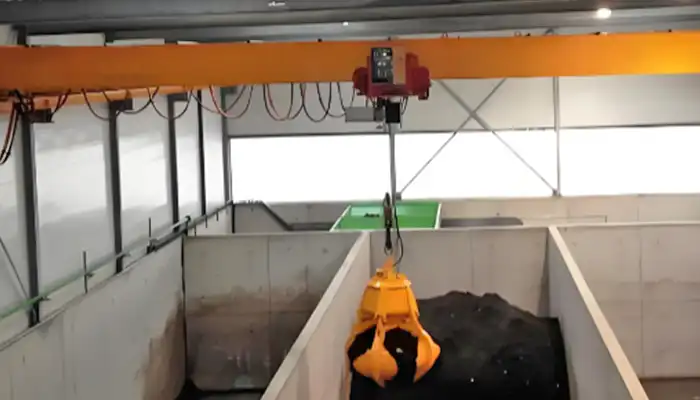
Typical use cases include:
- Smaller MSW plants with compact bunkers
- Moderate daily throughput and predictable waste loads
- Facilities with limited structural support for heavy cranes
The single girder design provides a lighter, simpler structure, but it comes with capacity limits. While easier to install and less demanding on building supports, these cranes may experience faster fatigue under heavy, repeated grab cycles.
Practical points to consider:
- One main beam supports all hoist and trolley loads
- Suitable for moderate lifts, but long spans or very heavy grabs may shorten fatigue life
- Reduced structural complexity can lower installation challenges and costs
Single girder cranes are generally easier to maintain on a day-to-day basis. However, major repairs or inspections on long-run systems can be trickier.
Maintenance insights:
- Quick access to hoist and trolley for routine checks
- Limited space for major component replacements
- Suitable for plants with standard maintenance capacity and moderate operating cycles
While single girder cranes are more affordable initially, they have trade-offs in long-term reliability and capacity.
Key points:
- Lower upfront cost and installation time
- Lighter structural requirements
- Limited heavy-duty capacity
- Potentially higher fatigue if used beyond design limits
Single girder waste grab cranes are a practical choice for smaller bunkers or moderate waste loads, offering easy maintenance and lower initial costs while performing reliably under expected operational demands.
Double Girder Garbage Cranes
Double girder garbage cranes are designed for plants with large bunkers and high daily throughput. Their robust structure allows them to handle heavy waste grabs and long-span operations that single girder cranes cannot manage effectively.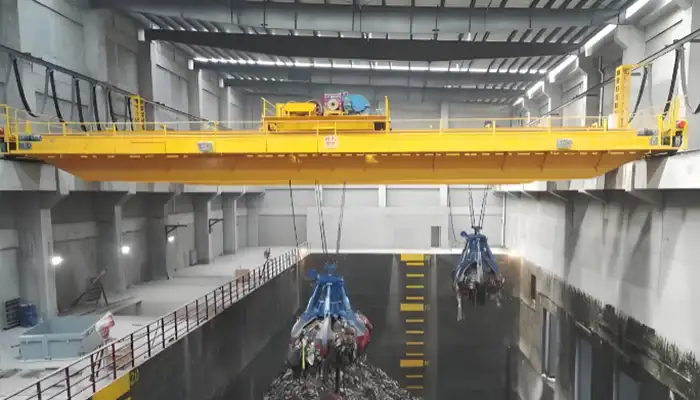
Typical applications include:
- Large municipal solid waste (MSW) plants with long bunkers
- Facilities with high daily waste volumes or peak feeding periods
- Plants requiring continuous operation with minimal downtime
With two parallel girders supporting the hoist, double girder cranes provide higher lifting capacity and better load distribution. This design reduces stress on each beam and allows the crane to handle heavier and irregularly shaped grabs.
Practical considerations:
- Can carry heavier loads compared to single girder cranes
- Supports longer spans without excessive deflection
- Reduces risk of structural fatigue under repeated heavy-duty grabs
Double girder cranes offer more space between the girders and the hoist, making maintenance easier, especially for larger cranes covering long bunkers. Operators can perform inspections, lubrication, and component replacements more safely and efficiently.
Maintenance advantages include:
- Improved access to hoist and trolley components
- Easier integration of safety features and monitoring devices
- Flexibility to operate in parallel mode or switch to standby, depending on plant needs
The robust design of double girder cranes improves waste crane fatigue life, which means fewer interruptions and a longer operational lifespan. This is critical in high-volume MSW plants, where equipment downtime can have significant operational and financial consequences.
Fatigue-related benefits:
- Reduced stress on structural components during repeated grabs
- Longer intervals between major maintenance
- Increased overall reliability and plant availability
Double girder cranes require higher upfront investment, but they can provide cost savings over time through lower maintenance and fewer replacements. Evaluating lifecycle costs is crucial when planning for long-term operations.
Key financial points:
- Higher initial purchase and installation cost
- Potentially lower lifecycle costs due to improved durability and reduced downtime
- Greater return on investment in high-capacity, heavy-duty applications
Double girder garbage cranes are ideal for large bunkers and heavy-duty MSW operations. They provide structural strength, longer fatigue life, easier maintenance access, and flexibility for high-volume plant demands, making them a practical choice for long-term reliability.
Structural Fatigue Under Grab Duty
Waste grab cranes operate in demanding environments, handling heavy, irregular loads repeatedly throughout the day. Each grab applies stress to the crane's girders, hoist, and trolley systems. Over time, this repetitive stress can lead to structural fatigue, which may manifest as cracks, deformation, or accelerated wear.
Key points to consider:
- The weight and frequency of grabs directly affect fatigue accumulation
- Irregular waste shapes can create uneven stress on crane girders
- Hoist mechanisms, ropes, and grabs also experience cyclical loading that impacts lifespan
The choice of crane structure significantly influences fatigue life.
Comparison:
Single girder waste grab cranes:
- One main beam bears the full load, which can accelerate fatigue under heavy or frequent grabs
- Suitable for moderate loads but may require more frequent inspections and maintenance for long-term reliability
Double girder garbage cranes:
- Load is distributed across two girders, reducing stress on each beam
- Can handle higher capacities and longer spans with less fatigue
- Typically longer fatigue life, resulting in fewer unplanned stoppages
Understanding load cycles helps plan maintenance more effectively. For example:
- A single girder crane performing 300 grabs per day at near-maximum capacity may need major inspections every 6–12 months
- A double girder crane under the same workload can often extend inspection intervals due to reduced stress on girders and hoist components
- In high-capacity plants, ignoring fatigue can lead to unexpected failures, impacting plant availability and repair costs
Maintenance considerations:
- Track daily load cycles and peak loads to schedule proactive inspections
- Monitor stress points on girders and hoists using visual inspections or sensors
- Adjust operating procedures if grabs consistently exceed design limits
Proper design choices can significantly reduce fatigue issues:
- Select a crane rated for slightly higher loads than daily operational peaks
- Ensure the hoist and trolley move smoothly to avoid jerking or uneven stress
- Consider double girder cranes for long spans or heavy grab duty
- Use fatigue-resistant materials and proper welding techniques in the crane structure
Maintenance Access and Operational Efficiency
Single girder waste grab cranes are generally simpler in design, which makes routine inspection of the hoist and trolley straightforward. Operators can quickly check lubrication points, wires, and mechanical components without much hassle.
However, the smaller structural footprint also limits workspace:
- Access for major component replacement is constrained
- Longer crane spans may create areas that are hard to reach safely
- Maintenance teams may need temporary platforms or scaffolding for thorough inspections
In practice, single girder cranes are convenient for standard maintenance but may pose challenges during more extensive repairs.
Double girder garbage cranes offer more room between girders and under the hoist, which makes maintenance of hoist mechanisms, grabs, and trolley systems easier. Technicians have more space to maneuver, reducing the risk of accidents and speeding up major inspections.
Practical points:
- Allows safer access for component replacement and lubrication
- Supports integration of monitoring devices for predictive maintenance
- Requires careful planning to ensure safety during maintenance on large or long-span cranes
While double girder cranes provide better access overall, plants need to plan maintenance routes and safety procedures in advance.
Regardless of crane type, safe access is critical. Poorly planned maintenance procedures can lead to downtime, accidents, or incomplete inspections. Key considerations include:
- Use of guardrails, platforms, and ladders for elevated inspections
- Scheduling maintenance during low-load periods to reduce risk
- Ensuring all components are reachable without overextending or improvising
Investing in proper access and maintenance planning improves operational efficiency and extends the life of both single and double girder waste grab cranes.
Long-Term Cost Implications
When choosing between single girder and double girder waste grab cranes, it's easy to focus only on the purchase price. Single girder cranes have a lower upfront cost, making them appealing for smaller plants or moderate loads. However, double girder cranes, while more expensive initially, often offer a lower lifecycle cost due to their ability to handle heavier loads and longer spans with less structural fatigue.
Key considerations:
- Single girder: lower installation and material costs, but may require more frequent maintenance or earlier replacement in high-duty environments
- Double girder: higher upfront cost, but potentially longer operational lifespan and fewer unplanned repairs
Operational downtime can be a hidden but significant expense. Fatigue, difficult access, or unexpected component failures can halt plant operations, affecting daily throughput and revenue.
Practical points:
- Single girder cranes may experience faster fatigue under heavy or frequent grabs, increasing the likelihood of downtime
- Double girder cranes can reduce downtime thanks to distributed load and improved maintenance access
- Factoring in lost production costs is essential for a realistic comparison
ROI is not just about purchase price—it's about reliability, operational efficiency, and maintenance costs.
What to consider:
- Double girder cranes: higher capacity and longer fatigue life can justify the investment in high-volume plants
- Single girder cranes: cost-effective in smaller operations with predictable loads
- Maintenance access, operator training, and downtime risk should be factored into ROI calculations
To make a practical, informed choice:
- Assess daily and peak waste handling requirements
- Estimate expected crane lifecycle and maintenance frequency
- Consider bunker size, crane span, and potential plant expansion
- Balance upfront costs against expected long-term savings from reduced downtime and extended crane life
Making the Right Choice for Your MSW Plant
Choosing between a single girder waste grab crane and a double girder garbage crane depends on several practical factors. Each plant has unique requirements, and matching the crane type to operational needs ensures efficiency and reliability.
Consider the following:
- Bunker Size: Longer or wider bunkers often require double girder cranes to cover the full span efficiently. Smaller bunkers may be well served by a single girder crane.
- Throughput: High-volume plants benefit from the strength and capacity of double girder cranes. Moderate throughput plants can often rely on single girder cranes without risking operational delays.
- Waste Type: Heavy, irregular, or bulky waste favors double girder cranes for structural strength. Lighter or uniform waste loads may not require the extra capacity.
- Operator Expertise: Single girder cranes are simpler to operate and maintain, while double girder cranes may require more experienced staff to handle maintenance and safety procedures.
Every choice comes with trade-offs.
- Upfront Cost: Single girder cranes are cheaper initially, while double girder cranes have a higher purchase and installation cost.
- Operational Flexibility: Double girder cranes offer more options, such as parallel operation or handling heavier grabs, but they require careful planning for maintenance and operator safety.
- Long-Term Reliability: Double girder cranes generally provide longer fatigue life and fewer unplanned stoppages, potentially offsetting the higher upfront cost over the crane's lifetime.
Understanding these trade-offs helps plant managers balance budget constraints with operational needs.
A practical approach for plant managers:
- Assess Plant Needs: Evaluate bunker size, daily throughput, and types of waste handled.
- Compare Crane Capabilities: Match crane design (single vs. double girder) to load capacity, span, and operational frequency.
- Consider Maintenance and Access: Ensure the crane design allows safe, efficient inspections and repairs.
- Estimate Lifecycle Costs: Factor in potential downtime, maintenance, and fatigue life to calculate total cost of ownership.
- Make an Informed Choice: Select the crane that provides the best balance between cost, reliability, and operational flexibility.
Conclusion
Key Takeaway
Selecting the right crane structure—single girder waste grab crane or double girder garbage crane—should be based on practical considerations such as plant size, expected load, and your maintenance strategy. The right choice ensures safe, reliable, and efficient MSW handling day after day.
Balancing Cost, Reliability, and Fatigue Life
When evaluating cranes, it’s important to look beyond the initial purchase price. Consider:
- Cost vs. durability: A cheaper single girder crane may be adequate for smaller plants, but high-capacity plants often benefit from the longer fatigue life of double girder cranes.
- Operational reliability: Minimizing downtime through proper crane selection improves throughput and reduces maintenance disruptions.
- Maintenance efficiency: Easy access and safe inspection points are key to extending crane life and reducing unexpected costs.
Striking the right balance between these factors will help you maximize both operational efficiency and return on investment.
Send Us An Inquiry
Every MSW plant is unique, and choosing the right crane requires careful evaluation. Consulting with experienced crane suppliers can help you:
- Select the most suitable crane type and configuration for your plant
- Plan installation and integration with minimal disruption
- Ensure long-term reliability, efficiency, and safety
Partnering with knowledgeable suppliers ensures that your crane investment meets your plant’s specific operational demands and supports smooth, continuous waste handling for years to come.