QDX 6t+6t Tandem Lift Double Girder Overhead Crane 12 Ton
QDX 6t+6t Tandem Lifting Double Girder Overhead Crane | 12 Ton Twin Hoist Crane for Industrial & Sugar Plant Applications
Check the QDX 6t+6t tandem lifting double girder overhead crane with twin hoist synchronized operation for 12 ton capacity. Learn specifications, span, lifting height, duty class, and speed details, plus real application insights for sugar plant operations, maintenance, and heavy industrial material handling. Ideal for buyers seeking reliable, high-efficiency overhead crane solutions.
Introduction — QDX 6t+6t Tandem Lifting Double Girder Overhead Crane for Sugar Plant Operations
QDX 6t+6t Tandem Lifting Overhead Crane in Sugar Plant Heavy Duty Material Handling
The QDX 6t+6t tandem lifting double girder overhead crane is widely used in sugar plant workshops where heavy equipment handling is part of daily maintenance and shutdown work. In this type of operation, lifting is not occasional. It is repeated, planned, and often time-sensitive.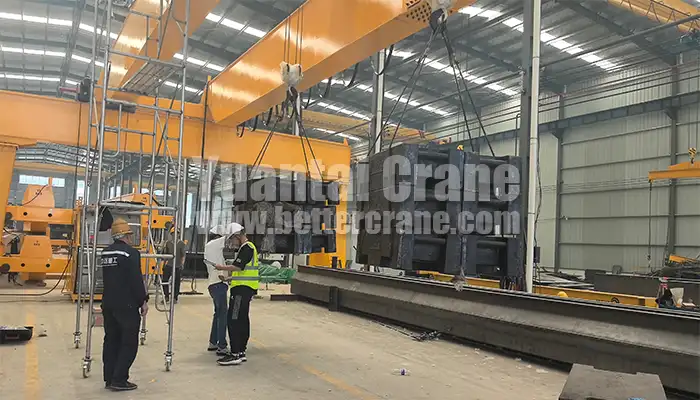
This crane system is designed for twin hoist synchronized lifting up to 12 tons total capacity, giving operators control over long or heavy machinery that cannot be safely handled by a single hook system. In real sugar mill conditions, this reduces lifting errors and improves alignment during installation or removal work.
- 6t + 6t twin hoist configuration for 12 ton tandem lifting
- Double girder overhead crane structure for stable load distribution
- Suitable for sugar mill maintenance crane applications and heavy equipment replacement
- Supports both synchronized lifting mode and independent hoist operation
In practical terms, this crane is not only about lifting capacity. It is about controlling heavy loads in confined industrial bays where precision matters more than speed.
Sugar plants operate with large rotating equipment such as mills, crushers, gearboxes, and pressure vessels. These components often require removal during maintenance cycles, and some of them are too long or too unbalanced for single-hook lifting.
This is where a tandem hoist overhead crane for sugar factory maintenance becomes necessary.
- Heavy sugar mill machinery lifting requires dual lifting points to prevent tilting
- Equipment like cane crushers and drive systems often exceed single hoist stability limits
- Maintenance shutdown periods demand fast and controlled lifting operations
- Indoor sugar mill crane systems must handle dust, humidity, and continuous operation cycles
In many cases, operators face a simple problem: one hoist is not enough, but two separate cranes are not practical. A synchronized twin trolley system solves this without increasing complexity in the workshop layout.
The twin trolley double girder overhead crane system used in the QDX 6t+6t configuration is built to support both synchronized lifting and independent hoist operation. This flexibility is important in real industrial workflow, especially in sugar production facilities where load sizes vary.
- Dual hoist overhead crane system allows synchronized lifting for long or heavy loads
- Independent hoist operation supports smaller maintenance tasks without full system use
- Synchronized crane control system helps maintain equal lifting speed and load balance
- Suitable for long load handling such as shafts, rollers, and gearbox assemblies
In real operation, synchronization is not just a feature—it is what keeps the load stable. Both hoists must lift at the same speed, or the load will tilt. That is why synchronized hoist control in double girder crane systems is a critical design point for sugar plant safety and efficiency.
For crane buyers, especially in sugar industries, the key concern is whether the crane fits actual working conditions, not just whether it meets rated capacity.
The QDX 6t+6t tandem lifting overhead crane for industrial workshops provides practical advantages in real use cases:
- Reduces risk of load imbalance during heavy equipment lifting
- Improves installation accuracy for sugar mill machinery replacement
- Supports flexible operation modes for different maintenance tasks
- Helps match crane capacity with real workshop span, duty class, and lifting height requirements
In practical industrial projects, the selection of a double girder twin hoist crane system is often based on workflow, not theory. If the crane cannot handle real maintenance loads safely, production delays become unavoidable.
This is why understanding both configuration and application is important before selection, especially in sugar plant environments where downtime directly affects output.
QDX 6t+6t Crane System Overview — Double Girder Twin Hoist Overhead Crane
Basic Configuration of QDX 6t+6t Double Girder Overhead Crane System
The QDX 6t+6t double girder overhead crane system is built on a rigid bridge structure designed for stable heavy-duty lifting in industrial workshops such as sugar plants and machinery maintenance bays. It uses a twin hoist arrangement to handle both balanced and unbalanced lifting tasks.
- Double girder overhead crane (QDX series structure) for higher rigidity and reduced deflection
- Two independent 6-ton wire rope hoists installed on separate trolleys
- Twin trolley overhead crane design suitable for long and heavy load handling
- Engineered for both synchronized lifting and flexible single-hoist operation
- Commonly used in sugar mill maintenance, equipment installation, and heavy workshop lifting
This configuration allows operators to switch between coordinated lifting and individual hoist use without changing the crane setup.
Operating Modes of Twin Hoist Tandem Lifting Crane System
The QDX 6t+6t tandem lifting overhead crane is designed with two practical working modes to match different industrial lifting conditions. This flexibility is important in sugar plant environments where load types change frequently.
- Synchronized lifting mode: 6t + 6t combined operation for up to 12 tons total capacity
- Independent hoist mode: each 6-ton trolley operates separately for lighter or single-point loads
- Load balancing control system ensures stable lifting during tandem operation
- Precision synchronization reduces risk of tilting for long or uneven equipment
- Suitable for heavy machinery lifting where dual-point support is required
In industrial operation, synchronized mode is used for large components like mill rollers or gear assemblies, while independent mode is used for routine maintenance tasks.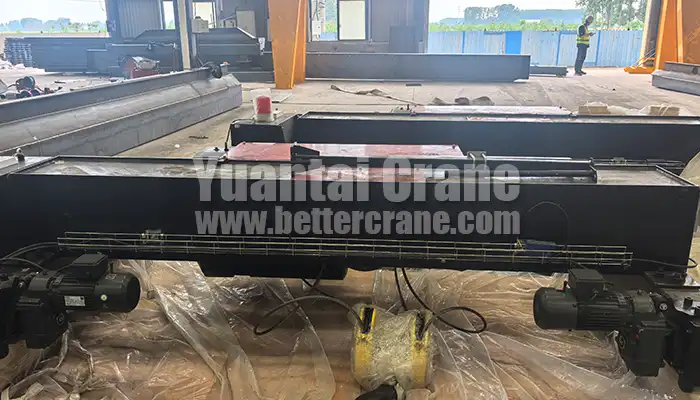
6 ton electric hoist for sale , European style electric crab trolley
Tandem Lifting System Design Concept — QDX 6t+6t Twin Hoist Crane
The QDX 6t+6t tandem lifting crane uses precise electrical synchronization to coordinate both hoist drives. This ensures that loads are lifted evenly and reduces stress on the crane structure during operation.
- Electrical synchronization between the two hoists for matched speed and torque
- Load balancing system adjusts in real time to maintain even lift
- Anti-skew and anti-tilt logic to prevent load rotation or uneven lifting
This system is essential when handling long or irregular equipment, keeping operations safe and predictable.
Tandem lifting depends on how the load is shared between the two trolleys. Proper distribution reduces bending on the crane girders and prevents overloading of a single trolley.
- Designed for equal load distribution across both hoists
- Handles minor uneven loading without compromising safety
- Dynamic load behavior accounted for during acceleration, deceleration, and start/stop cycles
In practice, this means heavy rollers or long shafts can be lifted without creating dangerous stress points on the crane or plant structure.
The crane's control system is designed to give operators precise command over both hoists while ensuring safety.
- Dual hoist control panel for simultaneous or independent operation
- VFD (Variable Frequency Drive) systems control smooth lifting and travel speeds
- Emergency stop buttons and interlocks integrated to protect operators and equipment
This architecture allows operators to manage complex lifts efficiently, maintaining both speed and accuracy while reducing downtime.
Technical Specifications — QDX 6t+6t Tandem Lifting Double Girder Crane
The QDX 6t+6t tandem lifting double girder overhead crane is designed for precise, heavy-duty lifting in industrial workshops such as sugar plants. Its twin trolley configuration allows either independent lifting or synchronized operation for long, heavy, or irregular loads.
Key specifications for evaluation:
- Lifting capacity: 6 t + 6 t (twin trolley, synchronized lift = 12 t total); 5 t rated per hoist
- Span (rail center-to-center): 30,720 mm ± 5 mm
- Lifting height: 15 m
- Hoisting speed (creep / full): 1.2 / 7.4 m/min
- Crane long-travel speed (VFD): 4.0 – 40 m/min
- Trolley cross-travel speed (VFD): 2.5 – 25 m/min
- Mechanism duty class: FEM 9.511 Group 4m / ISO M7
- Crane travel motors: 2 × FZAD89 / 3.0 kW; reducer i = 38.23
- Hoist motor per trolley: FDH 129/1.6/9.5 kW
- Trolley travel motors: 2 × FZAD39 / 0.37 kW per trolley
- Wheel diameter / tread: Ø315 mm / 80 mm
- End-carriage wheelbase: 4,400 mm
- Trolley rail gauge: 2,400 mm
- Static wheel load (under SWL): 88.3 kN
- Dynamic wheel load (under SWL × DLF): 107.4 kN
- Power supply: 400 V / 50 Hz / 3 Phase
- Control mode: Cabin (onboard) + dual-speed wireless remote
- Spreader beam: Customised, 2 lifting lugs at 1.2 m gauge
These specifications ensure the crane fits both structural and operational requirements of heavy industrial facilities. Buyers can quickly evaluate span, lifting height, speed ranges, duty class, and power system compatibility against their plant layout and workflow.
The combination of high capacity, flexible trolley operation, and advanced control modes makes this crane suitable for long, heavy, or awkwardly shaped loads. It provides a reliable solution for maintenance, equipment replacement, or production support in sugar mills and similar industrial applications.
Application in Sugar Plant Operations — QDX 6t+6t Twin Hoist Overhead Crane
The QDX 6t+6t tandem lifting double girder crane is widely used in sugar plants for handling heavy machinery and supporting maintenance operations. Its twin trolley design allows precise lifting of long, heavy, or irregular equipment while reducing downtime during production cycles.
In sugar mills, equipment such as mills, gearboxes, and turbines often needs to be moved, installed, or maintained. The crane's twin hoist system makes this possible without extra manpower or additional lifting devices.
- Lifting heavy process equipment safely and efficiently
- Handling sugar cane processing machinery such as crushers and rollers
- Supporting maintenance work for evaporators, centrifuges, and mills
- Ideal for long or awkward loads that require balanced lifting
With a synchronized lift, operators can move large machinery smoothly without tilting or overstressing the crane structure.
The QDX crane integrates easily into plant workflows, whether during scheduled maintenance shutdowns or continuous production. It provides reliability while meeting operational timing constraints.
- Used for crane-assisted shutdown maintenance cycles
- Supports continuous production with quick, precise lifts
- Handles indoor mill bay limitations such as tight clearances, dust, and humidity
- Reduces equipment handling delays during critical workflow periods
This integration ensures the crane is not just a lifting tool but part of the operational process, keeping maintenance and production on schedule.
Sugar plants present challenging conditions for overhead cranes, including high humidity, sugar dust, and heat near processing zones. The QDX crane is designed to withstand these factors.
- Resistant to high humidity and airborne sugar dust
- Corrosion protection with high-quality paint systems and sealing
- Heat resistance for operations near evaporators and boilers
- Built for long-term durability in demanding sugar mill environments
Safety and Operational Reliability — QDX 6t+6t Tandem Lifting Double Girder Crane
Safety is a critical concern when handling heavy loads in sugar plants. The QDX 6t+6t tandem lifting crane combines twin hoist synchronization with robust safety systems to protect both operators and equipment.
Using two hoists simultaneously introduces specific risks that must be managed carefully. Even small misalignments can lead to load tilt or uneven stress on the crane structure.
- Load imbalance between the two hoists can cause tilting of long or uneven equipment
- Structural stress may increase during mis-synchronized lifting
- Emergency stop behavior under full load must be predictable to avoid sudden shock
Operators need to understand these risks and use the crane controls according to the recommended procedures.
The QDX crane is equipped with multiple protection systems to prevent accidents and equipment damage during heavy industrial lifting.
- Overload protection for each hoist ensures lifting within safe limits
- Limit switches for upper and lower travel prevent over-travel of the hook
- Anti-collision and interlocking systems reduce risk of collisions with structures or other equipment
These features work together to create a safer operational environment, especially in confined sugar mill workshops.
Practical operator safety is as important as the crane's mechanical protections. Good visibility, clear communication, and standard procedures ensure smooth, reliable operations.
- Clear visibility during tandem lifting allows operators to monitor both hoists
- Communication between ground personnel and crane operators improves coordination
- Standard operating procedures (SOPs) in sugar mills guide safe handling of long or heavy machinery
Buyer Value and Decision-Making Benefits — QDX 6t+6t Tandem Lifting Double Girder Crane
For buyers in sugar plants or heavy industrial workshops, selecting the right overhead crane goes beyond rated capacity. The QDX 6t+6t tandem lifting double girder crane provides measurable value in terms of technical fit, efficiency, and long-term reliability.
Before purchasing, it's critical to ensure the crane matches the plant's structure and workflow. Choosing the correct twin trolley crane avoids costly mistakes and operational delays.
- Compatible with existing plant layout, runway beams, and building clearance
- Reduces risk of undersized or mismatched crane selection
- Ensures smooth integration with maintenance cycles and production workflows
This technical fit helps operators lift heavy machinery safely without modifying the plant infrastructure.
Twin hoist operation allows faster, more precise lifting of long, heavy, or irregular equipment, which keeps maintenance and production on schedule.
- Faster handling of heavy equipment via synchronized tandem lifting
- Reduced downtime during maintenance or equipment replacement
- Improved positioning accuracy for mills, gearboxes, and long shafts
With these gains, plant operators can complete heavy lifting tasks efficiently while keeping production running smoothly.
A properly selected tandem lifting crane reduces operational risks and protects the plant structure over the long term.
- Avoids structural overload on runway beams or building columns
- Prevents operational inefficiencies caused by poor synchronization or load imbalance
- Enhances long-term reliability in harsh environments like sugar mills
In practice, this means fewer maintenance issues, safer operations, and a crane that performs consistently under demanding industrial conditions.
Conclusion — QDX 6t+6t Tandem Lifting Double Girder Crane for Sugar Plant Operations
The QDX 6t+6t tandem lifting double girder overhead crane provides a practical lifting solution for sugar plants handling heavy machinery, long components, and maintenance-intensive operations. Its twin trolley synchronized lifting system allows stable handling of loads up to 12 tons while also supporting flexible independent hoist operation for routine tasks.
Selecting the right crane is not only about rated capacity. Parameters such as span, lifting height, duty class, wheel load, travel speed, and synchronization control must match the actual plant structure and workflow conditions. A crane that fits the building, runway system, and maintenance process will operate more safely and efficiently over the long term.
- Proper crane specification improves lifting safety and load stability
- Correct duty class helps support continuous industrial operation
- Matching wheel loads and span reduces stress on runway structures
- Reliable synchronization improves positioning accuracy for heavy equipment handling
In sugar mill applications, a correctly specified tandem lifting double girder overhead crane helps reduce downtime, improve maintenance efficiency, and support stable production operations year after year.