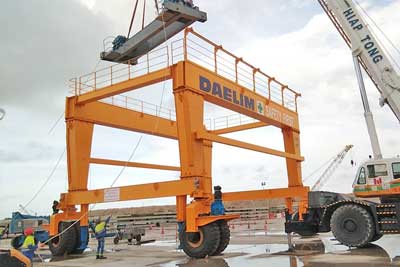
80 Ton RTG Crane for Highway Girder Lifting Vietnam
80 Ton RTG Crane for Highway Girder Lifting in Vietnam
Most Important Takeaways for Crane Buyers
For highway and bridge construction projects in Vietnam, choosing the right rubber tyred gantry crane is not only about lifting capacity. Contractors are increasingly focused on practical operation, stable outdoor performance, mobility across large construction zones, and long-term reliability under continuous heavy-duty work.
This 80 ton RTG crane project demonstrates how an 80 ton gantry crane helped solve real infrastructure lifting challenges involving precast bridge girders, while improving construction efficiency and reducing site preparation costs.
Key Takeaways
- The 80 ton RTG crane was designed specifically for highway bridge girder handling
- The rubber tyred gantry crane provided flexible site movement without rail installation
- The RTG gantry crane improved lifting stability for long precast girders
- The diesel-powered RTG crane supported outdoor operation in changing construction environments
- The 8-wheel traveling system improved ground adaptability and heavy-load stability
- The hydraulic control system provided smoother and more precise girder positioning
- The project reduced infrastructure preparation costs by eliminating rail foundations
- The RTG crane solution improved project workflow and construction efficiency
Questions Solved in This Case Study
This real RTG gantry crane project helps answer practical buyer questions such as:
- Why choose a rubber tyred gantry crane instead of a mobile crane?
- What are the advantages of an 80 ton RTG crane for bridge construction?
- How does an RTG crane improve girder transportation efficiency?
- What site conditions are suitable for RTG gantry cranes?
- Why is diesel power commonly used for outdoor gantry crane projects?
- How important is wheel configuration for heavy-duty RTG crane operation?
- What safety systems are necessary for lifting precast bridge girders?
- How can buyers reduce infrastructure costs when selecting a gantry crane?
Project Overview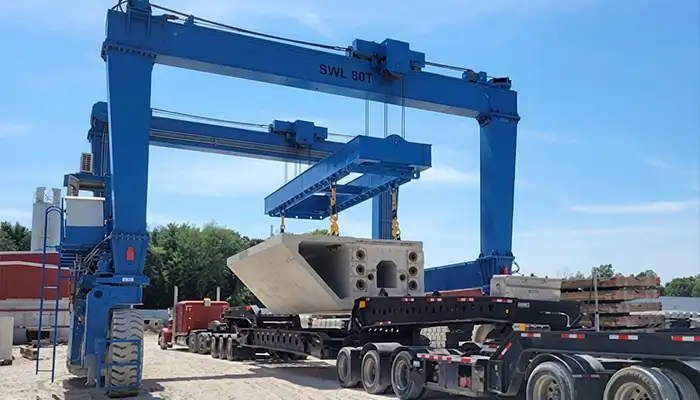
Vietnam Highway Infrastructure Project
A highway construction contractor from Vietnam required a reliable rubber tyred gantry crane solution for lifting and transporting precast concrete girders during a large infrastructure development project.
The customer needed an 80 ton gantry crane capable of operating continuously across multiple outdoor work zones while maintaining stable heavy-load lifting performance.
In Vietnam’s infrastructure construction industry, project contractors typically prioritize:
- Stable equipment performance
- Practical operational efficiency
- Reliable after-sales support
- Long-term cooperation
- Fast project execution
Rather than focusing only on the lowest purchase cost, the customer evaluated the total working efficiency and long-term operating practicality of different RTG crane solutions.
After reviewing several lifting methods, the contractor selected an 80 ton RTG crane because it offered the best balance between:
- Heavy-duty lifting stability
- Flexible site mobility
- Outdoor adaptability
- Continuous operation capability
- Reduced site infrastructure requirements
Customer Lifting Requirements
Main Requirements for the RTG Crane
The customer required an RTG gantry crane capable of:
- Lifting precast bridge girders up to 80 tons
- Traveling freely around the construction site
- Operating on temporary outdoor ground surfaces
- Supporting long-span girder lifting
- Maintaining stable lifting under continuous operation
- Reducing downtime during construction
The customer also emphasized several practical operating concerns commonly raised by Vietnamese contractors:
- Easy maintenance
- Stable spare parts supply
- Fuel efficiency
- Reliable field operation
- Simple operator control systems
For many Southeast Asian infrastructure projects, “stable operation with fewer interruptions” is often considered more valuable than overly complicated systems that are difficult to service on site.
Site Working Conditions
| Item | Details |
|---|---|
| Project Type | Highway Bridge Construction |
| Crane Type | Rubber Tyred Gantry Crane |
| Working Environment | Outdoor |
| Ground Condition | Temporary Construction Surface |
| Rail System | Not Required |
| Working Duty | Heavy Duty |
| Mobility Requirement | High |
Why the Customer Chose a Rubber Tyred Gantry Crane
One of the biggest advantages of the rubber tyred gantry crane was its ability to move freely around the construction site without requiring fixed rails.
One of the biggest advantages of the rubber tyred gantry crane was its ability to move freely around the construction site without requiring fixed rails.
For large highway bridge projects, construction zones frequently change during different installation stages. The RTG crane allowed the contractor to:
- Relocate lifting operations quickly
- Adapt to changing work areas
- Reduce crane setup time
- Improve overall project coordination
This flexibility is especially important in Vietnam, where infrastructure projects often involve large outdoor working areas with changing construction layouts.
Compared with rail mounted gantry cranes, the RTG gantry crane eliminated the need for rail installation, rail foundations, and additional civil engineering work.
This significantly reduced initial site preparation costs and shortened project startup time.
Compared with conventional mobile cranes, the 80 ton RTG crane provided:
- Better load distribution
- Improved lifting stability
- Safer handling of long concrete girders
- More reliable continuous heavy-duty operation
For bridge contractors, avoiding girder damage and maintaining stable lifting performance are critical for preventing project delays.
Material Handling Details
The 80 ton rubber tyred gantry crane was designed specifically for heavy bridge construction material handling, especially in highway and elevated infrastructure projects where large precast components need to be lifted safely and efficiently.
The RTG crane was designed for handling:
- Precast concrete girders
- Segment girders
- Long bridge beam sections
- Heavy infrastructure components
These materials are commonly used in highway bridge construction, elevated road systems, and urban infrastructure development.
| Item | Specification |
|---|---|
| RTG Crane Capacity | 80 Ton |
| Girder Type | Precast Concrete Girder |
| Span Requirement | Approx. 20 m |
| Lifting Height | Approx. 30 m |
| Traveling Method | Rubber Tire Traveling |
| Operation Type | Continuous Heavy Duty |
Before purchasing an RTG gantry crane, buyers should confirm real operating conditions rather than relying only on theoretical specifications.
- Actual maximum lifting load
- Girder dimensions and lifting points
- Ground bearing capacity
- Travel route conditions
- Daily lifting cycles
- Future relocation requirements
Experienced crane buyers in Vietnam often focus heavily on real site conditions to ensure long-term operational reliability and construction safety.
80 Ton RTG Crane Solution Design
Selected RTG Crane Configuration
The final solution was a heavy-duty 80 ton rubber tyred gantry crane specifically designed for infrastructure and bridge construction applications.
Main Technical Parameters
| Parameter | Specification |
|---|---|
| Crane Type | RTG Gantry Crane |
| Capacity | 80 Ton |
| Span | 20 m |
| Lifting Height | 30 m |
| Tire Quantity | 8 Units |
| Power Source | Diesel Engine |
| Engine Power | ≥400 HP |
| Traveling System | Rubber Tire Traveling |
| Control Method | Hydraulic Control |
| Application | Highway Girder Handling |
Key Features of the 80 Ton RTG Crane
The 80 ton rubber tyred gantry crane was engineered for heavy bridge construction environments where stability, durability, and continuous outdoor operation are critical for safe and efficient girder handling.
The RTG crane structure was designed to support:
- Continuous heavy-load operation
- Large precast girder handling
- Long-term structural durability
This is particularly important for outdoor construction projects in Southeast Asia where equipment must withstand high humidity and demanding weather conditions.
The 8-wheel design helped improve:
- Ground pressure distribution
- Traveling stability
- Heavy-load mobility
- Adaptability on uneven surfaces
For heavy-duty RTG gantry cranes, wheel configuration directly affects safety and operational reliability on construction sites.
The diesel-powered RTG crane provided:
- Independent outdoor operation
- Reliable continuous working capability
- Better flexibility for remote construction projects
Many contractors in Vietnam still prefer diesel-powered gantry cranes because they are practical and easier to support in outdoor construction environments.
The hydraulic system improved:
- Smooth crane traveling
- Precise girder positioning
- Stable lifting synchronization
- Safer heavy-load handling
Safety Design for Highway Girder Lifting
Main Safety Features Included
The 80 ton RTG crane was equipped with multiple safety systems:
| Safety Device | Function |
|---|---|
| Overload Protection | Prevents over-capacity lifting |
| Emergency Stop System | Immediate emergency shutdown |
| Anti-Collision System | Reduces collision risks |
| Outrigger Stabilizer | Improves lifting stability |
| Factory Testing | Verifies crane safety and performance |
Practical Safety Advice for RTG Crane Buyers
Before selecting an RTG gantry crane, buyers should evaluate:
- Local safety regulations
- Wind resistance requirements
- Ground condition suitability
- Anti-sway requirements
- Spare parts support availability
- Technical response capability
In Vietnam’s business culture, reliable after-sales service is often considered an important sign of long-term business trust and partnership stability.
Project Results and Customer Benefits
Final Project Results
The rubber tyred gantry crane successfully helped the customer:
- Improve girder handling efficiency
- Increase lifting safety
- Reduce site preparation costs
- Improve construction flexibility
- Accelerate project progress
Long-Term Operational Benefits
Site Operation Benefits
- Stable heavy-duty lifting
- Flexible movement across construction zones
- Reduced crane repositioning downtime
- Improved workflow coordination
Business Benefits
- Better construction efficiency
- Lower infrastructure investment
- Reduced operational interruption risks
- Improved project schedule reliability
For many infrastructure contractors in Vietnam, maintaining stable project delivery is essential for building long-term relationships with developers and government project owners.
Practical FAQ for RTG Crane Buyers
This section answers common questions from bridge contractors and infrastructure buyers who are considering a rubber tyred gantry crane for precast girder handling projects.
A rubber tyred gantry crane is often preferred because it can move heavy precast girders efficiently across large construction sites without requiring rail installation.
- For highway and bridge construction, work zones frequently change, so contractors need an RTG crane that can travel flexibly between lifting points.
- Compared with rail mounted gantry cranes, RTG gantry cranes reduce site preparation work and help shorten project setup time.
- Many infrastructure contractors also prefer rubber tyred gantry cranes for outdoor projects because they are practical for temporary construction roads and changing ground conditions.
An 80 ton RTG crane provides better lifting stability, improved working coverage, and more efficient continuous girder handling for bridge construction projects.
- Long precast girders require stable synchronized lifting, especially during transportation and positioning.
- An 80 ton gantry crane can maintain safer load distribution during repeated heavy-duty lifting operations.
- For contractors handling multiple girders daily, RTG cranes usually improve workflow efficiency and reduce crane repositioning downtime.
Diesel-powered RTG cranes are more suitable for outdoor infrastructure projects where stable electrical power may not always be available.
- Many bridge construction sites operate in temporary working areas without permanent electrical systems.
- Diesel RTG gantry cranes provide independent outdoor operation and easier deployment across large project zones.
- Contractors also value diesel-powered rubber tyred gantry cranes for their practical field mobility and reliable long working hours.
Wheel configuration is critical because it directly affects crane stability, ground pressure distribution, and heavy-load traveling safety.
- Multi-wheel RTG crane designs help distribute the weight of heavy precast girders more evenly across temporary construction ground.
- An 8-wheel rubber tyred gantry crane is commonly used for large bridge girder lifting because it improves stability during traveling and positioning.
- Buyers should also evaluate site ground conditions and travel routes before selecting the wheel arrangement for an 80 ton RTG crane.
The most important safety systems include overload protection, anti-collision devices, emergency stop systems, and lifting stability monitoring.
- Bridge girder lifting often involves large and long concrete structures that require stable synchronized handling.
- Modern RTG cranes should include safety systems that reduce swinging, overloading, and operational collision risks.
- Many experienced contractors also pay close attention to braking performance, wind resistance, and emergency response reliability when selecting an RTG crane for infrastructure projects.
Conclusion
This 80 ton RTG crane project in Vietnam demonstrates how a properly designed rubber tyred gantry crane can provide a practical and reliable lifting solution for large highway infrastructure projects.
For contractors handling precast bridge girders, choosing the right RTG gantry crane is not simply about crane capacity. Real project success depends on:
- Stable heavy-load performance
- Flexible outdoor mobility
- Reliable safety systems
- Easy maintenance
- Long-term operational practicality
By combining heavy-duty lifting capability with flexible site movement, the 80 ton rubber tyred gantry crane helped the customer improve construction efficiency while reducing infrastructure preparation costs and operational risks.
For bridge and highway contractors across Southeast Asia, RTG cranes continue to be one of the most practical solutions for modern large-scale girder handling applications.