60T Straddle Carrier for UAE Port Container Handling Solution
60 Ton Straddle Carrier Solution for UAE Port Container Handling Project
High-Efficiency Mobile Container Transport System for Port Yards
60T straddle carrier solution for UAE port container handling. High-efficiency mobile system for fast lifting, transport, and stacking in container yards. Designed for high-frequency operations, flexible movement, and harsh Middle East conditions.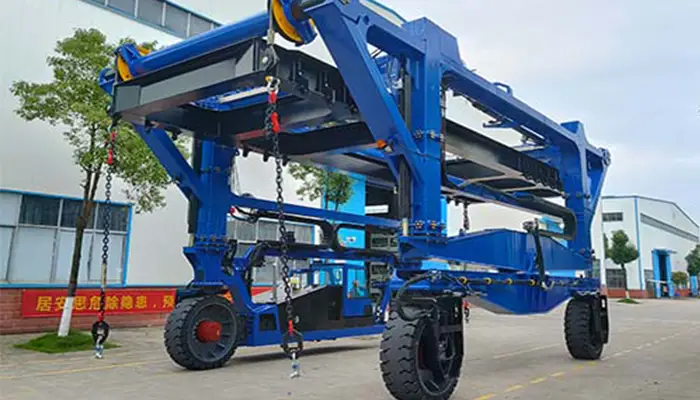
Project Background
Modern port operations depend heavily on how quickly containers can be moved between vessel side, yard stacks, and truck dispatch areas. When flow slows down, everything behind it also slows. That is usually where equipment choice starts to matter more than anything else.
For this project, a port logistics client from the United Arab Emirates was planning an upgrade for container yard handling. The existing setup was not flexible enough for the growing container volume and tighter yard layout.
The target was clear: improve container transfer speed and stacking efficiency without rebuilding the entire yard structure.
To support this, a 60-ton straddle carrier solution was selected. The idea was simple. Instead of relying on fixed rail systems or multiple handling steps, the equipment should move with the container directly from point to point.
- Focus on faster container flow inside the yard
- Reduce waiting time between lifting and transport
- Improve space usage in high-density stacking areas
- Support continuous daily port operation
In practical terms, the equipment needed to "follow the work", not force the yard to adjust around it.
The application belongs to port and heavy logistics operations, where container movement is continuous and tightly scheduled.
Typical working fields include:
- Port container handling: Large-scale container loading and unloading between ship, yard, and truck.
- Container yard logistics: Internal stacking, reshuffling, and storage management.
- Terminal cargo transfer operations: Short-distance container transport inside the terminal area.
- Intermodal freight hubs: Locations where containers shift between sea, road, and inland transport systems.
These environments usually share one condition: work cannot stop, and delays quickly build up.
The customer required a handling solution that could operate smoothly under real terminal pressure, not just on paper capacity.
The main expectations were as follows:
- Fast lifting and horizontal transport of containers: Containers need to be picked, lifted, and moved in one continuous motion without unnecessary waiting between steps.
- Efficient movement between stacking and transport zones: The equipment must travel freely across different yard areas, including storage blocks and truck lanes.
- Operation in narrow and high-density yard layouts: Space is often limited in UAE terminals. The machine must turn and reposition without blocking other traffic.
- Stable performance under continuous operation: The system is expected to run for long shifts, not occasional use. Stability matters more than peak speed.
- Compliance with international port safety standards: Load control, braking system, and operator safety protection must follow standard port requirements.
- Adaptation to high-temperature outdoor environments: Strong sunlight and high ambient temperatures require reliable cooling and protected electrical systems.
These requirements reflect typical container yard conditions in Middle East port projects, where working rhythm is fast and environment is demanding.
The working conditions were defined based on standard container handling requirements and local site environment.
- Load type: Standard ISO containers used in international shipping, including full and empty containers.
- Maximum capacity: 60 tons lifting and transport capacity, covering heavy loaded containers and operational safety margin.
- Operation mode: Continuous high-frequency operation throughout daily port working cycles, including peak loading hours.
- Working environment: Outdoor container yard with long operating hours and limited shelter structures.
- Climate condition: High-temperature environment with strong sunlight exposure, typical of Middle East coastal port areas.
In such conditions, equipment reliability is not only about lifting capacity. It is also about how consistently the system can keep working without interruption during long operating shifts.
60T Straddle Carrier Solution
The United Arab Emirates is one of the key container transshipment hubs in the Middle East. Most major ports in this region handle containers moving between Asia, Europe, and Africa, which means the yard operation is fast and continuous.
In this type of port system, containers do not stay long in storage. They are usually discharged, stacked, and reloaded within a short cycle. So the internal yard handling speed becomes very important.
Another point is the yard space. Many UAE terminals operate with high container density. The distance between stacks, truck lanes, and working routes is limited. Equipment needs to move smoothly without blocking other operations.
Climate is also a real working factor. High temperature, strong sunlight, and dusty outdoor conditions are common. Equipment must run stable for long hours without frequent downtime.
Because of these conditions, ports in the UAE often prefer mobile container handling equipment that can work flexibly inside the yard.
Straddle Carrier (Container Handling Transport Equipment)
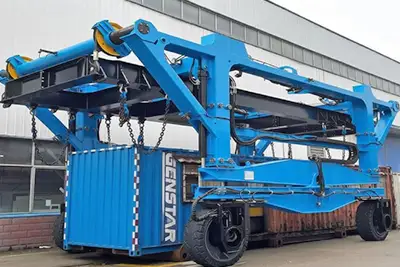
A straddle carrier is a mobile machine that can lift and carry containers directly inside the yard. It does not need fixed rails or a predefined track.
It is commonly used in busy port terminals where container flow is fast and working space is limited.
Lifting Capacity
- 60 tons
- Suitable for standard ISO containers and heavy loaded containers used in international shipping routes.
Equipment Type
- Straddle carrier
- Designed for direct lifting, transport, and stacking in one machine.
Main Function
- Lifting containers from ground or trailer
- Transporting containers across the yard
- Stacking containers in storage areas
Travel System
- Rubber tire movement
- Works on standard port yard surfaces such as asphalt and concrete
- Allows free movement across different working zones
Steering System
- Multi-directional steering
- Enables forward, lateral, and turning movement
- Helps operate in narrow container lanes and tight stacking areas
Application Area
- Port container yards
- Transshipment terminals
- High-density container storage areas
- Internal logistics transfer zones
This type of system is especially suitable for UAE port conditions, where container flow is fast, yard space is tight, and equipment must operate continuously under outdoor industrial environments.
Key Advantages for UAE Port Operations
In UAE ports, yard layouts often change as container volume grows. A straddle carrier operates as a fully mobile unit, so there is no need to invest in rail installation. This gives terminal operators more freedom when adjusting yard planning or expanding storage areas.
UAE container yards are usually busy and tightly arranged. The straddle carrier can lift and move containers directly between stacking blocks, truck lanes, and transfer points. This reduces unnecessary handling steps and helps maintain steady container flow during peak operations.
In hot and high-traffic port environments like Jebel Ali-type terminals, delays easily build up when equipment depends on multiple steps. The straddle carrier completes lifting and transport in one operation, which helps shorten cycle time and reduce waiting between processes.
Many UAE ports operate with limited expansion space but increasing container throughput. The straddle carrier can move freely within narrow lanes and dense stacks, allowing operators to use yard space more efficiently without changing the entire layout.
Ports in the UAE run continuous shifts to support global shipping schedules. The straddle carrier is designed for repeated loading cycles, stable travel performance, and long working hours, making it suitable for round-the-clock terminal operations.
Compared with rail-mounted systems, UAE port operators avoid heavy civil construction work. This reduces initial investment and simplifies future modifications, especially when terminal capacity needs to be upgraded over time.
For UAE port terminals, container handling is not a single lifting task. It is a continuous flow between ship unloading, yard stacking, and truck dispatch. The 60T straddle carrier is designed to fit into this flow rather than operate as a separate lifting machine.
In practical operation, it works as a mobile unit that connects different working points inside the terminal. This reduces the need for repeated transfers and helps keep container movement more direct and controlled, especially in high-density yard conditions commonly seen in Dubai and Abu Dhabi ports.
What this solution brings to port operations
- Faster container movement across key working points: Containers can be lifted and transported directly between vessel side, storage blocks, and truck lanes without multiple handling stages.
- Smoother yard circulation in busy terminals: The internal flow becomes more stable, with fewer interruptions caused by equipment switching or waiting queues.
- Lower reliance on multiple handling systems: One straddle carrier can replace several separate transfer steps, reducing coordination between different machines.
- Flexible operation inside changing yard layouts: UAE ports often adjust yard blocks based on traffic demand. The equipment can adapt its route without fixed infrastructure limitations.
This approach matches the working reality of UAE container ports, where speed, space efficiency, and continuous movement are more important than static handling capacity.
FAQ – Buyer Concerns
A: They are preferred because they can directly lift and transport containers inside the yard without fixed rail systems or extra transfer equipment.
In busy UAE terminals like Dubai and Abu Dhabi container yards, operators usually deal with high container turnover and tight stacking layouts. A straddle carrier fits this working pattern because it supports fast container movement between vessel side, yard storage, and truck loading areas in a single workflow, which helps keep yard circulation smoother in daily port operations.
A: Yes, they are designed to operate in high-temperature outdoor port environments with continuous working cycles.
Ports in the Middle East often face strong sunlight, high ambient temperature, and dusty yard conditions. The equipment is configured with heat-resistant electrical systems, reinforced cooling design, and protected hydraulic components, which allows stable operation in long-hour container handling work without frequent downtime.
A: Yes, they are built specifically for continuous heavy-duty container transport in round-the-clock port operations.
UAE container terminals typically run nonstop vessel schedules, so equipment must handle repeated lifting cycles throughout the day and night. Straddle carriers support this by combining lifting, driving, and stacking functions in one machine, reducing idle time between handling stages and keeping container flow consistent in high-throughput yards.
A: They improve efficiency by reducing multiple handling steps into one continuous container movement process.
Instead of using separate systems for lifting, internal transport, and repositioning, a straddle carrier moves containers directly across the yard. This reduces waiting time between operations, improves truck turnaround speed, and helps optimize yard space usage in dense container stacking areas commonly found in UAE port logistics hubs.
A: No, maintenance is designed to be practical and manageable even in continuous port operation conditions.
In real container yard operation, downtime directly affects port productivity, so the system is structured with modular components and accessible service points. This allows faster inspection, easier part replacement, and reduced maintenance interruption, which is important for terminals operating under high-frequency logistics schedules.
Application Scenarios
Straddle carriers are commonly used in busy container terminals and deep-sea ports where vessel arrival and departure schedules are continuous. They support fast container transfer between quay side, yard stacking areas, and truck loading zones.
- Suitable for high throughput ports with continuous ship operations
- Helps reduce congestion during peak container discharge periods
- Improves coordination between ship, yard, and gate operations
In many UAE-style port layouts, container stacks are arranged in tight blocks to maximize land use. Straddle carriers are well suited for these environments.
- Operate efficiently in narrow yard lanes and compact stacking layouts
- Support flexible movement between different storage blocks
- Reduce the need for fixed handling routes inside the yard
Straddle carriers are widely applied in logistics nodes where containers move between sea, road, and rail transport.
- Smooth transfer between trucks and storage areas
- Supports fast container handover in mixed transport systems
- Reduces waiting time between different transport modes
Inland depots often act as extended container handling zones for major ports. Straddle carriers help maintain stable container flow away from the port itself.
- Suitable for inland container staging and redistribution
- Supports flexible yard operation without port-side constraints
- Helps balance container volume between port and inland logistics
For large logistics parks handling imported and exported goods in container form, straddle carriers provide direct internal transport capability.
- Improves container movement efficiency inside logistics hubs
- Reduces dependency on multiple handling equipment types
- Supports continuous operation in large warehouse and yard systems
Why Choose Us
As a manufacturer focused on port lifting and container handling equipment, we understand that buyers in UAE and similar port markets usually care less about product description and more about whether the equipment will actually run smoothly inside a real working yard. That is where our approach is different.
We do not only supply standard machines. We design straddle carrier solutions based on actual terminal conditions such as yard layout, container flow, truck traffic pattern, and working temperature environment.
Each port project has different yard spacing, stacking height, and traffic density. We provide configuration based on real operating requirements rather than fixed standard models.
All equipment is manufactured under controlled quality systems, ensuring stable performance under continuous container handling cycles in port environments.
We are familiar with operating conditions in UAE and similar regions, including high temperature, coastal humidity, and high-frequency 24/7 port operation requirements.
Support is provided not only at quotation stage, but also during layout planning, technical design, installation guidance, and on-site commissioning to ensure smooth operation after delivery.
Port equipment downtime directly affects operation cost. We maintain stable spare parts supply and technical support to reduce interruption during long-term yard operation.
Get Your Customized Straddle Carrier Solution
If your port or terminal is dealing with growing container volume, tighter yard space, or faster vessel schedules, improving internal container movement becomes a practical priority rather than an option.
We design 60T straddle carrier solutions based on how your yard actually operates, including container flow direction, stacking density, truck access routes, and daily working rhythm. The goal is to match real port conditions, not just theoretical capacity.
What we can support you with
- Technical proposal based on your project requirements: We analyze your handling needs and suggest a suitable straddle carrier configuration for your operation.
- Yard layout and capacity planning: Equipment movement paths and container flow logic are considered to help improve overall yard efficiency.
- Equipment configuration recommendations: Selection is based on lifting capacity, operating frequency, yard space, and working environment conditions.
- Competitive quotation: A clear and practical cost structure is provided according to your technical and operational scope.
Let’s move forward
If you are planning a new container yard project or upgrading an existing terminal operation, we can support you with a structured solution that fits your working conditions.
A well-planned straddle carrier system can help improve container circulation, reduce handling delays, and make daily port operations more stable.
Contact us to start your project evaluation and solution design.