AI Anti-Sway & Hook Centering for Safer Crane Operations
AI-Powered Anti-Sway & Hook Centering: The Future of Safe Lifting Operations
Introduction: Why Traditional Lifting Still Carries Risk
Lifting with a bridge crane looks simple from the outside, but anyone who has worked on a shop floor knows it requires constant attention. Operators rely on manual controls and their own judgment to move the hook toward the load. Some days it feels easy; other days visibility is poor, the work area is busy, and the hook doesn’t move exactly where it should. That’s when risks start to show.
Even experienced operators can face small errors—just a few degrees off, a slight sway, or a moment of distraction. These small issues can quickly become unsafe situations if not corrected in time.
Common risks in traditional crane operation include:
- Hook skew and sway
When the hook is not aligned with the load, the first lift can pull sideways, creating stress on the hoist and rigging. - Off-center lifting
If the hook is not positioned vertically over the load, the lift starts unevenly, increasing the chance of load swing. - Limited operator visibility
Dust, blind spots, or long travel distances make it hard for operators to see the hook clearly. - Momentary lapses in attention
A brief distraction—radio noise, another worker passing by, or multitasking—can cause the hook to drift off the ideal position.
These conditions raise the risks of load swinging, collisions, rigging failure, and equipment damage. And once something goes wrong, the downtime and repair cost can be much higher than expected. That’s why many buyers today are looking for crane systems that help reduce these risks automatically.
How AI and Automation Transform Crane Safety
AI and automation are changing how bridge cranes work on a daily basis. Instead of relying entirely on the operator’s sight and hand-eye coordination, the crane can now “see” the hook position, understand its movement, and correct unsafe angles automatically. It doesn’t replace the operator, but it provides support where human judgment can slip, especially during busy or repetitive lifting tasks.
These automated systems run quietly in the background. They watch the hook, monitor the load, and adjust the crane’s movement before a small issue turns into a larger problem. The goal is simple: keep every lift stable and reduce the surprises that often happen in manual operation.
How AI and automation improve crane safety:
- Reduce human error
The system reacts to off-angle hooks, unbalanced lifting, or unexpected movement faster than an operator can, especially during long shifts. - More stable hook control
AI keeps the hook centered and minimizes sway during travel, which helps protect both the load and the surrounding workspace. - Better support in low-visibility conditions
When the operator cannot see clearly—because of obstacles, long distances, or poor lighting—the camera system continues to monitor the hook in real time. - Consistent handling for every operator
Whether the operator is new or experienced, the crane behaves the same way, creating predictable and safer lift cycles.
With these tools working together, AI-enabled bridge cranes offer a smoother and safer lifting experience. They maintain stability, reduce wear on equipment, and help operators focus on what matters: guiding the lift, not constantly fighting against hook swing or skew.
Automatic Hook Centering: Safety Starts Before the Lift
Automatic hook centering is one of the most practical safety features buyers can add to a bridge crane. It works quietly in the background, but it solves a problem that operators deal with every day: getting the hook perfectly vertical before starting the lift. Even a small angle or offset can cause the load to jerk, swing, or shift. With automatic hook centering, the crane takes care of this alignment on its own, giving operators a safer starting point every time.
What It Does
Before the operator even begins to lift, the system checks whether the hook is positioned correctly. If the hook is off to the side or tilted at an unsafe angle, the crane does not simply move forward with the lift. Instead, the automation steps in and fixes the alignment.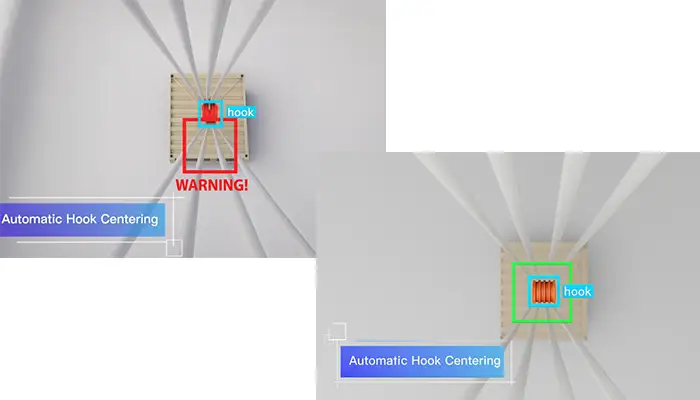
Key functions of automatic hook centering:
- Detects unsafe hook angles
Sensors and AI cameras monitor the hook’s position from multiple directions. Even a small deviation is detected instantly. - Identifies off-center positioning
If the hook is not directly above the load, the system recognizes the offset in real time. - Automatically corrects alignment
The crane adjusts its motion—forward, backward, or sideways—until the hook returns to the safe vertical lifting zone. - Works even when visibility is poor
Whether the operator’s view is blocked by equipment or the hook is at a long distance, the system continues to monitor and correct.
This process takes only seconds, but it prevents many lifting problems that usually show up later in the operation.
Why Buyers Need It
Automatic hook centering is not just a convenience feature. It directly reduces risks, mechanical stress, and unnecessary downtime. For many workshops, it becomes a daily time-saver.
Why this feature matters for crane buyers:
- Prevents side pulling
Side pulling is one of the most common causes of worn wire ropes, damaged hoists, and failed lifting points. Automatic centering stops these issues before they start. - Protects rigging and the load
When the hook is centered, the lift is smooth and controlled, reducing the chance of slipping, dragging, or sudden load movement. - Reduces wear on the hoist and structure
Proper vertical lifting avoids uneven stress on the crane’s trolley, beams, and hoist motor. Over time, this lowers maintenance needs and extends equipment life. - Ideal for precision production work
Industries that handle molds, steel plates, machinery parts, or other high-value items benefit from consistent and accurate hook positioning.
Automatic hook centering brings stability from the very first second of the lift. It helps operators work with confidence and reduces avoidable hazards and repairs—something every crane buyer can appreciate.
AI Camera Monitoring: Real-Time Safety Eyes
AI camera monitoring adds another layer of protection by watching the hook and surrounding area at all times. Unlike manual operation—where the operator must constantly adjust their position or rely on guesswork—AI cameras provide a clear, continuous view of the hook’s behavior. They notice small changes that are easy to miss, especially when the work area is crowded or the crane is operating across a long span. This gives the operator steady feedback while letting the automation correct unsafe movements immediately.
Continuous 360° Visual Tracking
AI cameras are positioned to capture the hook and lifting path from multiple angles. They work like a second pair of eyes that never get tired or distracted. Whether the hook is moving slowly or traveling the full length of the workshop, the monitoring remains active.
How continuous visual tracking supports safe lifting:
- Instant detection of hook deviation
If the hook leans, rotates, or drifts away from the intended direction, the system spots it right away. - Reliable feedback even when visibility is poor
When the operator’s line of sight is blocked by machinery, stacked materials, or structural columns, the camera system still sees everything. - Stable monitoring during long travel
For cranes that operate across wide workshops or long bays, the cameras maintain consistent tracking from start to finish. - Supports hook centering and anti-sway functions
The visual data feeds directly into the automation system, helping it correct movement smoothly and quickly.
This kind of monitoring brings peace of mind. The crane keeps track of the hook’s behavior even when the operator cannot.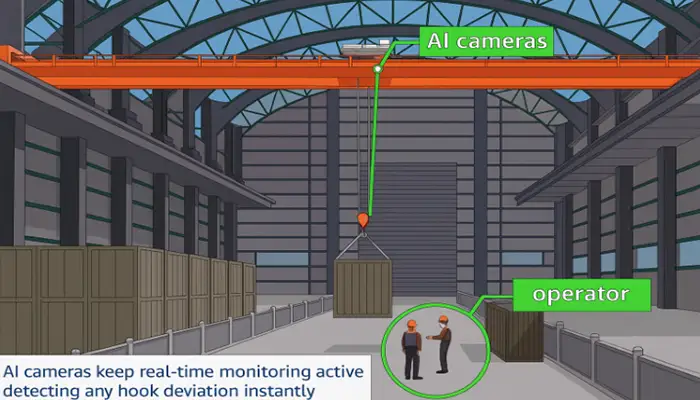
Keeps Operators and Equipment Safe
AI camera monitoring is not just about watching—it’s about reacting. When the system identifies movement that is unsafe or unusual, it immediately alerts the control system or activates corrective motion. This keeps both people and equipment protected.
What the system detects in real time:
- Unexpected hook movement
Sudden tilt or angle changes that could affect the lift. - Sway or drifting
Even small swings can lead to instability, especially with long or bulky loads. - Direction changes caused by obstacles
If the hook bumps into something or slides along a surface, the cameras catch it instantly.
Especially useful in environments such as:
- Congested workshops
Where machines, racks, and people create blind spots. - Long-span crane bays
Where operators often lose sight of the hook during travel. - Night shifts or low-visibility conditions
Dim lighting, dust, or backlighting do not affect the AI camera’s performance.
AI camera monitoring ensures that the crane reacts faster than human reflexes, reducing the chances of accidents and keeping lifting operations smooth and controlled.
Automatic Anti-Collision & Emergency Braking
Automatic anti-collision and emergency braking add another level of protection to bridge cranes, especially in workshops where space is tight and movement happens quickly. Even with a skilled operator, unexpected contact can occur—a hook brushing against a machine, a load drifting too close to a pillar, or a sudden skid when passing over uneven flooring. AI-assisted detection helps the crane react before the situation gets worse.
AI-Assisted Obstacle Detection
The system uses AI cameras and sensors to watch how the hook and load move through the workspace. If the hook touches an obstacle or changes direction suddenly, the crane doesn’t wait for the operator’s next command. It reacts on the spot.
How AI-assisted detection works:
- Instant recognition of contact or skidding
When the hook scrapes, bumps, or slides against an object, the system identifies the abnormal movement immediately. - Monitors both hook and load behavior
AI analyzes angles, speed, and direction, allowing it to catch issues that may not be visible to the operator. - Reduces delayed operator reactions
In busy environments, operators may not notice a minor collision right away. The system responds within milliseconds. - Works across the crane’s entire travel path
From the far end of the workshop to areas behind equipment or storage racks, the system keeps watch continuously.
This proactive detection helps prevent small incidents from turning into costly accidents.
Smart Brake Activation
Once the system detects a risky movement, it engages the brakes automatically. This quick response prevents the crane from continuing into a dangerous situation. It also helps stabilize the load before the swing grows too large.
Automatic braking helps prevent:
- Personnel injury
Stopping the crane immediately reduces the chance of the load or hook moving into a worker’s path. - Load swing
Sudden motion often starts with a small bump. Quick braking keeps the swing minimal and easier to control. - Structural impact
The crane slows or stops before the hook hits steel columns, machines, or storage racks. - Damage to machinery
Prevents collisions with tools, vehicles, or sensitive equipment inside the workshop.
Smart braking turns the crane into a more predictable and controlled machine. Instead of relying only on the operator’s reaction time, the system protects the work area automatically.
Intelligent Movement Control: Smoother, Smarter, Safer
Intelligent movement control is where automation becomes truly useful in daily crane operation. Instead of the crane responding directly to every button press, the system looks at the operator's command, checks the hook stability, and then adjusts the motion to keep everything smooth. It feels almost like power steering—still controlled by the operator, but much easier to handle. This creates steadier lifts, cleaner travel, and fewer moments where the operator has to fight against swing.
Sway control has always been a challenge, especially when moving long or bulky loads. AI uses real-time data from sensors and cameras to predict how the hook will move and then offsets the crane's acceleration or deceleration.
How intelligent sway control works:
- Smooth acceleration and deceleration
The crane speeds up and slows down in a controlled way, preventing sudden jerks that start swinging. - Automatic correction during travel
If the hook begins to sway—due to wind, operator input, or sudden movement—the system adjusts trolley or bridge speed to bring it back to center. - Consistent behavior across all shifts
Whether the crane is handling light parts or heavy steel plates, the stabilizing logic adapts instantly. - Reduces side-to-side drifting
Especially helpful when the crane travels across long spans or uneven load paths.
This reduces the operator's workload significantly, because less manual correction is needed.
Long bridge runs and wide workshops make stability difficult. Even slight movement at the start of travel can turn into a big swing by the time the hook reaches the other end.
Benefits during long-distance movement:
- Stable hook alignment across the full bay
The system keeps the hook vertical even when traveling tens of meters. - Fewer mid-travel adjustments
Operators no longer need to slow down or stop to regain control of the load. - Better flow in busy workshops
Less swing means safer traffic for forklifts, workers, and surrounding machinery. - Helps protect delicate or high-value items
Molds, machine frames, panels, and precision components stay steady and secure.
This makes the crane much easier to drive, especially during repetitive, high-throughput lifting tasks.
Anyone who has operated a crane for hours knows that constant corrections take a toll. Intelligent movement control reduces the mental load and helps operators work more comfortably.
How it supports the operator:
- Less stressful lifting
The crane feels more predictable, so operators can focus on positioning rather than fighting sway. - Reduced fatigue over long shifts
Automation handles routine corrections, allowing operators to maintain alertness. - Faster learning curve for new operators
Beginners can work safely while gaining experience, since the system prevents sudden or unsafe movement. - More consistent results every day
Skilled operators get smoother lifts, and new operators benefit from built-in stabilization.
Overall, intelligent movement control creates a safer and more comfortable working environment. Buyers looking to reduce operator stress, improve precision, and maintain steady workflow will see immediate benefits from this feature.
Key Benefits for Crane Buyers
Investing in AI-enabled crane technology is not just about adding new features. It brings practical improvements to day-to-day lifting, lowers operational risks, and helps workshops run more efficiently. These benefits show up in safety records, maintenance schedules, and the overall quality of each lift. For buyers comparing options, the advantages are clear and measurable.
Automation helps the crane follow safe lifting practices consistently, even when shifts are busy or operators are under pressure.
How automation supports safety compliance:
- Pre-lift checks happen automatically — off-center hooks and unsafe angles are corrected before the load leaves the ground.
- Monitoring never stops — cameras track hook movement regardless of visibility.
- Corrective actions activate instantly — prevents unsafe conditions that operators may not catch in time.
- Supports internal safety policies — gives companies a reliable way to maintain safe lifting routines.
This makes it easier for facilities to meet modern safety requirements and maintain clean audit records.
Fewer lifting incidents mean less unplanned downtime and fewer costly repairs. Even minor collisions or load swings can disrupt production.
Practical reductions from automated safety:
- Fewer load swings lead to fewer near-miss events.
- Prevention of side pulling protects hoists, ropes, and beams.
- Automatic braking reduces impact-related damage.
- Accident avoidance lowers insurance claims and worker injury risks.
Over time, this directly reduces operational costs and keeps production running smoothly.
When the hook stays vertical and movement is controlled, the entire crane structure experiences less stress.
Ways automation extends equipment lifespan:
- Reduced side loading prolongs hoist motor and gearbox life.
- Cleaner travel means less wear on wheels, rails, and trolley frames.
- Better alignment prevents uneven strain on beams and end trucks.
- Smoother acceleration/deceleration results in fewer shock loads.
Buyers benefit from lower maintenance costs and longer replacement cycles.
Many industries rely on precise, repeatable lifting to keep production consistent. AI-supported cranes help achieve this without slowing down operations.
Accuracy improvements that matter:
- Stable hook positioning makes it easier to align with jigs, molds, and fixtures.
- Minimal sway allows smoother material placement in tight spaces.
- Automatic corrections help maintain precision across all shifts.
- Predictable lift paths reduce time lost to repeated adjustments.
This is especially useful for fabrication shops, assembly lines, and facilities handling large or delicate components.
Older workshops often struggle with poor visibility, tight aisles, and aging cranes. Intelligent systems give these environments a practical safety boost without needing full crane replacement.
Why it's ideal for upgrading older facilities:
- Improves existing workflow safety even if the building layout is tight.
- Cameras reduce blind spots in crowded or low-light areas.
- Automation compensates for inconsistent operator skill levels.
- Helps extend the life of older cranes by reducing stress and accidental impacts.
This makes AI-based upgrades a cost-effective path for companies wanting modern safety levels without rebuilding their entire plant.
Ideal Applications
AI-enabled crane systems are not limited to one type of industry. Their safety features and movement control make them useful anywhere lifting is part of the daily workflow. From small workshops to large industrial plants, these systems help operators work more confidently while reducing the chance of errors or unexpected movement. Below are the environments where AI-assisted cranes deliver the most value.
Manufacturing floors often have tight spaces, mixed workflows, and many workers sharing the same area.
Why AI features help in manufacturing:
- Predictable hook movement keeps the load steady around machines and assembly stations.
- Fewer blind spots thanks to AI cameras, especially around tall equipment.
- Stable long-travel movement makes material handling smoother during shift operations.
- Supports repetitive lifting tasks with consistent accuracy each time.
This improves safety and keeps production running smoothly.
Heavy fabrication involves large, uneven, or awkward loads that are more difficult to control manually.
Benefits for heavy-load industries:
- Automatic hook centering helps avoid side pulling on heavy parts.
- Sway control improves placement accuracy for beams, plates, frames, and welded structures.
- Real-time monitoring maintains visibility even in dusty or hot environments.
- Emergency braking protects workers during heavy-load swings or unexpected shifts.
These features reduce downtime and protect both workers and expensive materials.
Warehouses move materials constantly, often through narrow aisles or around forklift traffic.
Why logistics centers benefit:
- Smooth crane travel helps avoid swinging loads that interfere with stored goods.
- AI-based obstacle detection protects racks and equipment from accidental impacts.
- Improved visibility reduces the risk of collisions in busy loading areas.
- Better control for operators during repetitive pallet or container handling.
This leads to safer workflow and higher efficiency across daily operations.
Industries that lift delicate or high-value components need accuracy, not just lifting power.
Ideal for precision handling because:
- AI stabilization keeps fragile loads steady.
- Precise hook alignment improves positioning for jigs, molds, and fixtures.
- Minimal sway helps place components exactly where they are needed.
- Reduced operator fatigue ensures steadier performance throughout the shift.
This is essential for electronics manufacturers, mold workshops, machine assembly lines, and aerospace component handling.
Even smaller workshops or mixed-use facilities benefit from cranes that operate predictably.
General advantages for any lifting environment:
- Consistent lifting behavior across all shifts and operator skill levels.
- Lower maintenance needs thanks to reduced mechanical stress.
- Safer work areas through continuous monitoring and automated corrections.
- Better workflow control with stable and repeatable movement patterns.
Any place where cranes operate daily can gain safer and more efficient handling with AI-enabled systems.
Conclusion: Make Every Lift Safer and Smarter
AI-driven features are changing how bridge cranes operate, and the improvement is easy to see on any workshop floor. With real-time camera monitoring, automatic hook centering, anti-collision protection, and intelligent movement control, traditional cranes become far more stable and predictable. Operators don’t need to fight against sway or guess the hook’s position—they work with a crane that helps them stay safe.
For buyers who care about safety, efficiency, and long-term reliability, these automation features are no longer “nice to have.” They are quickly becoming the new baseline for modern lifting. Whether a facility handles heavy steel, delicate components, or daily warehouse loads, AI-assisted cranes reduce risks, protect equipment, and deliver smoother lifting every day.
In short, upgrading to AI-enabled crane technology is one of the most practical ways to improve safety standards and keep lifting operations running with confidence—shift after shift.