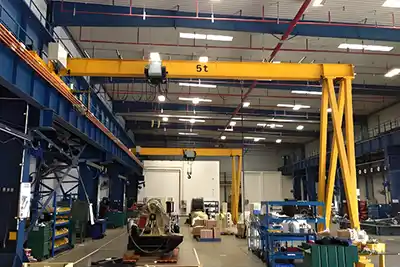
Why Semi-Gantry Cranes Are Ideal for Large Workshop Handling
Why Semi-Gantry Crane is the Best Overhead Material Handling Solution for Large Space Workshops
Introduction
Material Handling Challenges in Large Workshops
Moving heavy materials in a big workshop can be tricky. When the space is wide and open, workers often waste time pushing carts or using forklifts to move items. This slows down production and increases the risk of accidents. Reaching all areas safely and keeping the workflow smooth can be a real challenge.
- Heavy loads need stable, controlled movement over long distances.
- Busy floors with equipment can create bottlenecks.
- Manual handling increases the chance of injuries.
- Workflow interruptions can delay production.
Overview of Common Overhead Crane Types
There are a few main types of overhead cranes used in workshops:
- Bridge (EOT) Cranes: Run on rails across the building. Great for uniform layouts, but need strong building support and can be expensive.
- Full Gantry Cranes: Supported entirely from the floor. Highly mobile, but take up a lot of space and cost more for large spans.
- Semi-Gantry Cranes: One side runs on a floor track, the other on a fixed runway. They reduce installation cost and save floor space.
Each type has pros and cons depending on workshop size, load, and workflow.
Why Semi-Gantry Cranes Work Well
Semi-gantry cranes are a practical choice for large workshops. They combine the benefits of bridge and gantry cranes without most of the downsides.
- Can handle medium to heavy loads without expensive infrastructure.
- Take up less floor space than full gantry cranes.
- Flexible span and height to fit different workshop layouts.
Simply put, semi-gantry cranes make moving materials across large workshops easier, safer, and more efficient.
Semi-Gantry Cranes
Definition and Basic Structure
A semi-gantry crane is a type of overhead crane designed to move heavy materials in workshops with large spans. Unlike a full gantry crane, only one side of the crane is supported by a fixed runway beam. The other side runs on wheels directly on the workshop floor.
This design reduces the need for expensive building support while still allowing long-span lifting. It’s particularly useful in workshops where one side of the building can support a runway, but floor space must remain open.
- One side is fixed on a runway beam attached to the building.
- The other side moves on wheels along the floor track.
- Covers medium to heavy loads efficiently.
Key Components
A semi-gantry crane has several main parts, each serving an important function:
- Bridge Girder: The horizontal beam that spans the lifting area and carries the hoist. It provides stability and distributes weight evenly.
- Hoist and Trolley: The hoist lifts the load, while the trolley moves it along the bridge. Together, they allow precise positioning of heavy materials.
- Rails and Wheels: The wheels on the floor side move along rails, while the runway on the fixed side guides the crane along the building structure.
These components work together to make lifting, moving, and positioning materials easier and safer.
Types of Semi-Gantry Cranes
Semi-gantry cranes come in different configurations based on the workshop’s needs:
- Single Girder Semi-Gantry Crane: Has one main bridge girder. Suitable for lighter to medium loads, simple installation, and lower cost.
- Double Girder Semi-Gantry Crane: Has two parallel girders. Can handle heavier loads, provides better stability, and is ideal for larger workshops with high lifting demands.
Choosing the right type depends on your lifting weight, span, and workshop layout.
Advantages of Semi-Gantry Cranes in Large Workshops
Semi-gantry cranes offer several practical benefits for large workshops, balancing cost, space, and operational efficiency. Understanding these advantages can help buyers choose the right crane for their needs.
One of the main reasons workshops choose semi-gantry cranes is cost. Compared to full gantry or bridge (EOT) cranes, semi-gantry cranes require less investment upfront. You don't need a fully reinforced building structure on both sides, which cuts down on construction and installation costs.
- Lower initial purchase price than full gantry or overhead cranes.
- Less expensive runway beam and foundation work.
- Reduced need for heavy structural support, saving on building reinforcement costs.
This makes them a practical option for workshops that need reliable lifting without overspending on infrastructure.
Semi-gantry cranes are also great when floor space is a concern. Because only one side runs on wheels along the floor, you can keep more open space for other equipment, machinery, or workflow areas. This makes moving materials easier without creating obstacles.
- Save valuable floor space compared to full gantry cranes.
- Easier to arrange workshop layout and equipment placement.
- Provides better movement flexibility, allowing the crane to reach more areas efficiently.
These advantages make semi-gantry cranes ideal for large workshops where both cost and space efficiency are important.
Semi-gantry cranes are easier to install than full gantry or bridge cranes. Since only one side needs a fixed runway and the other moves on floor wheels, foundation work is simpler. Maintenance is also more convenient because most components are accessible without special equipment.
- Requires simpler foundation and runway beams than full gantry cranes.
- Easy access to the hoist, trolley, and electrical components for inspection.
- Reduces downtime during repairs or routine maintenance.
This makes them practical for workshops that want to avoid long installation times and costly maintenance procedures.
Despite their simpler structure, semi-gantry cranes can handle medium to heavy loads. This makes them suitable for most large workshop operations, from steel fabrication to machinery assembly.
- Can lift a wide range of weights depending on the model.
- Supports continuous operation in heavy-duty environments.
- Reliable for moving large or bulky materials safely.
Semi-gantry cranes can be adjusted to fit the unique layout of your workshop. Whether your space has partial obstructions or unusual dimensions, these cranes can be customized to suit your needs.
- Span and lifting height can be adjusted to match workshop requirements.
- Can operate in areas where other crane types may struggle due to obstacles.
- Available in single or double girder versions to match load capacity and space.
These cranes often consume less power than full overhead cranes because of their lighter structure and optimized design. Lower energy consumption reduces operating costs over time.
- Uses less electricity for the same lifting tasks.
- Smaller motors and simpler mechanisms reduce energy waste.
- Helps workshops manage operational costs more efficiently.
Typical Applications in Large Workshops
Semi-gantry cranes are versatile and can fit many types of large workshop operations. Their combination of cost efficiency, space savings, and load capacity makes them a practical choice across industries.
In steel fabrication shops, materials like beams, sheets, and heavy components need to be moved frequently. Semi-gantry cranes allow operators to lift and position steel accurately without blocking floor space.
- Move long or heavy steel beams safely.
- Support welding, cutting, and assembly operations efficiently.
- Reduce manual handling and improve workflow.
Workshops producing industrial machinery often deal with bulky components that need precise positioning. Semi-gantry cranes make it easier to handle parts like motors, frames, or gear assemblies.
- Safely lift heavy machinery parts.
- Facilitate assembly line operations.
- Minimize risk of damage to delicate components.
Maintenance shops for vehicles, construction, or agricultural equipment require lifting and moving heavy parts, engines, or complete assemblies. Semi-gantry cranes provide the flexibility to cover large spans without interfering with floor operations.
- Handle engines, transmissions, and large assemblies.
- Improve service speed by reducing manual effort.
- Adapt to workshops with irregular layouts or limited overhead support.
In storage and distribution facilities, handling pallets, containers, or heavy inventory can be challenging. Semi-gantry cranes help maximize usable floor space while moving materials efficiently.
- Navigate around obstacles and uneven layouts.
- Improve material flow across wide storage areas.
- Reduce reliance on forklifts or multiple small hoists.
Comparison With Other Crane Types
When choosing a crane for a large workshop, it helps to compare the main options. Semi-gantry cranes often strike the best balance between cost, space, and flexibility.
| Feature | Semi-Gantry | Full Gantry | Overhead EOT |
|---|---|---|---|
| Installation Cost | Lower | Higher | Medium |
| Space Efficiency | High | Medium | Medium |
| Load Capacity | Medium–High | High | Medium |
| Flexibility | High | Low | Medium |
| Maintenance Access | Easy | Harder | Moderate |
Summary
Semi-gantry cranes outperform other crane types in large workshops because they combine the benefits of overhead and gantry cranes without most of the drawbacks.
- Cost-effective: Lower installation and structural requirements.
- Space-friendly: Takes up less floor space than full gantry cranes.
- Flexible: Can adapt to irregular layouts and partial obstructions.
- Accessible: Maintenance is easier, reducing downtime and operational hassle.
For workshops with wide spans, varying load sizes, and the need for efficient material movement, semi-gantry cranes often offer the most practical solution.
Key Considerations for Buyers
Before choosing a semi-gantry crane, there are several practical factors buyers should consider to ensure safe and efficient operation.
The floor where the crane wheels run must be strong enough to support heavy loads. Any misalignment in the runway or floor rails can affect crane performance and safety.
- Check the load-bearing capacity of the floor.
- Ensure rails or tracks are properly aligned and level.
- Inspect floor condition for cracks, uneven areas, or obstacles.
Semi-gantry cranes are flexible, but their effectiveness depends on workshop design. Consider walls, columns, or machinery that could limit movement.
- Measure span and lifting height carefully.
- Plan crane path to avoid obstacles.
- Ensure sufficient clearance for safe operation.
The type of materials, load weight, and lifting frequency determine the crane specification. High-frequency lifting may require a stronger hoist or double girder design.
- Identify average and maximum load weights.
- Determine how often loads will be lifted daily.
- Choose a hoist and bridge type suitable for operational demand.
Workshops evolve over time. Planning ahead ensures the crane can accommodate future workflow changes or expansions without major reconstruction.
- Consider potential increase in load size or weight.
- Evaluate whether additional lifting points might be needed later.
- Choose a crane design that allows easy modification or relocation.
Safety should always come first. Semi-gantry cranes must comply with industrial standards and include safety devices to prevent accidents.
- Check for overload protection, emergency stop, and limit switches.
- Ensure compliance with local and international safety standards.
- Train staff on safe operation and inspection procedures.
Conclusion
Semi-gantry cranes offer a balanced solution for large-space workshops. They combine the lifting capacity of traditional cranes with a design that saves floor space and reduces installation costs. For workshops that handle medium to heavy loads across wide areas, these cranes make material handling safer, faster, and more efficient.
- Cost Savings: Lower installation and structural requirements make them more budget-friendly than full gantry or overhead cranes.
- Space Efficiency: One-sided floor support allows more room for machinery, workflow, and storage.
- Operational Flexibility: Adjustable spans, lifting heights, and the ability to navigate around obstacles make them suitable for evolving workshop layouts.
Before choosing a semi-gantry crane, buyers should carefully evaluate floor strength, workshop layout, lifting needs, and future expansion plans. Doing so ensures the selected crane not only fits current operations but also supports safe and efficient workflows for years to come.
Semi-gantry cranes may not be the flashiest solution, but in large workshops, they consistently deliver practical, reliable, and cost-effective performance.