Budget-Friendly Cranes: Semi-Gantry vs Full Gantry
Introduction: Making Smart Crane Choices for Wide Workshops
Wide workshops—those with large spans and open floor areas—present unique challenges for material handling. Lifting, moving, and positioning heavy loads efficiently requires careful planning. Without the right equipment, even simple tasks can become time-consuming and unsafe. Many buyers assume that bigger workshops automatically need bigger cranes, but that’s not always true. Understanding the specific needs of your workshop is key to choosing a crane that works well and stays within budget.
Selecting a cost-effective crane solution isn’t just about spending less upfront. It’s about matching the crane to your workflow, your load requirements, and the physical layout of your space. Choosing the wrong crane can lead to extra costs down the line—think of wasted energy, increased maintenance, or even having to replace the crane sooner than expected.
This guide focuses on comparing two popular types of cranes for wide workshops: semi-gantry cranes and full gantry cranes. By understanding the trade-offs, advantages, and limitations of each, buyers can make informed decisions that balance cost, capacity, and operational efficiency.
In this section, you’ll learn:
- Why workshop size and layout matter when choosing a crane
- How material handling requirements affect budget decisions
- What makes semi-gantry and full gantry cranes different, and when each is best suited
Wide-Workshop Material Handling Requirements
Before choosing a crane, it’s important to take a step back and really understand what your workshop requires. Wide workshops aren’t just “big rooms”—they come with specific challenges in terms of span, height, and the weight of materials you need to move. Overlooking these factors can lead to picking a crane that’s either too small to handle your work or unnecessarily expensive.
Typical Span, Height, and Load Considerations
When planning a crane for a wide workshop, the first thing to check is the span—the distance the crane needs to cover from one side to the other. Wide spans often require stronger structures and more precise engineering. Next is lifting height, which depends on the tallest item you need to move and the clearance needed for safe operation.
The load capacity of the crane is another critical factor. It’s not just about the heaviest single piece you lift, but also the frequency of lifting and total load over time. Keep in mind: a crane operating near its maximum capacity all day will wear faster, which can increase maintenance costs.
Key points to consider:
- Workshop span and whether the crane needs to cover the full width or only part of it
- Maximum lifting height required for operations
- Average and peak load weights, including bundles or multiple items at once
- Frequency of lifts and duration of daily operations
Common Workshop Activities Impacting Crane Selection
Different workshops have different workflows, and these can influence the type of crane you need. For example:
- Material storage and retrieval: Frequent movement of heavy items may require a more robust crane with faster operation.
- Assembly or production lines: Cranes may need precise positioning rather than maximum load capacity.
- Loading/unloading vehicles or containers: May require longer spans and flexibility in crane movement.
By reviewing how materials are handled in your workshop, you can avoid overbuying unnecessary features or underestimating what you actually need.
Factors Influencing Budget and Operational Efficiency
Budget isn’t just the purchase price. Installation, maintenance, energy consumption, and future expansion all play a role. Choosing the right crane can help reduce downtime and operational costs. Some practical considerations include:
- Floor strength and whether reinforcement is needed
- Available power supply and electrical requirements
- Potential need for future upgrades or workflow changes
- Maintenance accessibility and frequency
Semi-Gantry Cranes: Budget-Friendly and Flexible
Semi-gantry cranes are a practical solution for many wide workshops, especially when you want a balance between cost, flexibility, and performance. Unlike a full gantry crane that has legs on both sides, a semi-gantry crane is supported on one side by a vertical leg and on the other side by a runway beam attached to the workshop structure. This design reduces the amount of steel needed and makes it easier to install in workshops that have at least one open side.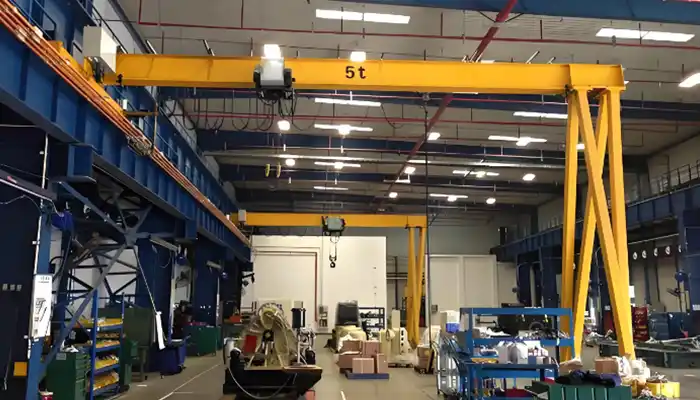
Semi gantry crane for wide shops, single girder semi gantry crane types and double girder semi gantry crane types
Advantages
Semi-gantry cranes are popular because they offer several practical benefits for workshop buyers:
- Lower initial investment: Since one side of the crane doesn’t require a full leg structure, material and fabrication costs are lower. This can make a significant difference if you are working with a limited budget.
- Less installation complexity: With only one leg to support and simpler connections on the building side, installation is faster and less disruptive to ongoing workshop operations.
- Saves floor space on one side: The open side allows vehicles, equipment, or workflow to continue under the crane without obstruction, which is ideal for workshops that need flexibility in layout.
Limitations
Of course, semi-gantry cranes aren’t perfect. Buyers should consider their limitations to avoid costly mistakes:
- Reduced load capacity compared to full gantry cranes: The single-leg support limits the maximum weight the crane can safely lift. For very heavy or frequent loads, a semi-gantry may not be enough.
- Limited mobility on the open side: Because one side depends on the runway beam, the crane can’t move freely in that direction, which may restrict certain operations in your workshop.
Best Applications
Semi-gantry cranes work best in situations where you don’t need full gantry support or maximum lifting capacity:
- Workshops with partial open areas: If one side of your workshop is free or has other structures, the semi-gantry can make use of that space efficiently.
- Moderate load handling and less frequent heavy lifting: Perfect for workshops that move medium-weight materials occasionally, rather than handling very heavy loads all day.
In short, a semi-gantry crane can be a practical, budget-friendly solution for workshops that need flexibility without breaking the bank. It gives you the strength and coverage you need for most moderate lifting tasks, while saving on installation costs and floor space.
Full Gantry Cranes: Robust but Costlier
Full gantry cranes are designed for heavy-duty lifting and maximum coverage. Unlike semi-gantry cranes, a full gantry crane has legs on both sides, supporting the crane independently from the building structure. This means it doesn’t rely on workshop beams or walls, making it highly versatile for both indoor and outdoor operations.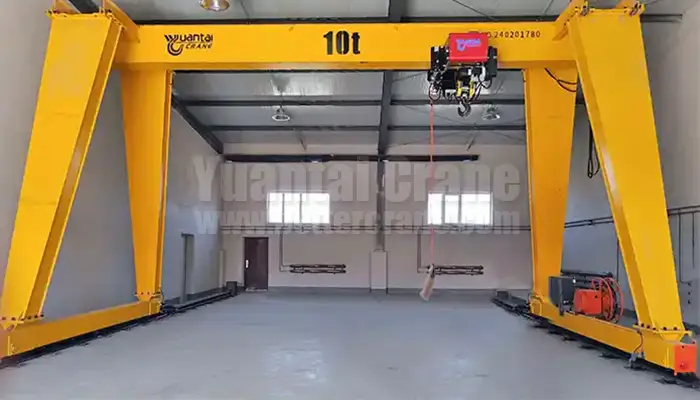
Full gantry crane for sale , single girder gantry crane types and double girder gantry crane types
Advantages
Full gantry cranes are built for strength and reliability, which comes with several practical benefits:
- Higher load capacity: With support on both sides, full gantry cranes can handle very heavy materials safely. They are ideal for operations where lifting limits exceed what semi-gantry cranes can manage.
- Greater stability and safety: The double-leg structure provides strong support and reduces sway, giving operators better control and reducing the risk of accidents.
- Can operate independently outdoors or indoors: Since it doesn’t rely on the building, a full gantry can be used in open yards, construction sites, or workshops without structural limitations.
Limitations
There are trade-offs when choosing a full gantry crane:
- Higher initial cost: More steel, more fabrication, and more installation work means a higher upfront investment. Budget-conscious buyers need to weigh this against long-term benefits.
- Requires more floor space: Both legs take up space on the workshop floor, which can limit vehicle movement or workflow if the area is tight.
- Longer installation time: With larger components and more complex assembly, full gantry cranes take longer to install, which may temporarily disrupt operations.
Best Applications
Full gantry cranes are most suitable in environments where strength and independence are priorities:
- Very wide workshops or outdoor yards: They cover large spans without relying on walls or support beams, making them ideal for open spaces.
- Heavy, frequent lifting operations: Perfect for operations that require moving very heavy materials often, such as steel processing, shipyards, or large assembly areas.
In summary, full gantry cranes provide maximum lifting capacity and operational freedom, but they come with higher costs and require more space. They are a solid choice when your workshop handles heavy loads frequently or when structural independence is needed.
Side-by-Side Comparison: Semi vs. Full Gantry
When it comes to choosing between semi-gantry and full gantry cranes, it helps to see the differences at a glance. Here’s a practical comparison that focuses on what really matters for workshop buyers: cost, space, lifting capacity, installation, and mobility.
| Feature | Semi-Gantry | Full Gantry |
|---|---|---|
| Cost | Lower upfront cost, more budget-friendly for smaller operations | Higher initial investment, but suitable for heavy-duty needs |
| Floor space usage | Saves space on one side, leaves room for vehicles or workflow | Needs more floor space due to two-leg structure |
| Load capacity | Moderate, suitable for medium-weight items | High, can handle very heavy materials safely |
| Installation | Faster and simpler; less disruption to workshop | More complex and time-consuming, requires careful planning |
| Mobility | Limited on the open side; depends on building beam | Fully mobile along entire span, independent of walls or structure |
Practical Takeaway
Choosing the right crane comes down to your workshop’s specific needs. If you have moderate loads, limited budget, or partial open space, a semi-gantry crane can be the most practical choice. On the other hand, if you handle heavy, frequent loads or need a crane that operates independently of your building structure, a full gantry crane makes sense despite the higher cost.
Factors Buyers Should Consider When Selecting a Crane
Selecting the right crane isn't just about picking a type—it's about matching the crane to the real-world needs of your workshop. Several practical factors can affect both the upfront cost and the long-term efficiency of your operations. Paying attention to these details helps avoid unexpected problems and ensures the crane performs reliably for years.
Before buying a crane, measure your workshop carefully. The span, ceiling height, and open floor space determine which crane type will fit and operate safely. Don't forget to consider any columns, doors, or equipment that could obstruct crane movement.
- Measure the maximum span the crane needs to cover
- Check available height for hoist operation and safety clearance
- Identify obstacles that may limit crane travel or positioning
Knowing the weight and frequency of your lifts helps you select a crane that won't be under- or over-designed. A crane running near its maximum capacity every day will wear faster and increase maintenance costs.
- Identify the heaviest item or bundle you plan to lift
- Track how often lifts occur per day or per shift
- Consider peak versus average loads for realistic capacity planning
Some workshops may require reinforced floors or special foundations to support a crane, especially for full gantry cranes. Installation logistics can also affect timing and cost.
- Check whether the floor can support the crane's load and wheels
- Verify electrical supply matches crane requirements
- Ensure enough space for crane assembly and installation
Workshops evolve over time. Choosing a crane that can adapt to changes in layout, lifting needs, or workflow can save money in the long run.
- Plan for potential increases in load or production
- Consider modular or adjustable cranes for flexibility
- Evaluate if the crane can be relocated or upgraded if needed
A crane that is hard to maintain or doesn't meet safety standards can create downtime and risks for operators. Prioritize features that simplify inspection, servicing, and safe operation.
- Ensure the crane meets local safety regulations
- Check accessibility for routine maintenance
- Consider training requirements for operators and technicians
Cases for References
Understanding the differences between semi-gantry and full gantry cranes is easier when you see how they perform in real workshops. Let’s look at two practical examples that illustrate cost, performance, and suitability.
Semi-Gantry for Medium-Duty Wide Workshop
Imagine a medium-sized workshop handling steel sheets and machinery components. The spans are wide, but the heaviest loads rarely exceed 10 tons, and operations happen a few times per day.
In this case, a semi-gantry crane is ideal:
- Requires only one leg structure, reducing material and fabrication costs
- Installation is quick and minimally disruptive, allowing production to continue during setup
- Open floor space on the other side improves workflow and vehicle access
- Handles moderate loads efficiently without over-investing in capacity
Result: A cost-effective solution that meets lifting needs without overspending, while leaving room for operational flexibility.
Full Gantry for Heavy-Duty Wide Workshop
Now consider a large steel processing yard or a workshop producing heavy machinery components, where lifts can reach 20–30 tons multiple times per day.
A full gantry crane makes sense here:
- Both legs support heavy loads safely, providing maximum stability
- Independent operation allows use indoors or outdoors, regardless of building structure
- Can cover the full span of the workshop, handling frequent, heavy lifting
- More robust, reducing wear and maintenance issues under continuous use
Result: Higher upfront cost and longer installation, but the crane meets the operational demands safely and reliably.
Cost-Benefit Analysis
| Factor | Semi-Gantry | Full Gantry |
|---|---|---|
| Initial Cost | Lower, fits smaller budgets | Higher, requires more investment |
| Installation | Faster and simpler | Longer and more complex |
| Load Handling | Moderate, occasional heavy lifts | High, frequent heavy loads |
| Floor Space | Less, saves workflow area | More, needs dedicated space |
| Long-Term Efficiency | Suitable for moderate use | Excellent for high-demand operations |
Practical takeaway: Choosing between semi-gantry and full gantry cranes depends on your daily lifting needs, workshop layout, and budget. Semi-gantry cranes save money and space in moderate-duty scenarios, while full gantry cranes deliver the strength and stability required for heavy-duty, high-frequency operations.
Conclusion: Making Budget-Smart Decisions
Choosing the right crane for a wide workshop isn’t just about picking the most powerful or the cheapest option—it’s about finding the balance that fits your space, workflow, and budget.
Semi-gantry cranes offer a cost-effective, flexible solution for moderate loads and partially open workshops. They save on installation and floor space while handling everyday lifting tasks efficiently. On the other hand, full gantry cranes provide maximum load capacity and stability, ideal for heavy-duty operations or workshops that require independent crane movement across a large span.
The key is to evaluate your actual needs before investing:
- Consider your workshop dimensions, load types, and lifting frequency
- Factor in installation requirements, floor strength, and future expansion
- Balance upfront costs with long-term operational efficiency and safety
Contact us to get your overhead crane solution for yor wide span workshops and factilities.