Automating Double Cantilever RMG Cranes | Terminal AI Upgrades 2026
Automating Your Terminal with Double Cantilever RMG Cranes: What’s Possible in 2026
Most Important Takeaway
Investing in double cantilever RMG cranes with advanced automation transforms container terminals by boosting efficiency, safety, and operational flexibility while future-proofing your yard for AI-driven workflows.
Key Takeaways
- Understand how automation reduces human error and optimizes container flow.
- Explore AI-based collision avoidance and predictive maintenance tools.
- Learn the benefits of remote control and semi-autonomous operations.
- Assess cost versus productivity improvements for long-term ROI.
- Integrate digital systems to streamline yard management and scheduling.
- Make informed decisions about retrofitting existing cranes vs. installing new units.
Questions solved here:
- How can automation improve throughput and reduce labor dependency?
- What AI safety features exist for dual-side container handling?
- Can remote control or semi-autonomous operation be scaled in my terminal?
- What is the impact on maintenance costs and equipment lifespan?
- How to plan digital upgrades for future operational growth?
Introduction
Double cantilever RMG cranes are a type of rail-mounted gantry crane designed to handle containers from both sides simultaneously. Unlike single cantilever cranes, these units extend their arms over two lanes, allowing for faster loading and unloading of trucks and rail wagons. Their dual-arm design is particularly useful for terminals with high-density stacking or tight schedules, where every minute counts.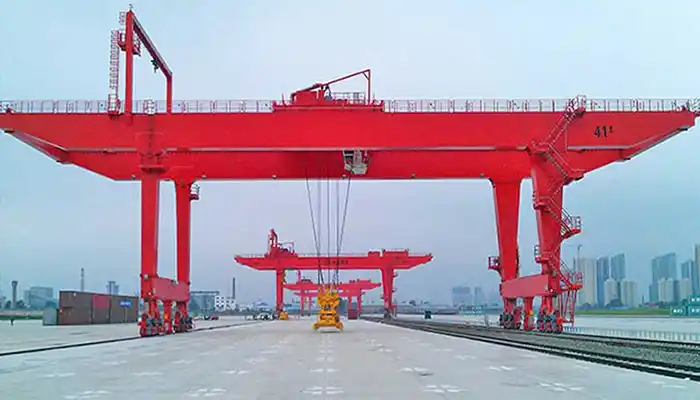
- Capable of lifting containers up to 65 tons or more depending on configuration.
- Allow simultaneous handling on two adjacent lanes, reducing internal moves.
- Compatible with standard ISO containers, including 20' and 40' sizes.
- Often integrated with terminal operating systems for workflow coordination.
In practice, a double cantilever RMG crane not only moves containers—it orchestrates the flow of goods within a terminal. By doing so, it reduces congestion and allows more predictable scheduling for trucks and trains.
As of 2026, container terminals are increasingly integrating AI and IoT technologies into their equipment. Modern RMG cranes now come with features like predictive maintenance alerts, collision detection, and automated stacking guidance. This digital layer helps operators manage cranes more efficiently, reduces downtime, and provides real-time visibility into yard operations.
- AI-based load positioning ensures containers are stacked accurately and safely.
- IoT sensors monitor equipment health, temperature, and operational cycles.
- Data collected from cranes can be used to optimize yard layouts and traffic flow.
- Remote monitoring allows supervisors to control or oversee multiple cranes from a central hub.
For terminal operators, embracing this technological shift is not just a matter of convenience. It directly impacts efficiency, cost management, and safety compliance. Terminals that adopt these technologies now are laying the groundwork for smoother operations and fewer operational bottlenecks in the years to come.
Upgrading to automated double cantilever RMG cranes isn't just about following a trend—it's about preparing for the next decade of logistics demands. Ports and intermodal yards are handling larger container volumes, tighter schedules, and higher operational expectations. Terminals that wait risk falling behind in efficiency, safety, and overall reliability.
- Reduces manual errors that can cause container damage or accidents.
- Improves turnaround time for trucks and rail, helping meet contractual deadlines.
- Supports digital integration with terminal operating systems, analytics tools, and future AI upgrades.
- Provides flexibility to scale operations as traffic grows, without major structural changes.
Simply put, digital upgrades today can prevent costly retrofits tomorrow. For operators, it's about building a foundation that supports both immediate efficiency gains and long-term operational growth.
Double cantilever RMG cranes are capable of lifting large container weights, often exceeding 65 tons. Their dual-arm design allows operators to work on two adjacent lanes simultaneously, significantly reducing the internal moves and accelerating the flow of containers through the terminal.
Modern double cantilever RMG cranes are fully compatible with terminal operating systems. This integration allows real-time coordination with yard operations, scheduling of truck and rail handling, and overall management of container flow, improving efficiency and reducing delays.
With AI and IoT integration, RMG cranes can provide predictive maintenance alerts, monitor operational cycles, and detect potential issues before they cause downtime. Remote monitoring capabilities allow supervisors to oversee multiple cranes from a central hub, ensuring reliability and continuous operations.
Terminals that upgrade now gain immediate benefits such as reduced manual handling errors, improved turnaround times, and better integration with analytics tools. Additionally, these upgrades future-proof operations by providing flexibility to scale and adopt further AI or automation enhancements as container traffic grows.
Automation Features in 2026
In 2026, many double cantilever RMG cranes are equipped with semi-autonomous capabilities. This means the crane can perform repetitive tasks like stacking or retrieving containers with minimal operator input, while still allowing a human to intervene when needed. For terminal operators, this reduces fatigue, improves consistency, and speeds up operations.
- Cranes can automatically lift and place containers based on pre-set coordinates.
- Internal yard moves, like shifting containers to clear lanes, are handled with AI guidance.
- Operators can supervise multiple cranes simultaneously from a central control room.
- Manual override remains available for complex or unusual handling tasks.
Semi-autonomous operation doesn't remove the human entirely—it helps the operator focus on monitoring, exceptions, and safety, while routine moves are handled efficiently and accurately.
Modern RMG cranes now integrate tightly with terminal operating systems. These systems schedule tasks dynamically, assign cranes to specific containers, and coordinate movements to reduce conflicts or bottlenecks. Automated task allocation ensures that each crane is always working on the most critical container moves, maximizing throughput.
- Real-time updates allow the system to respond to late arrivals or priority containers.
- Task optimization reduces crane idle time and unnecessary internal moves.
- Coordination between multiple cranes prevents collisions and stacking errors.
- TOS integration can track performance metrics for each crane, helping improve planning over time.
Automating the "who moves what, and when" process ensures smoother operations and better predictability, which is critical for terminals handling tight schedules or high-volume flows.
IoT-enabled sensors are now standard on most new double cantilever RMG cranes. These sensors monitor container weight, position, and orientation, guiding the crane for precise placement and safe stacking. The result is fewer dropped containers, less wear on equipment, and smoother overall operation.
- Laser and camera systems detect container edges and guide the spreader automatically.
- Weight sensors prevent overloading and reduce mechanical strain on crane components.
- Movement optimization algorithms calculate the most efficient lifting paths, saving energy and time.
- Integration with other cranes in the yard ensures coordinated movement to avoid congestion.
These smart sensors are like the crane's "eyes and brain," continuously analyzing conditions and adjusting operations on the fly.
One of the most practical features of automation in 2026 is predictive maintenance. Instead of waiting for breakdowns, RMG cranes can now monitor their own health and alert operators to potential issues before they happen. This proactive approach reduces downtime and extends equipment life.
- Sensors track motor temperature, wear on wheels, and hoist performance.
- Data is analyzed to forecast maintenance needs and schedule interventions during low-traffic periods.
- Predictive analytics can suggest part replacements or service checks before failures occur.
- Maintenance teams can plan spare parts inventory more accurately, reducing costs.
Predictive maintenance doesn't just save money—it keeps the terminal running smoothly and ensures cranes are available when throughput demands are highest.
AI Safety Tools
Safety is a top concern for terminals, and double cantilever RMG cranes handle multiple containers on two sides simultaneously—so the risk of collisions is real if not managed properly. Modern cranes now use AI-driven collision avoidance systems that scan both sides continuously, detecting obstacles and adjusting crane movements automatically.
- Lidar, radar, and camera systems track nearby containers and moving vehicles.
- AI algorithms calculate safe paths, slowing or stopping the crane if a potential collision is detected.
- Dual-side scanning ensures that simultaneous operations on both lanes don't interfere with each other.
- The system alerts operators with visual and audio cues before intervention is required.
This technology reduces accidents and ensures cranes can operate efficiently in tight or congested areas without risking damage to containers or equipment.
- Sensors detect the presence of personnel near active crane zones, issuing warnings or automatically stopping crane movement.
- Equipment and container positions are continuously updated in the terminal operating system.
- Alerts are sent instantly if containers are misaligned or obstructed, preventing accidents.
- Supervisors can monitor multiple cranes from a single dashboard, improving overall safety management.
By having a live picture of the yard, operators can anticipate problems instead of reacting after an incident occurs.
- Wind sensors can trigger speed reductions or temporary halts during high winds to prevent tipping or sway.
- Temperature and humidity monitoring helps identify conditions that could affect crane mechanics or container integrity.
- AI models analyze historical maintenance and operational data to predict potential failures or hazards.
- Early warnings allow operators to take corrective action before an issue escalates into downtime or damage.
Predictive risk assessment helps terminals maintain high throughput without compromising safety, even under challenging environmental conditions.
- Emergency stop buttons are positioned both on the crane and at remote operator stations.
- Safety overrides allow operators to regain control in complex or unexpected situations.
- Integration with TOS ensures halted cranes do not interfere with the overall yard workflow.
- Emergency systems comply with international safety standards for port operations.
These safety tools combine AI intelligence with operator control, creating a balance between automation and human supervision, ensuring accidents are minimized while productivity remains high.
Remote Control & Digital Operation
Remote operation is becoming a standard feature for double cantilever RMG cranes, especially in high-density terminals where multiple cranes operate in close proximity. By allowing operators to control cranes from a centralized control room, terminals can improve efficiency, reduce on-site risks, and better coordinate complex container movements.
- Operators can manage multiple cranes simultaneously, reducing idle time.
- Minimizes personnel exposure to heavy machinery and hazardous yard conditions.
- Improves response time in adjusting crane movements during busy periods.
- Enables real-time coordination with other yard equipment and trucks.
Remote operation doesn't just make work safer—it also allows terminals to run more smoothly even during peak traffic hours or challenging conditions.
- Live camera feeds and sensor data show container positions, crane motion, and lane occupancy.
- Diagnostic tools track motor performance, hoist cycles, and energy consumption.
- Alerts notify operators of anomalies or maintenance needs before they impact productivity.
- Dashboards integrate with terminal operating systems, allowing real-time scheduling adjustments.
Having all this information at your fingertips allows operators to act quickly, anticipate issues, and maintain a consistent workflow without stepping onto the yard.
- AI assists with container alignment, optimal lifting paths, and collision avoidance.
- Operators can override AI in cases of irregular loads, blocked lanes, or emergency situations.
- Hybrid control reduces operator fatigue by automating repetitive movements while keeping critical decisions in human hands.
- Training operators on hybrid systems improves confidence and operational safety.
This hybrid approach ensures terminals gain the efficiency of automation while maintaining human control for critical situations.
- Stable wireless networks (e.g., private 5G or dedicated Wi-Fi) are needed for real-time crane control.
- Cloud-based monitoring allows data storage, analytics, and remote access from multiple locations.
- Cybersecurity measures protect against unauthorized access, malware, and data breaches.
- Redundant network architecture ensures uninterrupted crane operation in case of hardware or software failures.
Strong connectivity is not just a technical requirement—it directly impacts crane reliability, safety, and terminal productivity.
Operational Benefits
Double cantilever RMG cranes provide measurable advantages for high-density terminals, improving throughput, reducing errors, and optimizing overall workflow. Their dual-arm design, automation, and AI integration ensure that containers move efficiently through the yard with minimal downtime.
- Two lanes can be loaded or unloaded simultaneously, doubling crane efficiency compared to single-arm models.
- Reduces internal moves, meaning containers spend less time being repositioned within the yard.
- Supports high-density stacking, allowing terminals to use available space more effectively.
- Real-time coordination through automation ensures smooth flow without collisions or bottlenecks.
Terminals that handle hundreds or thousands of containers daily see measurable improvements in speed and workflow efficiency.
- Semi-autonomous stacking and retrieval handle repetitive tasks consistently.
- Operators can oversee multiple cranes, reducing staffing requirements without sacrificing performance.
- Fewer mistakes in alignment or lifting prevent container damage and repair costs.
- Automated monitoring ensures compliance with safety standards at all times.
The combination of AI guidance and skilled oversight allows terminals to get the best of both worlds: efficiency and accuracy.
- Containers are retrieved and stacked in optimal sequences to avoid delays.
- Trucks spend less time waiting at the gate, improving yard circulation.
- Rail wagons can be loaded or unloaded more predictably, reducing schedule disruptions.
- Automated task allocation ensures cranes are always assigned to the most urgent moves.
Terminals that reduce dwell time not only increase capacity but also improve service reliability, which is increasingly important for logistics contracts and customer satisfaction.
- AI models suggest optimal crane assignments based on container type, location, and priority.
- Real-time data helps operators anticipate conflicts and adjust schedules on the fly.
- Integration with predictive maintenance ensures cranes are available when demand is highest.
- Terminals can plan long-term expansions with data-driven insights into workflow capacity.
By combining operational visibility with predictive scheduling, terminals can maintain consistent performance even in high-density or high-volume environments.
Cost & ROI Considerations
Investing in double cantilever RMG cranes with automation is a significant capital decision. While the upfront cost can be higher than standard cranes, the efficiency gains often justify the investment over time. Terminals need to balance initial expenditure with long-term operational benefits.
- Dual-side handling reduces internal moves, translating into faster container turnover.
- Semi-autonomous and AI-guided operations lower labor dependency and associated costs.
- Higher throughput allows terminals to handle more containers without expanding the yard.
- Automation reduces error rates, lowering potential repair and replacement costs.
For many terminals, the key question isn't whether the cranes are expensive—it's whether they help the terminal handle more volume safely and reliably while controlling ongoing costs.
- Optimized lifting paths reduce power usage during routine moves.
- AI-monitored hoist motors, brakes, and wheels detect wear before failures occur.
- Predictive maintenance scheduling prevents unexpected downtime and emergency repairs.
- Energy monitoring systems provide real-time data to improve operational efficiency further.
By using energy and maintenance data strategically, terminals can keep operational costs lower while extending crane lifespan.
- High-density terminals can see ROI in as little as 3–5 years due to faster throughput and reduced labor needs.
- Mid-sized terminals may see ROI over 5–7 years, especially if retrofitting older cranes is considered.
- Savings come from reduced container dwell time, lower accident rates, and fewer internal moves.
- Automation ensures that terminal growth can be handled without proportional increases in staff or infrastructure.
A careful analysis of workflow, container volume, and labor costs is essential to estimate ROI accurately for each terminal.
- Structural assessments are required to ensure the crane can handle new automation equipment.
- Retrofitting may include installing IoT sensors, predictive maintenance modules, and remote operator interfaces.
- Some older cranes may need updated electrical systems or hoist motors to support automated features.
- Retrofitted cranes can deliver many of the same efficiency and safety benefits as new units at a lower capital cost.
For terminals considering expansion on a budget, retrofitting provides a practical path to automation without the full upfront investment of brand-new cranes.
Planning for Long-Term Digital Upgrades
Modern terminals looking to fully leverage double cantilever RMG cranes need a clear plan for digital upgrades. Staged implementation, staff training, and system integration are essential for maximizing ROI while minimizing disruptions.
- Begin with semi-autonomous stacking and retrieval in less congested zones.
- Introduce IoT sensors for load detection, alignment, and equipment monitoring.
- Implement AI-guided predictive maintenance on a subset of cranes before full fleet rollout.
- Continuously assess performance, adjusting workflows and training as systems expand.
This phased approach reduces risk, allows early identification of challenges, and ensures each upgrade delivers measurable operational improvements.
- Verify data formats and interfaces for real-time container tracking.
- Confirm TOS can handle predictive scheduling inputs from AI-guided cranes.
- Ensure remote operation dashboards can pull and display TOS data accurately.
- Plan for software updates or middleware solutions if existing TOS is outdated.
Integration avoids operational bottlenecks and prevents siloed systems that could reduce the effectiveness of automation.
- Conduct hands-on training for semi-autonomous and remote operation controls.
- Teach operators how to interpret AI alerts and predictive maintenance notifications.
- Provide workshops for maintenance teams on IoT-enabled diagnostics.
- Establish clear change management procedures to guide employees through adoption.
Well-trained staff reduce errors, improve safety, and maximize the benefits of automation investments.
- Ensure AI and IoT systems can handle additional cranes and lanes.
- Design network and data infrastructure with capacity for increased sensor and control traffic.
- Maintain flexible layouts for yard expansion, allowing new automated cranes to integrate seamlessly.
- Use predictive analytics to forecast future workflow needs and plan crane deployment accordingly.
Scalable digital upgrades ensure terminals remain competitive over the long term, even as shipping volumes and customer expectations grow.
Frequently Asked Questions
Terminal operators often have practical concerns when considering double cantilever RMG cranes. These FAQs address common operational, safety, and investment questions.
Most terminals start by using semi-autonomous modes first. These allow cranes to handle routine stacking and retrieval with minimal human input. Over time, operators can transition to remote control, and with fully integrated AI and safety systems, fully unmanned operation is possible. However, many operators prefer keeping human oversight for complex or unexpected situations.
Automation significantly improves safety. AI-powered sensors continuously monitor container positions, crane paths, and even yard personnel. This reduces the risk of accidents, prevents collisions, and allows for high-density stacking without manual intervention. Essentially, the crane can "see" its surroundings in real time and adjust movements to avoid problems.
Terminals with dual-side handling, predictive task scheduling, and optimized crane paths often see a 20–40% increase in container handling rates. The exact improvement depends on factors like yard layout, container volume, and how effectively the automation features are implemented. Even moderate improvements can translate into faster truck and rail turnaround times.
Yes, many existing cranes can be retrofitted. Upgrades can include sensor packages, digital dashboards, and remote operation capabilities. That said, a structural assessment is important first to ensure the crane can safely support the new equipment. Retrofitting can deliver many automation benefits without the full cost of a new crane.
Absolutely. Even medium-sized terminals benefit from faster container handling, reduced labor costs, lower dwell times, and predictive maintenance savings. Automation can make operations more predictable and efficient, providing a long-term advantage as container volumes grow or schedules become tighter.
Conclusion
Upgrading to automated double cantilever RMG cranes in 2026 goes beyond simply improving efficiency—it is about preparing your terminal for the future. By integrating AI-driven guidance, remote operation, and predictive maintenance tools, terminals can handle more containers safely, reduce human error, and make operations more reliable.
- Dual-side handling and smart scheduling increase throughput without adding extra cranes.
- AI safety systems and real-time monitoring create a safer work environment for staff and equipment.
- Predictive analytics and maintenance reduce downtime, keeping operational costs under control.
- Gradual integration, retrofitting older cranes, and proper staff training ensure a smooth digital transition.
Terminals that plan carefully for automation, connectivity, and scalability will not only improve current performance but also remain competitive as container volumes grow and operations become increasingly digital. Investing now is a practical step toward smoother, safer, and more predictable yard operations over the long term.