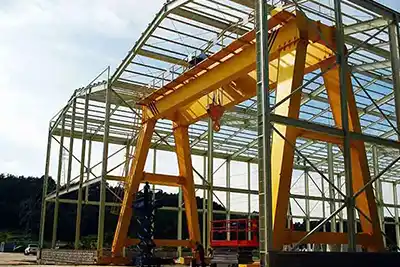
How Cantilevers Affect Gantry Crane Operation Efficiency
Many buyers who are planning to install a gantry crane often ask a simple but practical question — “Do I really need cantilevers on both sides?” It’s a fair question, especially when you’re comparing design options or trying to balance budget with yard efficiency.
A cantilever is an extended part of the crane girder that projects beyond the main runway span. In simple terms, it’s what allows your cantilever gantry crane to reach areas the main rails don’t cover — like when loading trucks parked beside the rail or lifting stones near the edge of a yard. Without cantilevers, operators may have to reposition materials or vehicles more often, which slows down work and adds unnecessary effort.
In many outdoor gantry cranes with cantilevers, these extensions make daily handling smoother and more flexible. They’re especially useful in yards or workshops where space is limited, or where materials need to be lifted just beyond the crane’s main working zone.
Here’s what we’ll look at in this section:
- How cantilevers extend the working reach of a gantry crane.
- The effect of cantilever length on movement, load balance, and overall stability.
- When cantilevers truly add value — and when they might not be worth the extra structure.
By understanding these points, you’ll be able to judge whether your next cantilever gantry crane should include one or both side extensions, and how they’ll influence your daily operations.
Basics of Cantilevers in Gantry Cranes
Before deciding whether your yard really needs a cantilever, it helps to understand what it actually does and how it fits into the overall gantry crane structure.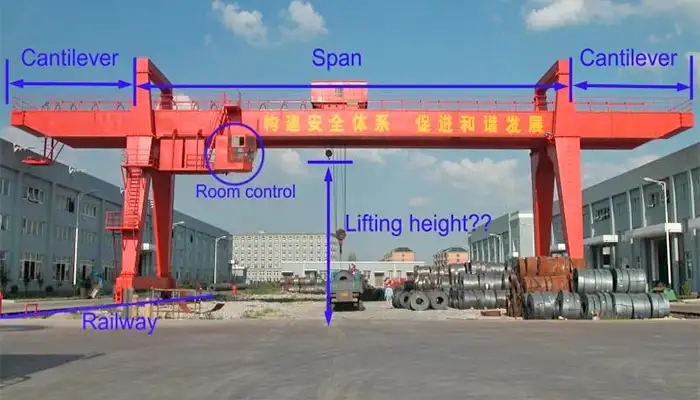
cantilever gantry cranes for sale
A cantilever is the portion of the gantry crane’s main girder that extends past the runway rails. Think of it as an “extra arm” that gives the crane a bit more reach. It allows the hoist trolley to travel beyond the normal working span, making it possible to pick up or place loads in areas that the main rails don’t cover.
The main purpose of a cantilever gantry crane is to improve working coverage and flexibility. It’s often used to:
- Load or unload trucks parked beside the rails.
- Transfer materials between inside and outside working zones.
- Handle large or awkwardly shaped blocks that can’t be positioned directly under the main span.
- Reach cutting tables, casting molds, or storage racks placed near the yard boundary.
In short, the cantilever turns a fixed-span gantry crane into a more versatile lifting system — especially valuable in outdoor yards, where space and accessibility are constant concerns.
Typical Configurations
Depending on the layout and work requirements, cantilevers can be designed in different ways:
- Single-side cantilever: Extension on one end only. Common for yards with a loading bay or truck access on one side.
- Double-side cantilever: Extensions on both ends of the gantry. Provides maximum reach and balance when handling materials in multiple zones.
- Adjustable or detachable cantilever: Modular design that allows sections to be added or removed as needed. Ideal for projects with changing yard layouts or temporary installation sites.
Each design has its own benefits, and choosing the right configuration depends on how your crane will be used daily — not just on paper, but in real working conditions.
Operational Advantages of a Cantilever Gantry Crane
Adding a cantilever to a gantry crane is not just about extending the beam — it's about making everyday work easier and more flexible. When designed correctly, a cantilever gantry crane brings several real-world advantages that directly impact how efficiently your yard operates.
A cantilever gives your crane the ability to cover more ground. The trolley and hoist can move beyond the main rail zone, reaching areas where the crane normally wouldn't have access.
- Makes it easier to load and unload trucks parked alongside the rails.
- Allows handling of stone blocks or steel plates placed near storage boundaries.
- Minimizes the need to constantly reposition materials just to stay within the crane's span.
When materials can be lifted directly from where they sit, your workflow becomes faster and smoother.
- Reduces reliance on forklifts, wheel loaders, or secondary lifting tools.
- Speeds up loading and stacking operations, especially in busy stone or metal yards.
- Less time spent on material transfers means more efficient use of manpower and equipment.
A cantilever gantry crane maximizes the use of your existing yard space without major structural changes.
- Extends coverage without the need for longer runways or additional foundations.
- Perfect for compact or irregularly shaped yards where full-span expansion isn't practical.
- Makes better use of the space between boundary lines and the crane rails.
Installing longer rails or extending foundations can be expensive and time-consuming. In comparison, adding cantilevers is often a more economical solution.
- Saves on civil construction costs while achieving a wider working area.
- Ideal for existing facilities where extending the runway would interrupt production.
- A good balance between investment cost and functional coverage.
In outdoor gantry cranes with cantilevers, materials often need to move between open storage areas and covered work zones.
- The cantilever makes this transfer seamless — no need for additional handling equipment.
- Especially useful in stone cutting plants, steel yards, and fabrication workshops where materials are processed under sheds but stored outside.
- Supports a cleaner, more continuous material flow, keeping the yard organized and reducing handling damage.
In daily operations, these advantages add up. A cantilever gantry crane doesn't just increase reach — it helps simplify logistics, improve safety, and get more done in the same space.
Factors Affecting Cantilever Performance
| Parameter | Effect on Operation | Buyer’s Consideration |
|---|---|---|
| Cantilever Length | Longer cantilevers extend reach but increase bending stress. | Match length to load size and working range. |
| Crane Capacity | Heavier loads increase moment at the cantilevered end. | Confirm safe working load at the overhang position. |
| Girder Design | Box or truss girders influence rigidity and deflection. | Choose suitable design for outdoor gantry crane with cantilever applications. |
| Trolley Travel Limit | Overhanging section reduces safe travel distance. | Check limit switch settings and travel stops. |
| Foundation & Rails | Added stress at the supports and end beams. | Ensure ground rails and concrete foundation can bear extra load. |
A cantilever gantry crane offers greater reach and flexibility, but its performance depends on several key factors. Each of these influences how smoothly, safely, and efficiently the crane operates in real working conditions. Understanding them helps buyers make better design decisions and avoid costly mistakes later.
Cantilever Length
The length of the cantilever directly affects how far the crane can reach beyond the main rails.
- A longer cantilever provides better access to outside areas but increases bending stress on the girder.
- Excessive length can also cause greater deflection (beam bending) during lifting.
- Buyer tip: Always match the cantilever length to your actual working range — not just to gain reach, but to keep the structure stable under load.
Crane Capacity
Heavier loads produce more stress on the overhanging section of the crane.
- The further the load is lifted from the support point, the greater the moment force applied to the girder.
- At the cantilevered end, the safe working load is usually lower than in the middle of the span.
- Buyer tip: Ask the manufacturer to provide a load chart that shows how lifting capacity changes along the cantilever.
Girder Design
The structure of the crane girder determines how much deflection or vibration occurs during operation.
- Box girders offer high rigidity and are preferred for heavy-duty outdoor gantry cranes with cantilevers.
- Truss girders are lighter, cost less, and suit lighter loads or long-span applications.
- Buyer tip: Choose the girder type based on load characteristics, working environment, and how frequently the crane will operate at the cantilevered end.
Trolley Travel Limit
The movement of the trolley must be controlled carefully when it travels over the cantilever.
- The overhanging section shortens the safe travel distance.
- Most cranes include limit switches or travel stops to prevent the trolley from going too far and overbalancing the crane.
- Buyer tip: Confirm that limit switches are properly set for the cantilever length during installation and testing.
Foundation and Rails
Cantilevers change how loads are distributed to the ground.
- The crane supports and rails experience additional horizontal and bending forces when the load moves to the overhang.
- Weak or uneven foundations can cause premature wear, rail misalignment, or crane instability.
- Buyer tip: Make sure the ground rails and concrete base are designed to handle the added stress from cantilever operations.
Every cantilever gantry crane works differently depending on these factors. By checking each one carefully — from girder design to rail strength — buyers can ensure safer lifting performance and longer equipment life.
Effects on Stability and Load Distribution
A cantilever gantry crane performs differently from a standard gantry crane because of its unbalanced structure. Once the load moves toward the cantilevered end, the forces acting on the crane shift — and that directly affects stability, safety, and how the load is distributed across the entire frame. Understanding these effects helps ensure safe daily operation and long equipment life.
The biggest difference with a cantilever gantry crane is that it doesn't lift symmetrically all the time.
- When a load moves out over the cantilever, part of the crane's weight and stress transfers unevenly across the girders and end carriages.
- This uneven distribution must be carefully calculated during design to prevent frame distortion or long-term fatigue.
- Practical note: In most cases, the working load near the cantilever end is limited to a lower percentage of the crane's total rated capacity to maintain stability.
For outdoor gantry cranes with cantilevers, wind is one of the most critical factors influencing stability.
- The extended cantilever acts like a lever arm, increasing the effect of wind pressure on the entire crane structure.
- Sudden gusts or crosswinds can cause unwanted sway or vibration, especially when the trolley is parked near the cantilever tip.
- Practical note: It's recommended to install wind-proof clamps, rail locks, or storm anchors to secure the crane during idle periods or bad weather.
Lifting at the cantilevered end changes the load angle and stress path on the crane.
- The load capacity typically decreases as the trolley moves further onto the cantilever.
- Manufacturers often provide load charts or working range diagrams showing these variations.
- Practical note: Operators should follow these charts strictly — overloading the cantilever can lead to excessive deflection or instability.
Because of these added stresses, cantilever gantry cranes require extra structural and safety features.
- Strengthened end beams and reinforced joints help control deflection under uneven loads.
- Travel stops and limit switches prevent the trolley from moving too far into the overhang.
- Some cranes also include anti-deflection systems or sensors that monitor girder behavior during lifting.
- Practical note: Always check that reinforcement details are clearly included in the technical drawings and approved by a qualified engineer before production.
In short, cantilevers add flexibility — but they also shift how loads behave on the crane. When designed with proper balance, wind protection, and safety limits, an outdoor gantry crane with cantilever can work reliably even under demanding yard conditions.
When to Use a Cantilever Gantry Crane
A cantilever gantry crane isn’t necessary for every yard, but in the right conditions, it can make operations smoother, safer, and more efficient. The key is knowing when a cantilever adds real value — and when it might introduce more challenges than benefits.
Best Applications
Cantilevers are especially useful when space or layout makes it difficult to reach everything with a standard gantry span.
- Yards with space limits: Ideal for areas where the runway rails can’t be extended due to boundaries, walls, or other site restrictions. The cantilever extends your reach without extra construction work.
- Truck loading and unloading: Perfect for loading materials onto vehicles parked beside the rails, especially in outdoor yards or logistics zones where trucks can’t move directly under the main beam.
- Handling heavy materials near the edge: Common in stone yards, granite workshops, or steel fabrication sites where large blocks or plates are stored close to the yard boundary.
- Indoor–outdoor transfer operations: A cantilever gantry crane can bridge open and covered areas, moving materials smoothly between working zones.
In these cases, the cantilever isn’t just a design feature — it’s a practical tool that saves time and reduces extra equipment handling.
Situations to Avoid or Limit Cantilevers
While cantilevers increase flexibility, they also introduce new structural and operational limits.
- Very heavy or off-center loads: If your operations frequently involve lifting at full capacity or handling unbalanced materials, a cantilever may cause excessive stress or deflection.
- High-wind environments: In open yards or coastal areas, an outdoor gantry crane with cantilever can face stability risks if not reinforced with storm anchors and anti-sway systems.
- Frequent full-capacity lifting on overhang ends: Continuous heavy lifting near the cantilever tip can shorten the crane’s service life and increase maintenance needs.
Practical advice:
If your workflow requires occasional extended reach but not constant heavy lifting, a single-side cantilever gantry crane is usually a good balance between flexibility and cost. But for heavy-duty, high-frequency lifting, it’s better to extend the rail span instead of over-relying on cantilevers.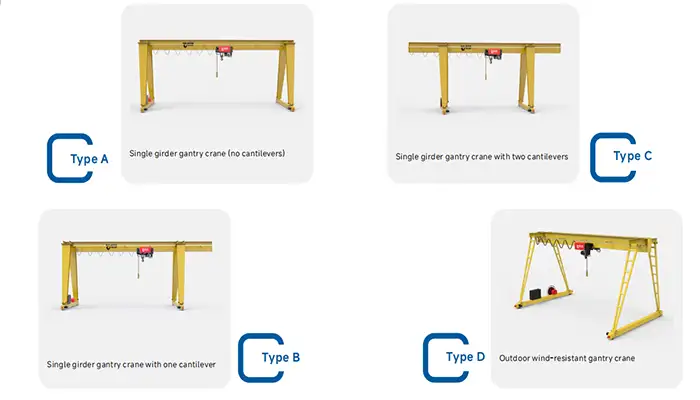
Gantry cranes with no cantilever, single cantilever, and two cantilevers for your reference , check cantilevered gantry cranes vs no cantilever gantry cranes
Practical Tips for Buyers
If you're planning to buy or customize a cantilever gantry crane, paying attention to design details early can save a lot of time, cost, and trouble later. Cantilevers add flexibility, but they also require careful consideration in engineering, materials, and operation. Here are some practical steps every buyer should take before finalizing the order.
Bring up your cantilever needs at the initial design stage — not after the drawings are done.
- Explain how you'll use the cantilever: for loading trucks, reaching beyond rails, or handling materials near boundaries.
- The manufacturer can then calculate the right cantilever length, reinforcement, and balance point to suit your yard layout.
- This early discussion avoids rework, ensures correct design loads, and keeps your delivery schedule on track.
Ask your supplier for detailed drawings that show stress points, girder deflection, and load paths on the cantilevered sections.
- These documents help verify the crane's structural reliability and compliance with safety standards.
- For large-capacity outdoor gantry cranes with cantilevers, request finite element analysis (FEA) reports or deflection simulations.
- Review these with your technical team or a local engineer to confirm stability and foundation requirements.
Every cantilever gantry crane has a slightly different load capacity depending on how far the trolley travels along the overhang.
- Request a load chart showing how capacity decreases at the cantilevered ends.
- Make sure the operator receives these charts — they are critical for safe daily lifting.
- Use them during installation testing to verify that limit switches and overload protection devices respond correctly.
Cantilever operation requires additional safety settings that aren't always present in standard gantry cranes.
- Confirm that travel limit switches, overload protection, and anti-wind locks are all configured to match your cantilever length.
- For outdoor use, also include storm anchors or rail clamps to prevent crane movement in strong winds.
- A safety checklist should be part of every commissioning inspection before the crane goes into service.
For outdoor gantry cranes with cantilevers, material protection is just as important as mechanical design.
- Ask for corrosion-resistant steel, galvanized fittings, or marine-grade paint coatings if the crane operates in humid or coastal environments.
- Pay attention to weld quality and drainage holes in hollow girders — these details prevent water buildup and rust inside structural members.
- Regular repainting and inspection will help extend the crane's service life and maintain load stability over time.
Conclusion
Cantilevers provide practical advantages for gantry cranes, giving operators extra reach and flexibility that standard spans alone cannot achieve. This is especially true for outdoor gantry cranes with cantilevers, where materials often need to be handled across open areas, near boundaries, or between covered and uncovered zones.
A well-designed cantilever gantry crane balances extended reach with safety. Proper engineering ensures stable operation even when lifting heavy loads toward the overhang, while minimizing deflection and stress on the girder and rails.
For buyers, the key is careful planning:
- Assess your yard layout and available space.
- Determine the working range and areas where the crane needs extra reach.
- Consider the types and weights of loads you’ll handle regularly.
By evaluating these factors before ordering, you can specify cantilever dimensions that maximize operational efficiency, maintain stability, and provide long-term reliability. A thoughtful design today prevents costly adjustments tomorrow and ensures your crane performs safely and efficiently for years to come.