Gantry Crane Girder Designs: Box vs Truss
Compare box and truss gantry crane girders to see how design affects strength, deflection, and cantilever performance for safe and efficient lifting.
Why Gantry Crane Girders Matter
Gantry crane girders are more than just steel beams—they are the core structure that holds the crane together. They carry the weight of the crane itself, the hoist, and the materials being moved. A weak or poorly designed girder can cause excessive bending, vibrations, or even structural failure. Simply put, the girder sets the foundation for safe and efficient crane operation.
How Girder Design Impacts Performance
The shape and construction of a girder influence:
- Load capacity – How much weight the crane can safely lift.
- Deflection – How much the girder bends under load, affecting precision.
- Cantilever reach – How far the crane can extend beyond its main supports.
Choosing the right design is not just about strength—it’s also about stability, long-term reliability, and operational efficiency.
Purpose of This Guide
In this article, we compare the two most common types of gantry crane girders: box girders and truss girders. You will learn:
- The differences in construction and materials.
- How each type performs under heavy loads.
- Which design handles deflection better.
- Practical insights on cantilever performance.
- Guidance for selecting the right girder for your crane application.
By the end, you’ll have a clear picture of which girder design works best for your workshop, warehouse, or industrial yard—whether your priority is heavy lifting, long spans, or cost-efficient construction.
Overview of Girder Types
When it comes to gantry crane girders, the design can make a big difference in how the crane performs. Two of the most common types are box girders and truss girders. Each has its own strengths, and knowing the difference helps you pick the right one for your yard or workshop.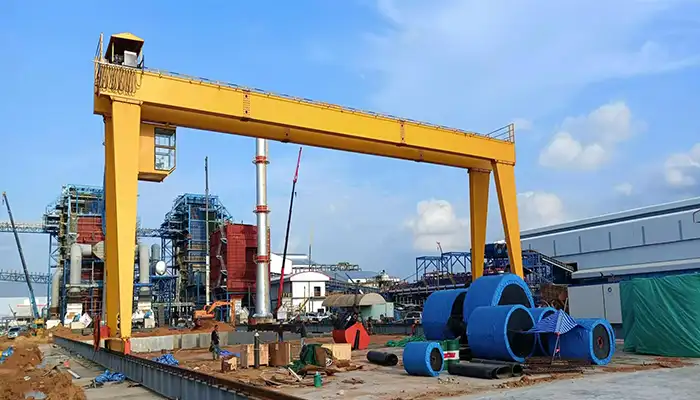
Box girder double girder gantry crane
Box Girder
What it is:
A box girder is a fully enclosed steel beam, usually rectangular or square in shape. Think of it like a hollow steel box—it’s strong, rigid, and can take a lot of stress without twisting.
Where it’s used:
- Heavy-duty gantry cranes in steel mills, shipyards, or container yards.
- Medium-to-long spans where you need maximum stability.
Why it works well:
- Very rigid: Resists twisting, keeping the crane steady even under heavy loads.
- Even strength distribution: Reduces weak points and keeps operations safer.
- Low deflection: Bends less under load, which means smoother and more precise lifting.
Tip for buyers:
If you handle heavy or sensitive loads, or you need a crane that will last years under constant use, box girders are usually the better choice.
Truss Girder
What it is:
A truss girder is made of an open web of steel, connected in triangles. Unlike a box girder, it’s not enclosed, which makes it lighter and easier to build for longer spans.
Where it’s used:
- Long-span gantry cranes that don’t need to lift extremely heavy loads.
- Warehouses or outdoor yards where reducing crane weight matters.
Why it works well:
- Lightweight: Easier on your runway and foundations.
- Efficient use of material: Strong enough for moderate loads without using as much steel.
- Cost-effective for long spans: Good option when you need wide coverage but aren’t lifting maximum loads.
Tip for buyers:
Truss girders are great when you need a long reach and lighter crane. But for heavy cantilevers or very frequent heavy lifts, they may need extra support.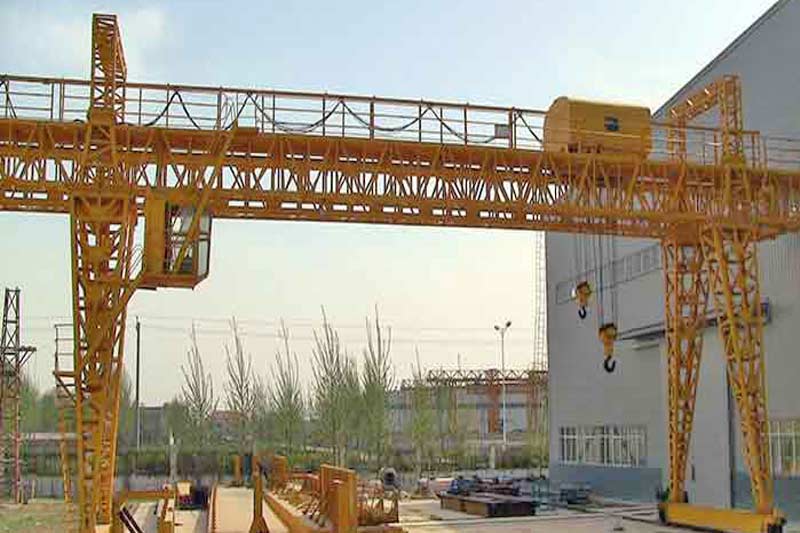
Truss girder double girder gantry crane for sale
Strength Comparison
The strength of a gantry crane girder is one of the most important factors in crane design. It affects not only how much weight the crane can lift but also how safely and reliably it performs over time. Box and truss girders achieve strength in very different ways, which makes each type more suitable for certain applications.
Box Girders
Box girders are made from a closed steel section, usually rectangular or square. The “box” shape gives them exceptional rigidity, both in bending (vertical loads) and torsion (twisting along the girder’s length). This makes them highly suitable for demanding crane operations.
Key advantages:
- High bending strength: Handles very heavy loads, including steel coils, containers, or large machinery, without excessive bending.
- Excellent torsional rigidity: Resists twisting when the load is off-center or when the crane moves quickly, ensuring smooth and predictable operation.
- Reduced risk of local buckling: The closed-section design spreads stresses evenly, preventing weak points along the girder.
- Durability under frequent use: Ideal for operations with high daily lifting cycles, where long-term structural reliability matters.
Practical insight for buyers:
- For steel mills, shipyards, or container terminals where heavy loads are lifted repeatedly, box girders are usually the safest and most reliable choice.
- They allow longer cantilevers without significant loss of stability, which can be critical in outdoor or yard applications.
- Slightly heavier than truss girders, so runway and support design must accommodate the extra weight.
Truss Girders
Truss girders use a network of triangular steel members to distribute loads. Instead of relying on a solid section like box girders, truss girders rely on geometry to maintain strength. This makes them lighter and more efficient for long spans, but their performance under very heavy or dynamic loads is different.
Key advantages:
- Strength distributed along web members: Loads are shared across multiple points, allowing for long spans without adding excessive steel.
- Lightweight for long spans: Reduces stress on runway beams and foundations, which can save on overall project costs.
- Cost-effective construction: Uses less material than a comparable box girder for the same span, which can be beneficial for moderate-load applications.
Limitations:
- May require additional bracing or reinforcement for very heavy or off-center loads.
- Slightly higher deflection under load compared to box girders, which can affect precision lifting in sensitive operations.
- Not as torsion-resistant as box girders, so extreme cantilever or uneven load conditions must be carefully evaluated.
Practical insight for buyers:
- Truss girders are ideal for warehouses, light-to-moderate industrial yards, or outdoor operations where long spans are needed but extremely heavy lifting is rare.
- Perfect for scenarios where reducing crane weight or steel usage is important, such as long-span gantry cranes over storage yards.
- Careful planning is required for cantilevers or areas with concentrated loads.
Buyer Takeaways:
- Box girders: Best for heavy-duty, high-frequency lifting, precise positioning, and longer cantilevers.
- Truss girders: Best for long spans, moderate loads, and cost- or weight-sensitive applications.
- Assess your load profile, span requirements, and frequency of operations before deciding on the girder type.
Deflection Performance
Deflection refers to how much a crane girder bends under load. Excessive deflection can affect the precision of lifting, create uneven stress on the crane structure, and even reduce the lifespan of the crane. Understanding how different girder types handle deflection is crucial when choosing the right crane for your operation.
Box Girders
Box girders are known for their high rigidity, which means they bend very little even under heavy loads. This makes them ideal for applications where smooth, precise movement is critical.
Key points:
- Low deflection under load: Maintains consistent alignment of the crane rails and trolley, allowing precise load positioning.
- Stable crane motion: Reduced vibration and twisting during operation, improving safety and reducing wear on hoists and mechanical components.
- Reliable for long-term use: High stiffness minimizes fatigue over time, which is important in high-frequency operations.
Practical insight for buyers:
- If your crane will handle sensitive or heavy loads where exact placement is essential, box girders are usually the safer choice.
- They also support longer cantilever extensions without excessive bending, making them suitable for outdoor yards or extended reach applications.
Truss Girders
Truss girders, with their open-web design, naturally allow a little more deflection under load. This doesn’t mean they are weak—it’s just a characteristic of their lighter, long-span-friendly design.
Key points:
- Slightly higher deflection: The open structure can bend more than a box girder under the same load.
- Adjustable performance: Adding extra web members or increasing the girder height can reduce deflection if needed.
- Weight advantage: Lighter girders reduce load on runway beams and foundations, which is beneficial for long spans.
Practical insight for buyers:
- Truss girders are fine for moderate loads or operations where small deflection is acceptable.
- For applications requiring precise positioning or handling delicate equipment, consider reinforced truss girders or a box girder instead.
Buyer Takeaways:
- Prioritize box girders for sensitive loads, high-frequency operations, or where minimal deflection is required.
- Truss girders are suitable for long spans with moderate loads, but plan reinforcement if precision or cantilever length is critical.
- Always request deflection calculations from your manufacturer based on actual load conditions to ensure safe and accurate operation.
Cantilever and Overhang Capabilities
Cantilevers allow a gantry crane to extend its reach beyond the main span. This is especially useful in outdoor yards, container terminals, or storage areas where materials may need to be lifted outside the crane’s primary footprint. The type of girder you choose plays a major role in how far and safely a crane can extend.
Box Girders
Box girders are excellent for cantilever applications because their closed, rigid design resists twisting. This makes it possible to extend the crane’s reach without compromising stability.
Key points:
- Longer cantilever support: The uniform torsional rigidity allows for heavier loads at extended overhangs.
- Heavy-duty operations: Suitable for lifting steel coils, large machinery, or other heavy materials beyond the main span.
- Stable performance: Reduces vibration and sway at the cantilever, which improves safety and load control.
Practical insight for buyers:
- If your operation requires long overhangs with heavy loads, box girders are typically the safer choice.
- Always check the manufacturer’s maximum cantilever specifications to ensure the crane can handle your load at full reach.
Truss Girders
Truss girders can be used for cantilevers, but their open-web design limits how far they can extend safely. The lighter structure is efficient for long spans but may need extra reinforcement for heavy or extended loads.
Key points:
- Limited cantilever length: Best for moderate loads or lighter extensions beyond the main span.
- Possible reinforcement: Additional bracing or deeper web members may be required for heavier cantilevers.
- Weight advantage: Still ideal for long spans where reducing the overall crane weight is a priority.
Practical insight for buyers:
- Truss girders are best for lighter cantilever operations or yards where long spans matter more than heavy lifting.
- For heavy-duty overhangs, consider a box girder or reinforced truss design to prevent excessive deflection or twisting.
Buyer Takeaways:
- Box girders: Best for heavy-duty cantilever operations, longer overhangs, and maximum stability.
- Truss girders: Suitable for moderate loads, lighter cantilevers, and long spans with weight-sensitive requirements.
- Evaluate your yard layout, load weight, and required reach before deciding on girder type for cantilever applications.
Material and Cost Considerations
When choosing between box and truss girders, material usage and cost are important factors. Beyond just the purchase price, you also need to consider installation, maintenance, and long-term operational costs.
Box Girders
Box girders are made from more steel and are fully enclosed, which makes them heavier and usually more expensive upfront. However, their robust design often reduces maintenance and extends service life.
Key points:
- Higher material usage: More steel means a heavier crane, which may increase foundation or runway requirements.
- Higher cost: Initial purchase and fabrication costs are generally higher than truss girders.
- Lower maintenance: The strong, closed-section design is less prone to damage, buckling, or wear, which can save money over the crane’s lifetime.
Practical insight for buyers:
- If your operation involves heavy, frequent lifting and long-term use, the extra upfront cost is often justified by durability and reduced maintenance.
- Make sure your supporting structure can handle the extra weight of a box girder crane.
Truss Girders
Truss girders use steel more efficiently, making them lighter and often less expensive upfront. However, their multiple joints require careful welding and inspection to ensure long-term safety.
Key points:
- Efficient material use: Lighter design reduces the crane’s weight, saving on foundation or runway reinforcement.
- Potentially lower cost: Less steel and easier fabrication for long spans can reduce initial investment.
- Maintenance considerations: Open-web design has more joints that need inspection and occasional tightening or repair.
Practical insight for buyers:
- Truss girders are ideal when weight reduction or long-span coverage is a priority and loads are moderate.
- Plan for regular inspections of welds and joints to maintain safety and performance over time.
Buyer Takeaways:
- Box girders: Higher upfront cost and heavier weight, but stronger, low-maintenance, and long-lasting.
- Truss girders: Lighter, potentially cheaper, but require more attention to welding and joint maintenance.
- Always factor in both installation and long-term maintenance costs when comparing girder types.
Practical Applications and Buyer Recommendations
Choosing the right girder type depends on your operational needs, load requirements, and the layout of your yard or workshop. Both box and truss girders have advantages in specific scenarios, and understanding these can help you make a more informed decision.
Box Girders
Box girders are built for strength, rigidity, and heavy-duty performance. Their low deflection and robust design make them ideal for high-frequency industrial operations where stability is critical.
Typical applications:
- Steel mills: Handling heavy coils, slabs, or billets.
- Shipyards: Lifting and positioning large machinery or ship components.
- Port container handling: Moving heavy containers safely over extended spans.
Buyer recommendations:
- Prioritize box girders when your operation involves frequent lifting of heavy or sensitive loads.
- Ensure that your crane runway and supporting structures can handle the extra weight of a box girder crane.
- Ideal for scenarios requiring long cantilever sections or minimal deflection for precise positioning.
Truss Girders
Truss girders are lighter and more efficient for long spans, making them suitable for moderate-load applications. Their open-web design allows for wide coverage without excessive material or weight.
Typical applications:
- Warehouses: Handling pallets, machinery, or moderate loads across long spans.
- Light manufacturing yards: Moving raw materials or finished products with moderate lifting requirements.
- Outdoor yards with long spans: Reduces the need for heavy foundations while still maintaining strength.
Buyer recommendations:
- Best suited for moderate-load operations where weight reduction and long-span coverage are important.
- Plan for regular inspection of welds and joints to ensure long-term safety.
- Consider reinforcing truss girders if long cantilevers or concentrated loads are expected.
Key takeaway for buyers:
- Box girders excel in heavy-duty, high-frequency, and precision-required operations.
- Truss girders work best for long spans, lighter loads, and applications where reducing crane weight is a priority.
- Evaluate your yard layout, typical load, span, and frequency of operations before deciding on the girder type.
Key Takeaways for Buyers
Choosing the right gantry crane girder is not just about the upfront cost—it impacts safety, performance, and long-term efficiency. Here are the practical points buyers should keep in mind:
- Match girder design to your operational needs: Consider load weight, span length, and cantilever requirements when selecting between box and truss girders.
- Prioritize box girders for heavy or sensitive loads: Their high rigidity and low deflection make them ideal for precision lifting and high-frequency operations.
- Consider truss girders for long spans and moderate loads: They are lighter, cost-efficient, and suitable for applications where weight reduction is a priority.
- Verify performance before purchase: Always request structural drawings and deflection calculations to ensure the girder can handle your expected loads and cantilever lengths safely.
Practical tip: Don’t just look at material and price—think about how the girder will perform over the lifetime of the crane under real working conditions.
Conclusion
| Feature | Box Girder | Truss Girder |
|---|---|---|
| Design | Closed rectangular or square section | Open-web triangular structure |
| Strength | High bending and torsional strength; resists heavy loads and dynamic operations | Moderate strength; load distributed along web members; may need bracing for heavy loads |
| Deflection | Low deflection; rigid and stable for precise positioning | Slightly higher deflection; can be reduced with deeper girders or extra web members |
| Cantilever Performance | Supports longer cantilevers; ideal for heavy-duty extensions | Limited cantilever length; best for lighter extensions or long spans with moderate loads |
| Weight & Material | Heavier; higher material usage; robust and durable | Lighter; efficient material use; cost-effective for long spans |
| Typical Applications | Steel mills, shipyards, port container handling, high-frequency heavy lifts | Warehouses, light manufacturing yards, long-span moderate-load operations |
| Maintenance | Lower maintenance due to robust design | Requires careful welding and joint inspection |
| Best For Buyers | Heavy loads, high-frequency operations, precise lifting, long cantilevers | Long spans, moderate loads, weight-sensitive applications, cost-efficiency |
The choice between box and truss girders directly affects crane performance, including strength, deflection, and cantilever capability.
A well-informed selection enhances operational safety, improves handling efficiency, and ensures a long-lasting return on investment.
Before finalizing a design, buyers should consult with crane manufacturers, providing detailed information on:
- Load profiles and frequency of operations
- Span length and yard layout
- Required cantilever reach and precision
By carefully evaluating these factors, you can choose the girder type that best fits your operational needs, ensuring safe, efficient, and reliable crane performance for years to come.