Box Girder vs Truss Girder Gantry Cranes for Stone Yards
Introduction
Gantry cranes are a backbone of stone yard operations. Whether you’re moving large marble blocks, granite slabs, or other heavy stone products, the crane you choose directly affects efficiency, safety, and long-term costs. In stone yards, material handling isn’t just about lifting—it’s about moving heavy loads smoothly across sometimes uneven or tight spaces without causing damage.
One of the most important decisions when selecting a gantry crane is the type of girder it uses. The girder—the main horizontal beam that supports the hoist—determines how much weight the crane can handle, how far it can span, and how stable it is during operation. Choosing the wrong girder can lead to unnecessary maintenance, higher operational costs, or even safety risks.
This guide focuses on two popular girder types for stone yard gantry cranes: box girders and truss girders. By comparing their structural design, load capacity, span flexibility, maintenance needs, and cost, you’ll get practical insights to help you make an informed decision for your specific yard layout and workload.
Key points to consider when comparing box and truss girders:
- Load capacity: Can the crane safely handle your heaviest stone blocks?
- Span and layout: How wide and long is your yard, and does the crane need to reach across large areas?
- Durability and maintenance: How much upkeep are you willing to do, and what’s your budget for long-term operation?
- Cost efficiency: Balancing initial investment versus long-term operational savings.
With these factors in mind, you’ll be able to choose a crane that meets both your immediate handling needs and future growth, keeping your stone yard operations smooth and safe.
Understanding Girder Types
When it comes to gantry cranes for stone yards, the type of girder you choose is one of the most critical decisions. The girder forms the backbone of the crane, supporting the hoist and handling the full load of heavy stone blocks. Choosing the right girder affects stability, maintenance, and how efficiently your yard operates.
Box Girder Gantry Crane
A box girder is a closed, rectangular steel structure. Think of it like a solid steel beam with a hollow core—simple in design but incredibly strong. Its enclosed shape gives it high torsional rigidity, meaning it resists twisting under heavy loads. This makes it particularly suitable for lifting dense, concentrated stone blocks, such as marble or granite.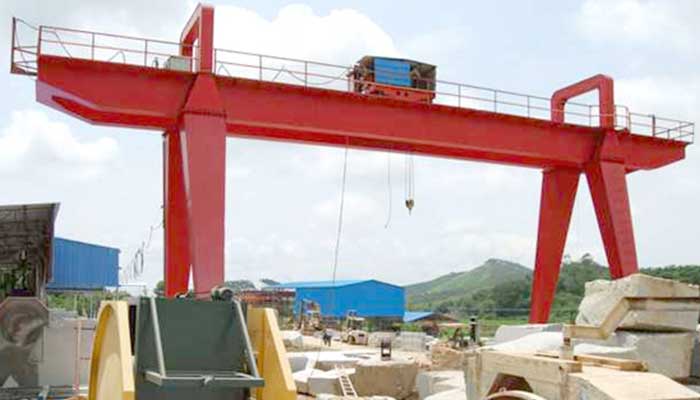
Box girder gantry crane for stone handling
Typical applications in stone yards:
- Moving very heavy stone blocks or slabs.
- Situations where stability is critical, such as short or medium spans.
- Operations requiring long-term durability with minimal deformation over time.
Practical considerations:
- Requires more steel, so the initial cost is higher than a truss girder.
- Heavier structure may need stronger foundations and supports.
- Low maintenance because the closed design protects the interior from dust, debris, and corrosion.
Truss Girder Gantry Crane
A truss girder is an open, lattice-like structure made of interconnected steel beams. Instead of a solid beam, it spreads the material into a triangular framework. This design is lightweight but strong, making it ideal for longer spans where material efficiency matters. The open structure allows for easy inspection and can handle medium to heavy stone loads with less steel than a box girder.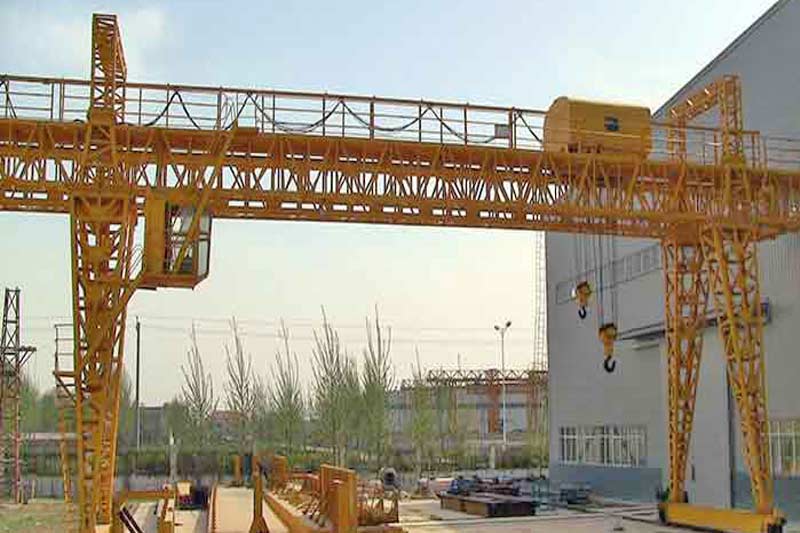
truss girder gantry crane for stone handling
Typical applications in stone yards:
- Handling medium to heavy stone blocks across large yard spans.
- Situations where the crane needs to cover wide areas without excessively heavy steel.
- Operations that prioritize cost savings in material and transport.
Practical considerations:
- Requires regular inspection, especially at joints, to prevent wear or corrosion.
- Less rigid than a box girder for very concentrated heavy loads—might need reinforcements for extra-heavy blocks.
- Easier to transport and assemble on site due to lighter structure.
Structural Design Comparison
Once you understand the basic girder types, the next step is to compare them from a structural standpoint. This helps stone yard operators and buyers see which design will perform best under their specific loads, yard layout, and operational requirements.
- Box Girder: Its solid, enclosed construction makes it highly resistant to twisting and bending. This means it's excellent for very heavy or concentrated loads, such as large granite blocks or stacked slabs. If your yard often handles extreme weights in a small area, a box girder provides reliable strength and stability.
- Truss Girder: The open lattice structure is more efficient for evenly distributed loads. It can handle medium to heavy blocks spread over a wider area. For very concentrated heavy loads, it may require extra reinforcement.
Practical takeaway: Choose a box girder for maximum strength under heavy, focused loads. Use a truss girder when handling wider or more evenly spread loads over longer spans.
- Box Girder: Best suited for shorter spans where rigidity is essential. The solid structure minimizes deflection, making it ideal for compact yards or heavy-duty lifting in limited spaces.
- Truss Girder: Designed for longer spans with less steel weight. Its lattice design allows for wide coverage without overly increasing crane weight, which is helpful in large stone yards with broad operational areas.
Practical takeaway: Match span length to girder type—short, heavy-duty lifts favor box girders; long, lighter lifts favor truss girders.
- Box Girder: The enclosed structure protects against dust, debris, and weather, reducing maintenance. It's durable over time, making it a good choice for high-use, outdoor stone yards.
- Truss Girder: Open lattice means more exposure to the elements. Joints can corrode, and inspections are critical to ensure long-term safety. Maintenance is higher, but the structure is lighter and easier to inspect visually.
Practical takeaway: Box girders are low-maintenance, while truss girders require more regular attention but save on material weight.
- Box Girder: Uses more steel and is heavier, which increases initial cost. However, its rigidity and low maintenance can deliver a strong long-term return on investment.
- Truss Girder: Uses less steel, reducing upfront cost, especially for long-span applications. For very heavy concentrated loads, reinforcements may be needed, adding some cost back in.
Practical takeaway: Box girders are a higher upfront investment but require less maintenance, while truss girders are more cost-efficient for long spans but may need additional support for very heavy loads.
- Maximum load capacity
- High rigidity and stability
- Low maintenance
- Cost-effective for long spans
- Lightweight and easier to transport
- Allows flexible yard layouts
- Box girders excel in heavy, concentrated loads and low-maintenance operation.
- Truss girders are better for long spans and distributed loads but need more inspection and occasional reinforcement.
- Choice depends on yard layout, span, load type, and budget.
Pros and Cons for Stone Yard Operations
When selecting a gantry crane for a stone yard, understanding the advantages and disadvantages of each girder type can help you make a practical, cost-effective choice. Every yard has its own layout, load patterns, and operational priorities, so weighing pros and cons is essential.
Box Girder Pros
Box girders offer strength and durability that many stone yard operators value. Their solid design is especially suited to lifting heavy, concentrated loads safely.
- Maximum load capacity: Can handle the heaviest marble and granite blocks without twisting or bending.
- High rigidity and stability: Solid structure minimizes vibration and deflection, which is critical for precise lifting.
- Low maintenance: The enclosed design protects the interior from dust, debris, and weather, reducing upkeep.
Practical note: Box girders are often preferred in yards where heavy blocks are moved frequently and safety is a priority.
Box Girder Cons
While strong, box girders come with some trade-offs.
- Higher material cost: More steel is required, increasing the initial investment.
- Heavier structure: The crane itself is heavier, which may require stronger foundations and more robust support structures.
Practical note: If your yard has budget constraints or weak foundation support, the upfront cost and weight of a box girder can be a limiting factor.
Truss Girder Pros
Truss girders are designed for efficiency and flexibility, making them suitable for a variety of stone yard layouts.
- Cost-effective for long spans: Requires less steel than a box girder, reducing material costs.
- Lightweight and easier to transport: Easier to move and install, especially in larger yards.
- Allows flexible yard layouts: Longer spans can be covered without excessively heavy beams, providing operational flexibility.
Practical note: Truss girders work well for yards where the crane needs to cover wide areas with medium to heavy loads.
Truss Girder Cons
Despite their advantages, truss girders also have limitations.
- Requires regular maintenance: Open lattice exposes joints and connections to weather and debris, so inspections are important.
- Less rigid under concentrated loads: Heavy single blocks may require additional reinforcement.
- Open structure may accumulate debris: Dust, dirt, and small stones can collect in the lattice, potentially affecting long-term durability.
Practical note: Truss girders are ideal when span and cost efficiency matter most, but they demand more hands-on maintenance and attention to load distribution.
Practical Buyer Guidance
Choosing the right gantry crane for your stone yard can feel overwhelming, but breaking it down into a few practical factors makes the decision easier. This section highlights key points buyers should consider to match girder type with operational needs.
One of the first questions is: how heavy are your stone blocks, and how are they distributed?
- Heavy concentrated loads: If your yard regularly lifts large granite or marble blocks in one spot, a box girder is usually the safer choice. Its solid design can handle concentrated weight without bending or twisting.
- Distributed loads: If the blocks are medium to heavy but spread over a larger area, a truss girder can be efficient. It handles long spans well while using less steel.
Tip: Always check the maximum block weight your crane will lift, plus a safety margin of 20–30%.
The size and layout of your yard will influence which girder type works best.
- Short span operations: Box girders are ideal when the crane doesn't need to cover very wide areas. Their rigidity ensures stability in compact spaces.
- Long span operations: Truss girders excel at covering wide yards. Their lattice design allows longer spans without overly heavy beams, saving material and transport costs.
Tip: Consider future yard expansion. A truss girder may allow for longer spans if your yard grows, while box girders are better for current heavy-lifting needs.
Balancing initial investment with long-term maintenance is key.
- CapEx-focused approach: If your priority is long-term durability and low maintenance, a box girder may justify the higher upfront cost.
- OpEx-focused approach: If your budget is tight or you plan to minimize material costs, a truss girder can be more cost-effective. Keep in mind it may require more frequent inspections and maintenance.
Tip: Factor in foundation costs for heavy box girders, and maintenance schedules for truss girders, when calculating total ownership cost.
- Scenario 1: Heavy granite block yard, compact space: Box girder crane, short span, high rigidity, minimal maintenance.
- Scenario 2: Large marble yard, widely spaced blocks: Truss girder crane, long span, lightweight structure, cost-efficient for covering wide areas.
- Scenario 3: Mixed workload with occasional ultra-heavy blocks: Consider a hybrid approach or reinforced truss girder to balance weight and span.
Tip: Match the crane to both current operations and potential growth. Over-specifying can be expensive, while under-specifying can cause safety and efficiency issues.
Conclusion
Choosing the right gantry crane girder for a stone yard comes down to understanding both structural performance and practical operational needs. Box and truss girders each have distinct advantages and limitations, and the right choice depends on your yard’s load patterns, layout, and long-term goals.
Key differences and buyer considerations:
- Box girders: Excellent for very heavy, concentrated loads; high rigidity and low maintenance; higher initial cost and heavier foundations required.
- Truss girders: Efficient for long spans and distributed loads; lighter, more cost-effective, and flexible for yard layouts; require more maintenance and inspection.
- Span and layout: Short, heavy-duty spans favor box girders; wide, long spans favor truss girders.
- Budget and maintenance: Balance upfront investment (CapEx) with ongoing upkeep (OpEx) to find the most practical solution for your yard.
Practical takeaway: Align your girder choice with your current workload, yard layout, and potential growth. This ensures safe, smooth, and efficient operations without overpaying for unnecessary capacity.
Next step for buyers:
- Evaluate the heaviest blocks and how they are distributed in your yard.
- Measure span requirements and consider future expansion.
- Consider budget and maintenance capacity for the long term.