
How to Fit an Overhead Crane in Low Headroom Workshop
If your factory has a low roof, you might think an overhead crane is out of the question. It's not. You just need to buy the right one and plan carefully. This guide walks you through what actually matters when you're the one signing the purchase order.
Step 1: Measure Your Building Yourself
Don't trust the old drawings. Buildings change. Pipes get added. Lights get moved. Trusses sag over time.
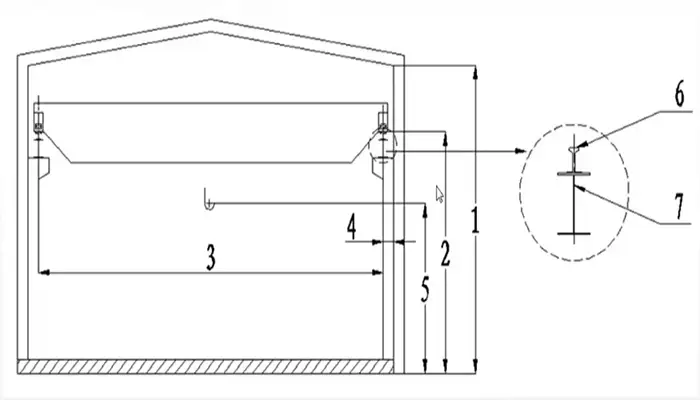
1. Height from floor to the lowest point of the factory building: ____ mm
2. Rail top elevation (top-of-rail level): ____ mm
3. Crane span: ____ m
4. Distance from rail center to the factory building edge: ____ mm
5. Lifting height (hook height / hoisting height): ____ m
6. Bridge (long-travel) rail type/model: ____
7. Crane runway beam type/model: ____
8. Bridge (long-travel) rail length: ____ m
What to do:
- Take a laser measure and walk the entire path the crane will travel.
- Write down the lowest point at every section. It might be a light, a duct, or a sprinkler pipe. Even one low spot can ruin your hook height.
- Take photos of anything hanging from the roof.
Three technical terms you need to know:
- Headroom — the space from the top of the rail to the nearest thing above it.
- Lift height — the distance from the floor to the hook at its highest point.
- Hook approach — how close the hook can get to the end of the runway or the bridge. This matters more than most buyers realize. In low-headroom buildings, the dead zones at the ends of the runway get bigger. Make sure your critical pick points aren't sitting in a spot the hook can't reach.
Lift height is what you actually care about. A salesman might say "great headroom" and still sell you a crane whose hook can't clear your tallest machine.
One more thing: Find out early if your roof can hold a crane. If not, you'll need a freestanding crane with floor columns. Ask a structural engineer before you shop. The runway beam itself needs a fatigue check, not just a strength check. A crane passing overhead millions of times creates stress cycles that can crack a beam even if it "passed" a static load calculation.
Step 2: Pick the Right Crane Type
The type of crane you choose decides how much height you gain or lose.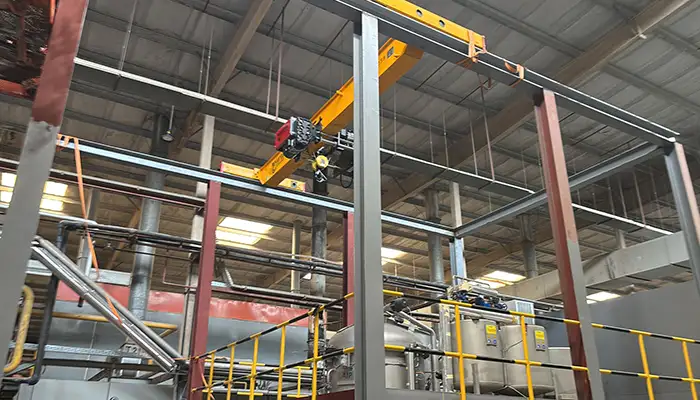
single girder overhead crane
Single girder vs. double girder
- Single girder is usually cheaper and saves height because the hoist hangs under one beam.
- But a double girder crane with the trolley running between the beams can sometimes give you more hook height. The hook doesn't hang below the beam.
What to do: Ask for both options priced. Compare the actual hook height each one gives you. Don't compare labels. Compare numbers.
Top-running vs. underhung
- Top-running means the crane sits on rails on top of the runway beam. This usually gives you more lift height.
- Underhung means the crane hangs from the bottom of the beam. This is often cheaper and gives better end approach, but you lose height.
If every inch of height matters, top-running usually wins.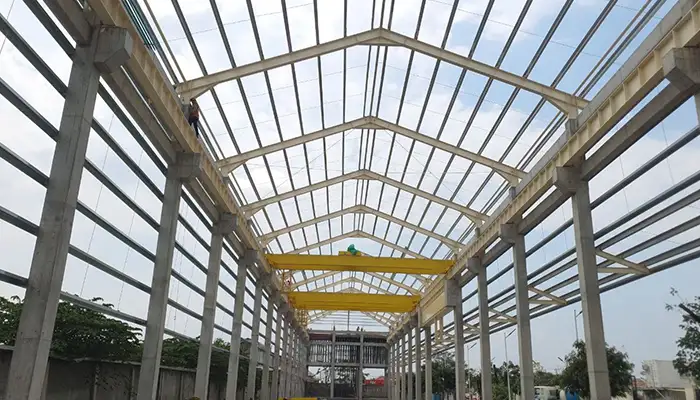
top running double girder overhead crane
Side connection
Where the bridge meets the end truck, ask for a side connection instead of a top connection. It's a small detail that adds a little extra height.
What to do: Ask each vendor to quote the actual hook height from your floor, using your measurements. Compare those numbers side by side.
Step 3: The Hoist Is the Most Important Part
The hoist is the machine that lifts the load. A standard hoist stacks its parts vertically. That eats height. A low-headroom hoist rearranges those parts to bring the hook closer to the beam.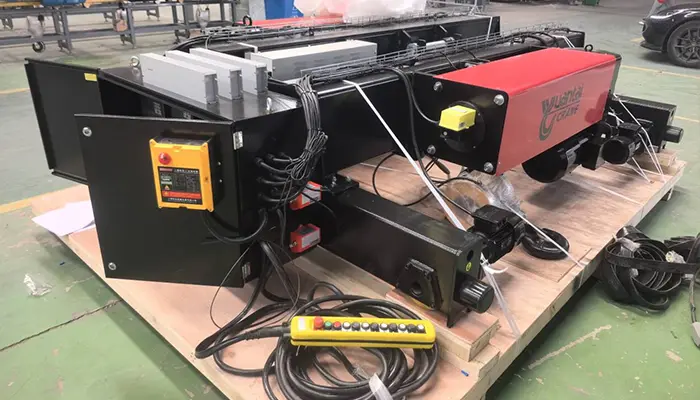
European style low headroom wire rope electric hoist
What to ask for:
- A "low-headroom hoist" or "low-built hoist."
- Actual dimensions in millimeters. Don't accept vague claims. Ask: "What is the distance from the hook to the beam?" This is sometimes called the C-dimension. It's the single most important number in a low-headroom crane quote.
Chain hoist vs. wire rope hoist:
- Chain hoists are often more compact. For capacities under 10 tons, they're usually the practical choice in low-headroom buildings.
- Wire rope hoists can work too, but the drum adds height.
Reeving: This is the path the chain or rope takes through the hoist. A reeving designed for height (instead of speed) can buy you a few extra centimeters. Ask the vendor to confirm the reeving configuration and what it does to the hook-to-beam distance.
What to do: Get the hook-to-beam dimension in writing. Compare it to the gap you measured in Step 1.
Step 4: Respect Clearances (And Know What Drives Them)
Tight spaces leave no room for error. Here are the rules and what they mean for you.
OSHA minimums:
- 3 inches of overhead clearance
- 2 inches of lateral clearance
These are minimums, not targets. Buildings move. Steel expands in heat. Roofs sag under snow. A crane that clears by 3 inches on a cold morning might hit the roof on a hot afternoon.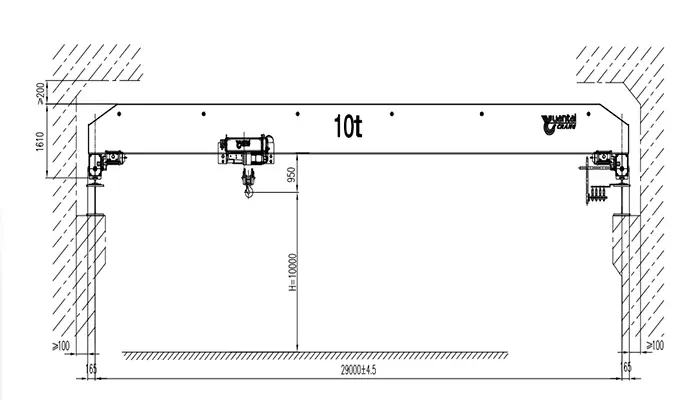
Better working margins:
- Overhead: 75–100 mm (about 3–4 inches) beyond the minimum.
- Lateral: At least 500 mm between the crane and walls or columns. You'll need room to service the end trucks.
Also think about what the crane travels over. Mezzanines, control panels, tall machines—map out where the hook and rigging will pass.
Watch for dead zones. In low-headroom setups, the hook can't reach the areas near the ends of the runway. This is hook approach at work. If your critical machine is near a wall, you need to know exactly how close the hook can get before you buy.
What to do: Build in extra clearance. The code minimum is the floor, not the ceiling.
Step 5: Plan the Installation
Low headroom makes installation harder. The usual method—lower the hoist from above—often doesn't work when there's no "above."
One solution that works: Place the girders on the runway first. Spread them apart. Lift the hoist into position from below. Then close the girders and connect everything.
What to do: Ask each vendor: "Walk me through the installation, assuming we have limited or no roof access." If they can't answer clearly, that's a warning sign.
Remember: Installation cost is part of the purchase price. Get it in writing.
Step 6: Don't Forget the Basics (This Is Where Money Gets Wasted)
It's easy to focus only on height and forget everything else. Don't.
Crane capacity tells you how much weight the crane can lift. Duty cycle tells you how frequently and intensively it is expected to work.
When selecting an overhead crane, the maximum lifting load is only one part of the calculation. You also need to consider the number of lifting cycles, average load weight, operating hours per day, and number of working shifts.
For example, a 10-ton overhead crane used for occasional maintenance work has very different operating requirements from a 10-ton crane handling production materials throughout two or three shifts. Both have the same rated capacity, but their motors, brakes, hoisting mechanisms, wheels, bearings, and structural components may need different duty ratings.
Depending on the destination market and design requirements, crane manufacturers may use different classification systems.
| Standard or system | Classification | General description |
|---|---|---|
| CMAA (North America) | Class A–F | Covers applications from infrequent or standby service (Class A) to continuous severe service (Class F). Classes C and D are commonly associated with moderate and heavy industrial applications. |
| FEM (Europe) | 1Am–5M | Classifies crane mechanisms according to operating time and load spectrum. Higher groups indicate more demanding service conditions. |
| ISO 4301-1 | A1–A8 | Classifies cranes by combining utilization class (U0–U9) and load spectrum (Q1–Q4). A1 represents the lightest duty and A8 the most demanding. |
| Chinese standard | A1–A8 | GB/T 3811-2008, Crane Design Rules, uses working classifications based on crane utilization and load spectrum. |
| Russian / EAC market | A1–A8 | GOST 34017-2016, Cranes – Classification of Operating Modes, provides a classification system based on utilization and loading conditions. |
For projects in China and markets covered by Russian or Eurasian technical requirements, buyers may encounter the A1–A8 classification.
Under GB/T 3811-2008 and GOST 34017-2016, the overall crane duty classification is based on two main factors:
-
Utilization class (U0–U9): The expected number of working cycles over the crane's design life. A higher utilization class means more operating cycles.
-
Load spectrum (Q1–Q4): How heavily the crane is loaded throughout its working cycles. Q1 represents a light load spectrum, while Q4 represents very heavy loading.
These two factors determine the overall crane classification from A1 to A8. A higher classification generally means the crane must be designed for more demanding operating conditions.
The duty of individual mechanisms, such as hoisting and travelling, should also be checked separately. Their operating time and load conditions may differ from those of the complete crane.
EAC stands for Eurasian Conformity. The EAC mark indicates that a product has met the applicable requirements of the relevant Eurasian Economic Union technical regulations.
For lifting equipment, buyers may need to consider TR CU 010/2011, On Safety of Machinery and Equipment, along with the applicable standards and conformity assessment requirements.
EAC is a conformity marking, not a duty-cycle classification. It does not mean that a crane is light-duty, heavy-duty, or suitable for continuous operation. The crane's working class must still be specified and verified separately.
For an EAC-market project, ask the manufacturer to clarify:
-
The crane's working classification under the applicable GOST or other agreed design standard
-
The classification of the hoisting and travelling mechanisms
-
The applicable EAC conformity assessment and documentation
-
Whether the proposed crane design meets the project's operating conditions
Before requesting a quotation, prepare the following operating information:
-
Lifting frequency: How many lifting cycles does the crane perform per hour or per day?
-
Load distribution: What is the average load compared with the crane's rated capacity?
-
Operating hours: How many hours does the crane work each day?
-
Working shifts: Does the factory operate one, two, or three shifts?
-
Application: Is the crane used for occasional maintenance, general production, or continuous material handling?
-
Working environment: Does it operate in a foundry, steel mill, outdoor yard, dusty workshop, or high-temperature area?
For example, a foundry crane handling heavy loads throughout multiple shifts generally needs a higher duty rating than a maintenance crane used for a few lifts each day. A steel mill crane working continuously may require a different design from a general-purpose warehouse crane, even if both have the same lifting capacity.
Do not choose a crane duty class based on lifting capacity alone. A 10-ton crane used occasionally and a 10-ton crane working continuously on a production line should not automatically have the same design classification.
When comparing quotations, check the classification standard, overall crane working class, and individual mechanism classes. CMAA, FEM, ISO, and GOST classifications use different systems and should not be treated as directly interchangeable. Ask the manufacturer to explain the design basis and confirm that it matches your actual operating conditions.
A "5-ton crane" lifting a 4.5-ton load with a 600-pound spreader beam is overloaded. Add up the load, the spreader beam, slings, shackles, and anything else hanging from the hook. That's your real capacity requirement.
What to do: Be honest about how hard you'll work the crane. Over-speccing wastes money. Under-speccing wastes the crane.
What to Put in Your Quote Request
Send these five things to every vendor. You'll get useful, comparable quotes.
- Your measured clearance profile along the entire runway, with photos.
- Required hook height from the floor, and the maximum load weight including rigging.
- Duty cycle: lifts per hour, shifts per day, typical load as a percentage of max. Tell them which standard you're using (CMAA or FEM) if you have a preference.
- Building structure details: Can the roof hold an underhung crane, or do you need floor columns?
- Installation constraints: roof access, floor access, power, and any hours when the factory can't be disrupted.
Vendors who ask good questions about these five items are worth talking to. Vendors who quote a price without asking about your sprinkler pipes? Keep shopping.
Frequently Asked Questions
Got questions about low-headroom overhead cranes? Here are the answers to the ones we hear most often.
There's no single number. It depends on the crane type, the hoist, and the capacity you need. Some low-headroom hoists need less than 300 mm between the beam and the hook. Others need more. The right way to find out is to measure your actual clearance first, then ask vendors for the hook-to-beam dimension (C-dimension) of their specific models. Compare those numbers to your measurement. Don't shop by rule of thumb.
Usually, yes—but you may need to accept trade-offs. You might get less lift height than you'd like. You might need a smaller capacity. You might need a chain hoist instead of a wire rope hoist. In some cases, a freestanding crane with floor columns is the only option. The key is to measure first and then design around your real constraints, not the other way around.
Headroom is the space from the top of the rail to the nearest obstruction above. Lift height is the distance from the floor to the hook at its highest point. Lift height is what you actually care about. A building can have decent headroom and still give you poor lift height if the crane and hoist are bulky. Always ask for lift height, not just headroom.
Hook approach is how close the hook can get to the end of the runway or bridge. In low-headroom buildings, the trolley and hoist are packed tighter, and things like festoon cable systems can stack up and block the hook from reaching the last few feet of the runway. If your critical machine is near a wall, this could mean the crane simply can't serve it. Map your pick points against the actual hook approach before you buy.
No. Single girder cranes are often cheaper and save height because the hoist hangs under one beam. But a double girder crane with the trolley running between the beams can sometimes give you more hook height. The only way to know is to ask for both options priced and compare the actual hook height numbers. Don't assume. Compare.
For capacities under 10 tons, chain hoists are often the practical choice. They're more compact, and low-headroom chain hoist designs are widely available. Wire rope hoists can work too, but the drum adds height. If your capacity is higher or your duty cycle is heavy, a wire rope hoist may still be the right call—just make sure you're comparing actual dimensions, not general claims.
OSHA requires a minimum of 3 inches of overhead clearance and 2 inches of lateral clearance. But these are minimums, not targets. Buildings move, steel expands, and roofs deflect. A smarter approach is to build in 75–100 mm of extra overhead clearance and at least 500 mm of lateral clearance for service access. The code minimum is the floor, not the ceiling.
Yes, but the installation sequence has to be planned carefully. One common method is to place the girders on the runway first, spread them apart, lift the hoist into position from below, then close the girders and connect everything. Ask each vendor to walk you through the installation sequence for your specific building. If they can't explain it clearly, that's a warning sign.
Sometimes, yes. Low-headroom hoists and custom installation sequences can add cost. But the comparison isn't fair unless you're comparing against a standard crane that actually fits your building. A standard crane that doesn't fit is worthless. Get quotes for cranes that meet your real constraints, and compare those. Also remember that installation cost is part of the purchase price—get it in writing. A difficult brownfield installation can cost far more than a straightforward new-building erection.
You need a structural engineer to answer that. Don't guess. If the roof can't handle the load, you'll need a freestanding crane with floor columns instead. That changes the cost and the floor layout, so find out early—before you get attached to a particular crane model. The runway beam also needs a fatigue check for the number of load cycles it will see over its life, not just a static strength check.
Both standards classify cranes by how hard they work, but they use different methods. CMAA (North American) uses Classes A through F based on general service descriptions—Class A is standby, Class D is heavy fabricating, Class F is continuous severe service. FEM (European/international) combines load spectrum and operating hours to assign designations like 1Bm, 2m, or 4m. FEM is more granular because it calculates both time and load, while CMAA is simpler to apply. Neither is "better"—what matters is that the vendor uses the standard correctly for your actual usage.
Send every vendor five things: your measured clearance profile with photos, your required hook height and maximum load weight (including rigging), your duty cycle details, your building structure information, and your installation constraints. Vendors who ask good questions about these five items are worth talking to. Vendors who quote a price without asking about your sprinkler pipes? Keep shopping.
A dead zone is an area the hook can't reach. In low-headroom setups, dead zones near the ends of the runway are often larger than expected because the trolley can't get as close to the end truck—this is limited hook approach. Before you buy, map your critical pick points against the crane's actual coverage. Make sure the machines you need to serve aren't sitting in a dead zone.
Usually not without major changes. Lift height is set by the building, the runway, the crane, and the hoist. If you need more height later, you may need a different hoist, a different crane type, or building modifications. That's why it's worth getting the spec right the first time. Measure carefully, compare actual dimensions, and don't cut corners on clearance.
Duty cycle. A crane that fits your building but is under-classified for your usage will wear out prematurely—motors, gearboxes, and brakes take a beating, maintenance frequency goes up, and unplanned downtime becomes a real cost. A crane that's over-classified costs more upfront without delivering benefit. The goal is matching the class to your real operation. Be honest about lifts per hour, average load weight, and shifts per day. If production might increase in the future, say so—it's cheaper to spec for it now than to replace the crane later.
All in All
Low-headroom cranes are a specialty. Not every manufacturer builds them well. Some will try to sell you a standard crane with a "low headroom" label.
The buyers who get good results do four things:
- They measure their building themselves—every obstruction, every height.
- They demand actual dimensions in millimeters, especially the C-dimension and hook approach.
- They match the duty class to their real operation, not a guess.
- They refuse to accept vague promises.
Your factory is tight. Your spec shouldn't be.